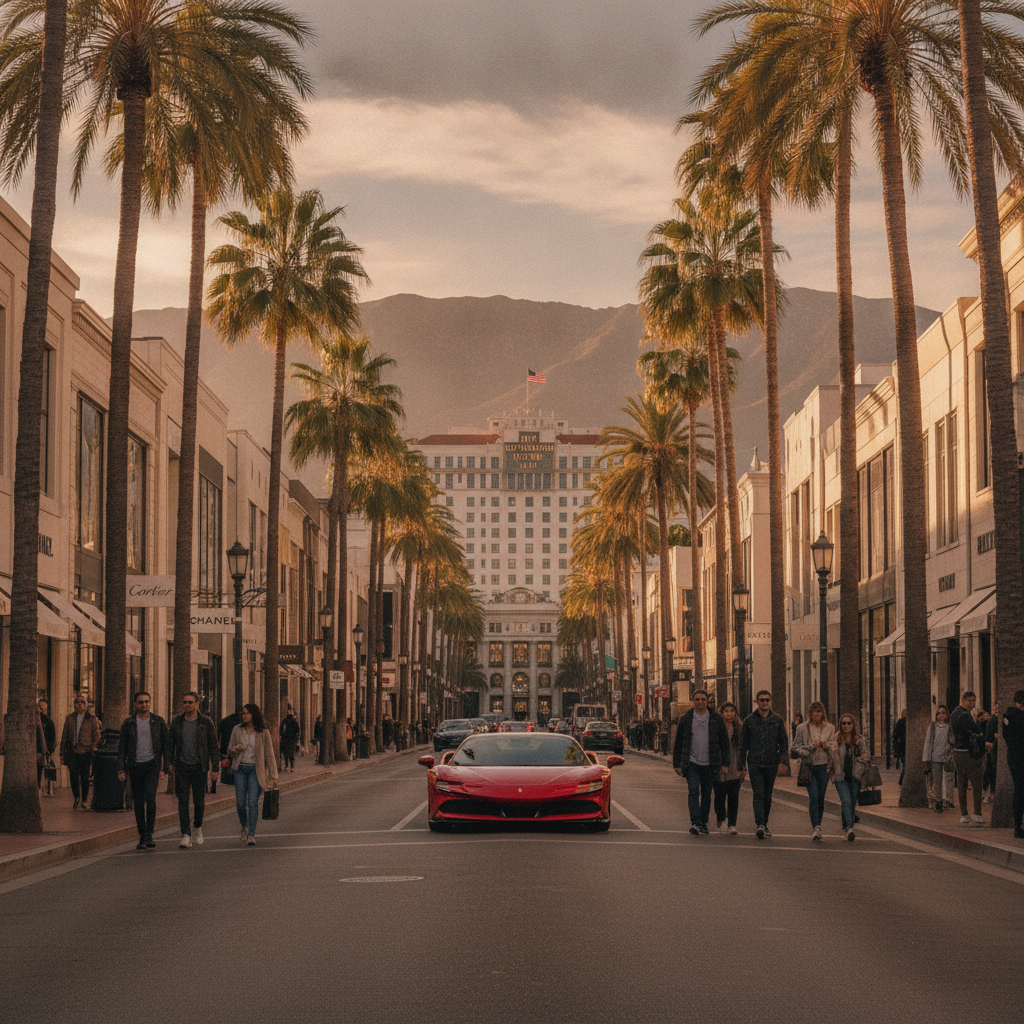
Downtown LA: Grand Central Market, Bradbury Building & Arts District
Downtown Los Angeles — dismissed as a wasteland for decades, now one of the fastest-changing urban neighborhoods in America — contains some of LA's most extraordinary architecture (the 1893 Bradbury Building, the 1928 Biltmore Hotel, the 1932 Griffith Park Observatory-adjacent City Hall) alongside the arts district that has replaced the warehouse district with galleries, studios, and restaurants, all anchored by the 1917 Grand Central Market, the most democratic food hall in California.
- 1
Bunker Hill & Walt Disney Concert Hall (2003)
Bunker Hill — once the Victorian residential district at the center of LA (1880s-1950s, filled with Queen Anne and Craftsman houses), razed by urban renewal between 1955 and 1970 and replaced with the brutalist towers of the Los Angeles Music Center and the Los Angeles Department of Water and Power headquarters — is now the cultural center of downtown, anchored by Frank Gehry's Walt Disney Concert Hall (2003), the titanium-clad concert hall considered one of the great works of American architecture: a series of stainless-steel 'sails' that reference the deconstructivist vocabulary Gehry developed at the Guggenheim Bilbao, housing the Los Angeles Philharmonic (founded 1919, the orchestra that premiered Stravinsky's Symphony in Three Movements in 1946 under Stravinsky's own baton). The Music Center complex includes the Dorothy Chandler Pavilion (1964), the Mark Taper Forum (1967), and the Ahmanson Theatre (1967). The 'Grand Avenue Project' (2024+) is transforming the blocks between Disney Hall and Grand Central Market into a mixed-use cultural corridor, the largest urban development in downtown LA since Bunker Hill's redevelopment.
- 2
Grand Central Market (1917)
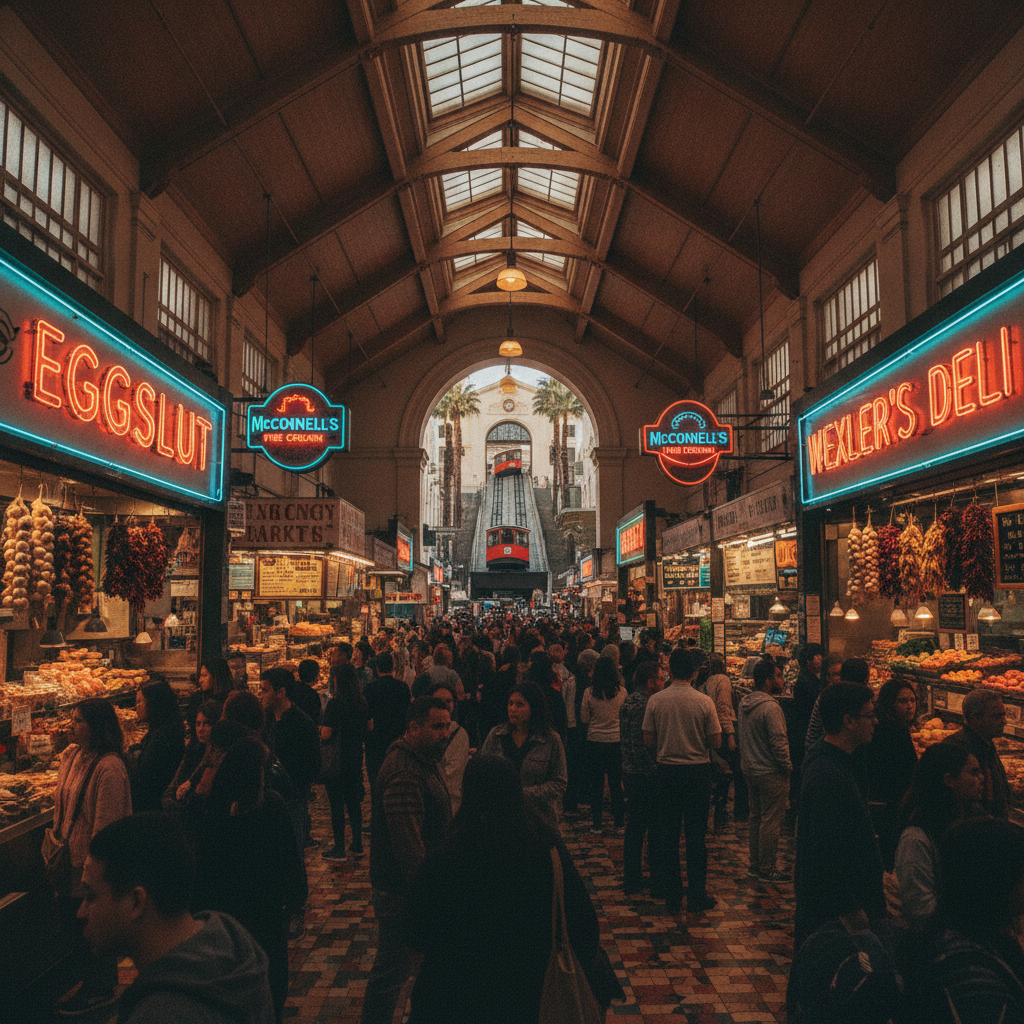
Grand Central Market (317 South Broadway, opened 1917) — the largest and oldest public market in Los Angeles, occupying the ground floor of the Homer Laughlin Building (1897, architect Dodd) on Broadway in the heart of what was then the main commercial street in LA — has operated continuously since 1917, surviving the decline of downtown Broadway, the riots of 1965 and 1992, and the wholesale migration of retail to suburban malls, emerging as one of the most vibrant food markets in the United States. The market today (after a revitalization beginning around 2013) mixes its historic vendors (Tacos Tumbras a Tomas, Roast to Go, the egg stand that has been here since the 1950s) with new-wave vendors (Eggslut, the McConnell's Ice Cream outpost, DTLA Cheese), serving a cross-section of LA that is genuinely democratic: the Mexican-American families from East LA who have been coming here for three generations shop alongside the tech workers from the Arts District. The Broadway facade — neon-lit, open to the street — looks almost exactly as it did in 1917.
- 3
Bradbury Building (1893) — LA's Most Extraordinary Interior
The Bradbury Building (304 South Broadway, 1893, architect Sumner Hunt after a design attributed to draftsman George Wyman, who claimed to have been inspired by a spiritualist communication from his dead brother) — the most celebrated Victorian commercial building in the western United States, and one of the great interiors in American architecture — is a five-story office building whose plain brick exterior gives no hint of what is inside: a magnificent glazed atrium court with ornate Mexican tile floors, open cage elevators, ornamental iron staircases in Moorish Revival style, and a sky-lit roof that floods the interior with light. The building appeared in Blade Runner (1982) as the location of Sebastian's apartment and J.F. Sebastian's encounter with Roy Batty (the 'tears in rain' scene is set in the building's rooftop); it has been used in over 300 films and television productions. The building was designated a Los Angeles Historic-Cultural Monument in 1962 and a National Historic Landmark in 1977 and is still occupied by offices and a small exhibit space.
- 4
Little Tokyo & the Japanese American National Museum (1925/1992)
Little Tokyo (1st Street corridor between Los Angeles Street and Alameda) — the cultural and commercial center of the Japanese-American community in Southern California since the 1890s, the largest Japantown in the United States (at its 1940 peak, home to 30,000 residents) — was forcibly emptied by Executive Order 9066 in 1942 (the Japanese American incarceration, when 110,000 Japanese Americans were removed from the West Coast and sent to internment camps in the desert). The community rebuilt after 1945 and Little Tokyo is now one of the most important cultural heritage districts in California. The Japanese American National Museum (JANM, 1992, in the Nishi Hongwanji Buddhist Temple, 1925) is the premier institution documenting Japanese American history and the incarceration experience; the Go For Broke National Education Center (adjacent) commemorates the 442nd Regimental Combat Team, the most decorated unit in US Army history, composed entirely of Japanese Americans who volunteered from internment camps to fight in Europe.
- 5
Arts District (2000s-present)
The Arts District (the 1-square-mile district roughly bounded by the LA River, 7th Street, Alameda, and 3rd Street) — the former industrial warehouse district east of downtown, originally the railroad and produce wholesale center of Los Angeles (1880s-1970s) — began its transformation into an arts district in the 1980s when cheap warehouse space attracted artists' studios; the pace accelerated dramatically after 2010 when restaurants, galleries, and residential conversions began to fill the historic brick buildings. The Arts District today is one of the most intensely developed artist neighborhoods in the United States — Hauser & Wirth Los Angeles (2016, in a 1920s flour mill), the Sonoratown tortilleria, Bestia and Bavel restaurants, the Robot Coffee industrial roastery, and the Row DTLA (a converted produce market complex) are among the anchors. The district is also home to the Wurstkuche sausage restaurant (2008, one of the early catalysts), and the Angel City Brewery in the 1888 Hellman Quijas Adobe building.
- 6
LA River & East LA Gateway
The Los Angeles River — 51 miles long, draining the San Gabriel Mountains to the ocean at Long Beach, channelized in concrete by the Army Corps of Engineers between 1938 and 1960 after catastrophic flooding in 1938 — has been the subject of a major ecological restoration effort since the 1990s, when activist Lewis MacAdams began removing concrete from the riverbed to restore riparian habitat. The 'LA River Master Plan' (2020, updated 2024) envisions removing concrete from 11 miles of the river channel, restoring wetlands and parks, and connecting the river to downtown through a continuous greenway. The stretch visible from the Arts District — just east of Alameda Street, where the river runs between its concrete walls through the Union Pacific rail yards — represents both the industrial heritage of the district and the contested future of what could become LA's Central Park. Frank Gehry was retained in 2014 to design the river revitalization; his firm has produced a master plan for a 51-mile greenway.
Walk this route with audio
Stories play automatically as you reach each stop — no tapping needed.
More in losangeles
The Getty Center, Brentwood & Malibu: Art Above Los Angeles
Hollywood Boulevard: Walk of Fame, TCL Chinese Theatre & Dolby Theatre
Anaheim & Orange County: Disneyland, Knott's Berry Farm & Angel Stadium
LACMA, La Brea Tar Pits & Miracle Mile: Museum Row on Wilshire
Pasadena: Huntington Library, Rose Bowl & Old Town