The Getty Center, Brentwood & Malibu: Art Above Los Angeles
The ridge of the Santa Monica Mountains separating the LA basin from the Pacific coast is the setting for two of the greatest art experiences in Los Angeles: the Getty Center (Richard Meier's monumental museum complex, opened 1997, housing one of the finest art collections in the United States) and the Getty Villa (a recreated Roman villa containing the world's greatest collection of ancient Greek and Roman art). Between them, the Pacific Coast Highway runs along the Malibu coast — the most scenically dramatic urban coastline in California.
- 1
Getty Center (1997, Richard Meier)
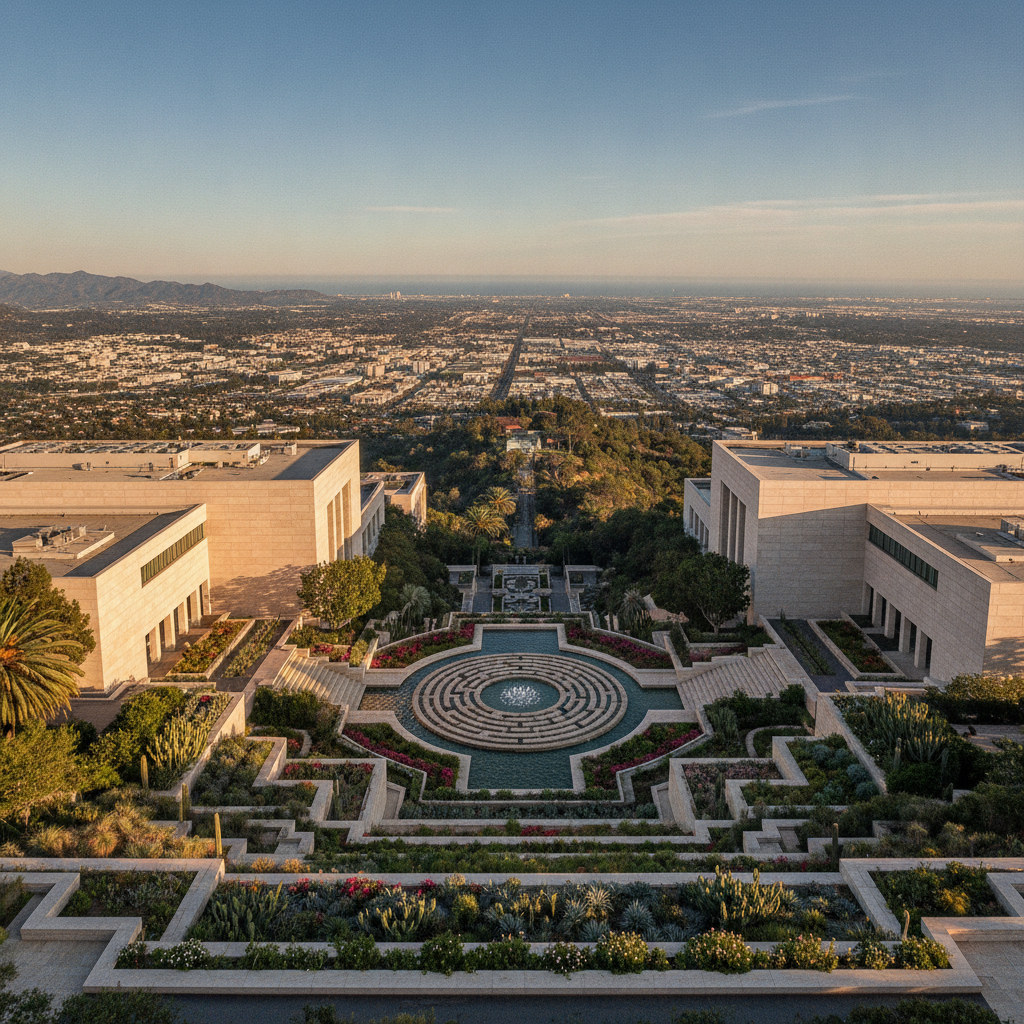
The Getty Center — designed by Richard Meier (his largest and most complex project, won the Pritzker Architecture Prize in 1984), built 1989-1997 for $1.3 billion on a 110-acre ridgeline site in Brentwood above the San Diego Freeway (I-405) — is simultaneously the most ambitious architectural project in the history of Los Angeles and the setting for one of the finest art collections in the United States. The complex (six buildings connected by walkways on a ridgeline at 900 feet elevation) is built entirely of cream-colored travertine marble quarried near Bagni di Tivoli outside Rome (the same quarry that supplied marble for the Colosseum and St. Peter's Basilica) — 16,000 tons of it, at a cost of $270 per square foot for the stone alone. The permanent collection (acquired with the $4.9 billion endowment of oil magnate J. Paul Getty, who died in 1976 leaving his entire estate to the museum) includes Rembrandt's 'Irises' (1889, van Gogh's most expensive painting ever sold at auction — $53.9 million in 1987 — donated by Alan Bond after he couldn't pay for it), Monet's 'Haystacks', Pontormo's 'Portrait of a Halberdier', and one of the finest collections of illuminated manuscripts in America. The Central Garden (designed by Robert Irwin) is a living artwork that changes with the seasons, centered on a flower maze around a circular pool. Admission to the museum is free (parking $25); a tram carries visitors from the parking structure to the hilltop.
- 2
Brentwood & Sepulveda Pass
Brentwood — the affluent residential neighborhood between Bel Air and Santa Monica, separated from the San Fernando Valley by the Sepulveda Pass (the lowest gap in the Santa Monica Mountains, through which the 405 freeway runs, the most congested freeway segment in the United States) — is the address of the Getty Center and several of the most architecturally significant residential projects in LA: the Eames House/Case Study House #8 (1949, Charles and Ray Eames, in Pacific Palisades immediately west, the most influential residential design in American modernism, now a museum), the Entenza House/Case Study House #9 (1949, Charles Eames and Eero Saarinen, adjacent), and the Stahl House/Case Study House #22 (1960, Pierre Koenig, in the Hollywood Hills, the subject of Julius Shulman's iconic nighttime photograph of the glass house cantilevered over the LA basin — the defining image of mid-century California modernism). Brentwood is also the location of the Brentwood Country Mart (1948, a community of small shops and restaurants around a central courtyard, the most beloved neighborhood gathering place in west LA).
- 3
Pacific Palisades & Will Rogers State Beach
Pacific Palisades — the neighborhood at the western edge of Los Angeles, on the bluffs above Santa Monica Bay — is named for the chalk cliffs (the 'Palisades') that drop from the bluffs to PCH below. The neighborhood contains the Villa Aurora (the former home of Bertolt Brecht and Lion Feuchtwanger, now a German-American artist-in-residence center), the Eames House (1949, Case Study #8), and the Gladstones restaurant on PCH (a LA institution since 1972, serving 2.5 million customers annually on the Pacific coast). Will Rogers State Beach — the 3-mile sandy beach at the base of the Palisades bluffs, accessible from Sunset Boulevard — is the closest significant beach to West Hollywood and Beverly Hills, and the starting point for the 22-mile Marvin Braude Bike Trail that runs south to Torrance.
- 4
Malibu & Surfrider Beach
Malibu — the 21-mile coastal community stretching from Malibu Lagoon in the east to the Ventura County line in the west, incorporated as an independent city in 1991 (having resisted incorporation for decades to maintain its exclusivity) — is simultaneously one of the most expensive real estate markets in the world and the site of the finest surfing beach in southern California. Surfrider Beach (at the Malibu Lagoon State Beach, the meeting point of Malibu Creek and the Pacific Ocean) is a right-hand point break that has been surfed since the 1920s and was the center of the world surfing culture in the 1950s-1960s (the 'Gidget' films and Beach Boys songs were set here). Malibu's history is defined by the Rindge family (who purchased the entire 13,316-acre Rancho Malibu in 1892 and fought the state of California through decades of legal battles to keep it private — the PCH through their land was only completed in 1929 after a Supreme Court ruling). The Malibu Colony (the gated beach community east of Surfrider) has been home to Hollywood celebrities since the 1930s.
- 5
The Getty Center, Brentwood & Malibu: Art Above Los Angeles — Local Life
The ridge of the Santa Monica Mountains separating the LA basin from the Pacific coast is the setting for two of the greatest art experiences in Los Angeles: the Getty Center (Richard Meier's monumental museum complex, opened 1997, housing one of the finest art collections in the United States) and the Getty Villa (a recreated Roman villa containing the world's greatest collection of ancient Greek and Roman art).
- 6
Getty Villa & Ancient Art (1974/2006)
The Getty Villa — a recreation of the Villa dei Papiri (the Roman villa at Herculaneum buried by Vesuvius in 79 AD, whose library of carbonized scrolls is still being read via multispectral imaging) — was the original J. Paul Getty Museum, opened in 1974, closed 1997 when the collection moved to the new Getty Center, and reopened 2006 after a $275 million renovation as the dedicated home of the Getty's collection of ancient Greek, Roman, and Etruscan art. The collection (86,000 objects) is one of the most important in the world outside the Mediterranean: ancient Greek vases, Roman bronzes, Egyptian antiquities, the Victorious Youth (the 'Getty Bronze', a 4th-century BC Greek athlete bronze recovered from the Adriatic Sea in 1964, one of the finest surviving ancient bronzes, subject of a 40-year ownership dispute between the Getty and the Italian government — Italy claims it was illegally exported), and the Morgantina Silver (15 silver objects from the 3rd-century BC Sicilian city, returned to Italy in 2010 after the Getty acknowledged they had been looted). The Villa's architecture (by Langdon Wilson, with redesign by Machado and Silvetti) incorporates authentic Roman garden design, including herb gardens, a peristyle garden with a reflecting pool, and an outer peristyle garden with more than 300 types of plants documented in Roman literature.
Walk this route with audio
Stories play automatically as you reach each stop — no tapping needed.
More in losangeles
Hollywood Boulevard: Walk of Fame, TCL Chinese Theatre & Dolby Theatre
Downtown LA: Grand Central Market, Bradbury Building & Arts District
Anaheim & Orange County: Disneyland, Knott's Berry Farm & Angel Stadium
LACMA, La Brea Tar Pits & Miracle Mile: Museum Row on Wilshire
Pasadena: Huntington Library, Rose Bowl & Old Town