LACMA, La Brea Tar Pits & Miracle Mile: Museum Row on Wilshire
The Miracle Mile — the 1.5-mile stretch of Wilshire Boulevard between La Brea and Fairfax Avenues, developed in the 1920s and 1930s as LA's first auto-oriented commercial strip — is now home to the greatest concentration of museums in Los Angeles: LACMA (the largest art museum in the western United States), the La Brea Tar Pits (the world's richest Ice Age fossil site), the Petersen Automotive Museum, and the Academy Museum of Motion Pictures.
- 1
Los Angeles County Museum of Art (LACMA, 1965/2020s)
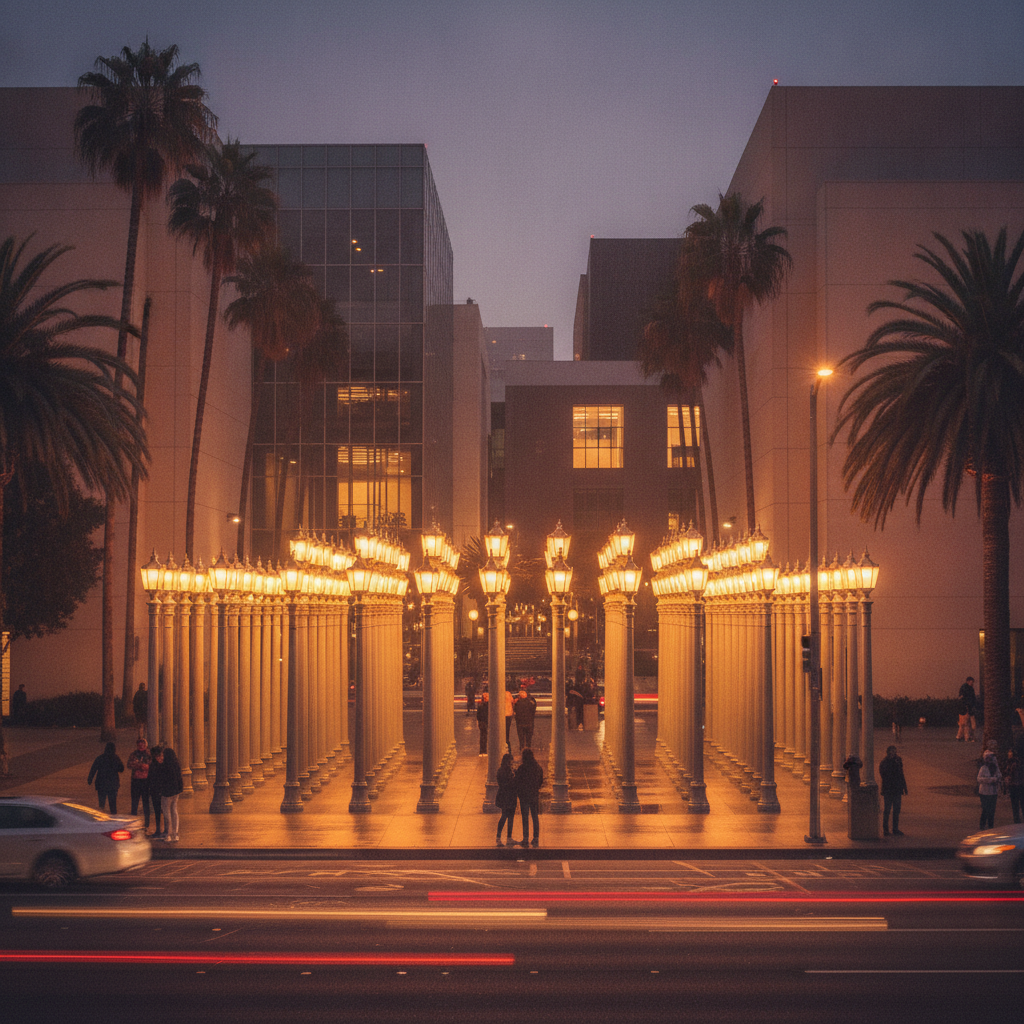
LACMA (Los Angeles County Museum of Art) — the largest art museum in the western United States (150,000 objects in the permanent collection, the most comprehensive collection of art in Los Angeles), occupying a 20-acre campus on Wilshire Boulevard, founded 1965 — is undergoing its largest transformation since opening: architect Peter Zumthor's new building (2024+, a 37,000 m² single-story 'floating bridge' spanning Wilshire Boulevard and the tar pits) is the most ambitious museum building project in the world currently under construction. The existing collection spans 6,000 years of art history from 6,000 BC to the present, with particular strength in South and Southeast Asian art (one of the finest collections outside Asia), ancient Egyptian and Near Eastern art, Islamic art, Latin American art, and Japanese art and armor. The permanent highlights include: Georges de La Tour's 'The Magdalene with the Smoking Flame', Magritte's 'The Treachery of Images (This is not a pipe)', the Resnick Pavilion (designed by Renzo Piano), and the most extensive collection of South Asian sculpture outside the subcontinent. The museum's iconic entrance is Chris Burden's 'Urban Light' installation (2008, 202 restored cast-iron street lamps from different Los Angeles neighborhoods, 1920s-1930s, the most photographed public artwork in LA).
- 2
La Brea Tar Pits & Pleistocene LA (38,000 years ago)
The La Brea Tar Pits (Rancho La Brea asphalt seeps) — natural asphalt pools that have been trapping animals since at least 38,000 years ago, located in Hancock Park adjacent to LACMA — are the world's richest source of Pleistocene fossil remains (Ice Age animals trapped in the sticky asphalt over tens of thousands of years). The fossils include: 650+ species of plants and animals; 40 Columbian mammoths, 2,000+ dire wolves (the most complete dire wolf specimens in the world, each skull slightly different, demonstrating individual variation), 1,000+ saber-toothed cats (Smilodon fatalis, the California state fossil), American camels, Western horses (both extinctions), ground sloths, mastodons, and giant condors. The ongoing excavation (Pit 91, open to public view in summer) is the longest continuously running paleontological excavation in the world. The Page Museum at La Brea Tar Pits (1977) displays the recovered fossils; the Fishbowl Laboratory allows visitors to watch fossil preparation in progress. The observation pit at the park's center is an active seep (asphalt bubbles to the surface even now), and the George C. Page Museum reopened in 2024 after a major renovation.
- 3
Miracle Mile Historic District
The Miracle Mile (Wilshire Boulevard between La Brea and Fairfax Avenues) — developed by real estate entrepreneur A.W. Ross beginning in 1921 as the first American shopping district designed specifically for automobile access (with wide sidewalks for window shopping, angled parking, and standardized storefronts to present a unified appearance to motorists) — contains some of the finest Art Deco commercial architecture in the United States. The surviving Deco buildings (many in the National Register of Historic Places) include: the Wilshire Colonnade (1929), the Dominguez-Wilshire Building (1929), the Darkroom Building (1938, with a giant camera lens entrance), and the EI Capitan Theatre-adjacent buildings. The district was the most fashionable shopping corridor in Los Angeles from the 1930s through the early 1950s (when Beverly Hills and the new suburban shopping centers began to compete); its decline in the 1960s-1970s has given the stretch its pleasantly time-capsule quality.
- 4
Petersen Automotive Museum (1994/2015)
The Petersen Automotive Museum — opened 1994 in a former Barker Brothers furniture showroom on Wilshire and Fairfax, the building dramatically renovated in 2015 with a stainless-steel red-and-silver 'ribbon' exterior by Kohn Pedersen Fox Associates — is one of the largest automotive museums in the world (150+ vehicles on display across three floors, from a 1886 Benz Patent-Motorwagen replica to the Batmobile and celebrity cars). The museum's location on Wilshire at Fairfax — 'the most important intersection in the history of the American automobile' by some accounts, in the heart of a city that defines itself more by its car culture than any other on earth — is symbolically appropriate. The vault below street level contains 250+ additional vehicles in rolling storage, accessible on tours. LA's car culture is inseparable from its urban form: the freeway system (9 freeways in the LA area), the drive-through (invented in Los Angeles in 1948 at In-N-Out Burger), and the car as personal expression are all documented here.
- 5
Academy Museum of Motion Pictures (2021)
The Academy Museum of Motion Pictures — opened September 2021 in the former May Company building at Wilshire and Fairfax (a 1940 Art Moderne landmark designed by Albert C. Martin, with a cylindrical gold-tile corner tower) augmented by a new spherical theater building (designed by Renzo Piano) — is the most important film museum in the world: the permanent home of the Academy of Motion Picture Arts and Sciences' collection of movie history, including Citizen Kane's Rosebud sled, Dorothy's ruby slippers from The Wizard of Oz, the 1968 Planet of the Apes mask, Psycho shower props, and the complete archives of the AMPAS collection. The Oscars® Experience (interactive) and the David Geffen Theatre (1,000-seat premiere theater) are the anchor programs. The museum's opening was delayed for years due to debates about how to address the Academy's whiteness and gender imbalance in its historical presentation — the permanent exhibition reflects this reassessment with substantial attention to overlooked contributions.
- 6
Farmers Market & The Grove (1934/2002)
The Original Farmers Market (6333 West 3rd Street at Fairfax, 1934) — opened on a vacant lot when two farmers parked their trucks and started selling produce directly to consumers, now 100+ stalls of produce, international food, and specialty shops occupying the same corner — is one of the most beloved institutions in Los Angeles, a rare democratic gathering place (open daily, free admission, no brand identity, just the market). The adjacent The Grove (2002, Rick Caruso, the most profitable retail center per square foot in the United States in 2006) is the antithesis: an elaborately stage-set 'Main Street' shopping experience with a trolley, dancing fountain, and luxury brand stores, that draws 18 million visitors per year. The contrast between the two — the organic messiness of the Farmers Market and the engineered nostalgia of The Grove — encapsulates the tension between authentic and manufactured urbanism that defines contemporary Los Angeles.
Walk this route with audio
Stories play automatically as you reach each stop — no tapping needed.
More in losangeles
The Getty Center, Brentwood & Malibu: Art Above Los Angeles
Hollywood Boulevard: Walk of Fame, TCL Chinese Theatre & Dolby Theatre
Downtown LA: Grand Central Market, Bradbury Building & Arts District
Anaheim & Orange County: Disneyland, Knott's Berry Farm & Angel Stadium
Pasadena: Huntington Library, Rose Bowl & Old Town