Lucerne Mountains — Pilatus, the Rigi, the Stanserhorn & the Golden Roundtrip
The mountains around Lake Lucerne define the Swiss mountain tourism experience — the Pilatus cogwheel railway, the Rigi sunrise, and the Titlis glacier each represent a different aspect of the Alpine environment accessible within 2 hours of the Lucerne waterfront.
- 1
Mount Pilatus — the Dragon Mountain
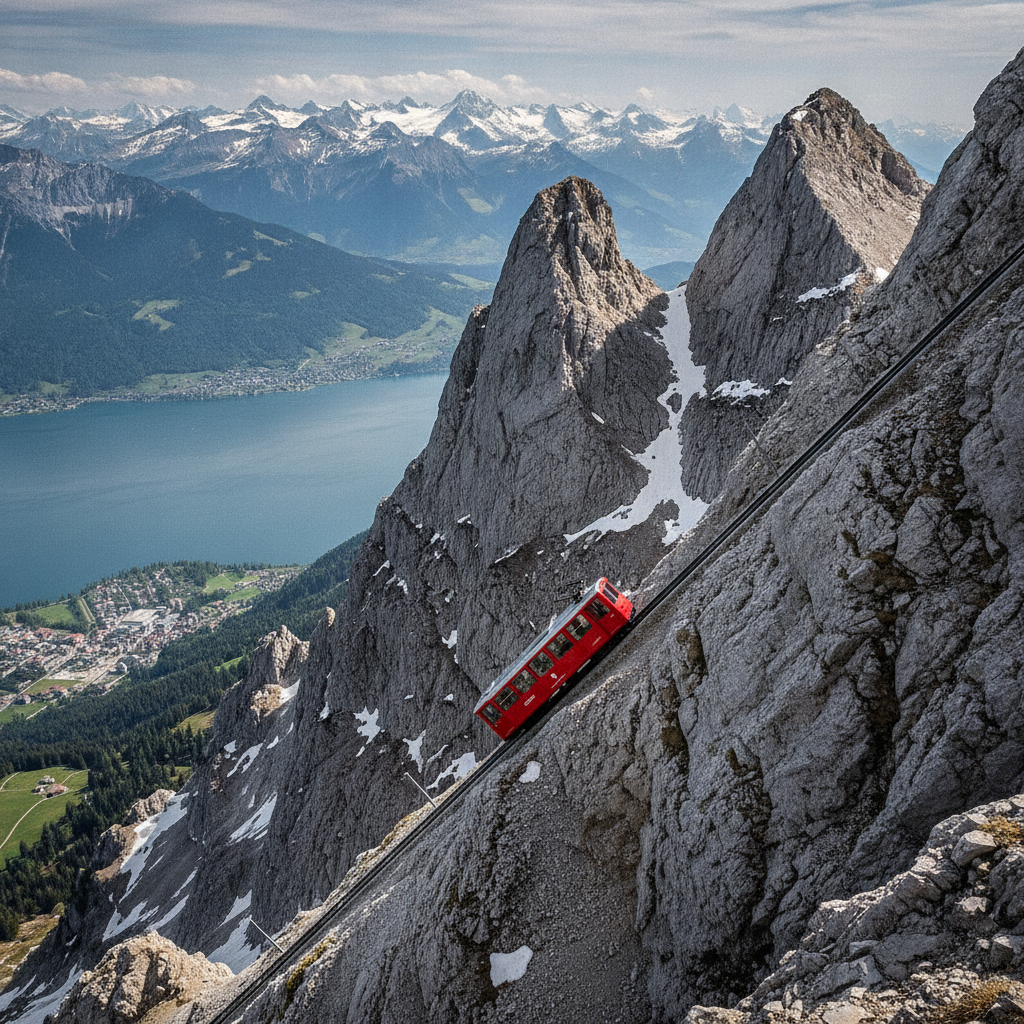
Pilatus (the 2,132m mountain directly south of Lucerne, the most dramatic mountain silhouette visible from the Lucerne waterfront, the name derived from the medieval legend that the ghost of Pontius Pilate haunted the mountain lake and caused storms when disturbed — the legend the reason the mountain was forbidden to climbers until 1585): the Pilatus cogwheel railway (the Pilatusbahn from Alpnachstad on the lake shore, the steepest cogwheel railway in the world at 48 percent maximum gradient, the rack system by Eduard Locher 1889 with the horizontal cogwheel gripping the horizontal rack rail — the only such system in the world, the 30-minute ascent from Alpnachstad at 440m to the Pilatus Kulm at 2,073m the most dramatic mountain railway journey in Switzerland, operating May-November, the Golden Roundtrip from Lucerne combining the lake steamer to Alpnachstad, the cogwheel railway to the summit, and the aerial gondola down via Fräkmüntegg to Kriens then bus to Lucerne at CHF 110 adults or 50% discount with the Swiss Travel Pass), the Pilatus summit (the Pilatus Kulm at 2,073m with the two viewing terraces — the Dragon View path and the summit ridge to the Tomlishorn at 2,132m, the panorama of 73 Alpine peaks on a clear day including the Jungfrau, the Finsteraarhorn, and the Titlis, the Hotel Pilatus-Kulm and the Hotel Bellevue the two summit hotels for overnight stays CHF 200-280 per person, the overnight stay giving the sunset and sunrise above the cloud layer the most transformative single experience at the Pilatus), the hiking routes (the hiking paths from the Pilatus Kulm to the Fräkmüntegg mid-station, 3km, 1.5 hours descent, the most recommended summer walking route on the Pilatus — the path through the Alpine meadows with the gentian and the edelweiss in June-July) and the Natur- und Gletscher Park (the winter toboggan run at Fräkmüntegg, 1.5km long, the longest toboggan run in central Switzerland, operational November-March at CHF 8 per run).
- 2
The Rigi — Queen of the Mountains
Rigi (the 1,797m mountain east of Lucerne between Lake Lucerne and the Lauerzer See, the 'Queen of the Mountains' — the most celebrated viewpoint in Switzerland since the 18th century Grand Tour, the mountain the destination of Goethe, Victor Hugo, and Mark Twain — Twain's 'A Tramp Abroad' 1880 the most entertaining literary account of the Rigi ascent): the Rigi Railways (2 independent cogwheel railways: the Rigi Bahnen from Vitznau on the lake shore — opened 1871, the oldest mountain railway in Europe — ascending to Rigi Kulm at 1,752m in 30 minutes at CHF 68 return; and the alternative access from Arth-Goldau on the south side — the Arth-Rigi Bahn, a 30-minute ascent with the different and wider view of the Alps, the combined circuit using both railways and the lake steamer the most complete Rigi experience at CHF 95-110), the Rigi sunrise (the principal Rigi tradition since the 1800s: the ascent by the evening train, the overnight at the Rigi Kulm Hotel or the Rigi Scheidegg Hotel, the alarm at 5am, the sunrise above the cloud layer covering the Swiss Mittelland the most celebrated single view in Switzerland — the sunlight striking the Bernese Alps while the valleys below are still in cloud, the image reproduced in 200 years of Swiss landscape painting, the hotel packages for the sunrise experience at CHF 180-250 per person including the dinner and the breakfast), the Rigi hiking (the 100km+ of marked hiking trails on the Rigi plateau, the Rigi Scheidegg circular trail — the most popular day hike on the Rigi, 2.5 hours, the path crossing the open Alpine meadows with the cowbells — the most quintessentially Swiss pastoral sound — and the panoramic views of Lake Lucerne and the Alps, the trail accessible at both ends by the Rigi cogwheel railway) and the Rigi-Kaltbad (the resort village at 1,438m on the Rigi, the Regina Montium thermal spa with the panoramic view pool, the outdoor pool with the direct view of Lake Lucerne and the Alps the most scenically extraordinary spa pool in Switzerland, CHF 39 adults for the day pass).
- 3
The Stanserhorn CabriO — the Open-Top Cable Car
Stanserhorn (the 1,898m mountain south of Lucerne, 30km from the city, accessible by SBB train to Stans in 20 minutes then the CabriO cable car in 20 minutes total, the mountain the most technically unusual of the Lucerne mountain experiences): the CabriO cable car (the world's first open-top double-decker cable car, opened 2012, the lower enclosed deck and the upper open-top deck with the wrap-around bench seating, the 20-minute ascent from Stans to the Stanserhorn summit with the passengers seated on the rooftop of the cable car gondola — the most physically exposed cable car experience in Switzerland, the wind and the Alpine air directly experienced rather than filtered through the cable car glass, the CHF 64 adults return including the cable car and the historic funicular from Stans station to the Kehli mid-station — the funicular from 1893 one of the oldest mountain railways in Switzerland), the summit (the Stanserhorn Kulm restaurant and the panoramic platform at the summit, the 360-degree view of Lake Lucerne, the Bernese Oberland glaciers to the south, the Jura mountains to the northwest, and the Titlis to the southeast — the most complete single-viewpoint panorama accessible from Lucerne — the marmot colony at the summit meadows the most reliably spotted wildlife encounter at any Lucerne-area mountain), the summer program (the summit hiking trails in the summer season, the paragliding launches from the Stanserhorn the most popular tandem paragliding site near Lucerne, CHF 160-190 per person for the 20-30 minute tandem flight from the summit landing at the Buochs airfield on the lake shore) and the Stans village (the capital of the Canton of Nidwalden at the base of the Stanserhorn, the Winkelried House museum, the Baroque Pfarrkirche St. Peter and Paul, the village the most architecturally intact small cantonal capital in central Switzerland).
- 4
Lucerne's Lake Swimming and the Summer Lido
Lucerne summer (the Lake Lucerne summer swimming season June-September, the lake water temperature reaching 22-24 degrees in July-August, the 5 public lidos around the lake offering the most varied outdoor swimming experience of any Swiss city): the Lido Lucerne (the main public lido at Lidostrasse 5-6 adjacent to the Swiss Museum of Transport, the largest open-air swimming complex in central Switzerland — 3 pools plus the direct lake swimming from the wooden pier, the 50m outdoor pool, the children's pool, and the diving pool with the 5m and 10m platforms, CHF 7 adults daily pass, open May-September 8am-8pm, the most attended public leisure facility in Lucerne in summer), the Tribschen beach (the free swimming area on the Lucerne lakeshore south of the city centre at Tribschenstrasse, the pebble beach and the grass area at the lake edge, no infrastructure but no entry fee, the local alternative to the Lido — the Richard Wagner Villa at Tribschen immediately adjacent — the house where Wagner lived 1866-1872 and composed the Siegfried Idyll, the Tribschen visit combining the Wagner Museum with the lake swimming the most culturally layered swim in Lucerne), the Naturstrand Tribschen (the natural pebble beach section immediately south of the Wagner Villa, the most private and the least touristic swimming area in Lucerne), the Richard Wagner Museum (the Villa Tribschen at Wagnerweg 27, the house where Wagner lived 1866-1872 and composed the Meistersinger von Nürnberg, completed the Meistersinger, started the Ring cycle, and raised Cosima von Bülow before marrying her in 1870, CHF 12 adults, Tuesday-Sunday 11am-6pm, the most important single Wagner residence museum outside Bayreuth) and the boat rental (the paddleboat and the rowing boat rental from the Lido Lucerne and the Hotel Seeburg piers at CHF 30-50 per hour, the lake paddleboating from the city pier to the Meggenhorn castle on the opposite shore the most relaxed Lucerne summer afternoon activity).
- 5
Lucerne's Carnival — the Oldest Swiss Fasnacht
Luzerner Fasnacht (the Lucerne Carnival, the most exuberant traditional festival in Catholic Switzerland, held in the 3 days before Ash Wednesday — the 'Schmutziger Donnerstag' dirty Thursday opening, the main Saturday parade, and the final Tuesday 'Güdismontag' — the Lucerne Carnival the largest Carnival celebration in the German-speaking part of Switzerland with 100,000+ visitors over the 3 days): the history (the Lucerne Carnival tradition documented from the 15th century, the city's Catholic identity maintained throughout the Swiss Reformation allowing the Carnival to continue when the Protestant Swiss cities suppressed theirs — the Lucerne Fasnacht the only major Carnival tradition in the German-speaking part of Switzerland, the tradition the most direct connection to the south German and Italian Carnival cultures), the Guggenmusik (the Guggen bands — the carnival brass bands playing deliberately 'wrong' music in elaborate monster and folklore costumes, the Guggenmusik the defining sound of the Lucerne Fasnacht, 50+ Guggen bands performing simultaneously in the Old Town creating the most anarchic musical event in Switzerland — the cacophony of 50 brass bands playing different pieces simultaneously at full volume in the Kapellbrücke area the most sonically memorable experience in the Lucerne annual calendar), the Wey Zunft (the Lucerne Carnival Guild, the organization managing the Fasnacht parade — the Fritschivater the jester figure leading the parade, the figure with the tall feathered hat and the bells the most recognized Carnival figure in Switzerland, the guild founded 1829 but incorporating an older tradition) and the practical information (the Fasnacht dates change annually with Ash Wednesday — Tuesday in February or early March, the Old Town hotels sold out 6 months in advance, the best viewing positions: the Kapellbrücke approach, the Kornmarkt, and the Schwanenplatz, the free entry to all outdoor events, the indoor club events requiring the Tageskarte day pass at CHF 30-50 at the Fasnacht ticket booths on the Schwanenplatz).
- 6
Lucerne's Schnitzelbängg — the Carnival Satirical Songs
The Schnitzelbängg (the satirical verses sung at the Lucerne Fasnacht Carnival, the tradition of the Carnival song teams performing the rhyming political satire on the events of the past year, the most specifically Lucerne cultural tradition of the entire Carnival season — the Schnitzelbänkler appearing in pairs with the illustrated cardboard panels depicting the satirical verses, the songs performed in the Lucerne dialect that the non-German speaker cannot understand but the illustration panels providing the visual punchline): the Schnitzelbängg tradition (the tradition documented from the late 19th century, the Schnitzelbänkler pairs performing in the Old Town restaurants and the carnival tents from the Thursday evening opening to the Tuesday midnight close, the most intimate and the most locally embedded Carnival performance — in contrast to the street parade Guggen bands performing for the crowds, the Schnitzelbängg performed for seated audiences of 20-60 people in the restaurant tents, the performance the most participatory Carnival experience in Lucerne), the restaurant tent circuit (the Beizentreiben — the tent circuit, the tradition of visiting 4-6 different restaurant tents over the Carnival evening, each tent housing its own programme of Guggen performances and Schnitzelbängg, the Carnival entry tokens — the Marken — required for the tent entry at CHF 10-15 per tent, the most social and the most expensive single Carnival evening in the Lucerne calendar), the children's Carnival (the Kinderfasnacht on the Thursday evening before the official start — the school children's parade through the Old Town in the costumes of the Swiss figures, the farm animals, and the fantasy characters, the most photogenic and the least crowded of all the Lucerne Carnival parades, free to attend on the Kornmarkt and the Bahnhofstrasse) and the Carnival confectionery (the Fasnachts-Chüechli — the deep-fried pastry dough strips served with the icing sugar, the traditional Carnival food available at every Lucerne bakery in the 3 weeks before Ash Wednesday, the most seasonally specific Lucerne food experience at CHF 1-2 per piece at the market stalls and the bakery counters of the Old Town).
Walk this route with audio
Stories play automatically as you reach each stop — no tapping needed.
More in lucerne
Swiss History from Lucerne — the Rütli, the Federal Charter & the Wilhelm Tell Legend
Lucerne Swiss Culture — Fondue, the Museggmauer, the Hofkirche & Swiss Traditions
Lucerne — the Chapel Bridge, the Old Town & Lake Lucerne
Lucerne Food & Nightlife — Swiss Fondue, the Old Town Restaurants & the Lake Bar Scene