Swiss History from Lucerne — the Rütli, the Federal Charter & the Wilhelm Tell Legend
The Lake Lucerne landscape is the stage of Swiss national history — the Rütli meadow where Switzerland was founded in 1291, the Wilhelm Tell legend, and the Bundesbrief in Schwyz are all accessible from Lucerne by lake steamer.
- 1
The Rütli — the Birthplace of Switzerland
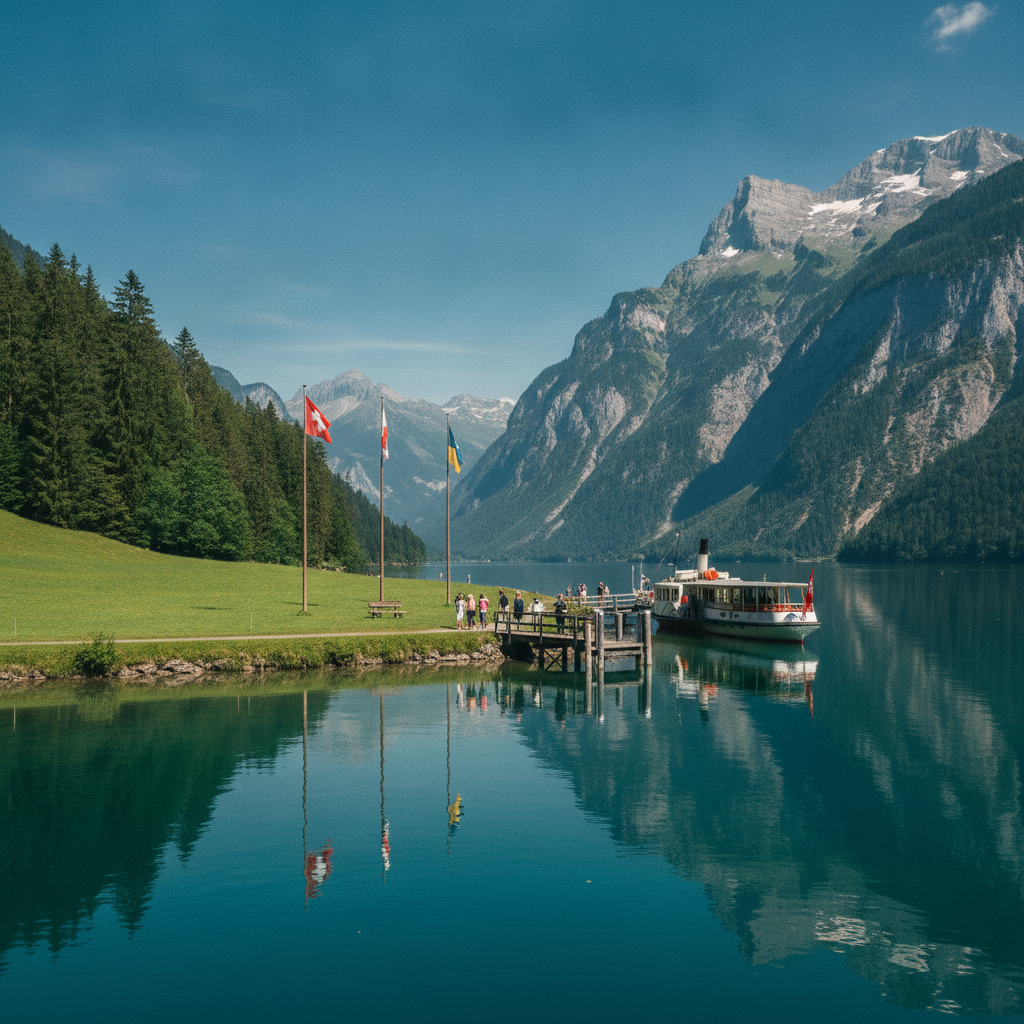
Rütliwiese (the Rütli meadow on the western shore of the Urnersee arm of Lake Lucerne, the site where the representatives of the three original cantons — Uri, Schwyz, and Unterwalden — swore the Oath of Eternal Alliance on August 1 1291, the founding moment of the Swiss Confederation, the most historically significant meadow in Switzerland): access (the lake steamer from Lucerne pier 1 to the Rütli landing in 90 minutes at CHF 19 adults one-way, the Swiss Travel Pass covering the steamer, the steamer arriving at the Rütli wooden jetty, the meadow immediately above the jetty on the hillside, free to visit, open always — the annual National Day celebration on August 1 the most attended event at the Rütli, the Federal Council members arriving by helicopter and the lake steamer simultaneously for the national ceremony), the Federal Charter 1291 (the Bundesbrief — the Latin document bearing the date August 1291 and the seals of the three founding cantons — the document establishing the mutual defence alliance that became the Swiss Confederation, the original document in the Bundesbrief Museum in Schwyz, the Rütli meadow the symbolic location the document refers to), the Wilhelm Tell connection (the Tell story set in the Uri and Schwyz districts around Lake Lucerne — the Rütli the geographical centre of the Tell landscape, the meadow where the three cantons met historically the same landscape where Tell's defiance of Habsburg authority is set in the Schiller play 1804, the Tell legend and the Rütli oath intertwined in the Swiss national mythology) and the Rütli walk (the 2-hour hiking circuit from the Rütli landing up to the Seelisberg village and back down to the lake via the Schlossweg path, the walk above Lake Lucerne the most historically embedded hiking route in the Swiss national landscape, the view of the Uri Alps from the Seelisberg the canonical Swiss mountain reflection in the lake image).
- 2
The Bundesbrief Museum — the Federal Charter of 1291
Bundesbrief Museum (Bahnhofstrasse 20, Schwyz, the museum holding the original Federal Charter of 1291 — the founding document of Switzerland, accessible from Lucerne by lake steamer to Brunnen then bus in 90 minutes total, or by SBB train to Schwyz in 45 minutes at CHF 15 return, €5 adults, Tuesday-Friday 9am-11:30am and 1:30-5pm, Saturday-Sunday 9am-5pm): the Federal Charter (the parchment document in Latin dated August 1291, the 3 wax seals of Uri, Schwyz, and Unterwalden — the seals the most legally significant elements of the document confirming the authenticity of the cantonal representation — the text of 394 words establishing the mutual defence alliance and the commitment to traditional law over external imposed law, the most symbolically important single document in Swiss history, the original in the temperature-controlled display case in the centre of the main hall), the museum context (the Bundesbrief Museum the most specialized of the Swiss national history museums — the building designed specifically to house and display the Charter, the surrounding exhibitions on the history of the Swiss Confederation from 1291 to the current 26-canton structure, the most complete single-room explanation of Swiss constitutional history available in the country), the Schwyzer Myth (the Canton of Schwyz giving Switzerland its name — the German name Schweiz derived from Schwyz, the original core canton whose name spread to designate the entire confederation, the Schwyz cantonal archives the most complete original Swiss cantonal records from the 13th century in any Swiss archive), and the Schwyz Old Town (the Hauptplatz in Schwyz, the Baroque Pfarrkirche St. Martin 1774 with the twin towers, the Ital-Reding-Hofstatt — the most elaborate patrician house in the Canton of Schwyz, built 1609 — and the Forum der Schweizer Geschichte Schwyz, the Swiss National Museum branch for the Swiss history from the origin to 1800, free Sunday, CHF 10 adults otherwise, Tuesday-Sunday 10am-5pm).
- 3
The Arnold Winkelried Monument at Stans
Stans and the Arnold Winkelried legend (the cantonal capital of Nidwalden 25km south of Lucerne, accessible by SBB train in 20 minutes at CHF 8 return, the village associated with the most celebrated act of self-sacrifice in Swiss military history): the Winkelried Monument (the bronze monument at the Dorfplatz in Stans commemorating Arnold von Winkelried — the Swiss soldier who at the Battle of Sempach 1386 gathered the Austrian Habsburg lances in his arms and fell on them, creating the breach in the Austrian line through which the Swiss infantry broke the Austrian cavalry formation, the act deciding the battle in favor of the Swiss Confederation and the most celebrated single act of military self-sacrifice in Swiss national history, the monument by Ferdinand Schlöth erected 1865, the largest bronze monument in Nidwalden), the Battle of Sempach context (the Battle of Sempach July 9 1386 the most important Swiss military victory of the 14th century — the victory establishing the military reputation of the Swiss infantry as the most formidable fighting force in Europe, the Swiss pike and halberd formations defeating the Austrian heavy cavalry, the Swiss mercenary soldiers the most sought-after military force in Europe for the next 150 years — the Swiss mercenary system the foundation of the Papal Swiss Guard that still guards the Vatican today), the Nidwalden Museum (at the Winkelriedhaus, the historical museum of the Canton of Nidwalden, the most complete collection of Nidwalden folk art and historical objects, CHF 8 adults, Wednesday-Sunday 10am-5pm) and the Stansstad access (the lake steamer stop at Stansstad on the lake shore 5km north of Stans, the most scenic approach to the Nidwalden canton — the view from the Stansstad lake shore north to Lucerne and south to the Uri Alps the widest single lake panorama available from any accessible shore point on Lake Lucerne).
- 4
Schwyz Canton and the Heart of Original Switzerland
Canton of Schwyz (the canton that gave Switzerland its name, the most historically resonant of the 26 Swiss cantons, the landscape of the Tell legend and the Rütli oath): the Schwyz landscape (the canton bounded by Lake Lucerne to the west and the Lauerzer See to the east, the mountains of the Mythen — the Grosser Mythen at 1,898m and the Kleiner Mythen at 1,811m, the most distinctively shaped twin peaks in the Swiss Alps, the peaks visible from the Rütli meadow and the Brunnen lake shore as the defining silhouette of the Tell landscape, accessible by cable car from Brunnen in 20 minutes at CHF 20 return), the Brunnen resort (the lakeside resort at the junction of the Urnersee and the Gersauer See arms of Lake Lucerne, 35km from Lucerne by steamer in 60 minutes or 25 minutes by SBB train, the most scenic small resort on Lake Lucerne — the Seepromenade lakeside walk the most romantic of any Lake Lucerne village promenade, the Hotel Waldstätterhhof the most beautifully located Belle Époque hotel on the lake, the Brunnen lido the warmest lake swimming on the eastern arm), the Lauerzer See (the small lake east of Schwyz, the Goldau landslide of September 2 1798 destroying 4 villages and killing 457 people — the landslide the largest natural disaster in Swiss history in the modern period, the Goldau Nature and Animal Park now on the landslide deposit, the capybara, the Patagonian mara, and the wild boar among the free-roaming animals, the most unusual Swiss wildlife park, CHF 14 adults) and the Einsiedeln Abbey (the Benedictine abbey 25km east of Schwyz, the most important Catholic pilgrimage site in Switzerland — the Black Madonna in the Chapel of Grace the primary devotional object, venerated since the 10th century, the Baroque abbey church of 1735 the most grandiose religious building in the Swiss Alps, free, daily 7am-8pm, the annual pilgrimage of 200,000+ Catholics from throughout the German-speaking world making Einsiedeln the most visited single site in eastern Switzerland after the Lucerne Old Town).
- 5
The Lake Lucerne Steamer Circuit — the Complete Lake Experience
The complete lake steamer circuit (the Lake Lucerne — the Vierwaldstättersee — the most complex lake shape in Switzerland with the 5 distinct arms creating a total shoreline of 147km, the complete steamer circuit from Lucerne to Flüelen at the south end of the lake and back the most comprehensive single transportation experience in Switzerland): the steamer fleet (the Schifffahrtsgesellschaft Vierwaldstättersee — SGV — operating 6 paddle steamers from 1901-1928, 4 motor vessels, and 9 smaller boats, the paddle steamers Uri 1901, Unterwalden 1902, Schiller 1906, Wilhelm Tell 1908, Stadt Luzern 1928, and Gallia 1913 the flagship vessels, the oldest continuously operating historic paddle steamer fleet in the world, the steam-powered vessels operating on selected services using the original coal-fired boilers of the Edwardian period), the Lucerne to Flüelen route (the 3-hour steamer journey from Lucerne pier 1 south through the lake, stopping at: Weggis 45 minutes, Vitznau 60 minutes — the Rigi cogwheel railway connection, Brunnen 90 minutes — the junction of the lake arms, Bauen 105 minutes — the smallest village landing on the lake, Flüelen 3 hours — the connection to the SBB main line and the Gotthard Pass route — the most scenic single continuous lake journey in Switzerland, the CHF 39 adults second class one-way, the Swiss Travel Pass covering the full journey), the Tell's Chapel (the steamer pause at Sisikon 2.5 hours from Lucerne, the steamer slowing near the Tell's Chapel on the cliff shore — the chapel marking the location where Tell leaped from Gessler's boat, the steamer crew announcing the Tell's Chapel over the public address in German, French, Italian, and English as the boat passes) and the return by rail (the SBB train from Flüelen to Lucerne through the Gotthard line 45 minutes at CHF 18, the train route through the Uri landscape — the valley of the Tell legend — following the Reuss River north from the Uri Alps to Lucerne, the complete lake-and-rail circuit from Lucerne and return to Lucerne combining the 3-hour steamer and the 45-minute train the most complete single-day Swiss transport experience available).
- 6
Lucerne's Connection to the Gotthard — the Heart of Europe
The Gotthard Pass and Lucerne (the Gotthard Pass 90km south of Lucerne — the most historically important Alpine pass in Europe, the primary route connecting northern and southern Europe since the 13th century, the pass that made Lucerne the most strategically important city in the Swiss Confederation): the Gotthard history (the Gotthard Pass opened to regular traffic by the construction of the Schöllenen Gorge path through the rock around 1200 CE — the path cut through the granite cliff above the Devil's Bridge the most technically audacious medieval engineering in the Alps, the Gotthard becoming the primary north-south transit route replacing the Brenner and the Great St. Bernard — the control of the Gotthard route the economic foundation of the Uri, Schwyz, and Unterwalden cantons and the reason for the formation of the Swiss Confederation, the transit tolls from the Gotthard the revenue base of the original Swiss cantons), the Gotthard rail tunnel (the Gotthard Base Tunnel — the world's longest railway tunnel at 57.1km through the Gotthard massif, opened June 1 2016, the tunnel requiring 17 years of construction and CHF 12.2 billion — the most expensive infrastructure project in Swiss history, the fastest train connection between Zurich and Lugano at 2 hours via the base tunnel versus the 3.5-hour mountain route, accessible from Lucerne on the SBB Intercity to Lugano through the base tunnel), the historic Gotthard road pass (the Gotthard Passstrasse, accessible in summer June-October by PostBus from Andermatt at the north end — the PostBus route the most spectacular public bus journey in Switzerland, the 19km serpentine road to the 2,106m summit of the Gotthard Pass, CHF 8 adults one-way, the summit with the Ospizio San Gottardo the 13th-century hospice now the pass museum) and the Andermatt resort (the mountain village at 1,444m at the north approach to the Gotthard, 70km from Lucerne by SBB train in 90 minutes, the Andermatt-Sedrun ski area the largest new ski development in Switzerland in 30 years, and the Chedi Andermatt hotel the most exclusive mountain hotel in the Swiss Alps at CHF 800+ per night).
Walk this route with audio
Stories play automatically as you reach each stop — no tapping needed.
More in lucerne
Lucerne Mountains — Pilatus, the Rigi, the Stanserhorn & the Golden Roundtrip
Lucerne Swiss Culture — Fondue, the Museggmauer, the Hofkirche & Swiss Traditions
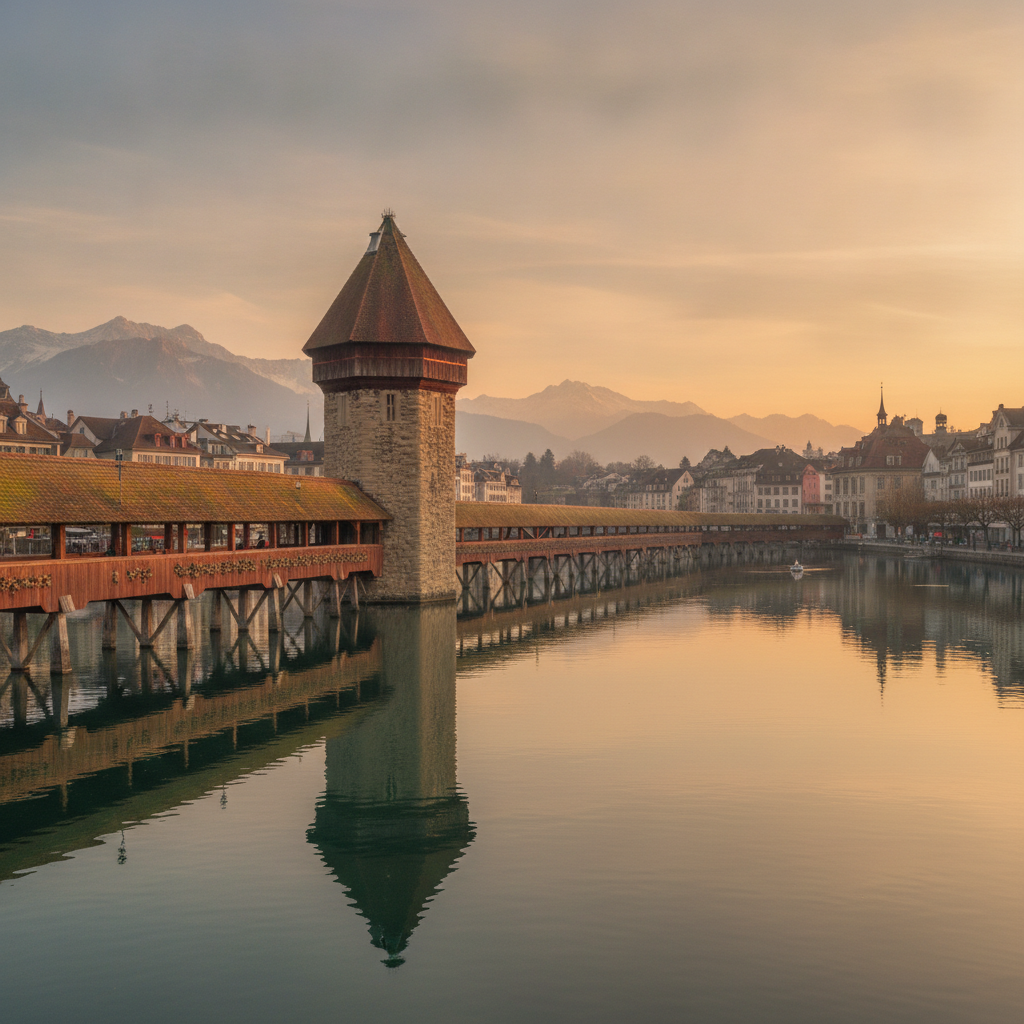
Lucerne — the Chapel Bridge, the Old Town & Lake Lucerne
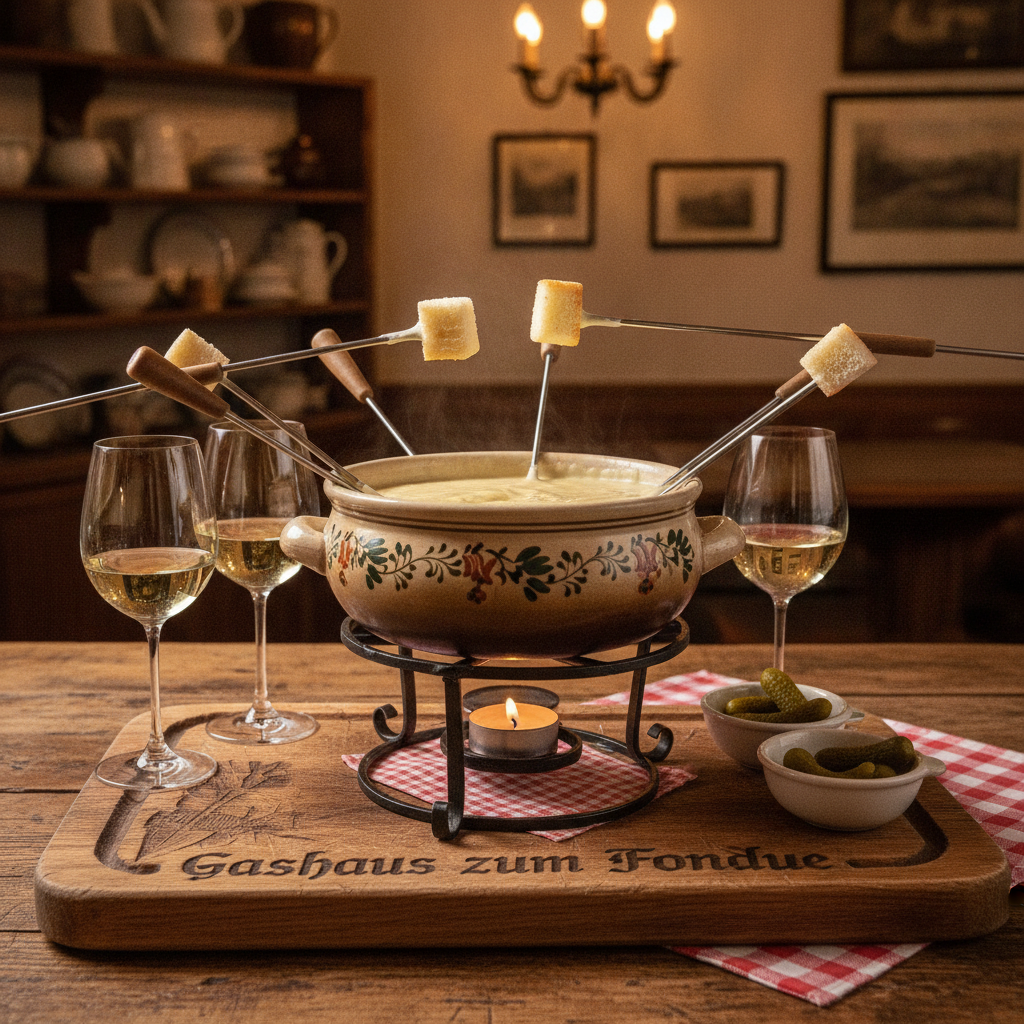
Lucerne Food & Nightlife — Swiss Fondue, the Old Town Restaurants & the Lake Bar Scene