Luxor: Akhenaten, Nefertiti, Tutankhamun, and the Amarna Revolution
The revolutionary 18th Dynasty at Luxor: Amenhotep III at the peak of New Kingdom power; Akhenaten and the radical Aten monotheism that abolished the entire Egyptian pantheon; Nefertiti and the Berlin bust; Tutankhamun and his intact tomb; the Opet Festival procession from Karnak to Luxor Temple; and Hatshepsut, the first female pharaoh, and her Deir el-Bahari mortuary temple.
- 1
Amenhotep III - The Builder of Luxor Temple and Peak of New Kingdom Power
Amenhotep III (ruled approximately 1390-1352 BCE): the builder of the core of Luxor Temple and the ruler during the peak of New Kingdom Egyptian prosperity. Amenhotep III controlled the gold mines of Nubia and the Mediterranean trade networks: at his court Egyptian art reached its highest refinement. He built Luxor Temple colonnade and commissioned the Colossi of Memnon (the 18-meter sandstone seated colossi that are the only surviving elements of the largest mortuary temple ever built in Egypt). His Great Royal Wife Tiye was the most politically powerful royal woman in Egyptian history before Hatshepsut: her colossal painted limestone head in the Neues Museum Berlin is one of the finest ancient portraits. The Amarna Letters (382 clay tablets in Akkadian cuneiform discovered at Amarna in 1887: the diplomatic correspondence between Amenhotep III, his son Akhenaten, and the rulers of Babylon, Assyria, the Hittites, Mitanni, Canaan, and Cyprus: the primary source for Late Bronze Age international relations). Late in his reign Amenhotep III may have elevated the Aten (sun disk) as his primary deity, preparing the theological ground for his son radical monotheism.
- 2
Akhenaten and the Aten Revolution - The Heretic Pharaoh and the First Monotheism
Akhenaten (born Amenhotep IV, ruled 1353-1336 BCE): the most controversial pharaoh in Egyptian history, who abolished the entire Egyptian pantheon and installed the Aten (the solar disk) as the sole state deity - arguably the first monotheism in history, predating Moses by approximately 50-100 years. In Year 5 of his reign he changed his name to Akhenaten (Effective for the Aten) and began construction of a new capital at a virgin site called Akhetaten (now Amarna, approximately 300 km north of Luxor). All other gods were suppressed: the temples of Amun at Karnak were closed: the name of Amun was chiseled off monuments throughout Egypt. The Aten was depicted as a solar disk with rays ending in human hands offering the ankh (life). The Amarna art style was revolutionary: elongated, naturalistic figures, informal family scenes, and the famous image of Akhenaten and Nefertiti with their daughters under the Aten rays. Nefertiti (Akhenaten Great Royal Wife: the Berlin Nefertiti bust (Neues Museum) discovered at Amarna by Borchardt in 1912 is one of the most famous portraits in the ancient world: Egypt has formally requested its return since 1924).
- 3
Tutankhamun and the Restoration - The Boy King Who Reversed the Heresy
Tutankhamun (ruled approximately 1332-1323 BCE, died approximately age 19): the son of Akhenaten who reversed the Aten revolution and restored the old gods. Born Tutankhaten (Living Image of the Aten), he changed his name to Tutankhamun and moved the capital back to Thebes. He reopened the Amun temples and funded their restoration. The intact tomb (KV62) discovered by Howard Carter on November 4, 1922 contains approximately 5,000 objects including the famous gold death mask (11.1 kg gold inlaid with lapis lazuli), the solid gold innermost coffin (110.4 kg), and the golden throne. Modern DNA analysis (2010) suggests Tutankhamun suffered multiple genetic defects from close-family intermarriage, malaria, and a compound leg fracture: he likely died from these complications. The Carnarvon Curse (Lord Carnarvon, Carter patron, died April 5, 1923 of blood poisoning: newspapers invented the Pharaoh Curse (no such text was found in the tomb): multiple deaths of people connected to the discovery were attributed to the curse over subsequent years). The Tutankhamun collection is now in the Grand Egyptian Museum near Giza (opened 2023).
- 4
The Opet Festival - Karnak to Luxor Temple in the Annual Sacred Procession
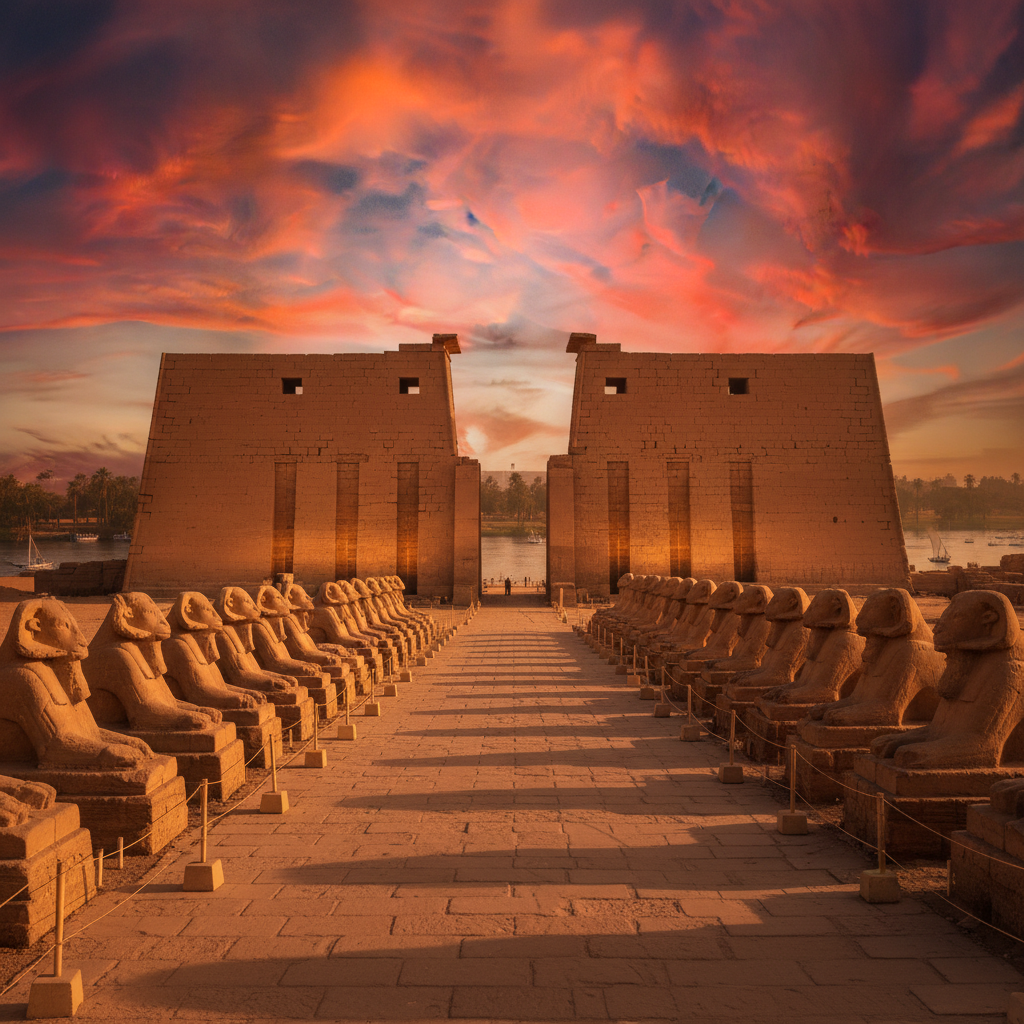
The Opet Festival: the most important religious festival in New Kingdom Egypt, lasting from 11 days in the early New Kingdom to 27 days in the later periods. The Opet Festival celebrated the renewal of royal power and the creative fertility of the Nile by processing the sacred barques (golden processional boats) of the Theban triad (Amun, Mut, and Khonsu) from Karnak Temple south along the 3km Avenue of Sphinxes to Luxor Temple. The crowds lining the route received food and beer from the pharaoh. In the inner sanctuary of Luxor Temple the pharaoh ritually merged with his divine ka (spiritual double), renewing his divine power and right to rule for another year. The colonnade of Amenhotep III in Luxor Temple (decorated by Tutankhamun) has a continuous painted relief narrative of the Opet Festival: the most complete surviving depiction of an ancient Egyptian religious festival. The Avenue of Sphinxes (the 3km processional avenue connecting Karnak and Luxor Temple, lined with human-headed sphinxes (Criosphinxes - ram-headed at the Karnak end, human-headed at the Luxor end): the avenue was completed and restored in the modern era and now allows walking the full processional route).
- 5
Hatshepsut and Deir el-Bahari - The First Female Pharaoh and Her Mortuary Temple
Queen Hatshepsut (ruled approximately 1473-1458 BCE): the daughter of Thutmose I who became regent for her young stepson Thutmose III and then declared herself pharaoh, ruling Egypt for approximately 20 years. She adopted male pharaonic regalia (false beard, double crown, crook and flail) while sometimes depicted as female. Her mortuary temple Djeser-Djeseru (Holy of Holies) at Deir el-Bahari is one of the finest examples of ancient Egyptian architecture: three colonnaded terraces built against the vertical limestone cliff of the Theban hills: designed by the royal architect Senenmut. The Punt Colonnade (the relief narrative of the Trading Expedition to Punt in Hatshepsut temple: ships, myrrh trees, the obese Queen of Punt, Puntite villages on stilts over water: one of the most informative ancient Egyptian foreign expedition narratives: Punt is believed to correspond to the modern Djibouti-Somalia-Eritrea coastal region). After Hatshepsut death, Thutmose III systematically defaced her images and removed her name from monuments: the erasure was discovered in the 19th century and identification of Hatshepsut was confirmed in the early 20th century. She is now recognized as one of the most successful rulers of the New Kingdom.
- 6
The Amarna Legacy - How Akhenaten Monotheism Influenced Western Religion
The Amarna legacy: the disputed question of whether Akhenaten monotheism influenced later religious traditions, particularly the Hebrew monotheism of Moses. The debate (the thesis: the Egyptologist and psychoanalyst Sigmund Freud proposed in Moses and Monotheism (1939) that Moses was an Egyptian priest of the Aten cult who led a group of followers out of Egypt after the death of Akhenaten and the reversal of the Aten revolution: the evidence (circumstantial): the theological similarities between Atenism and early Hebrew monotheism (one invisible god, rejection of idolatry): the Hymn to the Aten (the Great Hymn to the Aten composed by Akhenaten himself and carved in the tomb of his official Ay at Amarna: the hymn remarkable parallels with Psalm 104 in the Hebrew Bible in its description of the sun illuminating the world and sustaining all life): the counterargument (mainstream Egyptologists and biblical scholars reject a direct connection: the evidence is circumstantial and the theological differences are also significant: the monotheism of Moses is distinctly different from Atenism in excluding the solar disk as a physical divine object). The historical significance (regardless of the disputed connection to Mosaic monotheism, Akhenaten Aten revolution was an extraordinary moment in the history of human religious thought: the suppression of polytheism in favor of a single universal god occurred approximately 3,350 years ago in ancient Egypt).
Walk this route with audio
Stories play automatically as you reach each stop — no tapping needed.
More in Luxor

Luxor by River: The Nile Cruise to Aswan, the Dahabiyya Sailing Experience, the Temple of Edfu, and the Kom Ombo Temple
Luxor: The Nile Flood, Egyptian Afterlife, Coptic Christianity, and the Nile Cruise Guide
Luxor: Karnak, Luxor Temple, Valley of the Kings, and the World Greatest Open-Air Museum

Luxor Local Life: The East Bank Souq, the Alabaster Workshops, the Papyrus Art, and the Most Practically Lived-In Ancient City

Luxor Excursions: The Abydos Temple of Osiris, the Dendera Hathor Temple, and the Most Dramatically Colored Single Ancient Egyptian Sites
