Mandalay's Radius: Mingun's Unfinished 50-Metre Pagoda, the Ayeyarwady Slow Boat South & a 20-Lane Empty Capital
Around Mandalay—the Mingun river ferry to the world's largest incomplete pagoda (50 of 152 planned metres, the king died before completion, the 1838 earthquake cracked what remained) and the 90-tonne Mingun Bell that has never been rung for the pagoda it was cast for, the yama zatpwe marionette tradition down to a handful of Mandalay families whose 60-string puppets performed Ramayana for Konbaung kings, the 17-hour government ferry south to Bagan or the Belmond's heritage cruise vessels with excursions to riverside monasteries, 86th Street's jade dealers trading Hpakant jadeite in a $2–8 billion annual market involving military licenses and Kachin armed groups, Naypyidaw's 20-lane empty highways and replica-pagoda parking lots built in secret as the world's most surreal authoritarian capital, and the Sagaing Region's village burnings since 2021.
- 1
Mingun – The World's Largest Unfinished Pagoda
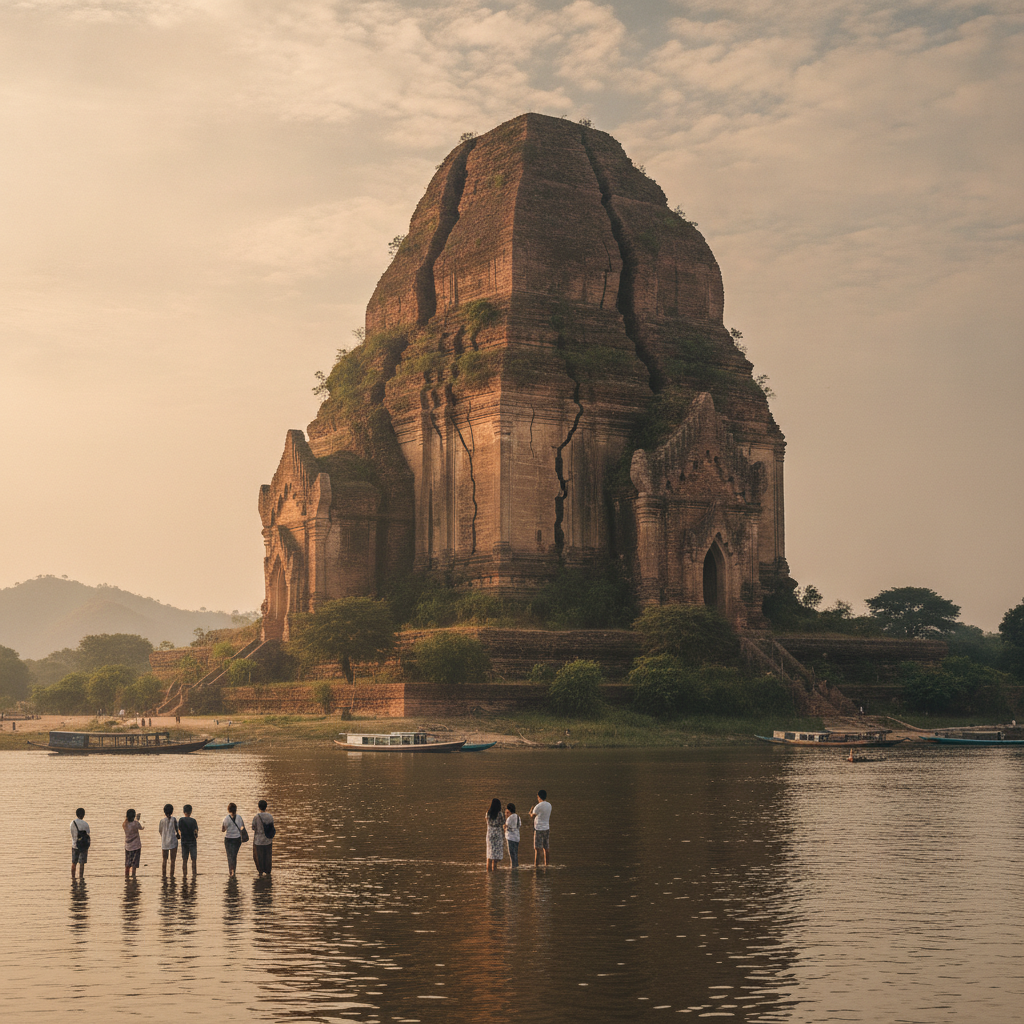
Mingun—11 km north of Mandalay on the western bank of the Ayeyarwady River, accessible by river ferry (45 minutes, departing from the Gaw Wein jetty near the old palace—the river crossing is itself one of the finest short river journeys in Myanmar)—contains the most extraordinary collection of religious monuments in the Mandalay area. The Mingun Pahtodawgyi (the 'Mingun Pagoda'): begun in 1790 by King Bodawpaya, intended to be the world's largest pagoda at 152 metres upon completion; the king died in 1819 with only 50 metres completed; the 1838 earthquake cracked the structure significantly; it remains the world's largest incomplete pagoda—the scale of the remaining 50 metres gives an almost incomprehensible sense of what 152 metres would have been. The Mingun Bell: a 90-tonne bronze bell (the world's largest functioning hung bell—second-largest bronze bell in the world after the Tsar Bell in Moscow, which fell and cracked before ever being hung) cast in 1808 for the pagoda that was never completed. The Hsinbyume Pagoda (Myatheindan): built 1816 by Crown Prince Bagyidaw in memory of his first wife—a white pagoda representing Mount Meru, encircled by seven concentric wavy terraces representing the mythological seven mountain ranges.
- 2
Mandalay's Marionette Theatre – Myanmar's Classical Performance
Mandalay's marionette theatre (yama zatpwe—'Ramayana show')—a classical performance art using wooden puppets articulated by up to 60 strings, performing scenes from the Ramayana, Jataka tales (stories of the Buddha's previous lives), and traditional Burmese historical stories—is one of Southeast Asia's most refined puppet traditions and one of the most endangered. The golden age: 18th–19th century Konbaung dynasty courts supported troupes of marionette performers who ranked below the king but above ordinary craftsmen; the puppet show was a royal entertainment that was also performed at pagoda festivals. The decline: with the end of the monarchy (1885), marionette theatre lost its court patronage; the parallel development of cinema (from the 1920s), video, and then TV progressively reduced the popular audience. The survivors: a handful of families in Mandalay still produce and perform with traditional marionettes; the Mandalay Marionettes Theatre (93rd Street, between 26th and 27th Streets) offers nightly performances for tourists at a venue that has operated since 1993—the most accessible traditional Myanmar performance art in the country. The puppets themselves are collected objects, with fine antique examples sold through specialist dealers in Yangon and Bangkok.
- 3
The Ayeyarwady River Cruise – Mandalay to Bagan
The Ayeyarwady River (Irrawaddy)—Myanmar's largest river, flowing 2,170 km from the Himalayan foothills to the Andaman Sea delta—was the primary commercial artery of British Burma and remains the most evocative way to travel between Mandalay and Bagan (220 km downstream). The slow government ferry (IWT—Inland Water Transport): a multi-decked vessel departing Mandalay at 06:00 and arriving Bagan approximately 17 hours later; wooden-bench 'ordinary class,' cushioned 'express class,' or the upper deck 'first class' with berths—a genuine river journey used by both tourists and Burmese travellers with goods and livestock. The tourist fast boats: high-speed aluminium vessels (7–8 hours, Mandalay to Bagan) operating primarily October–February when water levels are adequate; comfortable but less immersive than the government ferry. The heritage cruises: several luxury river cruise companies (Belmond Road to Mandalay, Pandaw River Cruises—the pioneer, operating converted colonial-style vessels) offer multi-day Mandalay-Bagan itineraries with excursions to riverside monasteries, villages, and ancient temples inaccessible by road.
- 4
Mandalay's Jade Market & the Myanmar Gem Trade
Mandalay's jade market (centred on 86th Street near the corner of 28th Street—a covered arcade of gem dealers operating primarily in the early morning)—is one of the most economically significant gem markets in Asia: the trade point where raw jadeite from the Hpakant mines of Kachin State (the world's primary jadeite source) is evaluated, traded, and eventually channels into the Chinese jade market where Myanmar stone commands premium prices. The jade trade economics: approximately 70–80% of the world's jadeite comes from Myanmar, and the trade (officially and unofficially) is estimated at $2–8 billion annually. The opacity: the actual trade value is obscured by the prevalence of informal trading, corruption, and the military's involvement in the mining licensing (the Hpakant area is controlled by military-connected companies and Kachin armed groups). The rubies and sapphires: Mandalay is the trading hub for the Mogok stone tract rubies (pigeon-blood rubies—the most valuable colour in the gem world) and the Mong Hsu sapphires; both are found at specialist gem dealers in the Mandalay gem market and at the annual Myanmar Gems Emporium (held in Naypyidaw, the capital).
- 5
Naypyidaw – Myanmar's Bizarre New Capital
Naypyidaw ('Abode of Kings')—constructed in secret in the dry scrubland 320 km south of Mandalay between 2002 and 2006 and announced as Myanmar's new capital city on November 6, 2005—is the strangest capital city in the world: a place built for approximately 1 million people on a vast planned grid, with 20-lane highways that are almost empty of traffic, replica versions of Yangon's famous pagodas scaled up and surrounded by parking lots, a zoo, a water park, several luxury hotels used primarily for government summits, and a residential pattern in which government ministries are separated from each other by kilometres of undeveloped land. The political motivation: various theories (the military feared a coastal invasion via Yangon, astrological advice, the generals' desire to escape the social mix of Yangon) have been proposed; the most credible is a combination of security concern and the military leadership's desire for a capital built entirely under their control, without the colonial-era footprint of Yangon. Naypyidaw is accessible from Mandalay by bus (4 hours) or by the Chinese-extended railway (under development); few tourists visit intentionally, but it is an extraordinary case study in authoritarian urban planning.
- 6
Mandalay in the Civil Conflict – The Sagaing Region Tragedy
The political situation in the Mandalay area since the February 2021 coup has been dramatically worse than in Yangon: the Sagaing Region (the administrative division directly west of Mandalay across the Ayeyarwady) has experienced some of the most intense civil conflict in Myanmar since the coup, with People's Defence Forces (PDF) operating in the villages and townships of the region and the Tatmadaw conducting systematic reprisals including the burning of villages (a documented counter-insurgency tactic used by the Myanmar military since the 1970s in ethnic minority areas, now applied in the Bamar heartland for the first time). The city of Mandalay itself: commercial activity has continued, though reduced; the economic impact of the conflict in the surrounding region (disrupted agriculture, displaced population, road insecurity) has affected the city's food supply and informal economy. Mandalay's Buddhist monasteries and the sangha (monastic community): the 2021 coup generated a significant response from Buddhist clergy, many of whom supported the CDM (civil disobedience movement); some monks in Mandalay participated in early protest marches; the military's subsequent pressure on the sangha (threats, arrests of politically active monks) has created division within the monastic community.
Walk this route with audio
Stories play automatically as you reach each stop — no tapping needed.
More in Mandalay
Mandalay's Soul: Anyein Comedy That Satirised Military Censors, Inwa's Rice-Field Ghost Capital & the Downstream River
Mandalay Endures: U Bein's Teak Silhouette, Thingyan's Water War & a City's Thousand-Year Continuity Under Pressure
Mandalay: 729 Marble Slabs of the Buddhist Canon, Gold Leaf Beaten on 36th Street & the Last Royal Palace