Mandalay: 729 Marble Slabs of the Buddhist Canon, Gold Leaf Beaten on 36th Street & the Last Royal Palace
Myanmar's cultural capital—Mandalay Palace's cosmologically centred compound (the royal throne room at the exact centre of a 2 km-square moat, the original teak buildings burned by Japan and Britain in 1945 and rebuilt in military-era concrete), Mandalay Hill's 1,700 covered steps to panoramic views of the Ayeyarwady and Sagaing's 500-stupa skyline, Kuthodaw's 729 white miniature pagodas each housing one marble slab of the entire Pali canon (the world's largest book, completed by 2,400 monks in 6 months), the Mahamuni Buddha's gold-layer-fattened torso from centuries of male devotee leaf-application, 36th Street's gold leaf beaters working deer hide and bamboo paper, and U Bein's 1.2 km of teak planks at sunset.
- 1
Mandalay Palace & the Last Royal Capital
Mandalay Palace (Mya Nan San Kyaw—'Royal Emerald Palace')—built 1857–1859 by King Mindon Min at the foot of Mandalay Hill, in the exact centre of a walled and moated square compound (each side 2 km)—was the last royal palace of Myanmar before British annexation in 1885. King Mindon's vision: the palace was designed as a cosmologically ordered centre of the universe, with the royal throne room (the Pyinsapat—the great audience hall where the king conducted state business under the gilded throne canopy) at the exact centre of the compound. The original palace: a complex of over 100 teak buildings of extraordinary craftsmanship—the finest Burmese royal woodcarving on teak screens, pillars, and pavilions. The destruction: virtually the entire original palace was burned in 1945 during the Battle of Mandalay (Japanese forces defending against Allied advance); the reconstruction by the military government in the 1990s (in concrete, painted to approximate the original's gold and red) is architecturally undistinguished but the setting—within the original moat, with the original wall—remains impressive. A Myanmar military garrison occupies part of the inner compound (limiting access to the reconstruction and the small museum).
- 2
Mandalay Hill – Panoramic Views & Religious Geography
Mandalay Hill—a 236-metre isolated hill north of the palace, covered with pagodas, prayer halls, and shrines from base to summit—is the religious and geographical landmark that defines the city and gives Mandalay its name (from 'Ratnamandala'—the jewelled plain). The ascent: a covered walkway (1,700 steps, sheltered from the sun)—lined with Buddha images, prayer stations, shrine rooms, and the resident souvenir stalls and vendors who have traded on the stairway for generations; the covered escalator (a more recent addition, running part of the way up) allows visitors with limited mobility to reach the summit. The summit: the Sutaungpyei Pagoda (the 'Wish-Fulfilling Pagoda')—a stupa offering 360-degree views of the entire Mandalay plain: the palace moat below, the Ayeyarwady River (Irrawaddy) glittering to the west, Sagaing Hill's silver stupa visible across the river, and the flat agricultural plain extending in every direction. The legend of Mandalay Hill: the Buddha is said to have visited the hill and prophesied that a great city of Buddhist learning would be founded at its foot—Mindon Min built Mandalay in 1857 as the fulfilment of this prophecy.
- 3
Kuthodaw Pagoda – The World's Largest Book
The Kuthodaw Pagoda (Kuthodaw Hpaya—'Royal Merit Pagoda')—built by King Mindon Min in 1868 at the foot of Mandalay Hill—contains what UNESCO describes as 'the world's largest book': 729 white marble slabs inscribed on both sides with the entire Pali Buddhist canon (the Tipitaka—the 'Three Baskets' of Buddhist scriptures), each slab housed in its own miniature white pagoda (kyauksa gu). The scale of the project: the text required 729 kyauksa gu (miniature pagodas)—each 5 metres high, arranged in orderly rows around the central golden stupa; if the text were printed in conventional book format, it would fill approximately 38 standard volumes. The inscription took 2,400 monks 6 months to complete, chanting and reading through the entire canon. The 729 pagodas from the air: a perfectly ordered white grid of identical small structures, an image that has become one of Myanmar's most reproduced aerial photographs. The Sandamani Pagoda (immediately adjacent to Kuthodaw—containing 1,774 slabs of Buddhist commentary on the Tipitaka, supplementing the canon): together they constitute the most comprehensive single-site repository of written Buddhist knowledge in the world.
- 4
Sagaing Hill & Amarapura – The Religious Heartland
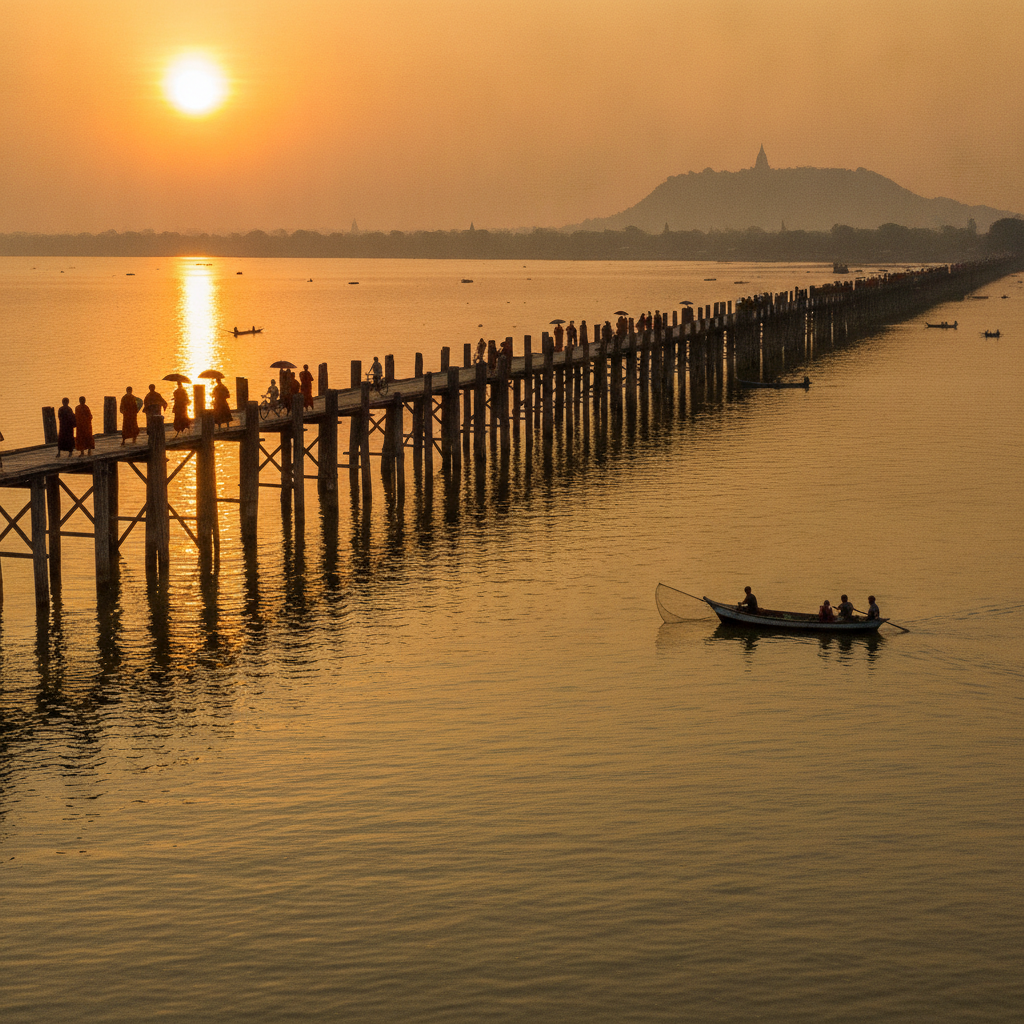
Sagaing—the low ridge of hills 20 km west of Mandalay across the Ayeyarwady River, visible from Mandalay Hill as a silver-studded skyline—is the most intensely religious landscape in Myanmar: over 500 Buddhist temples, monasteries, and meditation centres occupy the Sagaing Hills, and the area is home to approximately 6,000 monks and 4,000 nuns—the densest concentration of Buddhist clergy in Myanmar. The Sagaing Hill panorama: the summit of Tupayon Pagoda (one of the most accessible Sagaing hilltop temples)—300-degree views of the Ayeyarwady flood plain, the silver domes of dozens of stupas visible in the haze, and the river below. The Mahamuni Pagoda (Mandalay city—the most sacred Buddhist image in Mandalay and the second most sacred in Myanmar after Shwedagon): a seated Buddha image believed to have been made during the Buddha's lifetime and to carry his living energy; male devotees apply gold leaf directly to the image (which has accumulated such a thick layer of gold over centuries that its body proportions have visibly changed—the torso is now significantly fatter than the head). Amarapura (the 'Immortal City'—former capital of Burma, 11 km south of Mandalay): U Bein Bridge—the 1.2 km teak bridge across Taungthaman Lake.
- 5
Mandalay's Crafts – Gold Leaf, Marble & Puppets
Mandalay is the craft production capital of Myanmar: the city and its immediate suburbs contain the most concentrated collection of traditional Burmese artisanal workshops—gold leaf beating, marble carving, silk weaving, marionette making, and lacquerware—of any place in the country. Gold leaf beating (the 36th Street workshops between 78th and 79th Streets): workers beat small pieces of gold between layers of deer hide and bamboo paper for hours until the gold is so thin it floats away in a breath—the leaf is used to gild Buddha images and is applied by devotees at pagodas. Marble carving (Marble Street—35th Street): a continuous workshop district of carvers producing Buddha images in white Sagyin marble (quarried north of Mandalay) ranging from palm-sized to several tonnes, with electric tools for roughing out and hand tools for the finishing that creates the extraordinarily refined facial features of Myanmar's marble Buddhas. Mandalay marionettes (yama zatpwe—Myanmar's classical marionette theatre tradition, now primarily kept alive by a small number of families in Mandalay): the finest puppets are carved from light wood, articulated with up to 60 strings, and dressed in miniature silk court costumes.
- 6
Mandalay's Chinese Community & the Yunnanese Presence
Mandalay has, since the early 1990s, experienced a demographic and commercial transformation driven by a massive influx of Yunnanese Chinese migrants: an estimated 250,000–400,000 Chinese (most from Yunnan Province, crossing the porous border 200 km north) have settled in Mandalay, buying property, opening businesses, and effectively creating a Chinese commercial quarter in the city's core. The process: legal and illegal migration, investment in real estate (Chinese money drove Mandalay property prices to levels unaffordable for local Burmese residents in the 2000s–2010s), and commercial investment (Chinese-owned hotels, restaurants, wholesale markets, and factories). The language: Mandarin Chinese has become effectively a business language in Mandalay alongside Burmese. The political dimension: the influx of Chinese capital and people is connected to the Chinese government's strategic interest in northern Myanmar (border trade, the gas and oil pipeline from Kyaukphyu on the Rakhine coast to Yunnan—operational since 2013) and has been a source of resentment among Burmese residents of Mandalay who have been economically displaced by Chinese capital. The 2021 coup's economic disruption has altered but not reversed this Chinese commercial presence.
Walk this route with audio
Stories play automatically as you reach each stop — no tapping needed.
More in Mandalay
Mandalay's Soul: Anyein Comedy That Satirised Military Censors, Inwa's Rice-Field Ghost Capital & the Downstream River
Mandalay Endures: U Bein's Teak Silhouette, Thingyan's Water War & a City's Thousand-Year Continuity Under Pressure
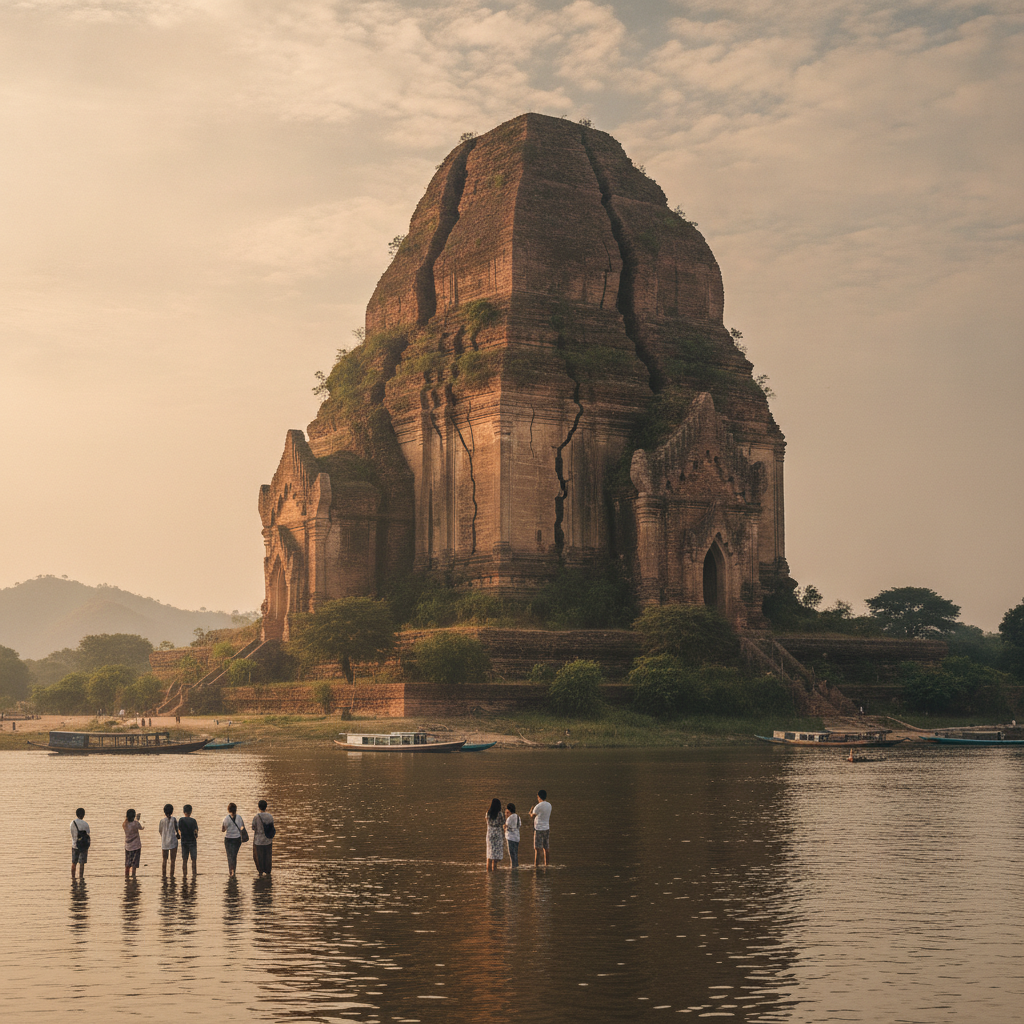
Mandalay's Radius: Mingun's Unfinished 50-Metre Pagoda, the Ayeyarwady Slow Boat South & a 20-Lane Empty Capital