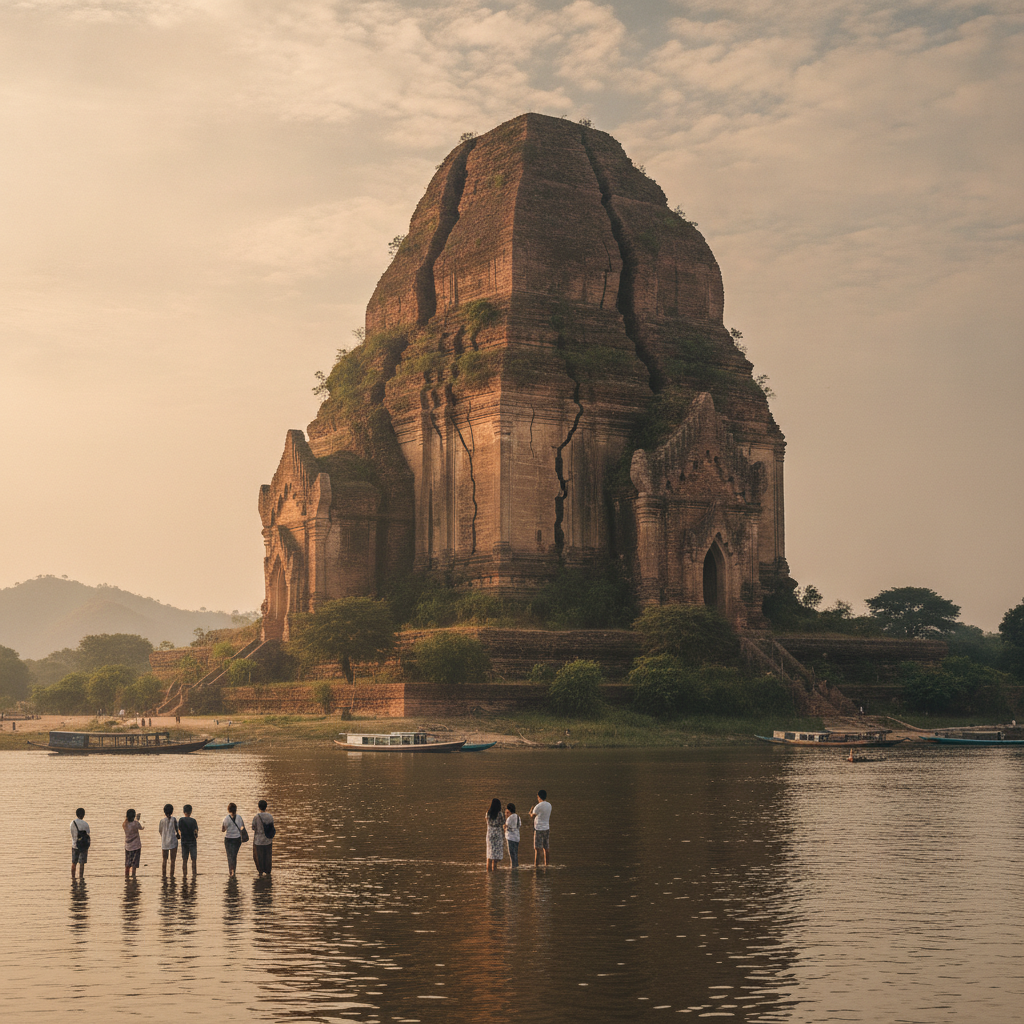
Mandalay's Range: Pyin Oo Lwin's Hill Station Strawberries, Gokteik Viaduct's 102-Metre Drop & Monk Breakfast Ethics
Mandalay beyond the palace—Pyin Oo Lwin's 1070-metre colonial bungalows and horse carriages and strawberry season (the British administration's summer escape from 42°C plains heat), Amarapura's luntaya achiek silk weavers using 30 simultaneous shuttles for the wave-pattern that takes days to set up on a treadle loom, the Shwenandaw Monastery's every-surface lacquer carving as the only 19th-century palace teak building that survived 1945 (moved by King Thibaw before the burning), Mahagandayon Monastery's 1,000-monk dawn breakfast increasingly surrounded by photographers (the ethical question of treating a private community meal as a spectacle), Kyal Sin the 19-year-old shot in the head March 3 2021 whose T-shirt reading 'Everything will be OK' became the coup resistance's most shared image, and the Gokteik Viaduct crossed at 5 mph on a century-old steel trestle.
- 1
Pyin Oo Lwin – The British Hill Station
Pyin Oo Lwin (Maymyo)—67 km east of Mandalay at 1,070 metres altitude—was British Burma's primary hill station: the place where the colonial administration retreated in summer to escape the Mandalay plain's heat (May–August temperatures in Mandalay regularly exceed 42°C). The British legacy: colonial bungalows (some with English garden names, some still occupied by the Myanmar military officer families to whom they were allocated after independence), the National Kandawgyi Gardens (opened 1915—the finest botanical garden in Myanmar, modelled on Kew, containing temperate-zone plants impossible at lower altitude), and the horse-drawn carriage transportation that remains the most evocative way to move around the town (one of the few places in Asia where horse carriages are still the practical alternative to tuk-tuks for short distances). Strawberries and temperate fruit: Pyin Oo Lwin grows strawberries, avocados, and temperate vegetables that are impossible in the lowlands; the strawberry season (January–March) brings domestic visitors from Mandalay and Yangon. The Peik Chin Myaung Cave: a naturally lit limestone cave 20 km north, containing Buddha images and bat colonies.
- 2
Mandalay's Silk Weaving Tradition – Amarapura's Looms
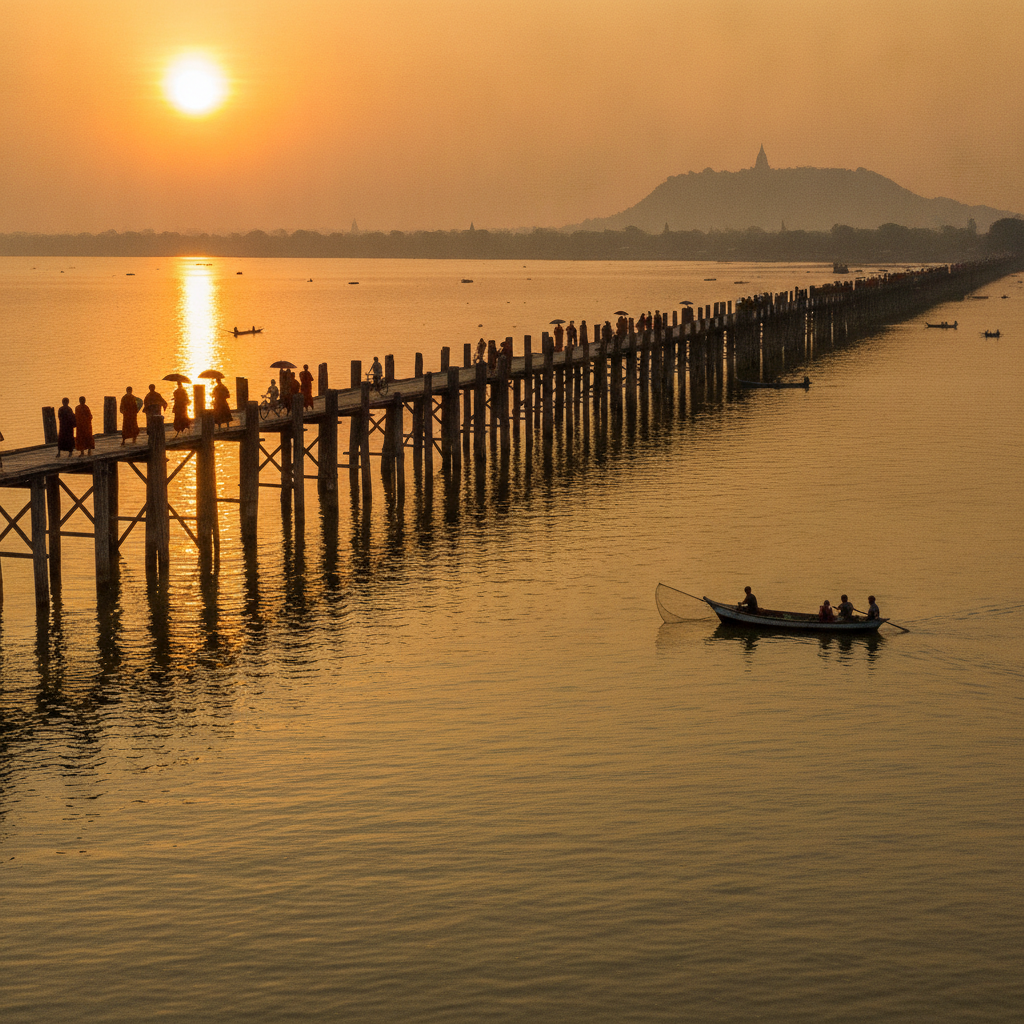
The silk weaving industry concentrated in Amarapura (the ancient capital 11 km south of Mandalay) is the primary production centre for Myanmar's most valued traditional textiles. The dominant technique: the htamein (the women's traditional skirt-garment) woven in two-shuttle silk on traditional treadle looms; the most prestigious are the luntaya achiek (a wave-pattern silk achieved by a precise two-shuttle technique that requires a separate shuttle for each colour element of the pattern—a weaver might use 20–30 shuttles simultaneously, and the process requires several days to set up and produce a single piece). The geography: the street around the U Bein Bridge approach road in Amarapura is lined with weaving workshops; visitors can watch the full production process from thread preparation through warping to weaving. The silk itself: Myanmar grows mulberry trees and raises silkworms in the Shan highlands; the reeling of silk from cocoons and the dyeing (natural dyes using imported and local plant materials) are separate artisanal operations before the silk reaches the Amarapura weavers. Myanmar silk competes with Thai and Chinese silk on quality; the best pieces (luntaya achiek in pure silk with complex colour patterns) are collected objects worth hundreds to thousands of dollars.
- 3
Mandalay's Monasteries & Religious Education
Mandalay's position as the most important Buddhist city in Myanmar (though Sagaing has more monks, Mandalay has the most significant Buddhist educational infrastructure) is expressed in its relationship with the state sangha and the monastic education system. The Mahagandayon Monastery (Amarapura—the largest and most prominent Buddhist monastery in Myanmar, housing approximately 1,000 monks and novices): it is famous for the dawn breakfast scene where the full monk community eats in disciplined formation—a disciplined procession of monks with bowls that has become one of Myanmar's most photographed spectacles, though the dawn photography crowds have themselves become a subject of ethical debate (the monks' morning meal is a private community activity, not a performance). The Shwenandaw Monastery (Mandalay—the only original 19th-century teak building that survived the 1945 burning of the palace compound, moved to its current location by King Thibaw): a masterwork of Burmese wood carving—every surface of the exterior covered in gilded lacquer relief carvings of Buddhist cosmological scenes, royal court life, and Jataka tales.
- 4
Mandalay's Role in the 2021 Coup Resistance
Mandalay—Myanmar's second city and the cultural capital of the Bamar Buddhist majority—was a significant centre of resistance to the February 2021 military coup in the critical early months of the Civil Disobedience Movement. The scenes in Mandalay: the CDM (civil disobedience movement) brought tens of thousands into the streets in the weeks following the coup (February–March 2021); the military's response in Mandalay included live fire on protesters—the deaths of Chit Min Thu and Kyal Sin (Angel)—a 19-year-old woman shot in the head on March 3 while wearing a T-shirt reading 'Everything will be OK'—became internationally known images. The Mandalay dock workers' strike: Mandalay's port workers (on the Ayeyarwady) went on strike as part of the CDM, halting river commerce; the economic and symbolic impact of workers in Myanmar's most important commercial river port refusing to work for the military government was significant. The subsequent crackdown: military checkpoints, raids on CDM participants, and the arrest of strike leaders; by mid-2021, the organised CDM in Mandalay had been substantially suppressed, though resistance continued in covert forms and in the armed PDF forces in the Sagaing Region.
- 5
The Mandalay-Lashio Railway & the Road to Shan State
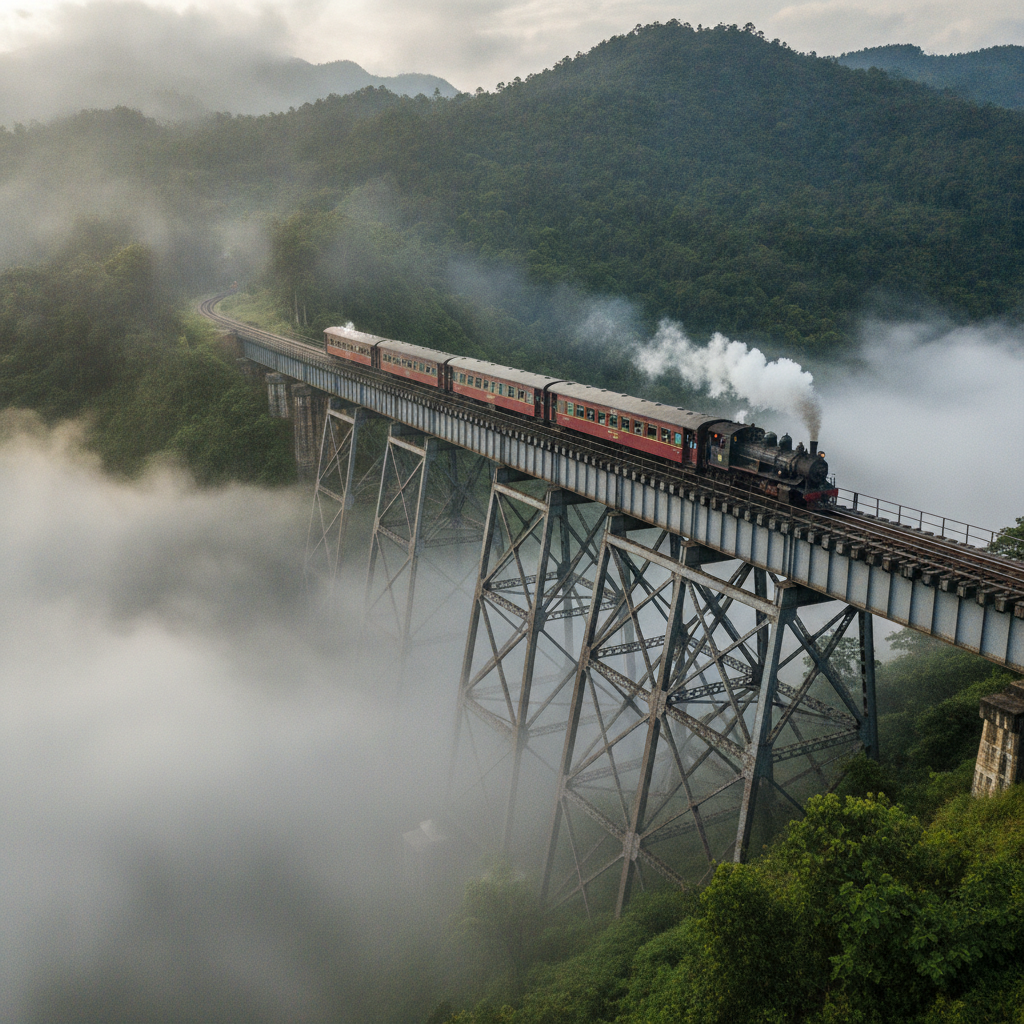
The journey from Mandalay east into Shan State—through some of Myanmar's most dramatic highland scenery—is the basis of one of Asia's most celebrated rail journeys: the Mandalay-Lashio Railway, which crosses the Gokteik Viaduct. The Gokteik Viaduct: built 1901 by the Pennsylvania Steel Company for British Burma's railway administration—a 689-metre-long, 102-metre-high steel trestle viaduct across a deep gorge in the Shan hills, the largest railway bridge in Asia at the time of construction. The train crosses the viaduct at walking pace (approximately 5 mph—a safety precaution for the century-old structure), giving passengers an extended view down into the gorge below. The route from Mandalay to Hsipaw (a market town in northern Shan State with a functioning Shan princely palace—the Haw—and several days' worth of village trekking): considered one of the finest rail journeys in Southeast Asia, combining colonial engineering, mountain scenery, Shan hill tribe villages visible from the train, and the atmospheric narrow-gauge carriages that have not substantially changed since the colonial era. Travel advisories (Shan State is under armed conflict conditions in multiple areas) require checking before departure.
- 6
Practical Mandalay – Getting Around & the Craft Circuit
Mandalay International Airport (MDL)—45 km south of the city centre—receives domestic flights from Yangon (1 hour, Air KBZ, Mann Yadanarpon Airlines) and Heho/Inle Lake; international connections are primarily through Bangkok (Air Asia—subject to operating status given the political situation). The train from Yangon: 14–17 hours on the Yangon-Mandalay express (upper class berths available, the night train departing both ends in the evening to arrive morning); the new Mandalay-Yangon Highway (completed 2010)—a 560 km expressway—makes the bus journey 7–8 hours. Getting around Mandalay: hired motorcycle or bicycle (flat city, easy to navigate by the grid street numbering system—streets run east-west from 1st to approximately 80th Streets, and north-south from 63rd to approximately 90th Streets); hired tuk-tuk for multi-destination days. The craft circuit: 36th Street (gold leaf, 08:00–11:00 best time), 35th Street (marble carving workshops), Amarapura (U Bein Bridge + silk weaving—half day), Sagaing (half day by motorbike bridge crossing—20 km roundtrip), Mingun (river ferry—half day). The Mandalay City Development Committee tour office offers licensed guides. Best season: November–February (dry, cool—27–32°C daytime); March–May reaches 42°C+.
Walk this route with audio
Stories play automatically as you reach each stop — no tapping needed.
More in Mandalay
Mandalay's Soul: Anyein Comedy That Satirised Military Censors, Inwa's Rice-Field Ghost Capital & the Downstream River
Mandalay Endures: U Bein's Teak Silhouette, Thingyan's Water War & a City's Thousand-Year Continuity Under Pressure
Mandalay: 729 Marble Slabs of the Buddhist Canon, Gold Leaf Beaten on 36th Street & the Last Royal Palace