Mandalay's Soul: Anyein Comedy That Satirised Military Censors, Inwa's Rice-Field Ghost Capital & the Downstream River
The final Mandalay layers—Zegyo Market's morning street food where Shan chickpea tofu salad meets South Indian paratha with dhal from the 84th Street breakfast stalls, Mandalay's role as the literary heart of the Konbaung dynasty whose court chronicles are the primary pre-colonial history source, the Dry Zone agricultural plain's sesame and groundnut farmers disrupted by Sagaing Region conflict since 2021, the anyein clown tradition that encoded political satire in comedy through every censorship era, Inwa's leaning tower and monastery ruins in rice paddies reached only by horse cart from a 5-minute ferry (Burma's capital for 500 years, now agricultural landscape), and leaving by the Ayeyarwady that passes Yandabo where the First Anglo-Burmese War ended in 1826 en route to Bagan.
- 1
Mandalay's Street Food – Shan Tofu & Mohinga North
The street food culture of Mandalay reflects its position as the cultural capital of the Bamar north and the commercial gateway to Shan State—a city where Bamar, Shan, Chinese, and Indian food traditions intersect in the tea houses and street markets. Shan tofu (pe byoke—not made from soy like Chinese tofu, but from chickpea or lentil flour—yellow, firmer, with a distinctly different flavour): served cold with oil and chilli as a salad (shan tofu salad) or fried crispy. Shan noodles (in Mandalay's version, served with a slightly different broth and garnishes than the Yangon variant). The Mandalay version of mohinga (the national dish is made differently in every city—Mandalay's version tends to be slightly drier and spicier). Indian breakfast: the substantial Indian community concentrated around 84th Street runs South Indian breakfast stalls (samosa curry, paratha with dhal, iddly)—some of the finest Indian breakfasts in Southeast Asia outside India. The Zegyo Market (the central covered market of Mandalay—a massive multi-floor market complex built in 1999, selling everything from jade to vegetables to electronics): the surrounding street stalls in the early morning are the best single concentration of Mandalay street food.
- 2
Mandalay's Literary & Intellectual Tradition
Mandalay's claim as Myanmar's cultural capital rests substantially on its literary and intellectual heritage. As the last royal capital (1859–1885), Mandalay was the centre of the royal court's patronage of literature, poetry, and scholarship—the finest literary output of the Konbaung dynasty (including the chronicles that are the primary historical source for pre-colonial Burma, the court poetry, and the development of the modern Burmese literary form) was produced in Mandalay. The Buddhist educational infrastructure: the monastic schools of Sagaing, Amarapura, and Mandalay itself trained Burma's literate elite for centuries; the transition to secular education under British rule (and the post-independence governments' combination of secular and religious schooling) preserved Mandalay's monasteries as centres of Pali scholarship. The contemporary: Mandalay has significantly fewer literary institutions than Yangon (which has the publishing industry); but the traditional scholarly infrastructure of the Sagaing monasteries and the craft knowledge traditions embedded in the gold-leaf, marble, and silk workshops represent a form of knowledge transmission as important as the written word.
- 3
The Irrawaddy Flood Plain – Mandalay's Agricultural Hinterland
Mandalay sits at the northern edge of the Dry Zone—the central belt of Myanmar's agricultural heartland where annual rainfall is insufficient for monsoon rice cultivation but adequate for a range of irrigated and rain-fed crops (sesame, groundnut, cotton, sugar, corn, and pulses). The Ayeyarwady (Irrawaddy) River's annual flood—which deposits alluvial silt on the flood plain and recharges groundwater—has sustained intensive agriculture in the Mandalay-Sagaing plain for millennia; the ancient capitals of Inwa, Sagaing, Ava, Amarapura, and Mandalay were all positioned on the river's western bank to take advantage of both the water supply and the defensive advantages of the river. The current agricultural situation: the Dry Zone's farmers depend on irregular monsoon rainfall supplemented by irrigation from the Ayeyarwady; climate change has altered precipitation patterns in ways that agricultural communities are struggling to adapt to; and the political disruption of the 2021 coup (displacement, road insecurity, disrupted markets) has severely affected the agricultural economy of the Sagaing Region, where much of the Mandalay area's food supply originates.
- 4
Mandalay's Anyein & Traditional Performance Arts
Mandalay's traditional performance arts—anyein (variety theatre combining comedy, dance, and music), yama zatpwe (classical marionette theatre), hsain waing (percussion ensemble)—represent the most complete surviving repertoire of traditional Burmese performing arts in the country. The anyein tradition: a particularly popular comic performance form in which a comedian (lu bye—literally 'clown') interacts with a female dancer and singer in a format that allows topical social and political commentary under the guise of humour (satirical comments about the government, officials, and social conditions have been a feature of anyein since the colonial period, and the form was a vehicle for coded political satire even during the strictest periods of military censorship). The Mintha Theatre (Mandalay—one of the few venues in Myanmar that still offers regular traditional Burmese performance including anyein, yama zatpwe, and classical dance): performances are less frequently offered since the coup (many performers left, some were arrested for CDM participation, and the audience base declined with the departure of international visitors). The hsain waing ensemble: performed at all major social events—weddings, pagoda festivals, funerals—the circular arrangement of tuned drums played by a single virtuoso drummer is the most characteristic sound of Burmese ceremonial music.
- 5
Inwa (Ava) – The Ghost Capital in the Rice Fields
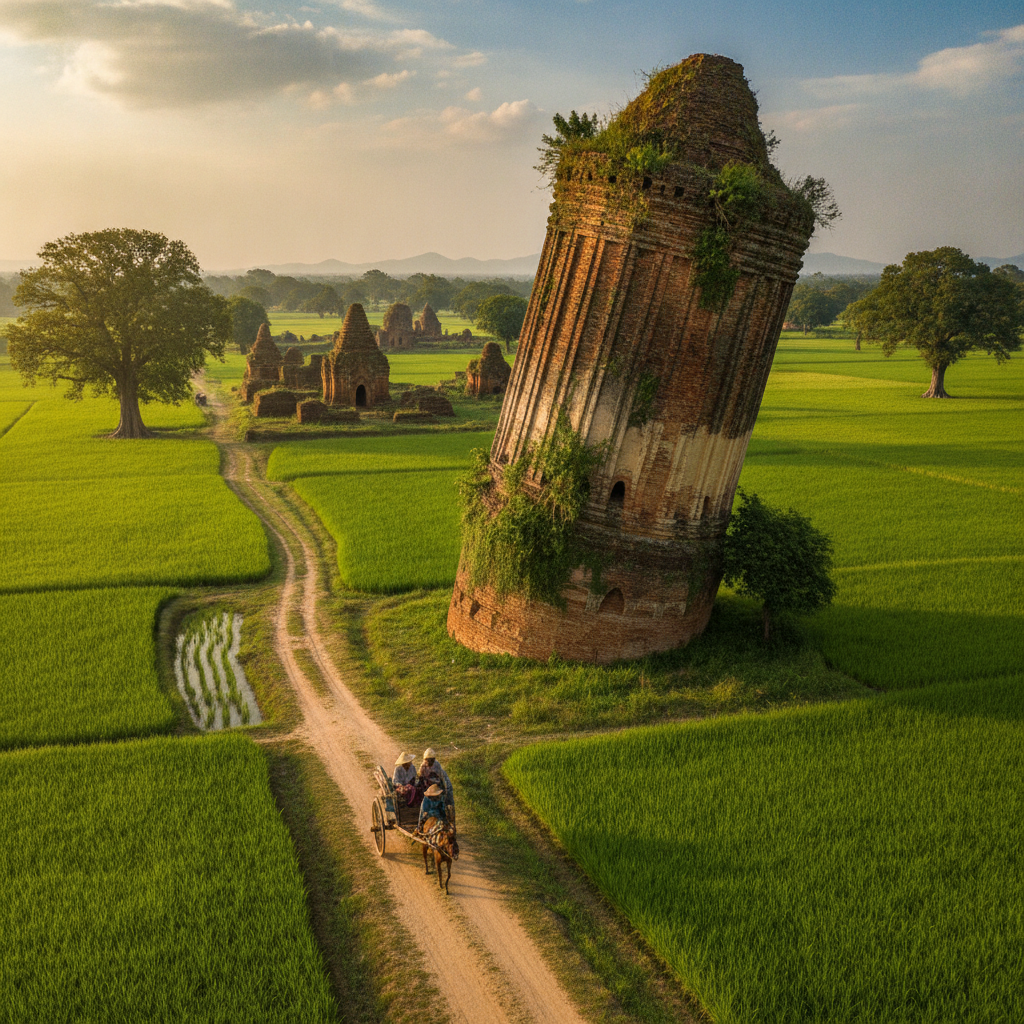
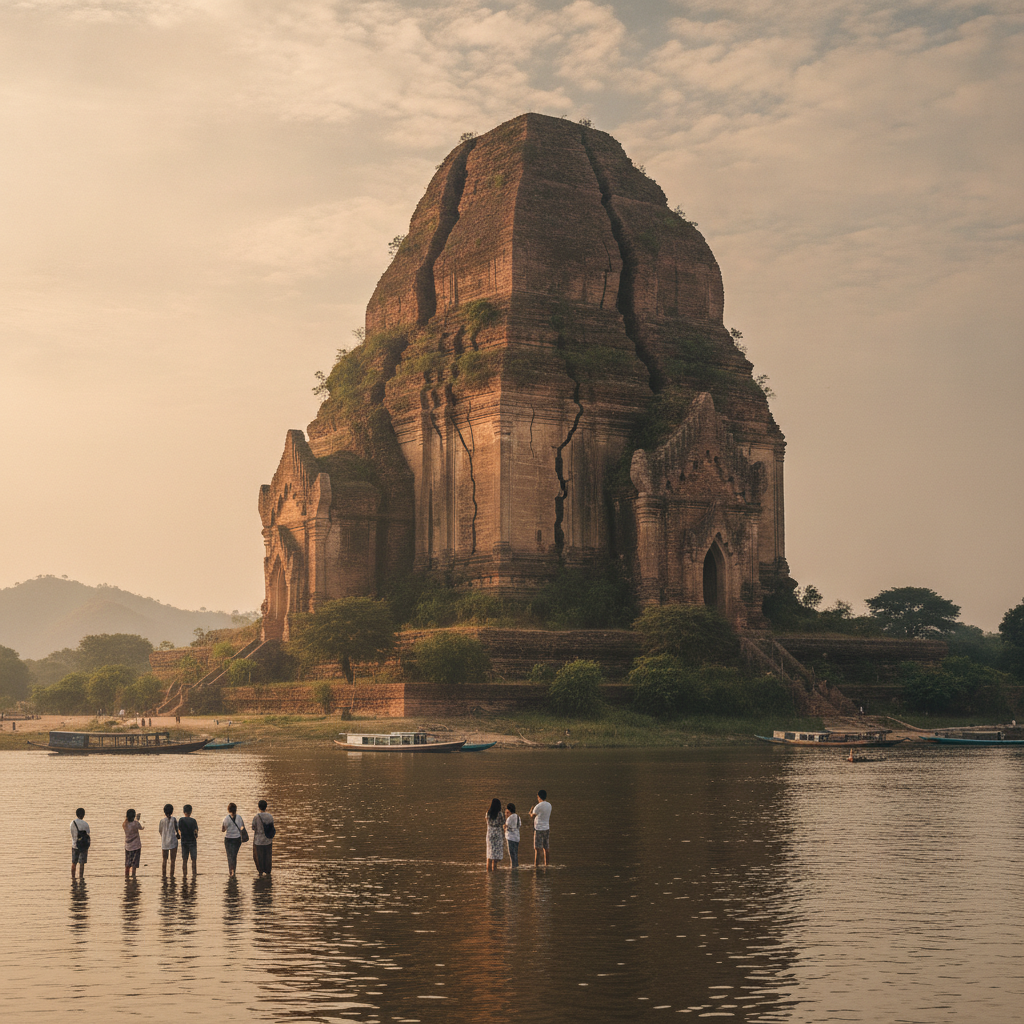
Inwa (Ava)—15 km south of Mandalay, on a former island in the Ayeyarwady-Myitnge confluence, now reachable by a small ferry (5 minutes) followed by horse cart along unpaved roads through rice paddies—is the most atmospheric of Mandalay's ancient capital sites: a former royal capital that served as Burma's capital almost continuously from 1364 to 1838 (with brief interruptions), now an agricultural landscape of rice fields, villages, and ruins. The sites: Maha Aungmye Bonzan Monastery (1822—a brick-and-stucco monastery that survived the earthquakes that destroyed most of Inwa's brick buildings, with fine stucco decorations); the Nanmyin ('Leaning Tower'—a 27-metre brick watch tower that was partially toppled by the 1838 earthquake and now leans at an 8-degree angle); the Lawka Nanda Pagoda (on the riverbank—a pagoda of modest size but fine proportions that served as the royal landing sanctuary). The horse cart: the traditional transport for the Inwa circuit (horse carts meet the ferry and travel the car-free paths between the ruins—the only practical way to cover the dispersed site, which has no road connections between monuments).
- 6
Leaving Mandalay – The River's Downstream Pull
The visitor who leaves Mandalay most commonly does so by river—either south to Bagan on the Ayeyarwady or north to the jade country of Kachin on the route that once served the old trade to China. The river makes leaving Mandalay into a continuation of Mandalay rather than a departure from it: the city's history is inseparable from the Ayeyarwady, and the downstream journey (which passes Inwa's ruins, Sagaing's stupas, Pakhan, Yandabo—where the First Anglo-Burmese War ended in 1826, and Bagan's temple plain) is, in effect, a journey through the country's entire recorded history in two dimensions: the river's width and the temple silhouettes against the sky. Mandalay is the city that best expresses Myanmar's continuity: the gold leaf beaten on 36th Street will end on a Buddha image that was made in the marble workshops of 35th Street, installed in a temple that was built in the same tradition as the Shwedagon and the Mahamuni, lit by the same sunrise that has risen over this river since the first capitals were built on its banks. The military coup of 2021 is real and serious—and it has not cancelled Mandalay's 700 years of layered civilisation.
Walk this route with audio
Stories play automatically as you reach each stop — no tapping needed.
More in Mandalay
Mandalay Endures: U Bein's Teak Silhouette, Thingyan's Water War & a City's Thousand-Year Continuity Under Pressure
Mandalay: 729 Marble Slabs of the Buddhist Canon, Gold Leaf Beaten on 36th Street & the Last Royal Palace
Mandalay's Radius: Mingun's Unfinished 50-Metre Pagoda, the Ayeyarwady Slow Boat South & a 20-Lane Empty Capital