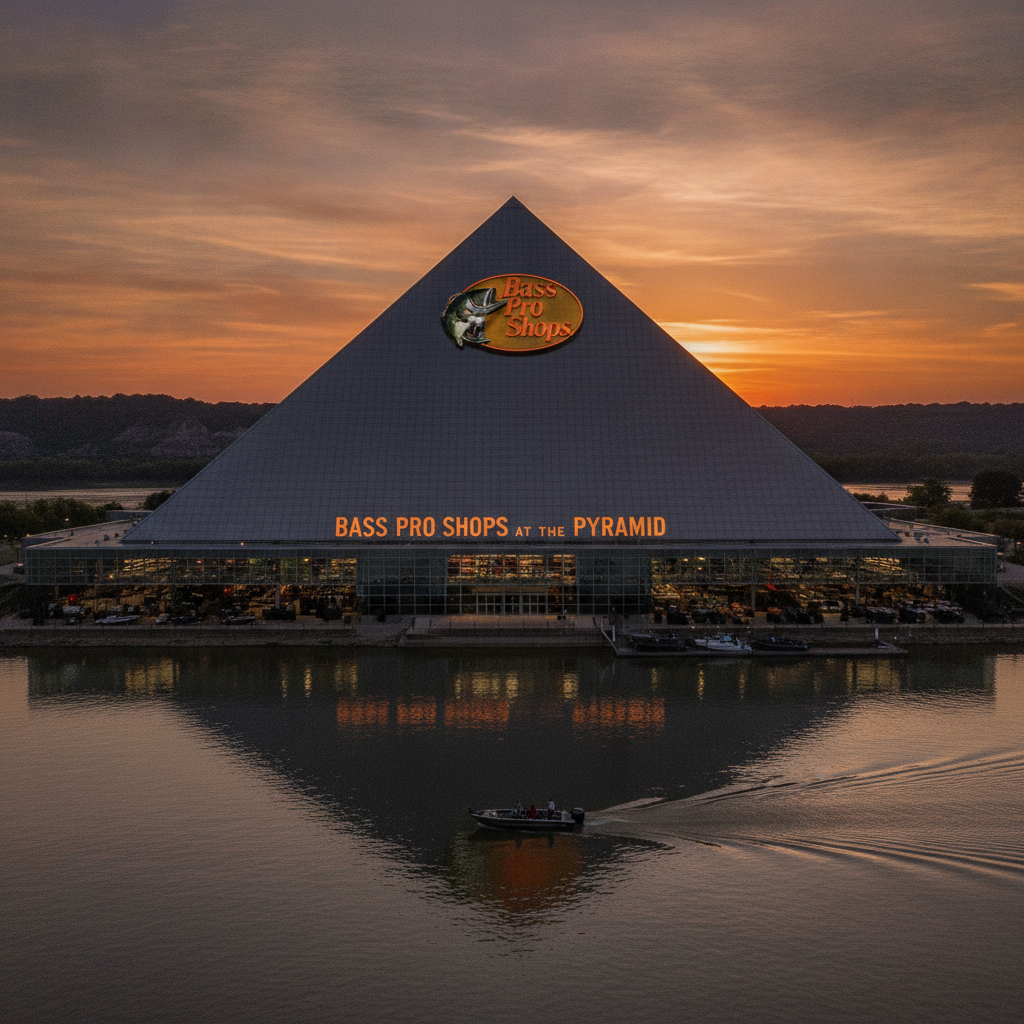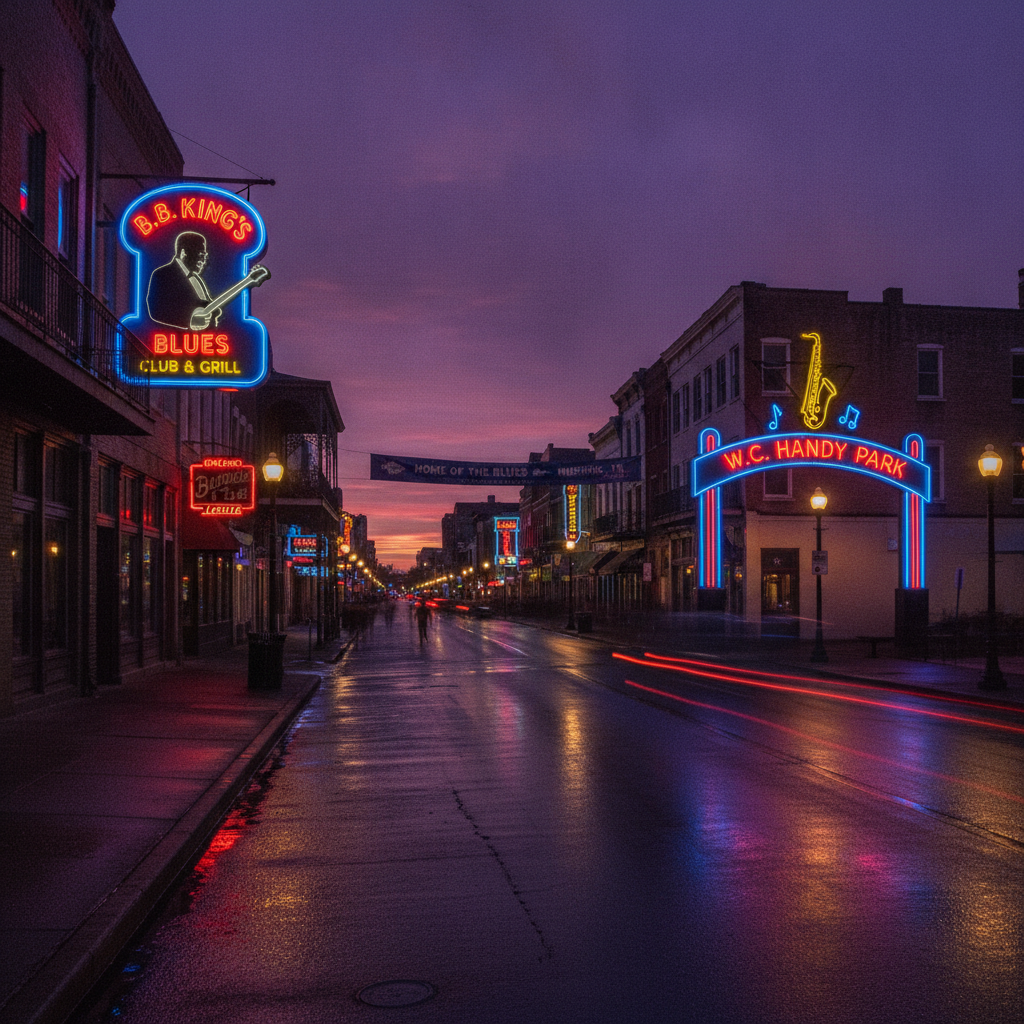
Memphis: Beale Street, Sun Studio, Stax Museum, National Civil Rights Museum, Graceland, and BBQ
Memphis overview: Beale Street blues music capital, Sun Studio birthplace of rock and roll (Elvis debut July 5 1954, Cash, Jerry Lee Lewis, Carl Perkins, Million Dollar Quartet December 4 1956), Stax Records soul music (Otis Redding, Isaac Hayes Theme from Shaft Oscar 1972, Booker T and the MGs), National Civil Rights Museum Lorraine Motel Martin Luther King Jr assassination April 4 1968 room 306 Memphis Sanitation Strike, Elvis Presley Graceland 650,000 visitors/year 1B records sold died August 16 1977 age 42, Memphis BBQ dry vs wet ribs Rendezvous 1948 Central BBQ Cozy Corner, Mississippi River Tom Lee Park Mud Island scale-model river replica, Memphis in May World Championship BBQ 220 teams 100,000 spectators.
- 1
Memphis - Blues, Beale Street, and the Birthplace of Rock and Roll
Memphis sits on the Chickasaw Bluff above the Mississippi River and has been called the most musically important city in the United States: more genres of American popular music — blues, rock and roll, soul, gospel, and rap — can be traced to Memphis than to any other single city. The geography: Memphis occupies a 15-km-wide bluff above the Mississippi River at the point where the river turns sharply westward, a site recognized by the Spanish explorer Hernando de Soto in 1541 as one of the few elevated and flood-free positions on the lower Mississippi. The city was founded in 1819 by three land speculators (Andrew Jackson, James Winchester, and John Overton) on land taken from the Chickasaw Nation by treaty in 1818 — making Memphis one of the latest-founded of the major Southern cities. Memphis music overview: the concentration of musical innovation in Memphis is explained by geography (the convergence of the Mississippi Delta, the Tennessee hill country, and the Arkansas lowlands within 150 km of the city), migration (the Great Migration brought African Americans from Mississippi, Alabama, and Arkansas to Memphis as a way station north, concentrating musical talent), and the distinctive black entertainment economy of Beale Street (which flourished from approximately 1890 to 1960 as one of the few places in the Jim Crow South where Black musicians could perform for Black audiences in their own establishments). Beale Street today: the 2-km stretch of Beale Street from Main Street to Fourth Street is now a tourist entertainment district, with live blues music nightly in the clubs (B.B. Kings, Blues City Cafe, Rum Boogie Cafe), restaurants, and souvenir shops, anchored by the historic Schwab's general store (at 163 Beale Street, established 1876, one of the oldest family businesses in Tennessee).
- 2
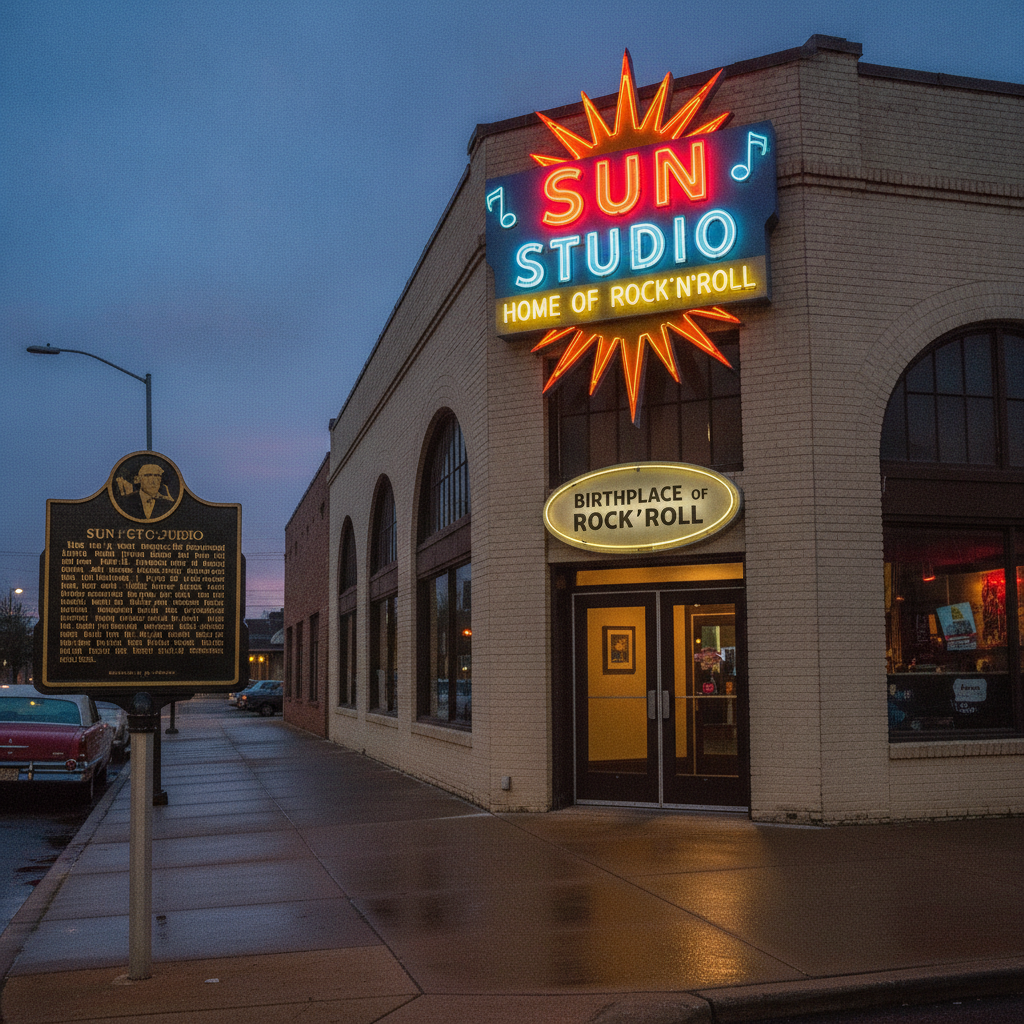
Sun Studio - Where Rock and Roll Was Born
Sun Studio (at 706 Union Avenue, Memphis): the most important recording studio in the history of popular music, founded by Sam Phillips in 1950 (as the Memphis Recording Service, renamed Sun Records in 1952), where the following recordings were made and changed the course of popular music: Elvis Presley's debut recording That is All Right Mama (recorded July 5, 1954 — a rockabilly treatment of the Arthur Crudup blues that is conventionally identified as the first rock and roll record), Johnny Cash's first Sun recording (Cry! Cry! Cry!, November 1955), Jerry Lee Lewis (Whole Lotta Shakin' Going On, 1957, Great Balls of Fire, 1957), Carl Perkins (Blue Suede Shoes, 1955), Roy Orbison (Ooby Dooby, 1956), and the Million Dollar Quartet (the informal December 4, 1956 session in which Elvis, Cash, Perkins, and Lewis happened to be in the studio simultaneously and jammed for two hours). Sam Phillips philosophy: Phillips's genius was recognizing that the African American musical tradition of the Mississippi Delta — blues, gospel, boogie-woogie — could be performed by white artists in a way that would be commercially acceptable to mainstream American radio and pop charts in the segregated 1950s. His phrase if I could find a white man who had the Negro sound and the Negro feel, I think I could make a billion dollars is the most quoted sentence in rock and roll history. The Sun Studio is still a working recording studio at night (U2, Ringo Starr, Bonnie Raitt, and dozens of other artists have recorded there since it was restored as a museum in 1987), and the building has been designated a National Historic Landmark.
- 3
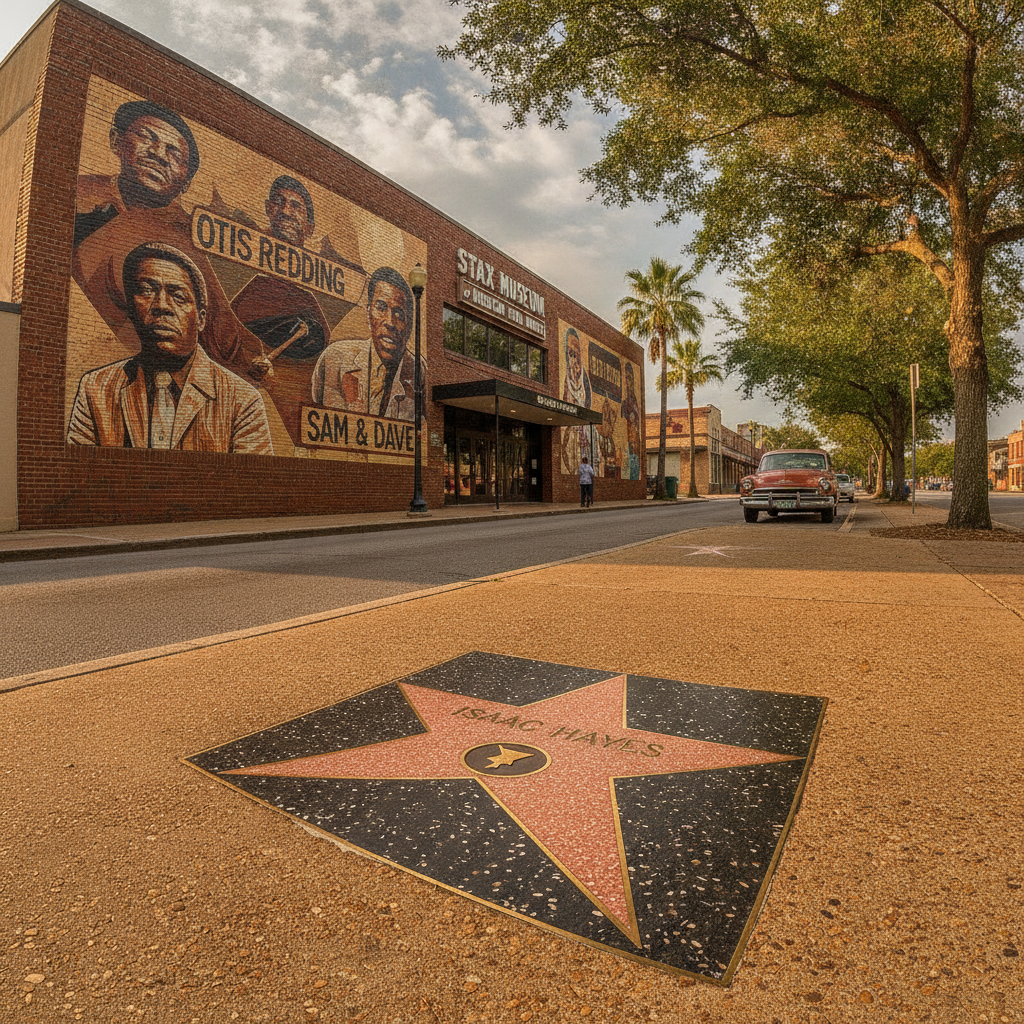
Stax Museum of American Soul Music
Stax Records (at 926 E McLemore Avenue, the Stax Museum of American Soul Music, South Memphis): the record label and recording studio that defined Memphis soul and Southern soul from 1957 to 1975, producing artists including Otis Redding (who recorded Dock of the Bay at Stax, dying on December 10, 1967, three days before its release), Sam and Dave (Hold On I'm Comin, Soul Man), Booker T. and the MGs (Green Onions, 1962), Isaac Hayes (Hot Buttered Soul, 1969, Theme from Shaft, Academy Award 1972 — the first Oscar for a Black composer for an original score), and The Staple Singers (I'll Take You There, 1972). The Stax sound: the distinctive Memphis soul sound of Stax (raw, gritty, gospel-influenced, with horns and rhythm section dominating over strings — in deliberate contrast to the polished Detroit sound of Motown) was created partly by accident, because the Stax studio was a converted movie theater (the Capitol Theater, built 1926) and the sloped floor of the theater created distinctive room acoustics that engineers could not replicate elsewhere. The Stax Museum: the original Stax building was demolished in 1989, but the Stax Museum was built on the same footprint in 2003 and contains the Isaac Hayes custom Cadillac El Dorado (with gold trim and mink-lined interior, used as a promotional vehicle), the original Stax mixing board, and the largest collection of soul music artifacts in the world. Soulsville USA: the surrounding South Memphis neighborhood (poverty rate approximately 45%, one of the most economically distressed urban areas in the United States) is the setting for the Stax Music Academy (providing music education to local youth) and ongoing gentrification debates about the relationship between music heritage tourism and neighborhood displacement.
- 4
Memphis and the Civil Rights Movement - National Civil Rights Museum
National Civil Rights Museum (at 450 Mulberry Street, at the former Lorraine Motel): the most important civil rights museum in the United States, built around and through the former Lorraine Motel, where Dr. Martin Luther King Jr. was assassinated by James Earl Ray on April 4, 1968, at 6:01 p.m. while standing on the second-floor balcony outside room 306. King's presence in Memphis: King came to Memphis in March-April 1968 to support the Memphis Sanitation Strike (the strike of 1,300 Black sanitation workers who walked off the job on February 12, 1968, protesting the deaths of two sanitation workers crushed by a malfunctioning garbage truck and the refusal of Mayor Henry Loeb to recognize their union), the most significant labor action in King's final years and the context in which he delivered the I Have Been to the Mountaintop speech on April 3, 1968 (the night before his assassination). The Lorraine Motel: the motel was a gathering place for Black entertainers and civil rights activists in the 1950s-1960s (Nat King Cole, Ray Charles, Otis Redding, Aretha Franklin all stayed there), and Room 306 (now preserved exactly as it was on April 4, 1968) is the most visited room in the American civil rights narrative. The museum expansion: the museum expanded in 2002 to include the boarding house across Mulberry Street where James Earl Ray fired the fatal shot, with exhibits on the FBI investigation, Ray's international flight, and the conspiracy theories (including the 1999 Memphis civil lawsuit in which a jury found that King was killed as a result of a conspiracy involving the Memphis police, the FBI, and organized crime — a verdict that has not been accepted by mainstream historians).
- 5
Elvis Presley and Graceland
Graceland (at 3734 Elvis Presley Boulevard, Whitehaven, 15 km south of downtown Memphis): the home of Elvis Presley from 1957 until his death on August 16, 1977, and the most visited private home in the United States after the White House (approximately 650,000 visitors per year). Elvis biographical facts: Elvis Aaron Presley was born January 8, 1935, in Tupelo, Mississippi (a two-room shotgun shack at 306 Elvis Presley Drive, now a museum), and moved to Memphis with his family in 1948 (to Lauderdale Courts, the public housing project at 252 N Lauderdale Street). He recorded his first single at Sun Studio in 1954 (see above), signed with RCA Victor in 1955 (in a deal brokered by Colonel Tom Parker for USD 35,000 — the largest sum ever paid for a recording contract in 1955), and became the most commercially successful solo artist in the history of recorded music, with over one billion records sold. Graceland: Elvis purchased Graceland in 1957 for USD 102,500 and lived there until his death (at age 42, from cardiac arrhythmia associated with prescription drug abuse — he had been prescribed 14,000 doses of prescription drugs in the 20 months before his death). The 13.4-acre estate includes the mansion (preserved essentially unchanged from 1977, with the famous green shag carpet and mirrored ceilings), the Jungle Room (Elvis's informal den with Polynesian-style carved furniture and a waterfall), the Trophy Building (containing his gold and platinum records, movie memorabilia, and stage costumes), and the Meditation Garden (where Elvis, his parents Gladys and Vernon, and his grandmother are buried). Graceland 2.0: the Guest House at Graceland (the luxury hotel opened 2016 adjacent to the estate) and the new Graceland entertainment complex (opened 2023) have made Graceland the anchor of a USD 90M entertainment district in formerly blighted Whitehaven.
- 6
Memphis BBQ, the Mississippi River, and Practical Guide
Memphis barbecue: Memphis is one of the four great American BBQ styles (with Kansas City, Texas, and the Carolinas), defined by slow-smoked pork ribs and pulled pork shoulder, with the choice between dry (rubbed with spice blend only, no sauce) and wet (basted with thin tomato-vinegar sauce). The canonical Memphis BBQ restaurants: Rendezvous (at 52 S Second Street, in the alley beside the Peabody Hotel, founded 1948 by Charlie Vergos, serving charcoal-broiled dry ribs in a basement dining room covered in beer signs and Greek family memorabilia), Central BBQ (at multiple locations, the most popular chain in Memphis with slow-smoked ribs, pulled pork, and smoked chicken), and The Cozy Corner (at 745 N Parkway, Old Daisy neighborhood, founded 1977 by Raymond Robinson Sr., the most acclaimed small restaurant in Memphis BBQ, with the barbecued Cornish hens being the most discussed single dish). World Championship Barbecue Cooking Contest (held annually in May at Tom Lee Park on the Mississippi River, part of Memphis in May International Festival): the world's largest BBQ competition, with approximately 220 competing teams and 100,000 spectators. The Mississippi River: Memphis sits above the widest and most dramatic stretch of the lower Mississippi River, with Tom Lee Park (the 30-acre riverfront park) and Mud Island River Park (the 18-hectare peninsula in the river with a scale-model replica of the entire lower Mississippi River from Cairo, Illinois to the Gulf of Mexico). Practical guide: Memphis International Airport (MEM) serves approximately 4M passengers/year; the downtown area is compact and walkable (5 km from Beale Street to Graceland). Best season: April-May (Memphis in May festival, moderate temperatures).
Walk this route with audio
Stories play automatically as you reach each stop — no tapping needed.
More in memphis
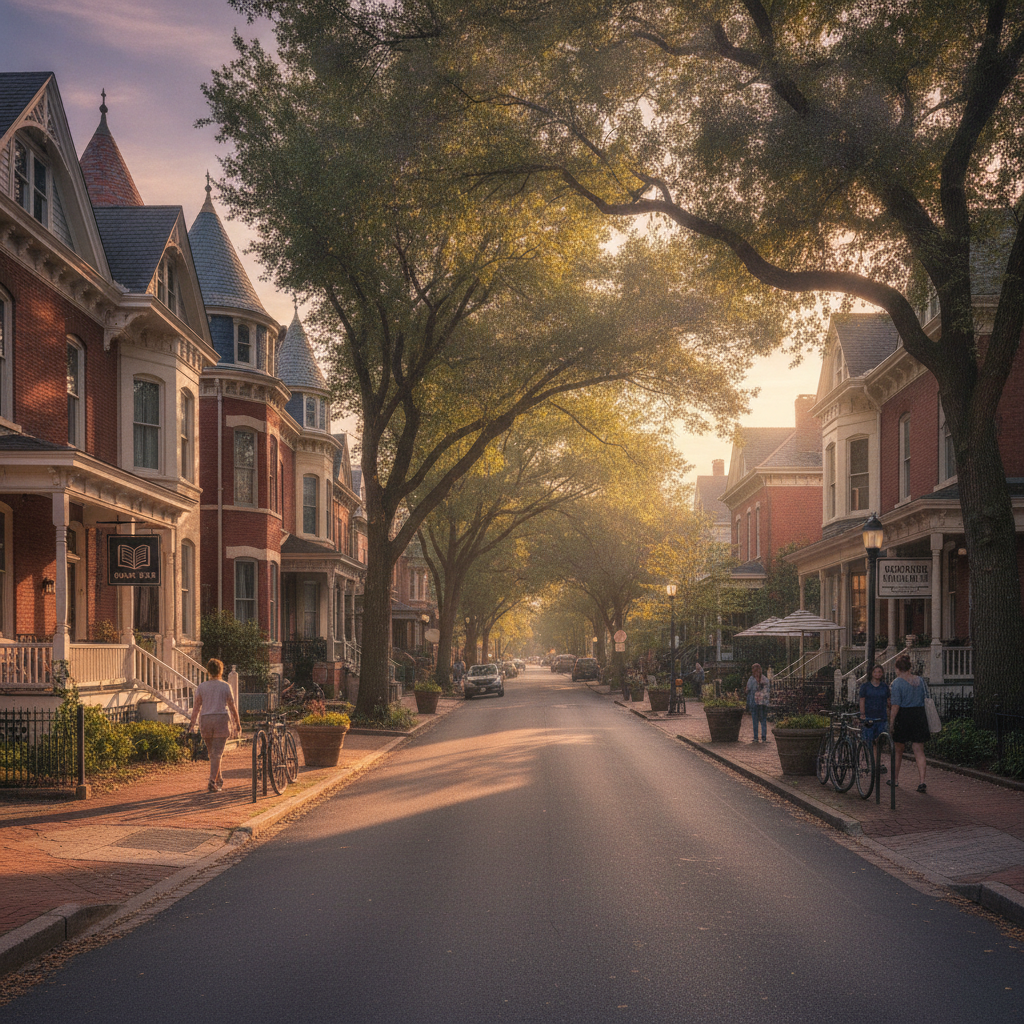
Memphis R3: Sanitation Strike (February 12 1968 65 days, Cole and Walker crushed in truck February 1, I Am a Man signs, King Mountaintop speech April 3 1968, Loeb capitulated April 16 after assassination), Rockabilly (Cash born 1932 died 2003, Jerry Lee Lewis died October 28 2022 last Sun Records survivor, Perkins Carl died 1998, Al Green pastor Full Gospel Tabernacle 1976 hot grits incident 1974), Soul food (Four Way Restaurant 1946 South Memphis MLK Civil Rights musicians, Gus Fried Chicken 1953 Napoleon Vanderbilt, Cozy Corner Raymond Robinson 1977), Neighborhoods (Midtown Cooper-Young Novel bookstore Cooper-Young Festival 110,000 September, Overton Park v Volpe 1971 Supreme Court landmark urban park protection, Orange Mound 1890 oldest Black-developed US neighborhood 45% poverty), Shelby Farms (1800 acres 3x Central Park 50km trails 30 bison, Greenline 10.65km rail-to-trail, Mississippi River Trail 3000km cycling headwaters Minnesota to Gulf), Architecture (Pink Palace Piggly Wiggly Saunders 1916 self-service grocery inventor went bankrupt 1923, Memphis Brooks Museum 9000 works 5000 years, Memphis Zoo panda Ya Ya repatriated April 2023, Autozone Park Triple-A Cardinals).
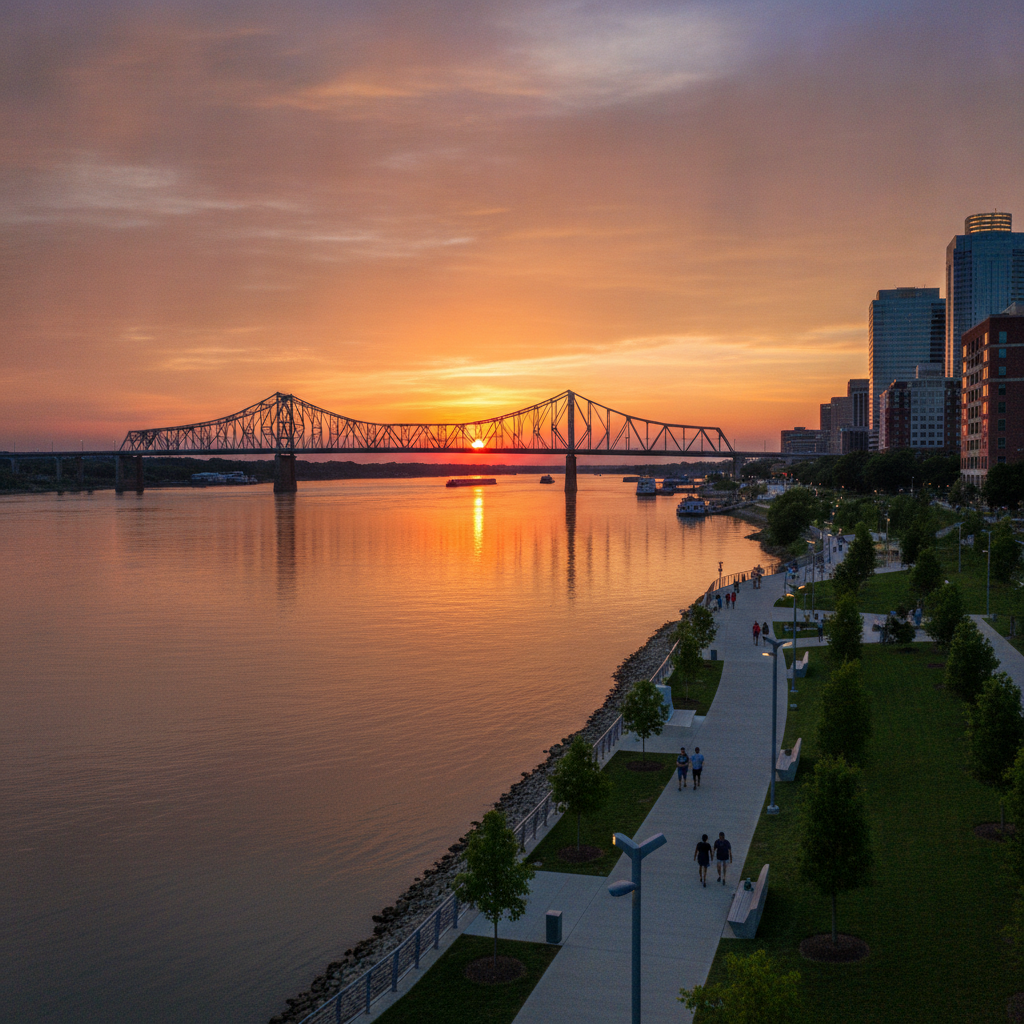
Memphis: Creative Districts, River Festivals and Living Music
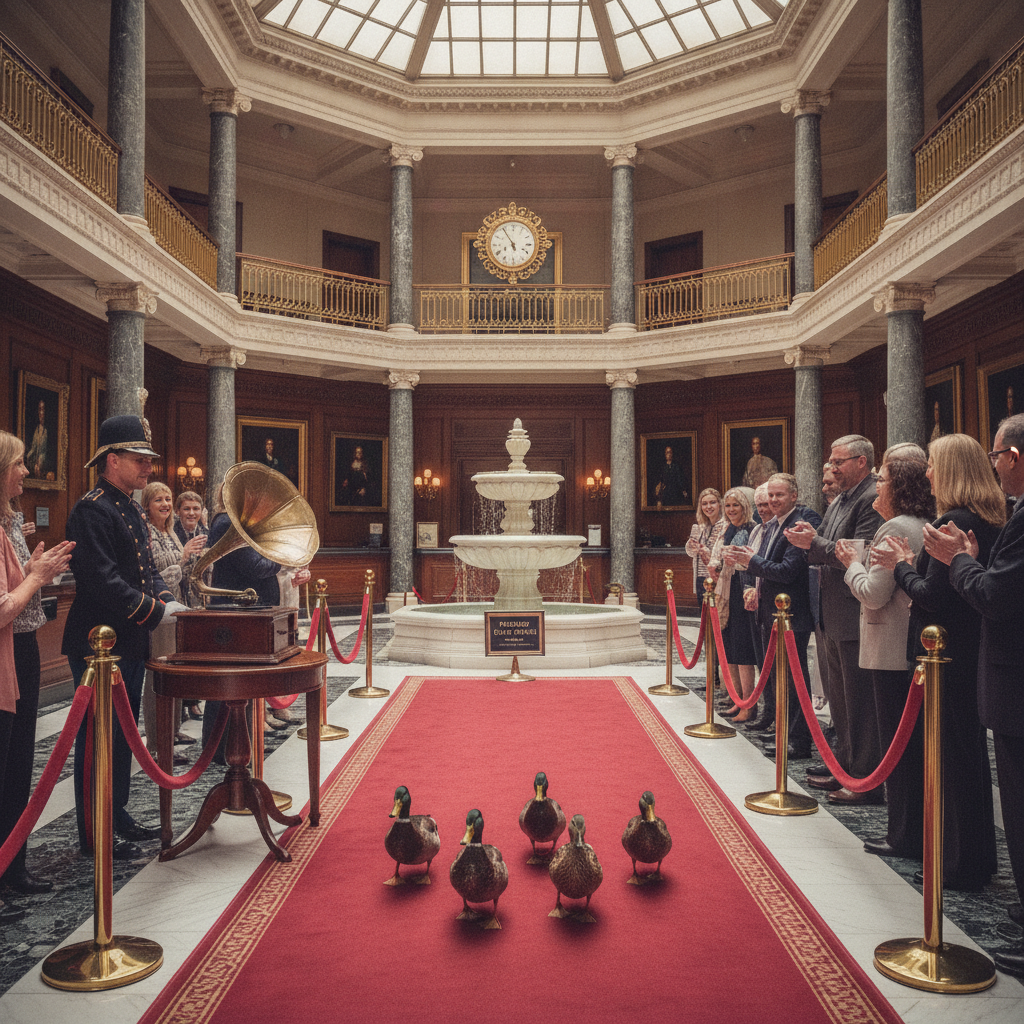
Memphis R4: Yellow fever epidemics (1873 1878 1879, 5000 dead 1878, population 40,000 to 14,000, municipal charter revoked 1879 operating as taxing district until 1893, Sisters St Mary Episcopal nursed dying, George Waring Memphis Sewer System 1880-1890 first modern US sanitary sewer), Cotton Exchange (84 Union Avenue, 2.2M bales/year 1920s-1930s, cotton compression 40% volume reduction, FedEx founded 1971 Frederick Smith MEM 4th busiest cargo world), Literature and film (Faulkner Oxford 100km south Memphis symbol of urban corruption in Sanctuary Sound and Fury, Guralnick Last Train to Memphis 1994 Careless Love 1999 finest rock biography, Hustle and Flow 2005 Craig Brewer Three 6 Mafia Oscar), African American history (Ida B Wells Memphis Free Speech 1889-1892 anti-lynching journalism exiled after mob destroyed office 1892 Pulitzer Prize 2020 posthumous, Robert Church Sr 1839 first Black millionaire South yellow fever real estate, Church Park 1899 first safe Black public gathering), Music economy (Beale Street USD 150M tourist economy cover bands, Soulsville Charter School 300 students South Memphis, Royal Studios 1320 Soul Avenue Willie Mitchell Al Green Hi Records, GloRilla born 2000 Memphis 2022 national attention, Julien Baker born 1995), Practical (MEM 4M passengers FedEx hub 4th cargo world, Peabody Hotel USD 300-450, April-May Memphis in May best season, 38C summer humidity).
Memphis: River Science, Rock and Roll Origins and Medical Miracles
Memphis: Soul Music, Civil Rights and the Taste of the South