Vizcaya, Coconut Grove & Miami's Historic Soul
Vizcaya Museum and Gardens (the 1916 Italian Renaissance estate on Biscayne Bay in the Coconut Grove neighbourhood of Miami — the finest Gilded Age estate in the American South and the finest Italian formal garden in the United States) and the surrounding Coconut Grove neighbourhood (the oldest continuously inhabited neighbourhood in Miami and the historic centre of Miami's arts and bohemian culture) offer the most historically and culturally layered experience in the city.
- 1
Vizcaya Museum & Gardens — The Italian Renaissance on Biscayne Bay
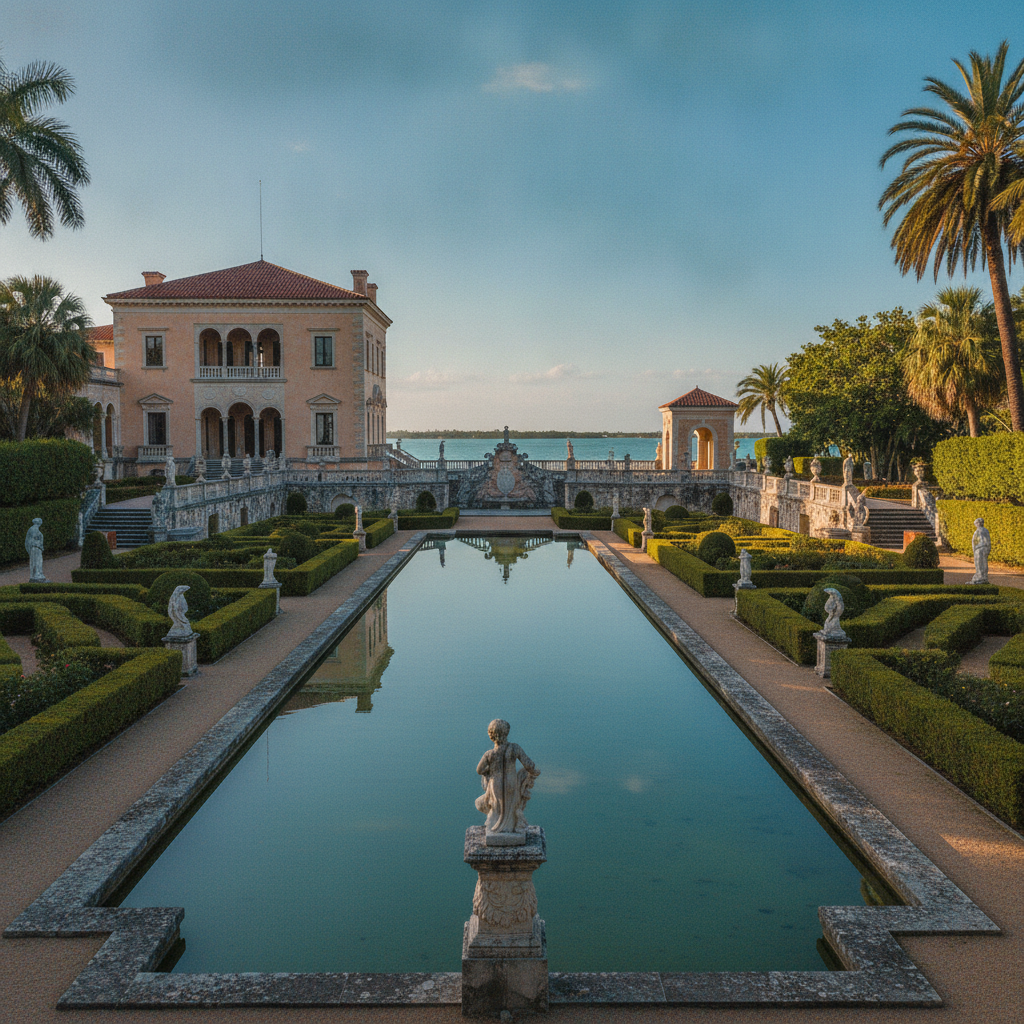
Vizcaya Museum and Gardens (3251 South Miami Avenue, in the Coconut Grove neighbourhood of Miami — the 28-acre (11-hectare) estate consisting of the 1916 Italian Renaissance Revival Villa Vizcaya and the formal Italian gardens surrounding it, on the western shore of Biscayne Bay): the estate was built between 1914 and 1923 for James Deering (1859-1925), the vice president and heir of International Harvester (the agricultural machinery company founded by his father William Deering that became one of the largest industrial companies in the United States — the source of the Deering family fortune), at a total cost of approximately $15 million (approximately $220 million in 2024 dollars); the Villa (the 34-room palazzo designed by the architect F. Burrall Hoffman Jr. in collaboration with the designer Paul Chalfin, built of locally quarried Miami oolite limestone and Dade County pine) is the finest surviving example of Italian Renaissance Revival domestic architecture in the United States south of New York; the formal gardens (the 10 acres of elaborate Italian Renaissance garden rooms designed by Diego Suarez (the Colombian-born landscape architect trained in Florence who created a series of terraced garden rooms in the Italian Renaissance style — the Secret Garden, the Casino Garden, the Theatre Garden, the Fountain Garden, the Mount — each with its distinctive planting, fountain, and stone sculpture)) are the finest Italian formal gardens in the United States.
- 2
The Stone Barge & Biscayne Bay Views
The stone barge (the decorative breakwater in front of the east (bay) facade of Villa Vizcaya, built in the form of a stylized Baroque barge with figureheads, carved stone decorations, and a central elevated pavilion — the most distinctive and photogenic architectural feature of Vizcaya, and the symbol most associated with the property in the popular imagination): the barge (designed by Paul Chalfin and built from Miami oolite limestone in 1916, the same material as the villa itself — the massive stone structure serves as both a decorative folly in the tradition of Italian Renaissance garden design (the Isola Bella on Lake Maggiore in Italy is the closest precedent) and a functional breakwater protecting the villa's bay-facing loggia from wave action) is visible from both the villa's bay-facing terrace and from Biscayne Bay itself; the views from the villa's east terrace and the stone barge across Biscayne Bay (the unobstructed view across the bay to the Miami Beach and Brickell skyline) are among the finest bay views in Miami; the Biscayne Bay shoreline in front of Vizcaya is also one of the few locations in Miami where the original mangrove shoreline vegetation (Rhizophora mangle — the red mangrove, the primary mangrove species of the Florida coastline, characterised by its distinctive prop root system that extends from the trunk down into the tidal water) has been preserved.
- 3
Coconut Grove Village — Miami's Bohemian Heart
Coconut Grove village (the walkable commercial district of the Coconut Grove neighbourhood, centred on the intersection of Main Highway and Grand Avenue — the most charming and human-scale urban environment in Miami): the Grove (as residents call Coconut Grove) is the neighbourhood in Miami that most resembles a traditional small town or European village — the characteristic features being the mature banyan tree canopy (the massive Ficus benghalensis trees whose aerial prop roots create cathedral-like interior spaces and whose canopies span entire blocks, making Coconut Grove the shadiest and most pleasant neighbourhood for walking in Miami), the mix of independent restaurants, coffee shops, bookshops, and galleries (in contrast to the chain-dominated retail of most Miami neighbourhoods), and the Victorian and Mediterranean Revival architecture of the residential streets (the 1880s-1920s houses that give Coconut Grove its historic character); the CocoWalk (the open-air shopping and entertainment complex at 3015 Grand Avenue, the heart of the commercial Grove) and the Coconut Grove Playhouse (the historic 1927 Mediterranean Revival theatre — the most important theatre in Miami history, the venue for the American premiere of Samuel Beckett's 'Waiting for Godot' in 1956 (in the production directed by Alan Schneider, with Bert Lahr and E.G. Marshall — the first major theatrical event in Miami history), currently undergoing restoration) are the main commercial and cultural landmarks.
- 4
Coral Gables — The Planned Mediterranean City
Coral Gables (the City Beautiful-era planned city immediately south and west of Miami, developed from 1921 by the developer and visionary George Merrick (1886-1942) in a unified Mediterranean Revival architectural style — the most complete and best-preserved example of American City Beautiful planning and Mediterranean Revival architecture in the United States): Coral Gables (the 'City Beautiful' — Merrick's marketing name for the planned city he developed on his family's citrus grove estate south of Miami) was conceived as a complete, self-contained city with a unified architectural vision: all buildings were required to be built in the Mediterranean Revival or Spanish Colonial Revival style (the distinctive Coral Gables look of cream-coloured stucco walls, red barrel-tile roofs, arched colonnades, and decorative wrought-iron work derived from Spanish, Italian, and Moorish architectural traditions), the streets were given Spanish names and lined with consistent plantings (the coral rock entrance gates, the 'Coral Gables Entrance Walls' (the monumental coral rock gateways at the main entrances to the city) were the grandest suburban entrance monuments in the United States): the Biltmore Hotel Coral Gables (the 1926 Italian Renaissance Revival grand hotel at 1200 Anastasia Avenue — the tallest building in Florida when built, modelled on the Giralda Tower in Seville, Spain, and the most architecturally significant hotel in Florida), the Venetian Pool (the 1923 public swimming pool carved from a coral rock quarry, designed in the Mediterranean Revival style with caves, waterfalls, and a sandy beach — the most beautiful public pool in the United States), and the Miracle Mile (the commercial main street of Coral Gables) are the principal landmarks.
- 5
Matheson Hammock Park & Miami's Natural Shoreline
Matheson Hammock Park (the 630-acre (255-hectare) county park in the Coral Gables/South Miami area on Biscayne Bay, at 9610 Old Cutler Road — the largest park in Miami-Dade County and the finest natural shoreline park in the metropolitan area): the park (donated to Miami-Dade County in 1930 by the industrialist and naturalist William J. Matheson) features the atoll pool (the man-made tidal pool connected to Biscayne Bay through a channel, allowing tidal water to flow in and out and maintaining a natural coastal marine environment within the protected pool — one of the most distinctive and enjoyable swimming environments in Miami), the mangrove shoreline (the extensive red and white mangrove forest along the Biscayne Bay shoreline of the park — one of the largest remaining urban mangrove areas in Miami-Dade County), the hardwood hammock (the dense subtropical forest interior of the park — the Matheson Hammock itself, one of the finest remaining examples of the Miami-Dade hardwood hammock (the subtropical forest community of live oak, gumbo limbo, strangler fig, and coonti palm that once covered the elevated ground of Miami-Dade County but has been reduced to small remnants by development)), and Biscayne Bay access (the marina and boat ramp, the kayak and paddleboard launches, and the bay views from the park shoreline).
- 6
Old Cutler Road & Miami's Canopy Drive
Old Cutler Road (the historic scenic road running south from Coconut Grove through Coral Gables and Palmetto Bay to Cutler Bay — the most beautiful drive in the Miami metropolitan area and one of the finest urban canopy drives in the United States): Old Cutler Road (the road built in 1897 as the first improved road in the area south of Miami (then called Coconut Grove), following the natural ridge of limestone that runs parallel to Biscayne Bay through what is now Coral Gables and South Miami) is famous above all for the magnificent banyan tree canopy (the rows of mature Ficus benghalensis trees (planted in the 1920s-1940s) whose massive prop-root systems and interlocking canopies create a cathedral-like tunnel of shade over the road for several kilometres, the finest example of a road-canopy tree tunnel in the continental United States outside of the live oak avenues of the Mississippi Delta and the Pacific Northwest): the combination of the banyan canopy (the dappled light filtering through the interlocking branches above the road), the glimpses of Biscayne Bay through the adjacent Matheson Hammock Park and Silver Bluff shoreline properties, and the historic residential character of the corridor (the large-lot Mediterranean Revival and mid-century modern estates along the road) makes Old Cutler Road the most scenically beautiful urban drive in South Florida.
Walk this route with audio
Stories play automatically as you reach each stop — no tapping needed.
More in miami

Everglades & Biscayne National Park — The Wilderness at Miami's Door
Florida Keys & Key West — The End of the Road and the Reef
Miami's Global Table — Cuban, Haitian, Venezuelan & Caribbean Cuisine
Brickell, Downtown & Miami's Soaring Financial District
South Beach, Art Deco & Ocean Drive — The Icon of Miami