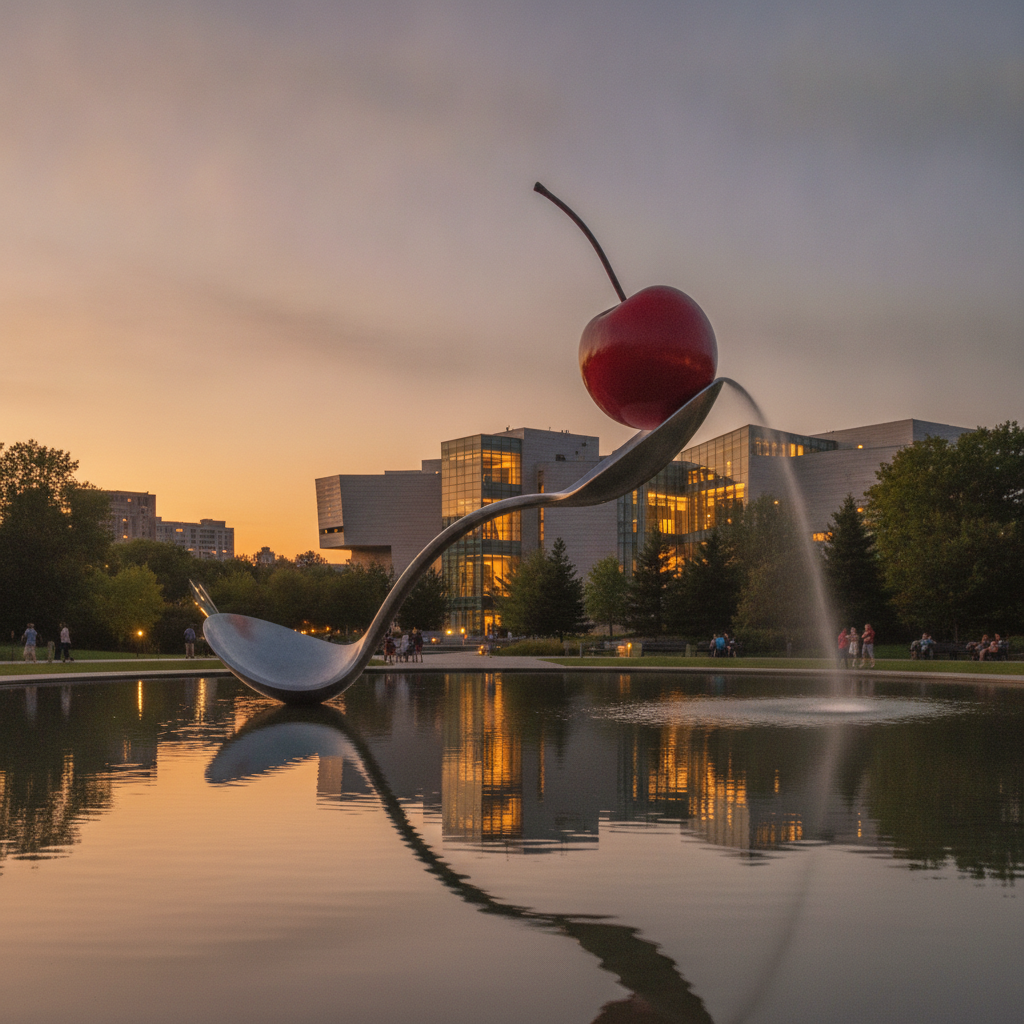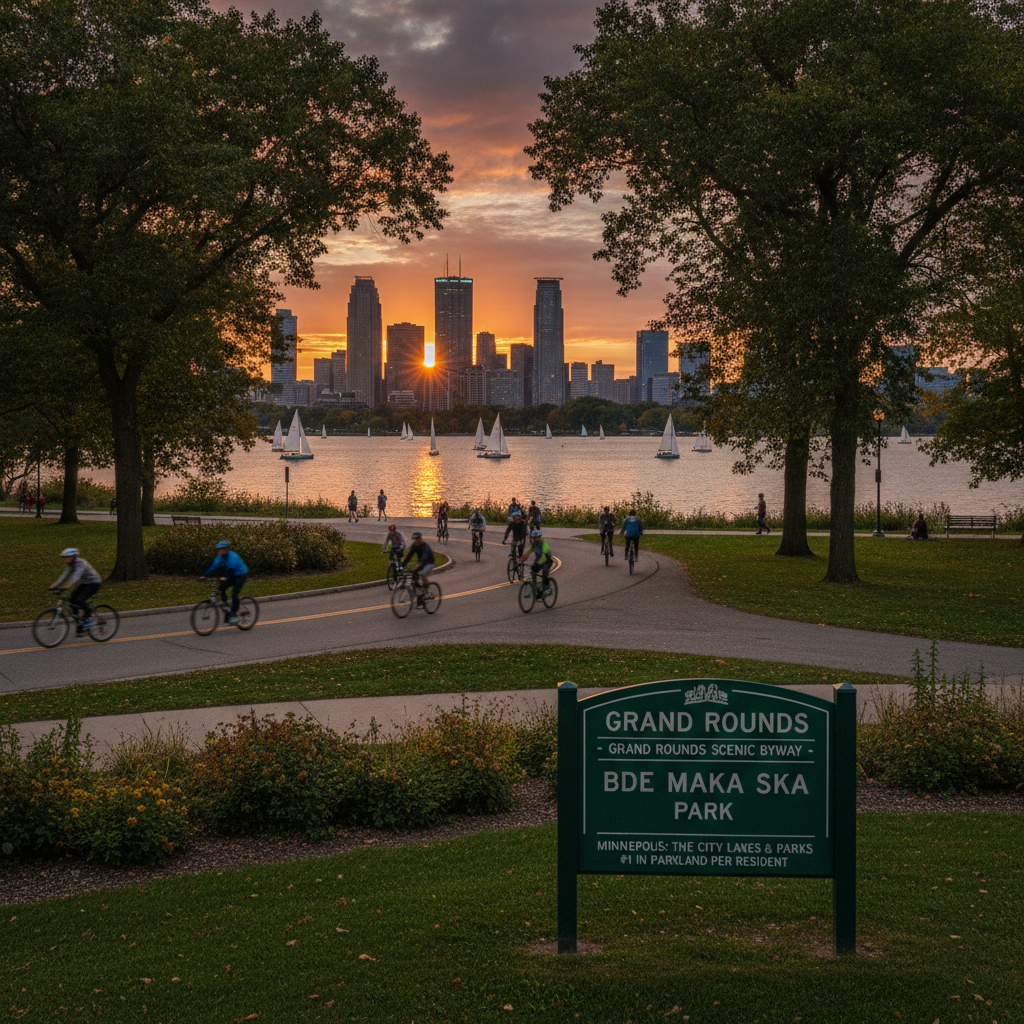
Minneapolis R3: Target Field and Twins (1987 and 1991 World Series champions, 1991 Greatest World Series ever, Kirby Puckett walk-off Game 6), Minneapolis literary scene (Graywolf Press, Milkweed Editions, Sinclair Lewis first American Nobel Literature, F. Scott Fitzgerald Saint Paul Summit Avenue), brewing culture (Surly Bill 2011 changed Minnesota law, Grain Belt Nordeast revival, North Loop warehouse district), Uptown and lakes (Bde Maka Ska renaming controversy, Lake Harriet Bandshell, chain of lakes 53km cycling), Vikings and US Bank Stadium (4 Super Bowls 0 wins, Minneapolis Miracle 2018 Diggs, Minnesota Lynx 4 WNBA titles), Grand Rounds cycling (best US bike city, 87km parkway loop, Midtown Greenway 5,000 daily cyclists, year-round winter cycling)
Minneapolis sports and culture: Target Field and Twins (1987 and 1991 World Series, 1991 greatest WS 5 one-run walk-off games, Kirby Puckett Hall of Fame), literary scene (Graywolf Press Milkweed Editions, Sinclair Lewis first American Nobel Literature 1930, F. Scott Fitzgerald Great Gatsby Saint Paul), brewing (Surly Bill 2011 legalized taprooms triggering 200 new breweries, Grain Belt Nordeast 1893 brand revival, North Loop warehouse district), Uptown and lakes (Bde Maka Ska 2020 renaming from Calhoun, 53km chain of lakes cycling, Lake Harriet Bandshell free summer concerts), Vikings and US Bank Stadium (4 Super Bowls 0 titles, Minneapolis Miracle January 14 2018 Keenum-to-Diggs, Minnesota Lynx 4 WNBA championships most successful franchise), Grand Rounds cycling (best or 2nd best US bike city, 87km Grand Rounds loop, Midtown Greenway 5,000 daily cyclists, year-round winter cycling culture studded tires).
- 1
Target Field and Minnesota Twins Baseball
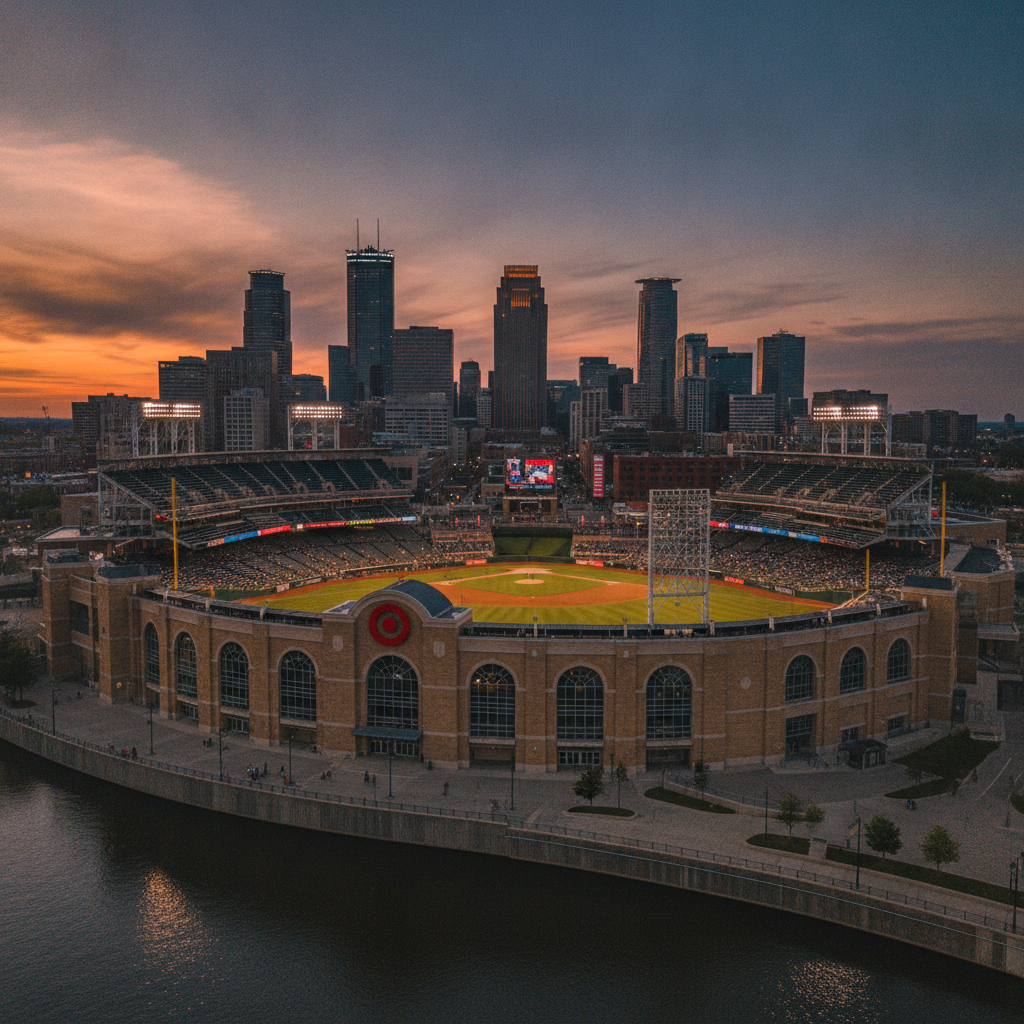
Target Field (at 353 North 5th Street, North Loop neighborhood, Minneapolis): the open-air baseball stadium of the Minnesota Twins, opened April 12, 2010, replacing the Hubert H. Humphrey Metrodome (where the Twins played from 1982 to 2009). Target Field design and context: designed by Populous (the architectural firm specializing in sports venues), Target Field is built into the urban fabric of downtown Minneapolis, with the left field line running along the light rail Green Line corridor, creating one of the most transit-accessible ballparks in the United States (the nearest light rail station is Target Field Station, 30 meters from the main entrance). The stadium is notable for its use of local Minnesota limestone on the exterior facade, the open views of the Minneapolis skyline from the upper deck, and the Minnie and Paul sign (the vintage scoreboard graphic of the two figures shaking hands across the Mississippi River, recreating the original Metropolitan Stadium neon sign). Twins history: the Minnesota Twins began as the Washington Senators (the original franchise, one of the American League's founding 8 teams in 1901), relocated to Minnesota in 1961. The Twins' two World Series championships: 1987 (beating the St. Louis Cardinals in 7 games, with the Metrodome home crowd noise reaching 118 decibels, measured as the loudest indoor crowd noise in history at the time) and 1991 (beating the Atlanta Braves in 7 games, with 5 of the 7 games decided by one run in the final at-bat, considered by many baseball historians the greatest World Series ever played). Kirby Puckett (the Twins' most beloved player, 1984-1995, Baseball Hall of Fame 2001): his walk-off home run in Game 6 of the 1991 World Series is one of the most celebrated moments in Minnesota sports history.
- 2
Midwest Literary Scene and the Written Word
Minneapolis-Saint Paul literary scene: the Twin Cities have one of the most vibrant literary cultures of any American metropolitan area, consistently ranking among the top cities for bookstores per capita and library usage. Minneapolis is home to the Loft Literary Center (the largest independent literary center in the United States), the Rain Taxi Review of Books (one of the most respected independent literary review publications in the country), and Milkweed Editions (one of the most important independent literary publishers in the United States, specializing in literature on the natural world). Graywolf Press (at 250 Third Avenue North, Minneapolis): one of the most important independent literary publishers in the United States, founded 1974, specializing in multicultural and international literature; it has published the works of Carolyn Forche, Tomas Transtromer, and many other major contemporary poets and novelists. The bookstore culture: Magers and Quinn Booksellers (at 3038 Hennepin Avenue S, Uptown Minneapolis): the most beloved independent bookstore in Minneapolis, with over 100,000 titles in stock. The Midwest Writers Workshop and Minnesota connections: Sinclair Lewis (born Sauk Centre, Minnesota, 1885): the first American to win the Nobel Prize in Literature (1930), author of Main Street (1920, satirizing the provincial small-mindedness of the American Midwest), Babbitt (1922), and Elmer Gantry (1927). F. Scott Fitzgerald (born Saint Paul, 1896): author of The Great Gatsby (1925), widely considered the greatest American novel of the 20th century; Fitzgerald set the early sections of his novels in the Saint Paul neighborhood of Summit Avenue where he grew up.
- 3
Minneapolis Brewing Culture and the North Loop
Minneapolis craft beer and brewing culture: Minnesota has a long history of brewing (the state was home to dozens of regional breweries before Prohibition, including the Hamm Brewery in Saint Paul and the Grain Belt brewery in Minneapolis), and the craft beer revival since the 2010s has made Minneapolis one of the top craft beer destinations in the Midwest. Surly Brewing Co. (at 520 Malcolm Avenue SE, Minneapolis, founded 2005 in Brooklyn Center by Omar Ansari): the brewery that single-handedly changed Minnesota law — Surly lobbied successfully for the Surly Bill (the 2011 amendment to Minnesota law allowing breweries to sell beer on-site for consumption), which transformed the Minnesota craft beer industry and led to the opening of over 200 new breweries in the state. Surly Destination Brewery: the 2014 destination brewery facility (50,000 square feet on 5 acres, with a beer hall, a restaurant, a beer garden, and a private event space) was one of the most ambitious craft brewery facilities in the United States at the time of opening. Grain Belt Brewing (the historic Minneapolis brewery, founded 1893, closed 1975, revived 2014 at the original Grain Belt Nordeast building at 79 13th Avenue NE, Northeast Minneapolis): the revival of the most iconic Minnesota beer brand. The North Loop neighborhood (the warehouse district north of Target Field): the most rapidly gentrifying neighborhood in Minneapolis, with dozens of restaurants, boutiques, and the weekend Farmer's Market, housed in repurposed 1890s warehouse buildings. Northeast Minneapolis (Nordeast): the traditional working-class Bohemian and Polish and Ukrainian immigrant neighborhood, now the art gallery and studio district of Minneapolis.
- 4
Uptown Minneapolis and the Lakes District
Uptown Minneapolis (the Lyn-Lake and Uptown neighborhoods, centered on the intersection of Hennepin Avenue and Lake Street, approximately 3 km south of downtown): the most vibrant and progressive neighborhood in Minneapolis, known for its independent restaurants, clothing boutiques, vintage stores, and progressive political culture. The Uptown film scene: the Uptown Theater (at 2906 Hennepin Avenue S): the historic 1939 neighborhood movie house, the last single-screen neighborhood theater in Minneapolis, showing independent and art house films. The Lagoon Theater (at 1320 Lagoon Avenue): an arthouse 5-screen cinema adjacent to Calhoun Square shopping. Lake Calhoun-Bde Maka Ska: the largest lake within the Minneapolis city limits (165 acres), renamed in 2020 from Lake Calhoun (which honored John C. Calhoun, the US Vice President and Senator who was an ardent defender of slavery) to Bde Maka Ska, the original Dakota name meaning White Bank Lake, in one of the most significant public renaming controversies in Minneapolis history. The lakes parkway system: the chain of lakes in south Minneapolis (Bde Maka Ska, Lake Harriet, Lake of the Isles, Cedar Lake) connected by the Grand Rounds National Scenic Byway, with 53 km of paved bicycle and pedestrian paths, 34 km of unpaved trails, 35 picnic areas, 11 swimming beaches, and 4 sailing marinas, forming the most comprehensive urban lakes recreational system in the United States. Lake Harriet Bandshell (the open-air amphitheater on the south shore of Lake Harriet): the most beloved outdoor entertainment venue in Minneapolis, with free summer concerts every weekend from Memorial Day to Labor Day.
- 5
Minnesota Vikings and the US Bank Stadium
The Minnesota Vikings (founded 1961, member of the NFC North division of the National Football League, home games at US Bank Stadium in downtown Minneapolis): one of the most consistently competitive but historically heartbreaking NFL franchises, with 4 Super Bowl appearances (after the 1969, 1973, 1974, and 1976 seasons) and 0 championships — tied with the Buffalo Bills for the most Super Bowl appearances without a win. US Bank Stadium (at 401 Chicago Avenue, Minneapolis): the Vikings home since 2016, a 66,655-seat stadium with a fixed ETFE semi-transparent roof (the same material used in the Beijing National Aquatics Center for the 2008 Olympics), designed by HKS Inc. The stadium hosted Super Bowl LII (February 4, 2018: Philadelphia Eagles 41, New England Patriots 33, the Super Bowl played in the home stadium of an NFC team for the first time in history) and the NCAA Men's Basketball Final Four (2019). The Minneapolis Miracle (January 14, 2018, NFC Divisional Playoff): the 61-yard last-second touchdown pass from Case Keenum to Stefon Diggs (with 0 seconds remaining in the game, Diggs caught the pass and ran untouched into the end zone as the Saints safety made no attempt to tackle him, one of the most dramatic plays in NFL history): the Vikings defeated the New Orleans Saints 29-24 to advance to the NFC Championship Game (where they lost to the Philadelphia Eagles 38-7). Minnesota Lynx WNBA: the most successful WNBA franchise in history with 4 championships (2011, 2013, 2015, 2017), built around Maya Moore, Seimone Augustus, Sylvia Fowles, and Lindsay Whalen (born in Hutchinson, Minnesota).
- 6
Grand Rounds, Cycling Culture, and Minneapolis as Bike City
Minneapolis as the best cycling city in the United States: Minneapolis consistently ranks as the top or second-top cycling city in the United States (alongside Portland, Oregon), with 217 km of on-street bicycle lanes, 116 km of off-street trails, and a culture of year-round cycling that persists even through the harshest Minnesota winters. The Nice Ride Minneapolis bike share system (launched 2010 as one of the first bike share systems in the United States): the system has expanded to e-bikes and merged with the Lyft system, with over 300 stations across Minneapolis and Saint Paul. The Grand Rounds National Scenic Byway (the 87-km parkway loop encircling the city of Minneapolis, connecting the chain of lakes to the Mississippi River gorge to the Minnehaha Creek corridor to the north Minneapolis parks): the most comprehensive urban cycling route in the United States, usable as a single-day cycling tour (5-6 hours at a leisurely pace) or as multiple shorter segments. The Cedar Lake Trail, Midtown Greenway, and trail network: the Midtown Greenway (the below-grade rail corridor converted to a 13-km bicycle highway through south Minneapolis, connecting the Chain of Lakes to the Mississippi River): the most heavily used bicycle corridor in the Midwest, with over 5,000 daily cyclists during peak season. Winter cycling culture: Minneapolis has a significant population of year-round cyclists who ride through snow and -20 degree temperatures, facilitated by the city's investment in winter trail maintenance (plowing bicycle paths within 24 hours of snowfall), studded snow tires, and a cultural ethos of outdoor activity regardless of weather.
Walk this route with audio
Stories play automatically as you reach each stop — no tapping needed.
More in minneapolis
Minneapolis: Cuba-Touring Orchestra, Indigenous James Beard Winner and 150 Miles of Lake Superior Cliffs
Minneapolis: Mississippi River national park and 22 city lakes (best urban park system US, Grand Rounds 87km loop, Bde Maka Ska), Prince and Paisley Park (Purple Rain 1984, First Avenue nightclub, 100M records, Paisley Park museum), Mall of America (largest US mall, 40M visitors, Nickelodeon Universe, Walker Art Center Spoonbridge and Cherry, Guthrie Theater Jean Nouvel), Twin Cities food and diversity (Somali diaspora largest US 70,000-100,000, Hmong Village Saint Paul, Juicy Lucy invention, Minnesota State Fair 2M visitors), George Floyd Square (May 25 2020, Darnella Frazier, largest US protest movement 15-26M people, Chauvin convicted 2021), Practical (skyway system 13km longest world, Vikings 4 Super Bowls 0 wins, MSP airport Delta hub, Metro Blue Line airport rail)
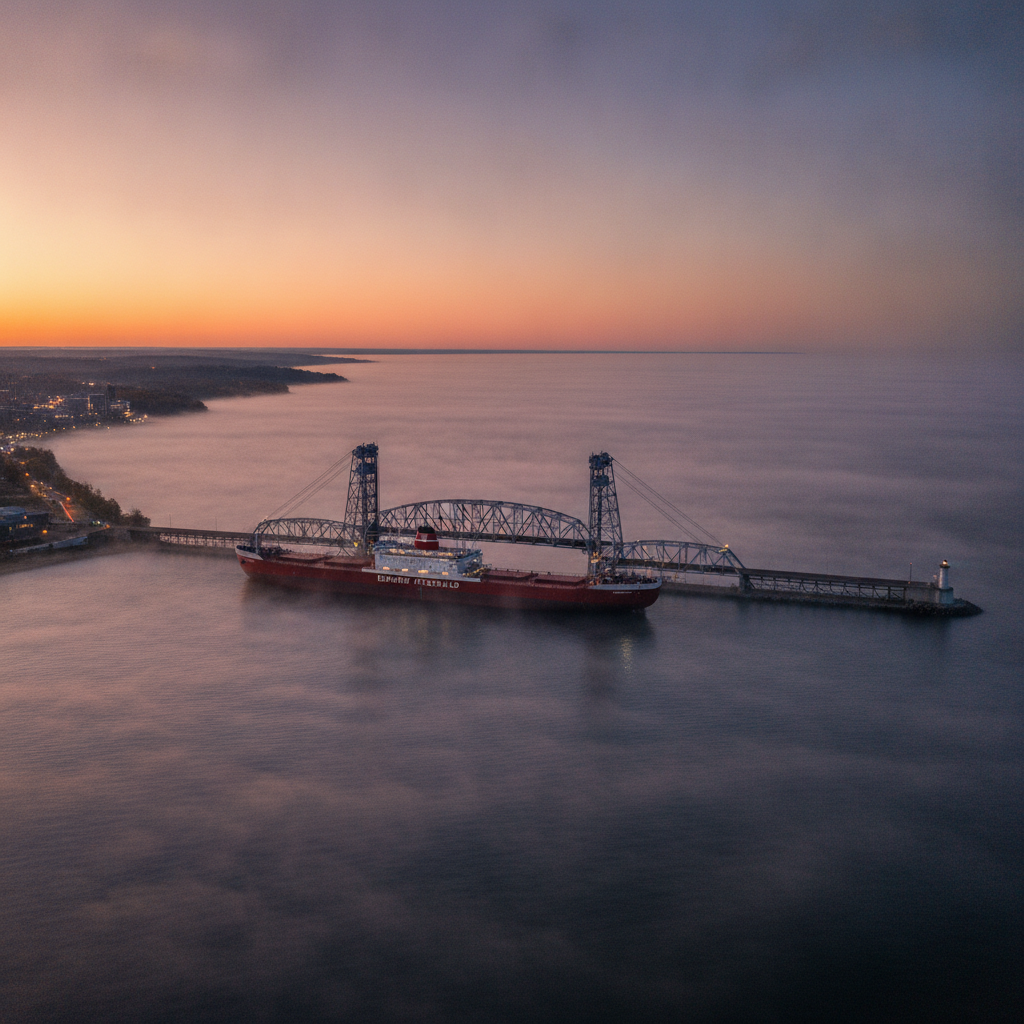
Minneapolis R2: Nicollet Mall and downtown architecture (IDS Center Philip Johnson 1972, Foshay Tower 1929 W Hotel, Mary Tyler Moore statue, Hennepin Ave theater district), University of Minnesota (51,000 students, 29 Nobel laureates, Norman Borlaug Green Revolution 1 billion deaths prevented, Bob Dylan Dinkytown 1959-1960), Boundary Waters Canoe Area (1.1M acres, 1,175 lakes, most visited US wilderness, Twin Metals mining controversy), Saint Paul (Minnesota State Capitol Cass Gilbert, Summit Avenue F. Scott Fitzgerald, Cathedral of Saint Paul), Minnesota Scandinavian heritage (1.5M Norwegian descent, Minnehaha Falls Longfellow, lutefisk Lutheran church suppers, Lake Wobegon Garrison Keillor), Day trips (Duluth Lake Superior Aerial Lift Bridge, Mayo Clinic Rochester, Stillwater Victorian birthplace of Minnesota)
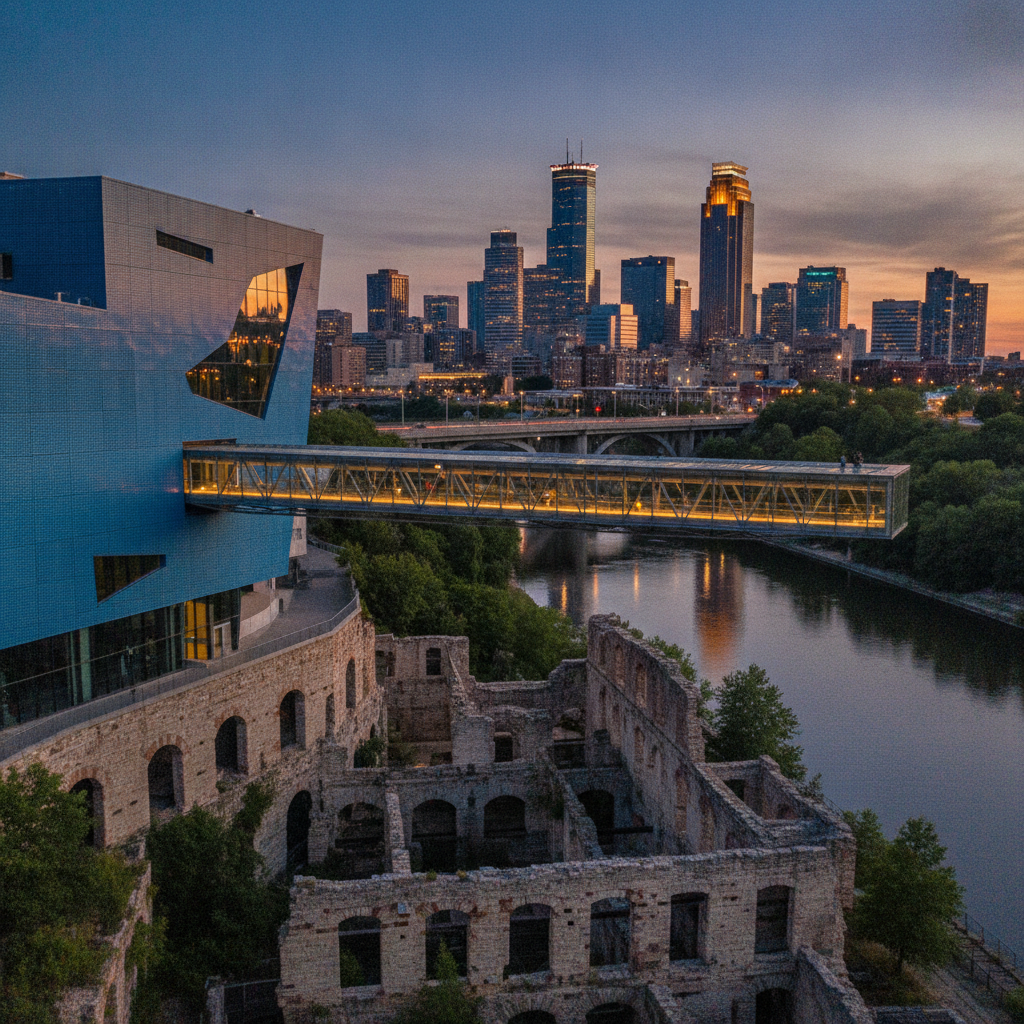
Minneapolis: F. Scott Fitzgerald Summit Avenue, Guthrie Theater Over the River and 9 Miles of Indoor Skyways
Minneapolis: Bob Dylan Dinkytown Coffeehouses, East African Little Mogadishu and Gehry Campus