Dharavi, Dhobi Ghat & Mumbai's Local Train — City of Extraordinary Contrasts
Mumbai is a city of extraordinary contrasts — between extreme wealth and extreme poverty, between modernity and tradition, between the colonial heritage of South Mumbai and the organic urban sprawl of the northern suburbs — nowhere more visibly than in Dharavi (one of Asia's largest informal settlements, also one of Asia's most productive industrial areas), the Dhobi Ghat open-air laundry, and the legendary Mumbai local train network (the busiest commuter rail system in the world).
- 1
Dharavi — Asia's Most Productive Informal Settlement
Dharavi (the approximately 2.1-square-kilometre informal settlement in central Mumbai between the Western and Central railway lines, originally a mangrove swamp and fishing village that was settled by migrant workers in the early 20th century and grew organically into one of the most densely populated areas on Earth — estimated population 600,000-1,000,000 in an area smaller than Central Park in New York City): Dharavi's international image (popularized by the 2008 film 'Slumdog Millionaire' (largely not filmed in Dharavi)) as a 'slum' understates its economic complexity — Dharavi has an estimated annual economic output of approximately $1 billion USD, generated by approximately 15,000 single-room factories and 5,000 businesses producing leather goods, pottery, recycled plastics, garments, and food products; the Dharavi pottery colony (Kumbharwada) is the largest concentration of traditional potters in Mumbai, with approximately 50 Kumbhar (potter) families producing traditional earthenware using kick wheels; the leather and garment industries in Dharavi supply major Indian and international brands; responsible tourism operators organize walking tours of Dharavi that provide economic benefit to residents and a genuine understanding of the settlement's economic life.
- 2
Dhobi Ghat — The World's Largest Open-Air Laundry
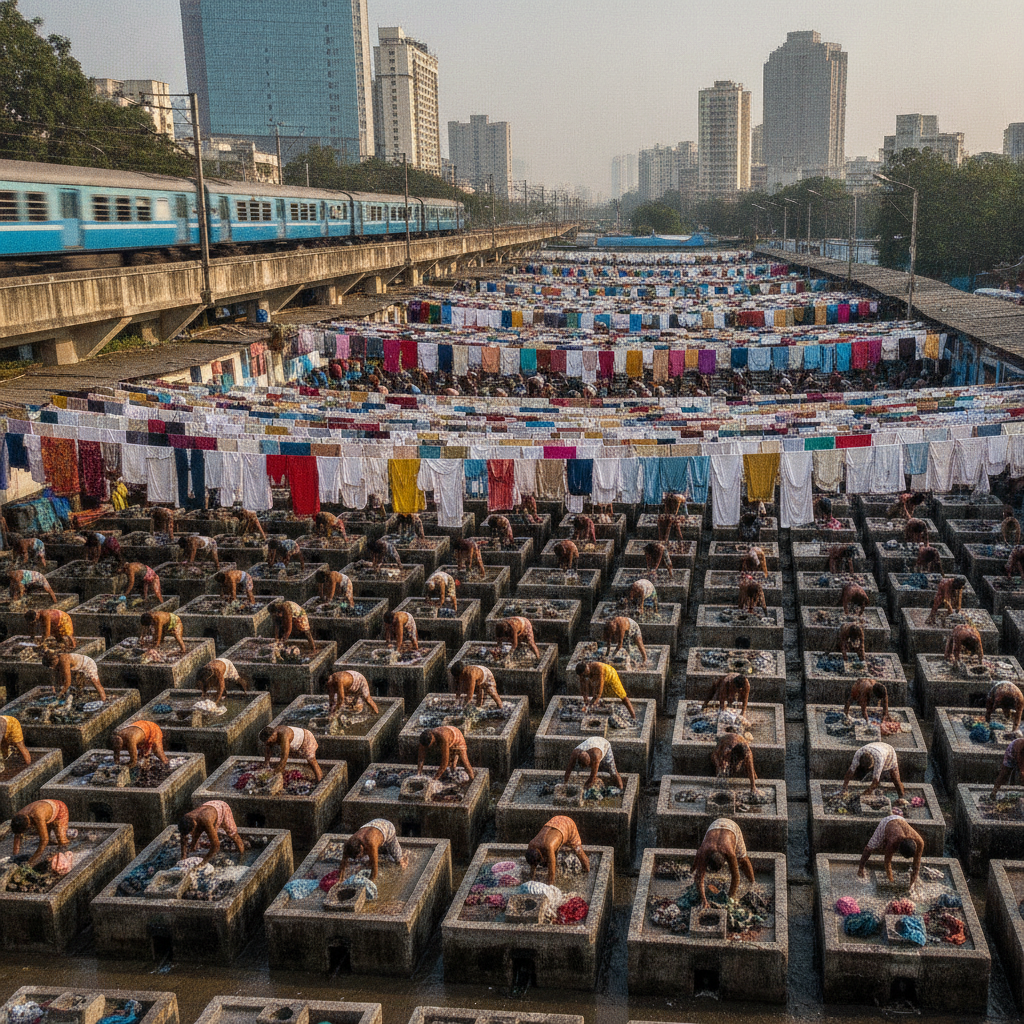
Dhobi Ghat (Mahalaxmi Dhobi Ghat — the large open-air laundry at Mahalaxmi, central Mumbai, established in the 1890s, containing approximately 731 wash pens (ghats) organized in rows beside the Mahalaxmi railway station): the Dhobi Ghat is the largest open-air laundry in the world and one of the most visually extraordinary sights in Mumbai — approximately 700 dhobi (washerman) families process the laundry of Mumbai's hotels, hospitals, and restaurants by hand, each family occupying an assigned set of wash pens that can be inherited or rented; the washing process is entirely manual: soaking in soapy water, scrubbing with soap and a hard brush, thrashing the wet fabric against a wash stone (patthar), wringing, rinsing, and hanging to dry on ropes above the wash pens; the colourful array of drying textiles — hotel linens, hospital scrubs, saris, salwar kameez, and shirts in every colour — is the visual spectacle that draws photographers; the best viewpoint over the Dhobi Ghat is the pedestrian bridge over the railway line at Mahalaxmi station.
- 3
Mumbai Local Train — The Lifeline of the City
Mumbai Suburban Railway (the Mumbai local train — the network of three lines (Western, Central, and Harbour) that carries approximately 7.5 million passengers per day, making it the busiest commuter rail system in the world in terms of passenger density): the Mumbai local is the circulatory system of the city — without it, the 21 million people of Greater Mumbai could not get to work, school, or the market; the trains (12-car rakes running at 2-3 minute intervals at peak times) carry 4-5 times their rated capacity during rush hours, with passengers hanging out of the open doorways (the doors remain permanently open) and hanging from the overhead grip rails; the 'Virar fast' (the fastest and most crowded Western line service, running 60 km from Virar to Churchgate station) is the canonical symbol of Mumbai's punishing commute culture; riding the Mumbai local from Churchgate to Dadar (the central hub) in the 'general' (non-first-class) carriage during the 8-9am or 5-7pm rush is one of the most intense human experiences available in any city in the world.
- 4
Crawford Market & Mohammed Ali Road — Old Bombay Food Culture
Crawford Market (Mahatma Jyotiba Phule Market — the Victorian-era covered market at Dr. Dadabhoy Naoroji Road, South Mumbai, built 1869, designed by William Emerson (later architect of the Victoria Memorial in Calcutta) with bas-relief sculptures by Rudyard Kipling's father Lockwood Kipling above the main entrance): Crawford Market is the wholesale fruit and vegetable market of Mumbai, a cacophony of colour, noise, and produce piled in towers under the iron-and-glass roof, with licensed porters carrying loads on their heads through the narrow passages between the stalls; Mohammed Ali Road (the street running north from Crawford Market through the Muslim neighbourhood of Bhendi Bazaar — the most important street for traditional Mughal cuisine in Mumbai): the Mohammed Ali Road Iftar (the breaking of the fast after sunset during Ramadan) is one of the great food events in Mumbai, when the entire street fills with food stalls selling Mughal food — haleem (slow-cooked meat and lentil stew), nihari (braised lamb), seekh kebab, biryani, and the extraordinary desserts of the Bohri Muslim community (malpua, shahi tukda, and phirni).
- 5
Haji Ali Dargah — The Mosque on the Sea
Haji Ali Dargah (the mosque and tomb of the Sufi saint Haji Ali Shah Bukhari, 1431, situated on a small islet 500 metres off the coast of Worli in South Mumbai, connected to the mainland by a narrow 500-metre stone causeway that is submerged at high tide): the dargah (the tomb-shrine of a Muslim saint) is one of the most visited pilgrimage sites in Mumbai, attracting Hindu and Muslim devotees in equal measure — a remarkable example of the syncretic religious culture of Mumbai; the causeway to the dargah (flanked by beggars, flower sellers, and the blind and disabled who live on the causeway waiting for charitable alms from pilgrims) is one of the most extraordinary approaches to any religious site in India, with the white mosque and its minaret rising from the sea at the end of the causeway; the experience of crossing to the dargah at high tide (when the causeway is submerged and the mosque appears to float free of the land entirely) is one of the most memorable in Mumbai.
- 6
Mahalaxmi Temple & Worli Sea Face
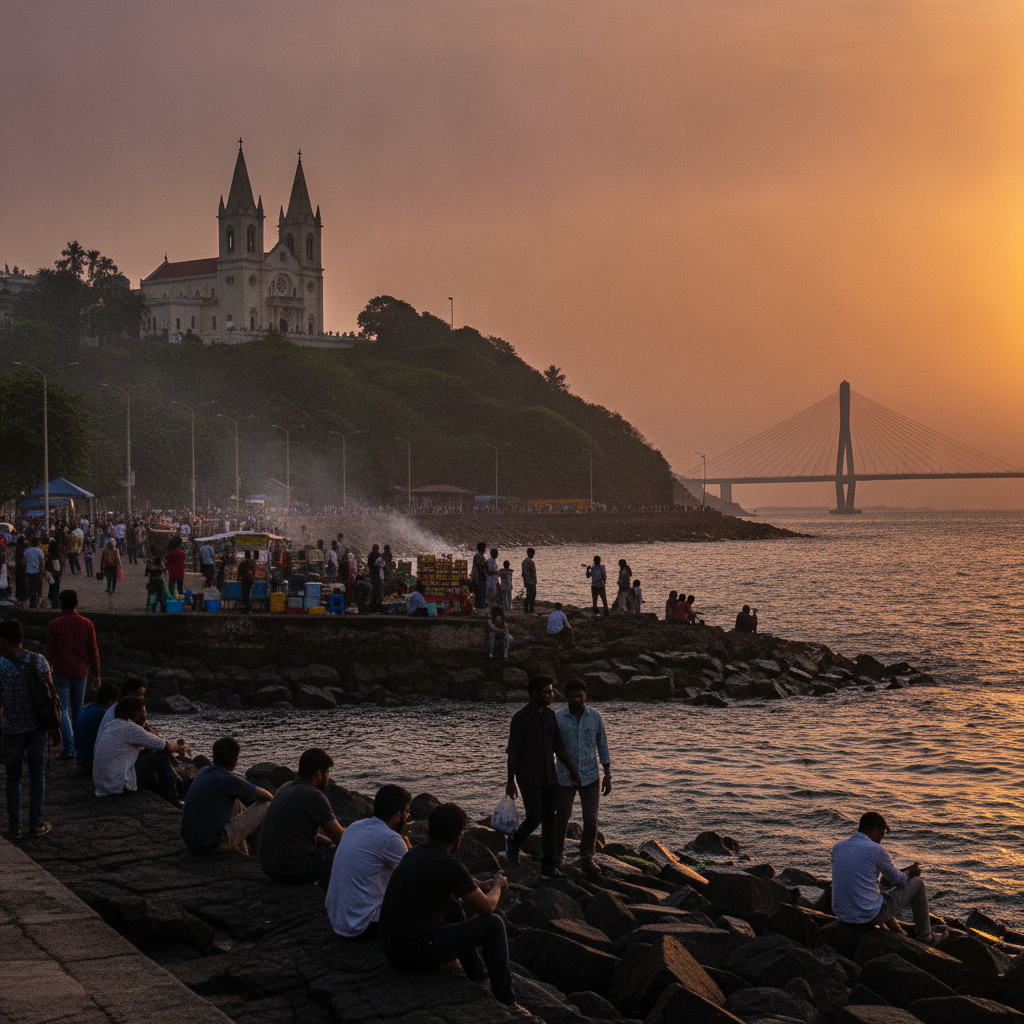
Mahalaxmi Temple (the most important Hindu temple in Mumbai, dedicated to the goddess Mahalaxmi (an avatar of Lakshmi, goddess of wealth and prosperity), built approximately 1831 on the rocks of the Mahalaxmi seafront in Bhuleshwar): the Mahalaxmi Temple is the most visited temple in Mumbai, attracting approximately 20,000-25,000 devotees daily (and several hundred thousand during the Navratri festival in October); the temple is particularly visited by Mumbai's business community, who come to pray for prosperity and success; the Worli Sea Face (the 4-kilometre seafront promenade from Mahalaxmi to Worli, one of the few long waterfront walkways in Mumbai) and the Bandra-Worli Sea Link (the 5.6-kilometre cable-stayed bridge across Mahim Bay, opened 2009, the most dramatic piece of modern infrastructure in Mumbai, visible from the Sea Face) form the modern counterpoint to the historic colonial waterfront of South Mumbai.
Walk this route with audio
Stories play automatically as you reach each stop — no tapping needed.
More in mumbai
Juhu Beach, Bollywood Villas & the North Mumbai Coastline
Mumbai Street Food — Vada Pav, Pani Puri, Irani Cafés & Bombay Cuisine
Mumbai Monsoon — The City That Celebrates the Rain
Kanheri Caves, Sanjay Gandhi National Park & Mumbai's Wild Side
Gateway of India, the Taj Mahal Palace & Mumbai Harbour