The Mississippi River, Steamboats & New Orleans's Port Heritage
The Mississippi River at New Orleans (the stretch of the lower Mississippi at the 'Crescent City bend' — the horseshoe bend that gives New Orleans its nickname 'the Crescent City') is the reason New Orleans exists: the city was founded in 1718 by Jean-Baptiste Le Moyne de Bienville specifically to control access to the Mississippi River and its vast drainage basin, and for the first 150 years of its existence, the Port of New Orleans was the most important commercial port in North America.
- 1
Moon Walk & the French Quarter Riverfront
The Moon Walk (the elevated promenade along the top of the Mississippi River levee between Jackson Square and the Toulouse Street Wharf in the French Quarter — named for Maurice 'Moon' Landrieu, the mayor of New Orleans from 1970 to 1978 who opened the riverfront to public pedestrian access for the first time in the city's history (before Landrieu's administration, the riverfront was entirely occupied by working port facilities and was inaccessible to the public)): the Moon Walk experience (the experience of standing on top of the Mississippi River levee and looking out at the vast, brown, slow-moving Mississippi — the river that at this point is approximately 600 metres (2,000 feet) wide, running at approximately 5 km/h (3 mph) in normal conditions (faster in spring flood stage, slower in late summer low-water conditions), and carrying approximately 3.5 million tonnes of sediment per day to the Gulf of Mexico): the barge traffic (the characteristic lower Mississippi commerce — the enormous push-tow configurations (a single towboat pushing up to 45 barges (each carrying approximately 1,500 tonnes of grain, fertiliser, petroleum, or coal) lashed together in a rectangular formation) that make the lower Mississippi the most commercially active inland waterway in the world): the Woldenberg Riverfront Park (the 3.5-acre (1.4-hectare) park along the riverfront between the Aquarium of the Americas and the French Market, the most popular outdoor gathering space in the French Quarter, where street performers, food vendors, and musicians gather on weekend evenings).
- 2
Steamboat Natchez — The Last Authentic Steam Paddleboat
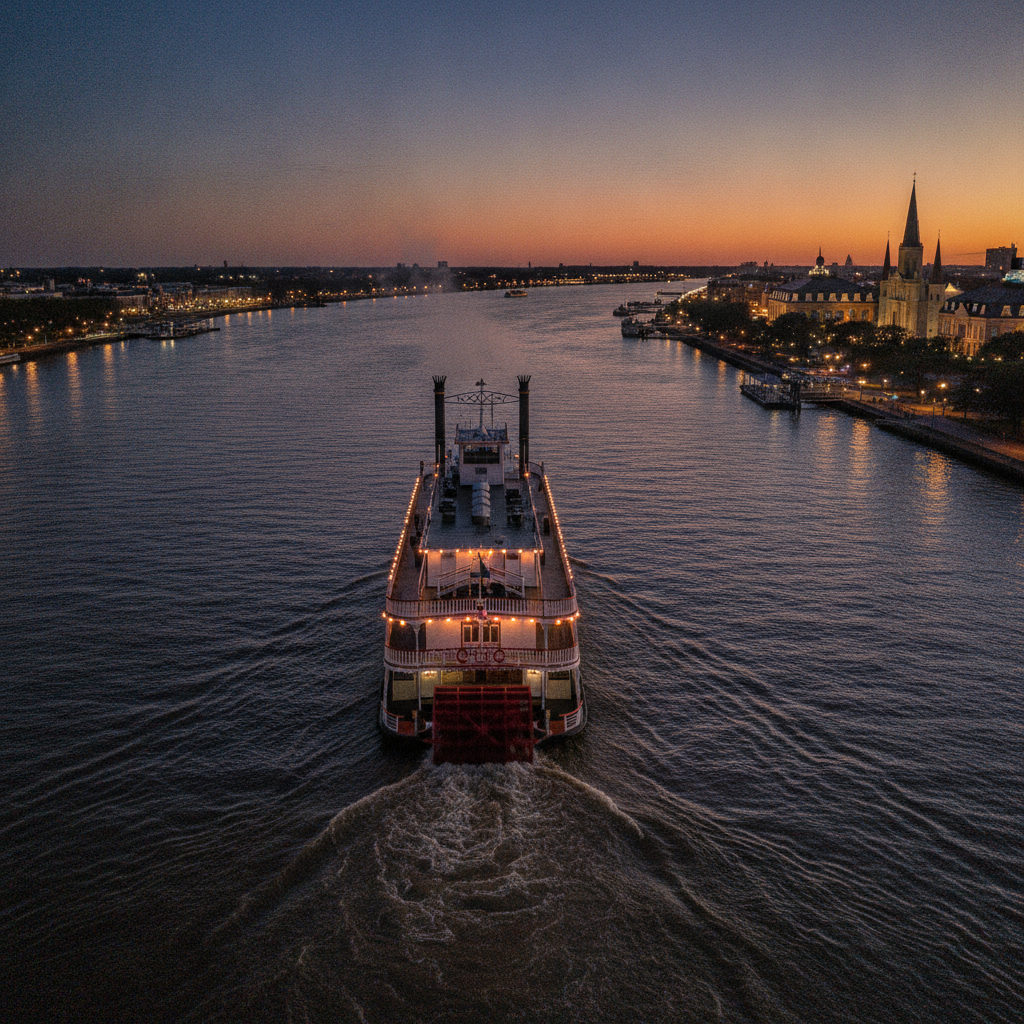
The Steamboat Natchez (the 265-foot (80-metre) steam-powered sternwheel paddleboat operated by the New Orleans Steamboat Company from the Toulouse Street Wharf in the French Quarter — one of only a handful of authentic steam-powered paddleboats still in commercial operation on the Mississippi River): the Natchez (built 1975 at the Bergeron Shipyard in Braithwaite, Louisiana — the ninth steamboat to bear the name 'Natchez', the name associated with the fastest and most celebrated Mississippi River steamboats in the antebellum golden age of steam navigation): the Natchez's steam engine (the authentic steam-powered reciprocating steam engine (the 'Corliss engine' configuration — the type of high-efficiency steam engine developed by George Corliss in 1849 that powered the great steamboats of the Mississippi's golden age) that drives the 28-foot (8.5-metre) diameter sternwheel (the wooden paddlewheel at the stern of the boat, contrasting with the sidewheel configuration of the other famous Mississippi paddleboats)): the calliope (the steam-powered calliope (the 'steam piano' — the musical instrument consisting of a series of steam whistles played by a keyboard, producing a loud, unmistakable sound that was used on the Mississippi steamboats to announce their departure and arrival) that plays traditional Mississippi River tunes (the 'Battle Hymn of the Republic', 'Dixie', and 'When the Saints Go Marching In') as the Natchez departs the wharf on its daily 2-hour river cruises.
- 3
The Port of New Orleans — America's Gateway Port
The Port of New Orleans (the port complex along the east and west banks of the Mississippi River in New Orleans and the adjacent parishes — the fifth-busiest port in the United States by tonnage and one of the most strategically important ports in the world): the history of the Port of New Orleans (the port that was the raison d'être of the city of New Orleans — the reason Jean-Baptiste Le Moyne de Bienville founded a city in this difficult, low-lying, mosquito-infested location in 1718 was to control access to the Mississippi River and the 31-state drainage basin (the 3.2 million km² (1.24 million sq mile) Mississippi watershed that drains approximately 40% of the continental United States)): the antebellum port (the port of New Orleans in the period 1820-1860 was the busiest port in the United States and the second-busiest port in the world (after Liverpool, England), processing more than $300 million worth of cotton, sugar, and other agricultural commodities per year — the cotton trade (the export of the cotton grown on the slave plantations of the Mississippi Delta and the Deep South) made New Orleans the wealthiest city in the antebellum American South and one of the wealthiest cities in the world): the current port (the Port of New Orleans currently handles approximately 75 million tonnes of cargo per year, including grain (the largest grain export port in the world), coffee (the second-largest coffee import port in the United States), and containers).
- 4
Algiers Point — New Orleans's West Bank Neighbourhood
Algiers Point (the neighbourhood on the West Bank of the Mississippi River directly across from the French Quarter — the oldest neighbourhood in the City of New Orleans on the West Bank of the Mississippi, the second-oldest neighbourhood in New Orleans overall (after the French Quarter), annexed to the City of New Orleans in 1870): the Algiers Point experience (the neighbourhood accessed by the Canal Street Ferry (the free municipal ferry service across the Mississippi River from the Canal Street Ferry terminal in the French Quarter to the Algiers Point Ferry terminal on the West Bank — the most scenic 5-minute ferry ride in the United States, crossing the 600-metre (2,000-foot) wide lower Mississippi with its barge traffic and ocean-going vessels)): the Algiers Point neighbourhood (the low-density residential neighbourhood of Victorian cottages and Creole cottages, the quiet tree-lined streets in marked contrast to the tourist bustle of the French Quarter visible across the river, the independent restaurants and coffee shops (the Old Point Bar — the neighbourhood bar established 1896, the oldest continuously operating bar in the West Bank of New Orleans), and the Mardi Gras Indians who mask in the Algiers Point area during Carnival season): the view from Algiers Point back across the river (the finest view of the New Orleans skyline (the modest but distinctive skyline of downtown New Orleans — the Superdome (the Caesars Superdome, the domed sports stadium that served as the shelter of last resort during Hurricane Katrina), the Crescent City Connection bridge (the twin cantilever bridges carrying Interstate 90 across the Mississippi at New Orleans — the longest cantilever bridges in the world), and the French Quarter's low roofline) from the river.
- 5
Aquarium of the Americas & IMAX Theatre
Aquarium of the Americas (1 Canal Street, at the foot of Canal Street on the Mississippi River — the major public aquarium established 1990 by the Audubon Nature Institute, the institution that also operates the Audubon Zoo (the zoo in Audubon Park in Uptown New Orleans, the zoo rated one of the top ten zoos in the United States by the American Zoo and Aquarium Association)): the Aquarium of the Americas collection (the 60 exhibits and approximately 10,000 animals representing the aquatic ecosystems of the Americas — from the Amazon River (the 'Amazon Rainforest' gallery with the piranhas (Pygocentrus nattereri — the red-bellied piranha, the most notorious of the piranha species), the electric eels (Electrophorus electricus — the South American knifefish capable of generating up to 860 volts of electrical discharge), and the giant river otter (Pteronura brasiliensis — the world's longest otter, up to 1.8 metres (6 feet) in length, listed as endangered by the IUCN), to the Gulf of Mexico (the 'Gulf of Mexico' gallery with the sharks and rays, the sea turtles, and the tarpon (Megalops atlanticus — the 'silver king', the large gamefish of the Gulf that can exceed 2 metres (6.5 feet) in length and 160 kg (350 lb) in weight)), and the Sea Horse Gallery (the gallery devoted to the seahorse species of the Western Hemisphere — the leafy seadragon (Phycodurus eques), the pygmy seahorse (Hippocampus bargibanti), and the weedy seadragon (Phyllopteryx taeniolatus)).
- 6
National WWII Museum — America's Greatest History Museum
The National World War II Museum (945 Magazine Street, in the Warehouse District of New Orleans — the museum dedicated to the American experience in the Second World War, established 2000 as the 'D-Day Museum' (the museum commemorating the Normandy landings of June 6, 1944) and renamed the National World War II Museum in 2003 by Act of Congress (Congress designated the museum as the official national museum of the United States dedicated to the Second World War)): the museum's choice of New Orleans (the museum is located in New Orleans because the Higgins boat (the LCVP — the 'Landing Craft, Vehicle, Personnel' designed by New Orleans boatbuilder Andrew Jackson Higgins (1886-1952) and manufactured in New Orleans at the Higgins Industries plant on City Park Avenue — the flat-bottomed wooden landing craft that was the primary vehicle for amphibious landings in all theatres of World War II, used in the Normandy landings, the Pacific island-hopping campaign, and every other major amphibious operation of the war — General Dwight D. Eisenhower called Higgins 'the man who won the war for us') was manufactured in New Orleans): the museum experience (the six permanent pavilions covering the Pacific War, the European Theatre, the home front, the liberation of Western Europe, and the aftermath of the war — the most comprehensive and most professionally curated museum of the Second World War in the world, consistently rated among the top five museums in the United States by TripAdvisor and the American Alliance of Museums).
Walk this route with audio
Stories play automatically as you reach each stop — no tapping needed.
More in new-orleans
Hurricane Katrina, the Lower Ninth Ward & New Orleans's Resilience
Garden District Mansions, St. Charles Streetcar & Uptown Life
Swamps, Bayous & Louisiana's Wild Cypress Country
Voodoo, Marie Laveau & the Supernatural Culture of New Orleans
The French Quarter, Jazz & the Soul of New Orleans