Voodoo, Marie Laveau & the Supernatural Culture of New Orleans
New Orleans Voodoo (the syncretic religious tradition (the synthesis of West African Vodun religious practices (particularly those of the Fon and Ewe peoples of Dahomey — the modern-day Republic of Benin) with Roman Catholic devotional practices and indigenous Louisiana spiritual traditions) that developed in New Orleans during the 18th and 19th centuries among the city's enslaved and free African-American community): Louisiana Voodoo (also called New Orleans Voodoo or Creole Voodoo — distinct from Haitian Vodou and from the Hollywood stereotype of 'voodoo dolls') is a living spiritual tradition still practiced in New Orleans and is inseparable from the city's cultural identity.
- 1
St. Louis Cemetery No. 1 — The City of the Dead
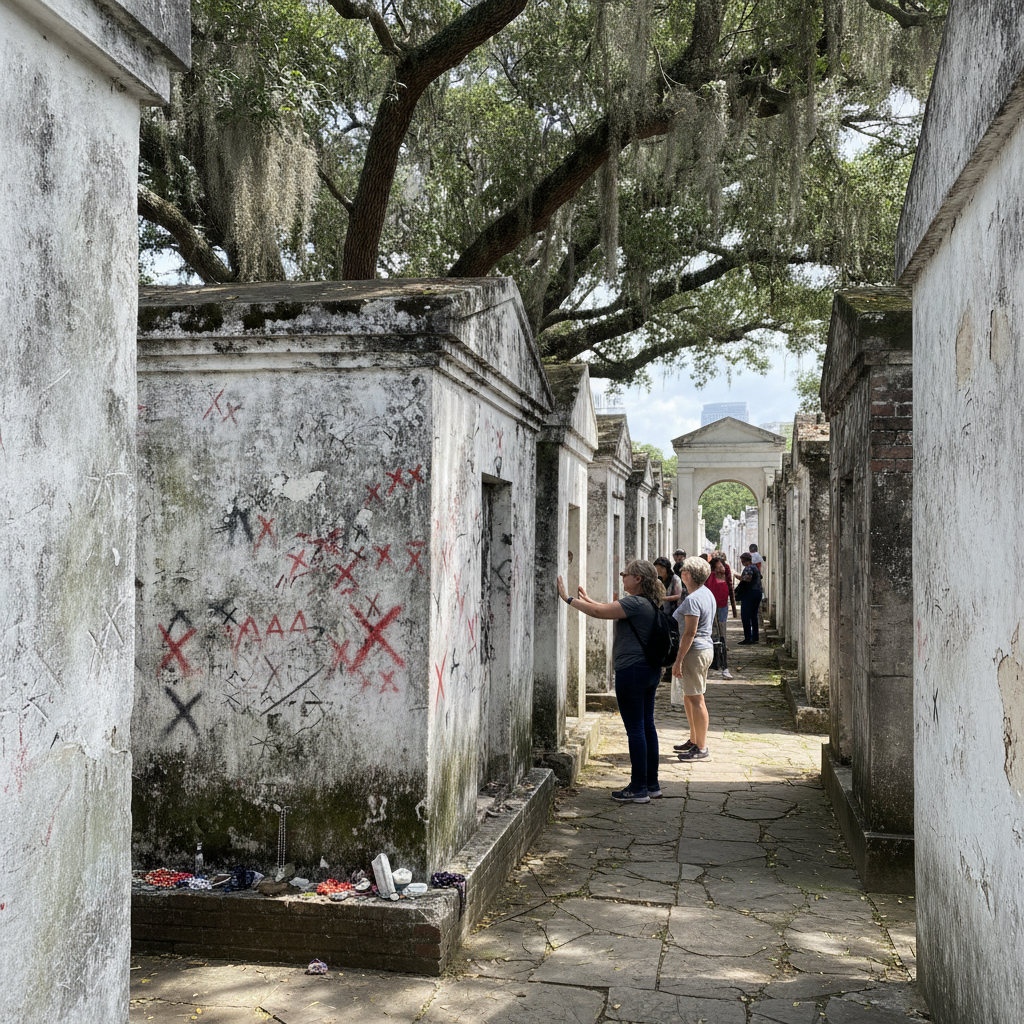
St. Louis Cemetery No. 1 (Basin Street at St. Louis Street, Tremé — the oldest surviving cemetery in New Orleans, established 1789 (replacing the earlier St. Peter Street Cemetery destroyed in the 1788 fire)): the above-ground tomb tradition (the 'cities of the dead' — the New Orleans custom of above-ground burial in whitewashed plastered brick vaults, developed in response to the city's position below sea level (the high water table made in-ground burial impractical — early coffins floated to the surface after heavy rains), influenced by Spanish colonial burial practices and West African funerary traditions): the tomb of Marie Laveau (the whitewashed vault near the Basin Street entrance, traditionally identified as the burial site of Marie Laveau (1801-1881 — the 'Voodoo Queen of New Orleans', the most famous practitioner of Louisiana Voodoo in history), covered in the X-marks scratched by visitors (the practice of marking three Xs on Marie Laveau's tomb, knocking three times, and making a wish — a folk practice with no documented basis in authentic Voodoo tradition but now an established New Orleans ritual): the Archdiocese of New Orleans designated St. Louis Cemetery No. 1 a 'sacred place' in 2015 and now requires all visitors to enter only as part of a licensed tour (due to the vandalism of the tombs by tourists).
- 2
The New Orleans Historic Voodoo Museum
New Orleans Historic Voodoo Museum (724 Dumaine Street, French Quarter — the small museum established 1972 by Charles Massicot Gandolfo dedicated to the history, culture, and spiritual practice of Louisiana Voodoo): the museum collection (the assemblage of Voodoo altars (the 'mojo altars' — the arrangements of candles, gris-gris bags, talismans, Catholic devotional objects (saint cards, rosaries, crucifixes), animal skulls and bones, herbs, and other objects of ritual power in the Louisiana Voodoo tradition), the gris-gris bags (the 'charm bags' — the small cloth bags filled with herbs, roots, stones, and other objects of power that are the most characteristic material object of Louisiana Voodoo practice), the photographs and documentation of Marie Laveau and her successor Marie Laveau II (her daughter, who continued the Voodoo Queen practice after her mother's death), and the altar dedicated to the Voodoo lwa (the spirits — the Voodoo entities that mediate between the Supreme Creator (Bondye) and humanity) Baron Samedi (the lwa of the dead, of sexuality, and of resurrection, depicted as a top-hatted skeleton with dark glasses) and Erzulie Dantor (the lwa of love and jealousy, depicted as a dark-skinned woman): the shop (the gift shop selling gris-gris bags, Voodoo dolls, and spiritual supplies — the best single source of authentic Louisiana Voodoo spiritual objects in the French Quarter).
- 3
Marie Laveau — The Voodoo Queen of New Orleans
Marie Laveau (born 1801, died June 15, 1881 — the 'Voodoo Queen of New Orleans', the most famous and most powerful practitioner of Louisiana Voodoo in history, and one of the most famous women in the history of Louisiana): the life of Marie Laveau (the free woman of colour (a 'femme de couleur libre' — a free Black woman in antebellum New Orleans) born in the French Quarter to a wealthy Creole planter and a free woman of colour of African, Native American, and European descent): Laveau worked as a hairdresser to the Creole and American elite of New Orleans (the profession that gave her access to the private lives, secrets, and fears of the most powerful families in the city), gathering information that enhanced her reputation for supernatural knowledge and power: her Voodoo practice (Laveau combined authentic West African Vodun practices brought to New Orleans by enslaved Africans from Dahomey with Roman Catholic devotional practices (she remained a devout Catholic throughout her life and received the last rites from the St. Louis Cathedral), creating the syncretic practice that became Louisiana Voodoo): her social power (by the 1830s-1850s, Laveau was the most influential woman in New Orleans — she interceded with judges and jailers for imprisoned men, obtained pardons and reduced sentences, and her ceremonial gatherings at Lake Pontchartrain attracted thousands of participants (Black and white, enslaved and free) in an era of rigid racial segregation).
- 4
The French Quarter's Occult Shops & Spiritual Traditions
The French Quarter occult and spiritual supply shops (the cluster of shops in the French Quarter and adjacent neighbourhoods selling spiritual supplies (Voodoo gris-gris bags, candles, herbs, roots, and oils), occult books, tarot cards, and New Orleans spiritual paraphernalia): the principal shops: Marie Laveau's House of Voodoo (739 Bourbon Street — the Bourbon Street shop named for the Voodoo Queen, the most prominently located and most tourist-oriented of the French Quarter spiritual supply shops, selling a wide range of Louisiana Voodoo and hoodoo (the African-American folk magic tradition of the Deep South — distinct from Voodoo as a religion, hoodoo is a system of practical folk magic using herbs, roots, curios, and prayer) supplies): Esoterica Occult Goods (541 Dumaine Street — the more seriously-oriented occult shop, considered by practitioners to be the finest source of authentic spiritual supplies in the French Quarter); and Island of Salvation Botanica (835 Piety Street, Bywater — the spiritual supply shop operated by Sallie Ann Glassman, an initiated Haitian Vodou priestess (mambo) and the most respected living practitioner of authentic Haitian Vodou tradition in New Orleans, whose work bridges the Haitian Vodou tradition (the direct descendant of West African Fon religious practice) and the Louisiana Voodoo tradition that developed in New Orleans).
- 5
Voodoo Fest & Halloween in New Orleans
The New Orleans Voodoo Music + Arts Experience (the annual music festival held at City Park in New Orleans in late October (typically the last weekend of October, coinciding with or immediately preceding Halloween) — the festival established 1999 that combines the New Orleans tradition of outdoor music festivals with the Halloween season and the city's association with the supernatural and the occult): the Voodoo Fest (as it is commonly called) typically features 60-80 acts performing across 4-5 stages over three days, with a lineup spanning hip-hop, rock, electronic, and jazz: previous headliners have included Nine Inch Nails, Eminem, Radiohead, Foo Fighters, The Killers, and numerous other major international acts: the New Orleans Halloween tradition (New Orleans is widely considered the finest city in the United States for Halloween celebrations, combining the city's existing culture of costume-wearing (Mardi Gras), outdoor drinking (the open container laws), and its deep associations with the supernatural, death, and the occult — the Haunted History Tours (the walking tours of the French Quarter's most famous ghost stories and haunted locations), the St. Louis Cemetery tours, and the costume parties on Frenchmen Street and in the French Quarter make New Orleans Halloween the most atmospheric in the country).
- 6
The Mississippi River & New Orleans Waterfront
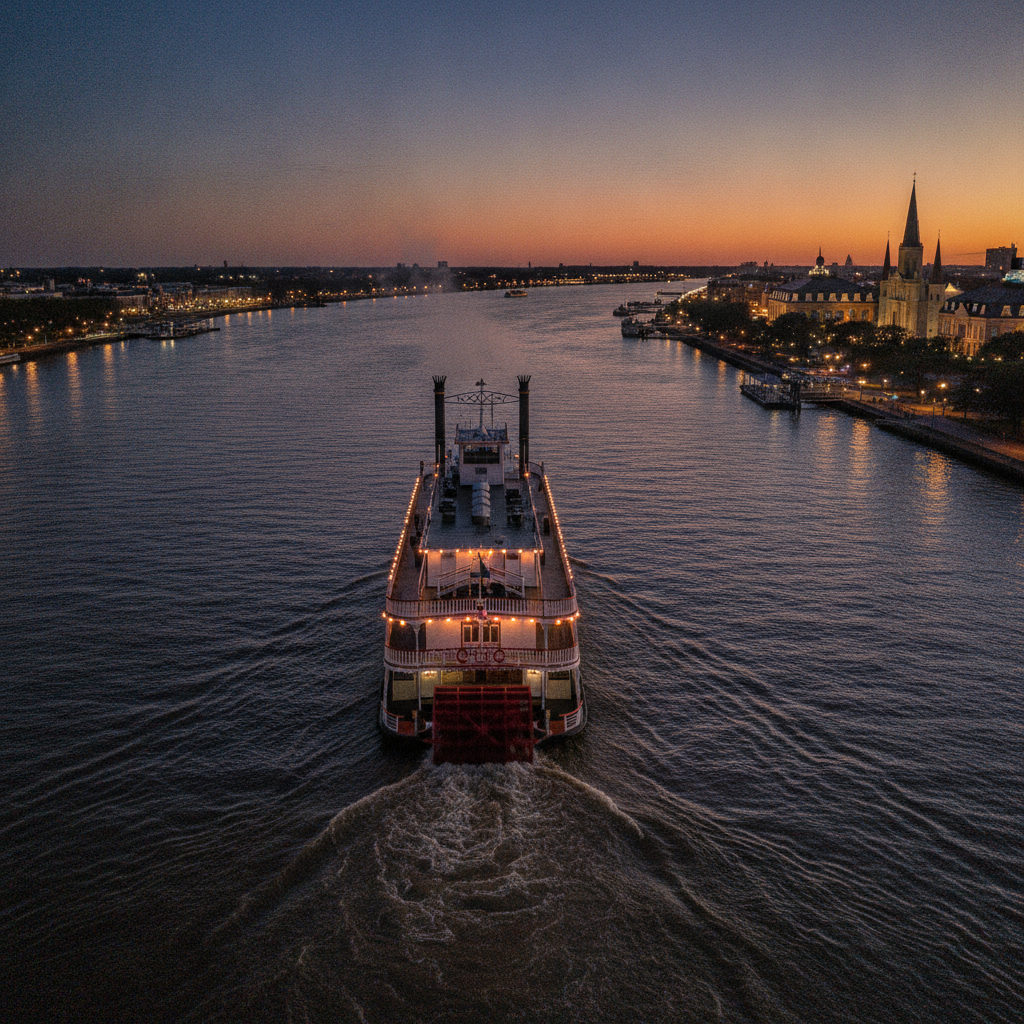
The Mississippi River (the 'Father of Waters' — the Ojibwe 'misi-ziibi', 'great river' — the 3,730 km (2,320 mile) long river flowing from Lake Itasca in northern Minnesota to the Gulf of Mexico, the fourth-longest river in the world and the most important river in the economic history of the United States): the Mississippi River at New Orleans (the stretch of river at the city of New Orleans — the river at this point is approximately 600 metres (2,000 feet) wide and flows at approximately 5 km/h (3 mph) in normal conditions, faster in flood stage, carrying approximately 3.5 million tonnes of sediment per day to the Gulf of Mexico — the river is 'muddy' (the familiar brown colour of the lower Mississippi results from the enormous sediment load — the clay and silt washed from the farmlands and river banks of 31 US states and 2 Canadian provinces that drain into the Mississippi watershed, the largest watershed by area in North America)): the Jackson Square riverfront (the view of the Mississippi from the Moon Walk (the riverside promenade along the top of the levee between Jackson Square and the Toulouse Street Wharf) — the classic New Orleans view: the broad brown river with the barge traffic (the enormous grain barges (the 'tow' — the push-barge configuration in which a towboat pushes a 'tow' of up to 45 barges (each barge carrying approximately 1,500 tonnes) lashed together in a rectangular formation — the most common form of freight transportation on the lower Mississippi), the tanker ships and container vessels of deep-draft international shipping, and (occasionally) the historic Mississippi riverboats: the Steamboat Natchez (the authentic steam-powered sternwheel paddleboat (one of only a handful of authentic steam-powered paddleboats still operating on the Mississippi River) that runs dinner cruises from the Toulouse Street Wharf).
Walk this route with audio
Stories play automatically as you reach each stop — no tapping needed.
More in new-orleans
Hurricane Katrina, the Lower Ninth Ward & New Orleans's Resilience
Garden District Mansions, St. Charles Streetcar & Uptown Life
Swamps, Bayous & Louisiana's Wild Cypress Country
The Mississippi River, Steamboats & New Orleans's Port Heritage
The French Quarter, Jazz & the Soul of New Orleans