Greenwich Village & SoHo: Bohemian Heart of Downtown Manhattan
Greenwich Village—New York's bohemian neighborhood since the 1910s, home to the Beat Generation, the folk revival (Bob Dylan played his first New York gig here in 1961), the gay rights movement (the Stonewall riots, 1969) and generations of artists, writers and radicals—sits directly north of SoHo, the neighborhood of cast-iron Victorian warehouse buildings that was the center of the New York art world in the 1960s–1980s and is now the world's most expensive retail shopping district. Together they form the most historically and culturally rich two-square-mile area in American urban life.
- 1
Washington Square Park — The Living Room of Downtown
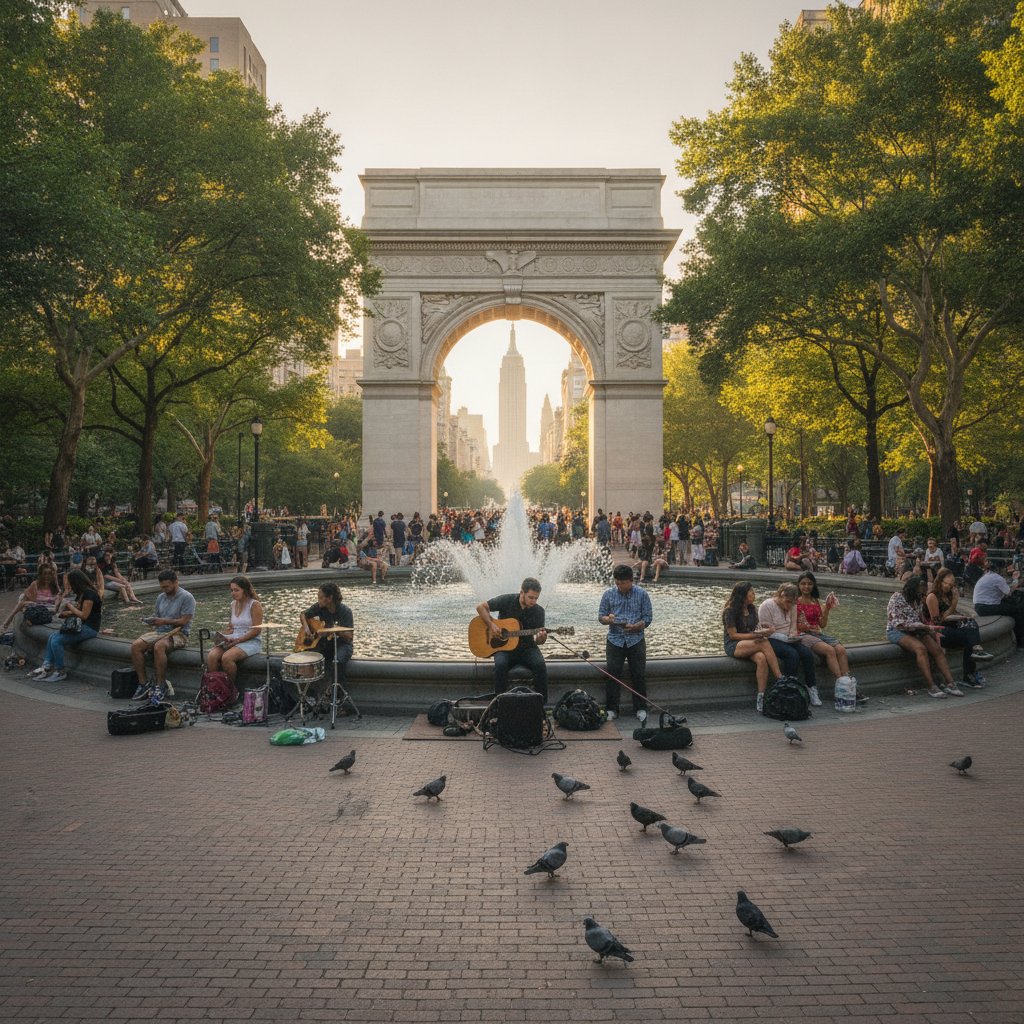
Washington Square Park, at the heart of Greenwich Village, is the social center of downtown Manhattan. The Washington Arch—a triumphal marble arch modelled loosely on the Arc de Triomphe, designed by Stanford White and completed in 1895—marks the formal southern entrance to Fifth Avenue and frames the park's northern view. The park itself (9.75 acres) has a circular fountain that is the de facto gathering point of Village life: on any given day you will find NYU students, street musicians, chess players (the southwest corner has permanent chess tables), dog walkers and tourists from everywhere. The park was originally a public burial ground (an estimated 20,000 bodies remain below ground), then a military parade ground, before being landscaped in the 1870s. Henry James grew up next to it; Edgar Allan Poe, Walt Whitman and Mark Twain all lived nearby. Bob Dylan gave his first major New York performance in the park in 1961.
- 2
Bleecker Street — The Street That Invented Folk Rock
Bleecker Street, the main commercial artery of the West Village, is the street most associated with the folk music revival of the late 1950s and early 1960s. Clubs like the Bitter End (147 Bleecker, still open—opened 1961), Café Wha? (115 MacDougal, opened 1959), and Gerde's Folk City (where Bob Dylan, Joan Baez, Simon & Garfunkel, and Jimi Hendrix all performed) made this strip the center of American folk and early rock. Today Bleecker Street between 6th and 7th Avenues is known for boutiques and restaurants; the western section (Christopher Street west toward the Hudson) retains more of its Village character. The street is also associated with a different chapter in New York music: in the 1970s and 80s, a concentration of live music venues on Bleecker (CBGB was nearby on the Bowery) made it central to the emergence of American punk.
- 3
Stonewall Inn — Where the Gay Rights Movement Was Born
The Stonewall Inn, at 51–53 Christopher Street in the West Village, is the site of the Stonewall Uprising of 28 June 1969—a series of spontaneous, violent protests by members of the LGBTQ community against a police raid that began in the early morning hours of that date. The Stonewall riots are widely considered the most important event in the modern LGBTQ rights movement: they sparked the formation of the Gay Liberation Front, the first gay pride marches (the first anniversary march was held on June 28, 1970, in New York), and the global gay rights movement that followed. In 2016, President Obama designated the Stonewall Inn and the surrounding area a national monument—the first national monument to LGBTQ rights and history. The bar is still open. The building itself (a former stable converted to a bar in 1966) is a National Historic Landmark.
- 4
SoHo Cast-Iron District — The World's Largest Collection of Victorian Iron Architecture
SoHo (South of Houston Street) contains the world's largest concentration of cast-iron Victorian architecture: 26 blocks of 19th-century commercial buildings whose facades are covered in prefabricated cast-iron elements—columns, pilasters, cornices—that allowed the rapid construction of elegant, ornamental buildings at low cost. The buildings were constructed between 1840 and 1880 as warehouses and light manufacturing spaces; they were abandoned in the mid-20th century when manufacturing moved to cheaper locations, then colonized by artists in the 1960s–70s (when 'loft living' was invented), and gentrified from the 1980s onward. Today SoHo is one of the most expensive shopping neighborhoods in the world (flagship stores of every major fashion brand line Broadway and Prince Street), but the architecture is extraordinary: walk down Greene Street or Mercer Street for the best-preserved blocks. The buildings are cast iron, not stone—they were designed to look like stone but weigh far less.
- 5
Chelsea Market — Eating in the Former Oreo Factory
Chelsea Market, a block north of the High Line's southern entrance at the Meatpacking District, is one of New York's best food destinations: a former Nabisco factory (where Oreo cookies were made) converted into a food hall running an entire city block. The market has over 35 food vendors, with highlights including the Lobster Place (fish market with outstanding sushi counter), Los Tacos No.1 (New York's best tacos), Mokbar (Korean-inspired ramen), and Dickson's Farmstand Meats (dry-aged steaks, house-made charcuterie). After eating, walk north one block to the entrance of the High Line.
- 6
Father Demo Square & The West Village Grid — The Street Plan That Never Was
The West Village, south of 14th Street and west of 7th Avenue, is the only neighborhood in Manhattan where the regular grid of streets that covers the rest of the island fails: instead of the numbered north-south avenues and numbered east-west streets of the 1811 grid plan, the West Village has a tangle of diagonal, curved and irregularly angled streets inherited from the original farm and village paths that predated the grid. Streets like Christopher, Bleecker, Bedford, Hudson and Charles run at oblique angles to each other, creating odd triangular intersections (like Father Demo Square on Sixth Avenue and Bleecker) and a constant sense of intimate, village-scale streetscape. The brownstone rowhouses, carriage houses converted to residences, and small shops that line these streets are among the most beautiful urban fabric in New York. End with a walk down Bedford Street to the narrowest house in New York (9.5 feet wide, at number 75½, where Edna St. Vincent Millay and Cary Grant both lived).
Walk this route with audio
Stories play automatically as you reach each stop — no tapping needed.
More in new-york
Central Park & Museum Mile: Art, Nature & the Heart of Manhattan
Brooklyn: Food Markets, Art & the Best Views of Manhattan
Midtown Icons: Grand Central, Rockefeller Center & Times Square
Lower East Side & Chinatown: The Immigrant City
The High Line & Hudson Yards: New York's Reinvented West Side