Harlem: Jazz, Soul Food & the African American Renaissance
Harlem—the neighborhood of upper Manhattan above 110th Street, which became the center of African American cultural and intellectual life following the Great Migration of the early 20th century—is the birthplace of jazz as we know it, the site of the Harlem Renaissance (the extraordinary flowering of African American art, literature and music in the 1920s and 30s), and home to some of the greatest soul food restaurants in the United States. This walk moves through the cultural landmarks that made Harlem the most important neighborhood in American music history.
- 1
Apollo Theater — The Stage That Made American Music
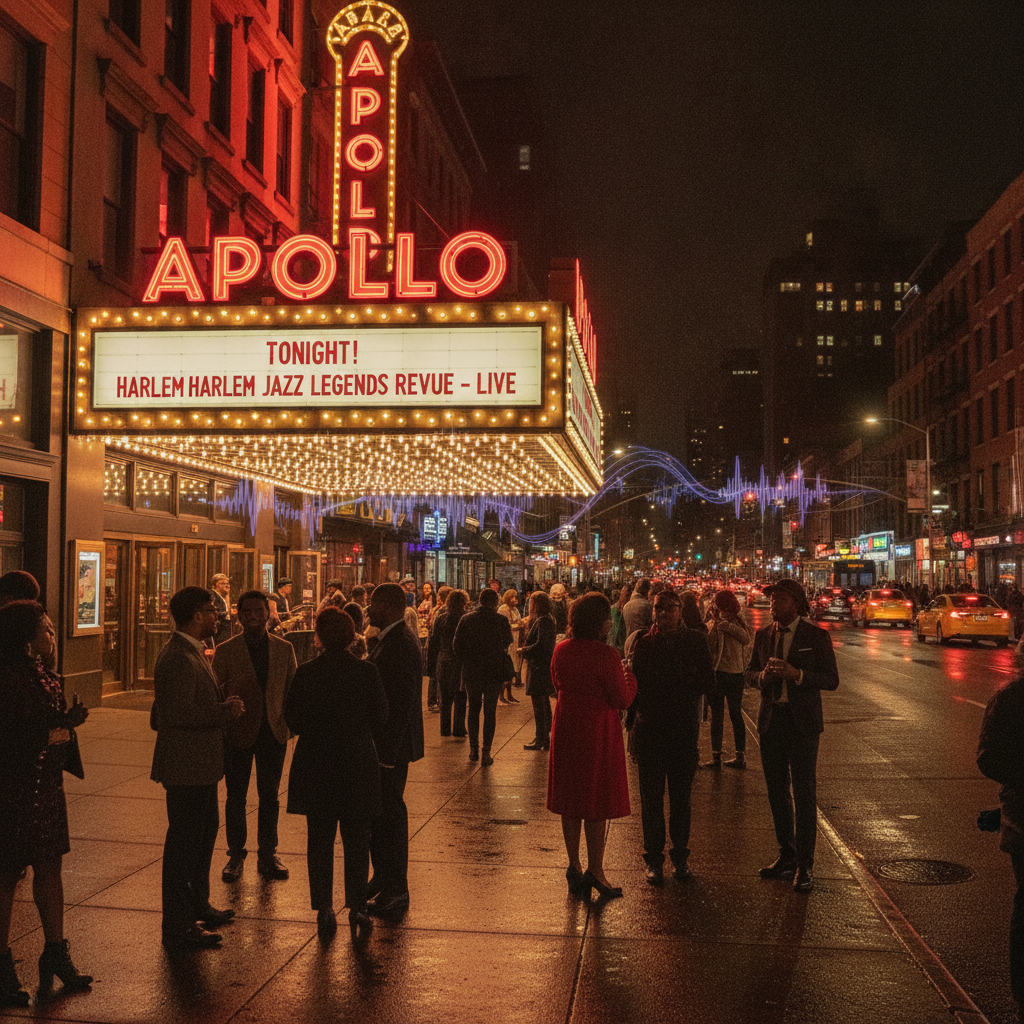
The Apollo Theater at 253 West 125th Street is the most important music venue in American history. Since 1934 (when it began holding its famous Amateur Night—'Where Stars Are Born and Legends Are Made'), the Apollo has launched the careers of Ella Fitzgerald (who won Amateur Night in 1934, age 17, singing 'Judy'), James Brown, Billie Holiday, Stevie Wonder, Gladys Knight, Michael Jackson, Jimi Hendrix, Dionne Warwick, Marvin Gaye and Luther Vandross—among hundreds of others. The theater itself (1914, designed by George Keister) is a 1,506-seat venue with a distinctive horseshoe balcony and famously responsive audience—'the toughest audience in the world' who will boo a bad act off the stage in seconds. The Amateur Night tradition continues every Wednesday night. Tours of the theater are available; it also presents major concerts and events. The 'Stump of Good Luck' (a tree stump near the stage that performers traditionally rub for luck) is a key stop.
- 2
Studio Museum in Harlem — The Institution That Defined Black Art
The Studio Museum in Harlem, at 144 West 125th Street, was founded in 1968 as an artist-in-residence space for Black artists working in Harlem, and has become the most important institution in the United States for collecting, preserving and presenting the work of Black artists. The museum has hosted or supported the early careers of Kara Walker, Glenn Ligon, Kehinde Wiley, Kerry James Marshall, Lorna Simpson and many others. The current building is a 1970s bank branch that has been used for 50 years; a new building (designed by Adjaye Associates) will replace it. The permanent collection (over 2,000 works) spans painting, sculpture, photography and new media; temporary exhibitions are among the best in New York. Free entry on Sundays; suggested donation at other times.
- 3
Sylvia's Restaurant — The Queen of Soul Food
Sylvia's Restaurant at 328 Lenox Avenue (Malcolm X Boulevard) has been the most famous soul food restaurant in the United States since 1962, when Sylvia Woods (born in Hemingway, South Carolina, 1926) opened it with a $20,000 loan cosigned by her mother. Sylvia's serves: fried chicken (described by James Brown as the best in the world), smothered pork chops, collard greens, candied yams, black-eyed peas, cornbread and sweet potato pie. The restaurant became a cultural institution when it began hosting Sunday gospel brunches in the 1970s—a tradition that continues today. Sylvia's has fed Louis Armstrong, Muhammad Ali, Jesse Jackson, Al Sharpton, and (on a famous occasion) Bill Clinton and Al Gore. Sylvia Woods died in 2012; the restaurant is still run by her family. Large groups are recommended to make reservations.
- 4
Marcus Garvey Park — Harlem's Civic Heart
Marcus Garvey Park (formerly Mount Morris Park) at 120th-124th Streets and Mt Morris Park West, is a rocky hilltop park centered on a basalt outcrop that juts 55 feet above the surrounding streetscape. The park was redesigned in 1973 and named after Marcus Garvey, the Jamaican-born Black nationalist and pan-Africanist who founded the Universal Negro Improvement Association in Harlem in 1917 and organized the largest Black mass movement in American history. A cast-iron fire watchtower dating from 1856 sits atop the rocky summit—the only remaining example of the watchtower system that once ringed Manhattan before the introduction of the telephone fire alarm. The park hosts the Harlem Cultural Festival in summer. On weekdays it is quiet; on summer evenings it fills with local residents.
- 5
Strivers' Row — Harlem's Most Beautiful Street
Strivers' Row—the nickname for the two blocks of West 138th and 139th Streets between Adam Clayton Powell Jr. Boulevard and Frederick Douglass Boulevard—is the most elegant residential block in Harlem, originally developed in 1891 by developer David King who commissioned three different architects (Stanford White for one row, Bruce Price and Clarence Luce for the others) to create unified rowhouse terraces in different architectural styles. The houses were so desirable that they became home to the Harlem elite—musicians, doctors, lawyers and business people who were 'striving' upward in the social hierarchy, hence the nickname. Residents have included W.C. Handy (the 'Father of the Blues'), Eubie Blake (the composer), Fletcher Henderson (the bandleader who pioneered big-band jazz), and Bill Robinson (the tap dancer who taught Fred Astaire). The rear alleyways of the houses are accessible through iron gates marked 'Private Road — Walk Your Horses'.
- 6
Hamilton Grange National Monument — Alexander Hamilton's Home
Hamilton Grange National Monument, at 414 West 141st Street, is the former country house of Alexander Hamilton—Founding Father, first Secretary of the Treasury, subject of a Broadway musical—built in 1802 in what was then an rural area north of the city. Hamilton commissioned John McComb Jr. (who also designed New York's City Hall) to build the Federal-style wood-frame house as a summer retreat; he was killed in his famous duel with Aaron Burr at Weehawken, New Jersey, just two years later in 1804, and never spent a full summer there. The house was moved twice (first to 141st Street in 1889, then to its current location in St. Nicholas Park in 2008) and is now managed by the National Park Service. Free entry; ranger-led tours available.
Walk this route with audio
Stories play automatically as you reach each stop — no tapping needed.
More in new-york
Central Park & Museum Mile: Art, Nature & the Heart of Manhattan
Brooklyn: Food Markets, Art & the Best Views of Manhattan
Greenwich Village & SoHo: Bohemian Heart of Downtown Manhattan
Midtown Icons: Grand Central, Rockefeller Center & Times Square
Lower East Side & Chinatown: The Immigrant City