The High Line & Hudson Yards: New York's Reinvented West Side
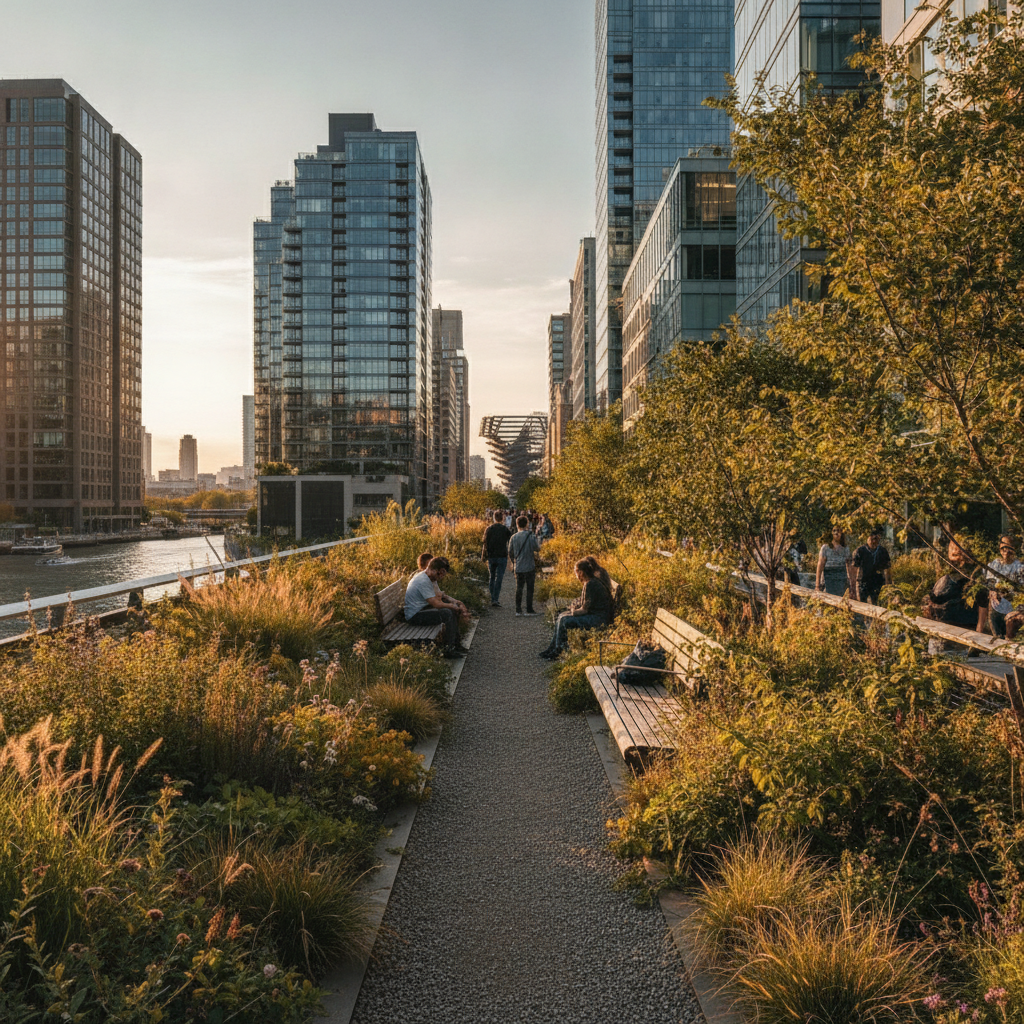
The High Line—a 1.45-mile elevated linear park built on a disused freight railway line that ran through the western edge of Manhattan (1934–1980)—opened in 2009 and became one of the most successful urban regeneration projects in American history. It sparked the transformation of West Chelsea, the Meatpacking District and Hudson Yards from industrial zones to some of the most expensive real estate on Earth. This walk traces the High Line from its southern terminus at the Whitney Museum of American Art northward to Hudson Yards (the biggest private real estate development in US history), then back south to the edge of the Hudson at Little Island.
- 1
Whitney Museum of American Art — At the Foot of the High Line
The Whitney Museum of American Art—relocated from its Marcel Breuer brutalist building on the Upper East Side to a purpose-built Renzo Piano building at the foot of the High Line in 2015—is the most important museum of 20th and 21st century American art in the United States. The building itself is a masterpiece: eight floors of raw concrete, steel, painted brick and blue-grey glass, with outdoor terraces on every level offering views over the Hudson, the meatpacking district rooftops and the High Line. The permanent collection (over 24,000 works) is strong in Abstract Expressionism (de Kooning, Pollock, Rothko), Pop Art (Warhol, Lichtenstein, Basquiat) and contemporary American work. The Whitney Biennial—held every two years—is the most important survey of contemporary American art. The ground floor café has an outdoor terrace facing the Hudson. Paid entry.
- 2
High Line Southern Section — The Gansevoort to 14th Street
The High Line begins at Gansevoort Street in the Meatpacking District—the neighborhood that was once the center of New York's wholesale meat trade (still active in a few buildings) and is now lined with designer boutiques, clubs and restaurants. The first section of the High Line, from Gansevoort to 14th Street, is the most densely planted: wild-style perennial gardens designed by landscape architect Piet Oudolf (who also designed the Battery Conservancy and the gardens at the Serpentine Gallery), with thousands of species of grasses, flowers and shrubs planted in naturalistic drifts in the gaps between the old railway tracks. The Gansevoort Woodland, at the park's southern end, is a grove of flowering trees underplanted with shade-tolerant groundcovers. The Whitney terrace restaurant overlooks this section.
- 3
High Line Mid-Section — Chelsea's Outdoor Gallery
The middle section of the High Line, from 14th to 26th Streets, passes through West Chelsea—the center of New York's contemporary art gallery scene. At street level (and visible from the High Line), dozens of galleries cluster in the former industrial buildings lining the west 20s streets: David Zwirner, Gagosian, Pace, Hauser & Wirth among them. On the High Line itself, a rolling lawn (the 23rd Street Lawn) offers a place to sit on the grass; the 10th Avenue Square (a bleacher-like seating section facing a large window that frames a view straight down 10th Avenue) is the park's most photographed spot. Art installations are mounted throughout the High Line—new commissions are announced each year.
- 4
Chelsea Market — Food Hall in a Former Oreo Factory
Chelsea Market, at 75 Ninth Avenue (the block between 15th and 16th Streets), occupies the former National Biscuit Company (Nabisco) factory complex where the Oreo cookie was invented in 1912. The building was converted into a food hall and retail complex in 1997 and has become one of the most popular food destinations in New York. Inside (the building spans an entire city block), a 800-foot corridor of food vendors, restaurants, shops and market stalls runs through the old factory floor. Highlights: the Lobster Place (one of the best seafood counters in NYC), Dickson's Farmstand Meats, Los Tacos No. 1, and the Japanese grocery Miznon. The building also houses the studios of Google New York and the Food Network. The High Line passes directly over the building on the outside.
- 5
Hudson Yards & The Vessel — New York's New Neighborhood
Hudson Yards, the neighborhood that rose on the rail yards west of 34th Street from 2015 onward, is the largest private real estate development in American history: 28 acres, 18 million square feet of offices, apartments, hotels, shops and public spaces over a platform built above the Long Island Rail Road's storage yards. The Vessel—a 16-story, 2,500-step honeycomb structure of 154 interconnected staircases designed by Thomas Heatherwick and opened in 2019—is the centerpiece of the public plaza. The Edge, an outdoor observation deck on the 100th floor of 30 Hudson Yards (1,100 feet up, with a glass floor), is the highest outdoor observation deck in the Western Hemisphere. The Shops at Hudson Yards are the most expensive retail space ever built in New York.
- 6
Little Island — The Floating Garden on the Hudson
Little Island, opened in May 2021, is a public park built on 132 tulip-shaped concrete piles (the 'pots') rising from the Hudson River at Pier 55, at 13th Street. The park—designed by Heatherwick Studio (also responsible for The Vessel) and funded by the Barry Diller-Diane von Furstenberg Foundation at a cost of $260 million—creates an artificial island of 2.4 acres with meadows, gardens, an amphitheater (700 seats, free summer performances) and winding paths, all slightly above the level of the Hudson. The views from the park's high point—west across the Hudson to New Jersey, east across the West Side Highway to the Meatpacking District, south to the Statue of Liberty—are among the most unusual in New York. The park is free and open daily. The lawn is the best place in New York to sit and watch sunset over the Hudson.
Walk this route with audio
Stories play automatically as you reach each stop — no tapping needed.
More in new-york
Central Park & Museum Mile: Art, Nature & the Heart of Manhattan
Brooklyn: Food Markets, Art & the Best Views of Manhattan
Greenwich Village & SoHo: Bohemian Heart of Downtown Manhattan
Midtown Icons: Grand Central, Rockefeller Center & Times Square
Lower East Side & Chinatown: The Immigrant City