Midtown Icons: Grand Central, Rockefeller Center & Times Square
Midtown Manhattan—the section of Manhattan between 34th and 59th Streets—is the commercial and architectural heart of New York, where the city's most famous buildings, institutions and public spaces cluster within walking distance. This walk visits six of the greatest: Grand Central Terminal (the most beautiful train station in the world), the Chrysler Building (the most beautiful skyscraper in the world), the New York Public Library, Rockefeller Center (the greatest urban development of the 20th century), St Patrick's Cathedral, and Times Square (the world's most famous intersection).
- 1
Grand Central Terminal — The Cathedral of Commerce
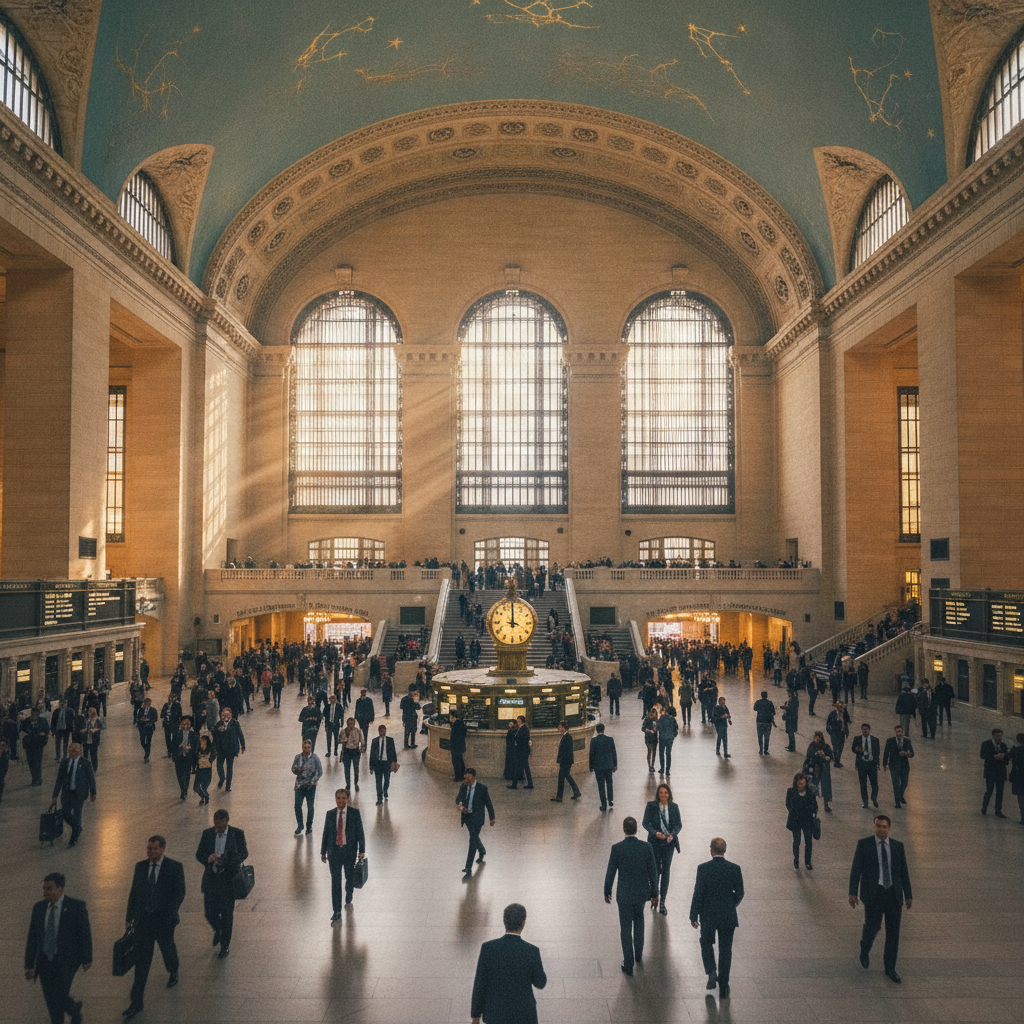
Grand Central Terminal, completed 1913 by Reed & Stem and Warren & Wetmore, is the most beautiful train station in the world and one of the most extraordinary interiors in America. The Main Concourse—120 feet tall, 275 feet long, 120 feet wide—has a vaulted ceiling painted with the constellations of the Mediterranean winter sky (Orion, Taurus, Gemini, Aquarius), in turquoise and gold on a pale green vault, with sunlight streaming through the arched south-facing windows. The four-faced opal clock on the central information booth is the most recognizable object in New York after the Statue of Liberty. Below the concourse are the lower level (with its famous Oyster Bar, open since 1913) and the Campbell Apartment (a lavishly decorated 1920s cocktail bar converted from a private office). The terminal handles 750,000 people per day; 44 platforms serve 30 tracks below street level. Free to enter.
- 2
Chrysler Building — The Greatest Art Deco Skyscraper
The Chrysler Building, completed 1930 at 405 Lexington Avenue and 42nd Street, is the most beautiful skyscraper ever built: an Art Deco tower of 77 floors topped by a stainless-steel crown of terraced arches and gargoyle-eagles modelled on Chrysler car hood ornaments. The building was briefly the tallest in the world (318 meters) before the Empire State Building surpassed it in 1931. The lobby—black marble walls, chrome and amber fixtures, murals of transportation and industry—is one of the finest Art Deco interiors in the world and is open to the public during business hours. The building was designed by architect William Van Alen for car magnate Walter Chrysler, who funded its construction personally (not through Chrysler Corporation) and used it as his personal monument. In a famous race with 40 Wall Street (which was competing to be the world's tallest), Van Alen assembled the 56-meter steel spire in secret inside the building and raised it through the roof on 23 October 1929.
- 3
New York Public Library — Stephen A. Schwarzman Building
The New York Public Library's main building on Fifth Avenue and 42nd Street—the Stephen A. Schwarzman Building, completed 1911, designed by Carrère and Hastings in Beaux-Arts style—is one of the finest public buildings in America. The exterior features two marble lions ('Patience' and 'Fortitude') flanking the Fifth Avenue entrance; the interior has the Rose Main Reading Room (297 feet long, 51 feet high, with an elaborately coffered and painted ceiling) which is one of the great public spaces in New York. The library holds 55 million items—the second-largest research library system in the United States after the Library of Congress. The building is free to enter and the reading room is a working research library; anyone can request books from the stacks and read them in the room. Bryant Park, directly behind the library, is a French-style formal garden with a winter ice-skating rink and summer outdoor cinema.
- 4
Rockefeller Center — The Greatest Urban Complex of the 20th Century
Rockefeller Center—a complex of 19 commercial buildings on a 22-acre site in midtown Manhattan, built between 1930 and 1939 by John D. Rockefeller Jr.—is the finest ensemble of Art Deco architecture in the world and the greatest urban development in American history. The complex's centerpiece is 30 Rockefeller Plaza (the 'GE Building', 70 floors), whose ground-floor lobby contains José Maria Sert's enormous mural American Progress (replacement of the destroyed Diego Rivera mural). The sunken plaza in front becomes the famous skating rink in winter (October to April) and an outdoor café in summer; the enormous Christmas tree (erected every November, lit from late November to January) is one of New York's most beloved traditions. Top of the Rock (the observation deck on the 70th floor of 30 Rockefeller Plaza) offers the best view of Midtown Manhattan available, including the only view of the Empire State Building from above. Paid entry to Top of the Rock. The NBC Studios in 30 Rock offer guided tours. Radio City Music Hall (opened 1932, 6,000 seats, the largest indoor theater in the world) is in the complex.
- 5
St Patrick's Cathedral — Faith in the Shadow of Commerce
St Patrick's Cathedral, on Fifth Avenue between 50th and 51st Streets, directly across from the Atlas statue at the entrance to Rockefeller Center, is the largest Gothic Revival Catholic cathedral in North America: 101 meters tall, seating 2,400, begun in 1858 and consecrated in 1879. The cathedral's position—surrounded by skyscrapers on three sides and directly across from 30 Rockefeller Plaza—creates one of the most extraordinary urban juxtapositions in New York: a Gothic cathedral from the 1870s dwarfed by and yet defiant against the towers of 20th-century commerce. The interior is relatively simple (the stained glass is mostly 19th century and undistinguished) but the scale is impressive and the atmosphere is one of genuine quiet amid the midtown chaos. Free to enter; crowds are largest on weekends and in the lead-up to Christmas.
- 6
Times Square — The World's Most Famous Intersection
Times Square—the intersection of Broadway, 7th Avenue and 42nd Street in midtown Manhattan—is the world's most visited tourist destination (50 million visitors a year, more than the Eiffel Tower) and the place New York mythologizes most intensely in its own imagination: the electronic billboards covering every building face from ground to rooftop, the theatrical lighting, the costumed characters, the pedestrian plazas. Times Square is named after The New York Times, which moved its headquarters here in 1904 and marked the occasion with the first New Year's Eve ball drop (a tradition that has continued every year since, except 1942-43 when it was suspended during wartime). The TKTS discount theatre ticket booth (in the red steps at the north end of the square) sells same-day and next-day Broadway and Off-Broadway tickets at 20-50% discount. Theater District: most of Broadway's 41 official theatres are within a 6-block walk of Times Square—the largest concentration of legitimate theatres in the world.
Walk this route with audio
Stories play automatically as you reach each stop — no tapping needed.
More in new-york
Central Park & Museum Mile: Art, Nature & the Heart of Manhattan
Brooklyn: Food Markets, Art & the Best Views of Manhattan
Greenwich Village & SoHo: Bohemian Heart of Downtown Manhattan
Lower East Side & Chinatown: The Immigrant City
The High Line & Hudson Yards: New York's Reinvented West Side