Oaxaca 2006 Uprising and the APPO: When Teachers Occupied the Zocalo for Six Months and the State Government Lost Control of Its Capital City in a Social Movement That the Rest of Mexico Watched and the International Press Covered as a Revolution
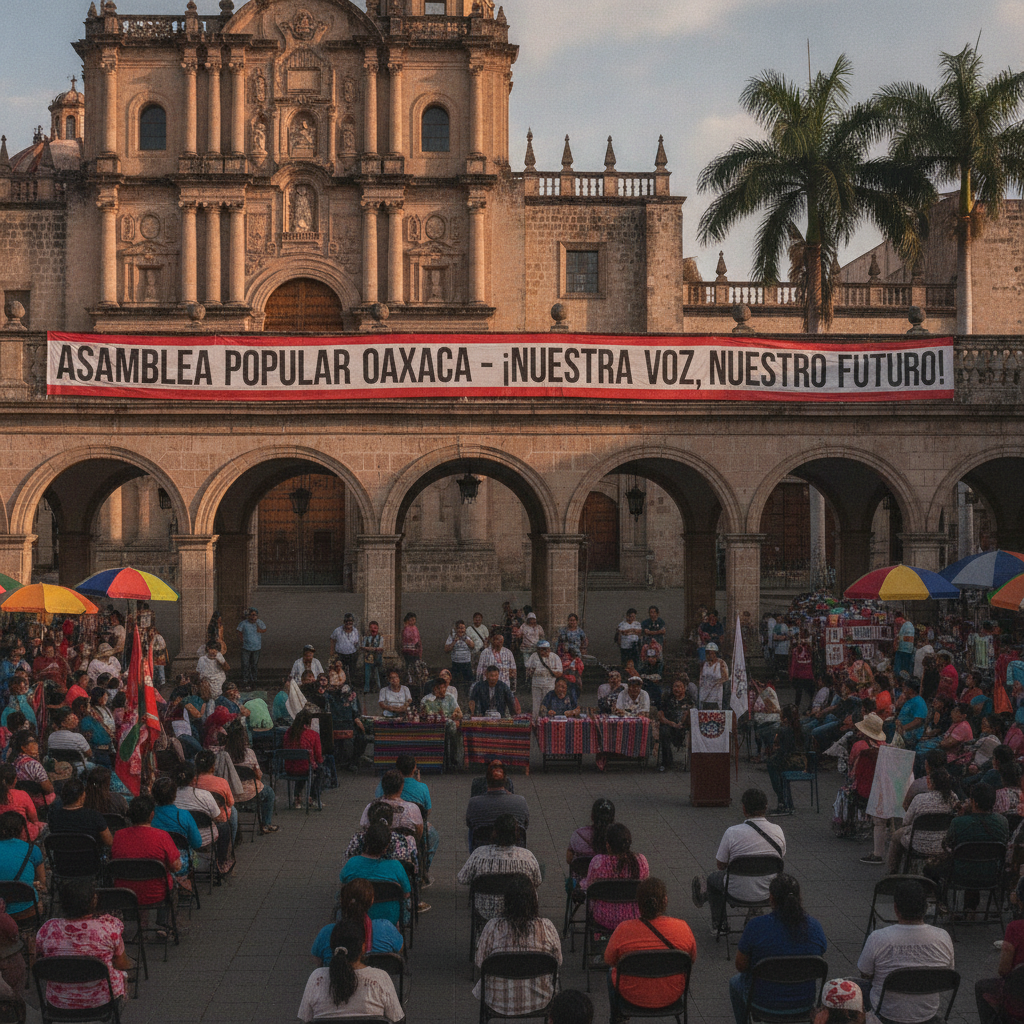
In May 2006 the teachers union of Section 22 of the SNTE union, which had occupied the Oaxaca Zocalo every year since 1981 in its annual June wage negotiation with the state government, established a tent encampment in the plaza that the state governor Ulises Ruiz Ortiz attempted to evict by police force on June 14, 2006, sending 3,000 police with tear gas, water cannons, and helicopters to clear the encampment in the early morning. The police action failed: teachers and residents from surrounding neighborhoods counterattacked the police with rocks, fireworks, and determination, forcing the police to retreat and leaving Section 22 in control not only of the Zocalo but of an expanding zone of the historic center that included the state television and radio stations taken over by the striking teachers as communication tools. The Popular Assembly of the Peoples of Oaxaca, the APPO, formed in the days after the failed police eviction as a coalition of teachers, indigenous community organizations, women's groups, human rights organizations, and left political parties that demanded the resignation of Governor Ulises Ruiz and managed the occupied zone through assembly democracy for six months. The federal government of President Vicente Fox sent the Federal Preventive Police in late October 2006, retaking the Zocalo and dispersing the APPO encampment in violent confrontations that resulted in several deaths including US journalist Brad Will shot by paramilitary gunmen on October 27. The 2006 Oaxaca commune, as it was called by its international supporters, was the most significant urban uprising in Mexico in the period between the 1994 Zapatista rebellion and the 2017 earthquakes.
- 1
Section 22 Teachers and the Annual Strike Tradition
Section 22 of the Sindicato Nacional de Trabajadores de la Educacion, the teachers union that covers the public school system of Oaxaca state, has occupied the Oaxaca Zocalo in an annual strike action since 1981, establishing a pattern of tent encampment, wage negotiation, eventual settlement, and departure that had become a fixed element of the Oaxacan June calendar before the 2006 escalation transformed it into a six-month occupation and political crisis. The Section 22 tradition of annual mobilization reflects the specific character of the Oaxacan teachers movement, which combined wage demands with indigenous education and language rights demands, community control of education demands, and opposition to the privatization and testing reforms that the federal education ministry periodically attempted to impose on state systems. The union had negotiated successfully in previous years through escalation and settlement in periods of days to weeks, and the 2006 escalation to a six-month occupation was a rupture from this established pattern caused by the state government decision to use force rather than negotiate. The political alignment of Section 22 with the broader Oaxacan indigenous movement reflects the composition of the teaching workforce in a state where indigenous communities constitute the majority: many Oaxacan teachers come from the same communities where their students live, speak the same indigenous languages, and maintain the same community governance obligations, making them organic community leaders rather than simply state employees.
- 2
APPO Assembly and Occupied City
The Popular Assembly of the Peoples of Oaxaca, the APPO, functioned as a parallel government for the occupied zone of Oaxaca city from June through October 2006, organizing security patrols using neighborhood volunteers with two-way radios to monitor police movements and alert the assembly to threats, managing the distribution of food and water to the encampment through community donations, operating the occupied radio and television stations to broadcast assembly decisions and community communications, and conducting the regular assembly meetings that took political decisions by majority vote of the hundreds of organizations participating in the coalition. The model of assembly democracy that the APPO practiced drew on both the Zapatista autonomous community governance tradition developed in Chiapas after 1994 and the traditional Zapotec community assembly governance of usos y costumbres, creating a hybrid political form that combined indigenous governance tradition with urban social movement organization. The women of the APPO occupied the state television station CORTV on August 1, 2006, when male assembly members hesitated to take the action, broadcasting for six hours before federal authorities cut the transmission, and established an independent radio station, Radio Cacerola — Pot Radio, named for the cacerolazo protest tradition of women banging pots — that continued broadcasting throughout the occupation. The international attention generated by the APPO, which attracted solidarity demonstrations in Mexico City, the United States, Europe, and Latin America, reflected the broad interpretation of the Oaxacan uprising as a laboratory of direct democracy in resistance to an authoritarian state government.
- 3
Brad Will and International Media Coverage
Brad Will, the US independent journalist and anarchist activist who had been filming the APPO occupation for the Indymedia network, was shot on October 27, 2006, while filming a paramilitary attack on an APPO barricade in the Colonia Santa Lucia del Camino outside Oaxaca city, dying from the gunshot wounds in a death that was filmed by another camera operator and that became the most documented political killing in the Mexican drug war period. The footage of Will's shooting, which showed men in civilian clothing with firearms associated with the Oaxacan state government, was broadcast internationally and increased diplomatic pressure on the Mexican federal government to respond to the situation in Oaxaca. The Mexican federal attorney general opened an investigation that identified state police and officials associated with the Ulises Ruiz government as responsible for Will's death, but the case produced no significant convictions, following the pattern of impunity that characterized political violence investigations throughout the drug war period. The death of Brad Will was the most internationally visible of the deaths associated with the 2006 Oaxacan uprising; at least 20 people died during the six-month conflict, including several APPO participants killed by paramilitary attacks and at least one federal police officer killed during the October crackdown. The Oaxacan human rights organization EDUCA and the organization families of the detained-disappeared documented the injuries, detentions, and deaths throughout the conflict.
- 4
Ulises Ruiz and PRI Political Culture
Ulises Ruiz Ortiz, the Oaxaca governor whose decision to use police force against the teachers encampment on June 14, 2006, triggered the six-month uprising that followed, represented the traditional PRI political culture of Oaxaca in which the state governor functioned as the source of all political authority, patronage was distributed through party loyalty rather than merit, indigenous community grievances were managed through co-optation rather than addressed structurally, and social protest was expected to remain within the boundaries of negotiable demands rather than escalating to political challenge. The Oaxacan PRI had governed the state continuously since 1929, 77 years of single-party rule that had produced a political system of exceptional stability and exceptional social inequality: Oaxaca ranked consistently among the three or four poorest states in Mexico by all development indicators despite being governed throughout the modern period by the same political party that governed the federal government, suggesting that the governance model itself was the obstacle to development rather than any specific policy failure. The 2006 uprising was not the first social movement to challenge PRI governance in Oaxaca: the indigenous community organization COCEI in the Isthmus of Tehuantepec had won municipal elections in Juchitan in 1981 through a political process that the PRI ultimately cancelled, and the post-1994 indigenous rights movement had created political organizations throughout the state that were available to join the APPO coalition in 2006 when the opportunity arose.
- 5
Oaxaca Post-2006 Political Transformation
The aftermath of the 2006 uprising transformed Oaxacan politics in ways that were not immediately visible: Ulises Ruiz completed his term as governor and was succeeded in 2010 by Gabino Cue Monteagudo, the candidate of a left-center coalition that included the PRD and the PAN, ending 81 years of PRI gubernatorial control in Oaxaca. The shift was enabled partly by the discrediting of the PRI through the 2006 events and partly by the federal electoral reform that reduced the ability of state-level PRI machines to control electoral outcomes. Section 22 continued its annual mobilizations and remained one of the most politically active teachers unions in Mexico, engaging in national education reform confrontations including the 2016 clash with federal police in Nochixtlan that killed 11 people in opposition to the Pena Nieto education reform that required teacher evaluation. The APPO coalition dispersed after the October 2006 crackdown but many of the community organizations that had participated in it continued their organizing work, with the indigenous community organizations developing community governance and resource management programs in the Sierra Norte and other regions. The Colectivo Mano Vuelta and similar Oaxacan civil society organizations continued human rights documentation and indigenous rights advocacy. The political culture of Oaxaca that produced the 2006 uprising — the active civil society, the strong indigenous governance tradition, the teachers movement — continues to make the state one of the most politically dynamic in Mexico.
- 6
Oaxaca 2017 Earthquake and Recovery
The September 7, 2017 earthquake, an 8.2 magnitude event centered offshore in the Gulf of Tehuantepec that struck at 11:49 PM local time, caused widespread structural damage in the coastal communities of the Isthmus of Tehuantepec and in the city of Juchitan, where hundreds of buildings collapsed and 96 people died in the single most affected community, and lesser but significant damage in Oaxaca city and the central valley communities where the colonial architecture sustained structural cracks that required assessment and in some cases evacuation. The Juchitan disaster, which destroyed the historic Presidencia Municipal building and hundreds of traditional adobe houses in the oldest neighborhoods, compounded the existing economic vulnerability of the Isthmus communities and required a reconstruction effort that proceeded slowly through bureaucratic and political obstacles in the subsequent years. The 2017 earthquake sequence in Oaxaca and Chiapas, combined with the September 19 earthquake of that year centered in Morelos and felt severely in Mexico City, generated an unprecedented national solidarity mobilization of volunteer rescuers, supply donations, and digital coordination that represented a new model of civil society disaster response in Mexico. The reconstruction of Juchitan, which included the Isthmus Zapotec women in prominent roles as community leaders of the recovery process, reflected the matriarchal social organization of the Isthmus communities in a context where this organizational tradition was visibly functional rather than anthropologically theoretical. Several colonial buildings in Oaxaca city that sustained 2017 earthquake damage remained under repair or assessment through the early 2020s.
Walk this route with audio
Stories play automatically as you reach each stop — no tapping needed.
More in Oaxaca
Oaxaca Landscape and Ecology: Cloud Forest Orchids in the Sierra Norte, the Monarch Butterfly Corridor Through the Sierra Sur, the Pacific Coast Turtle Nesting at Mazunte and the Lachatao Archaeological Botanical Garden
Oaxacan Textiles Alebrijes and Black Clay: The Village Craft Traditions That Survived Because They Were Too Remote for Factory Competition and Now Feed a Global Market That Values Handmade More Than Ever
Zapotec and Mixtec Civilization: The Cloud People Who Built Monte Alban Before Rome Was an Empire, the Mixtec Codices That Are the Only Pre-Columbian Books Surviving Complete, and the Tomb 7 Gold That Changed What Scholars Knew About Pre-Columbian Metalwork
Oaxaca: The Valley City Below Monte Alban Where Zapotec Civilization Built Its Pyramid Capital, Where Mole Negro Takes Three Days to Make, and Where Every Street Has More Indigenous Cultural Survival Than Any Other City in Mexico
Oaxacan Markets Chocolate and Chapulines: The Mercado 20 de Noviembre Charcoal Corridor, the Chocolate Mills of the Mina Street and the Grasshopper Tradition That Foreign Food Writers Use as a Shortcut to Oaxaca and That Oaxacans Find Exhausting