Viking Ship Museum, Kon-Tiki & Bygdøy — Norway's Maritime Heritage
The Bygdøy peninsula (the museum peninsula of Oslo, 15 minutes by ferry or bus from the city centre) concentrates Norway's most important historical collections: the Viking Ship Museum (the finest Viking Age artifacts in the world), the Kon-Tiki Museum (Thor Heyerdahl's balsa raft), the Fram Museum (Nansen and Amundsen's polar exploration ship), and the Norwegian Maritime Museum.
- 1
Viking Ship Museum — The Greatest Viking Age Artifacts in the World
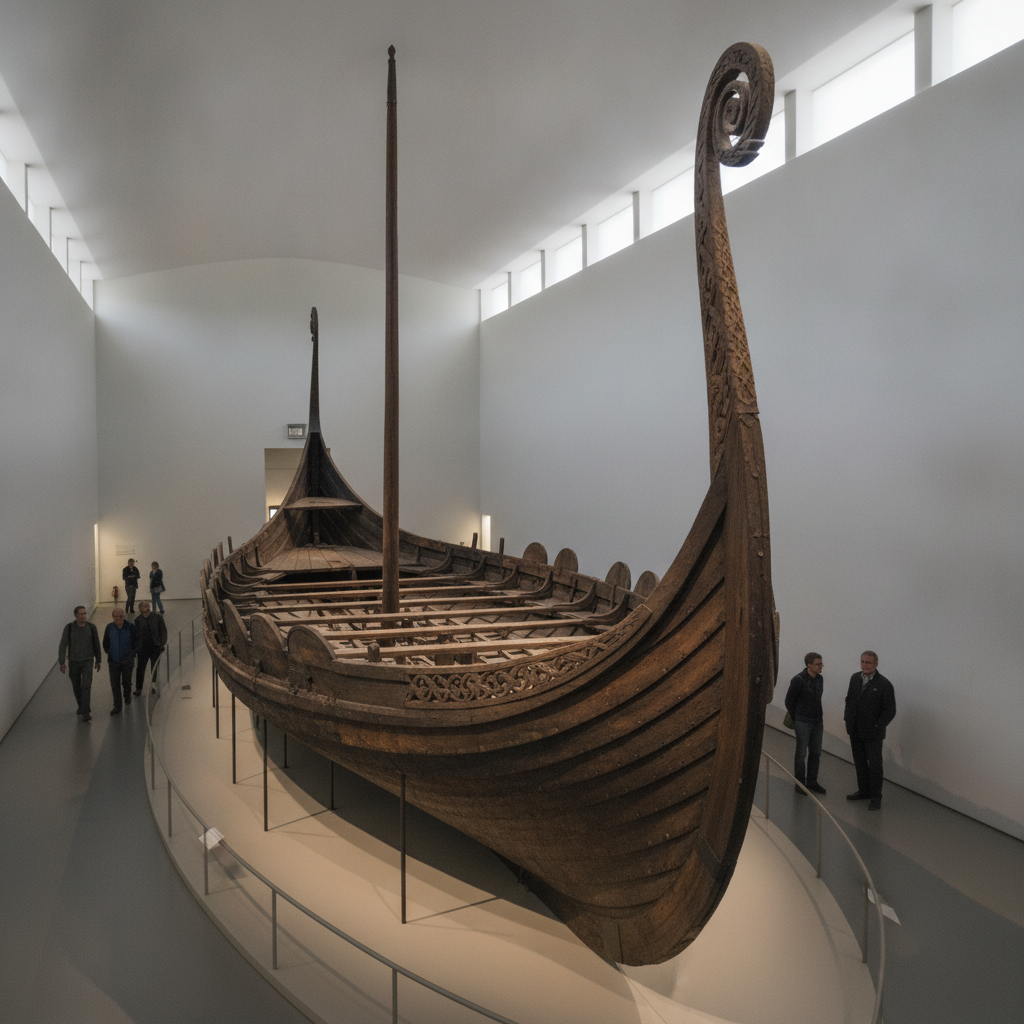
Vikingskipshuset (Viking Ship Museum — Huk Aveny 35, Bygdøy — the museum housing three Viking Age ships (the Oseberg ship, the Gokstad ship, and the Tune ship) excavated from burial mounds in eastern Norway in the late 19th and early 20th centuries): the Oseberg ship (built c.820 CE, used as a burial ship for two women of high status in 834 CE, excavated 1904-1905 from a burial mound at Oseberg in Vestfold, with an extraordinary collection of grave goods including carved wooden sleighs, carts, beds, tents, and kitchen equipment — the finest collection of Viking Age wooden artefacts in existence); the Gokstad ship (built c.890 CE, the largest and most seaworthy of the three, used as a burial ship for a man of high status, probably a petty king, excavated 1880 — a replica of the Gokstad ship (the Viking) sailed across the Atlantic to the 1893 Chicago World's Fair in 28 days, demonstrating the ocean-going capability of Viking ships); the Tune ship (the oldest, built c.900 CE, fragmentary, excavated 1867). Note: the Viking Ship Museum was closed for renovation 2021-2026 and is expected to reopen as the Museum of the Viking Age (Vikingtidsmuseet) in its new expanded building.
- 2
Kon-Tiki Museum — Thor Heyerdahl's Pacific Crossing
Kon-Tiki Museum (Bygdøynesveien 36, Bygdøy — the museum housing the Kon-Tiki raft and other vessels used by the Norwegian explorer and ethnographer Thor Heyerdahl (1914-2002) in his experimental voyages demonstrating pre-Columbian transoceanic contact): Thor Heyerdahl's Kon-Tiki expedition (1947) — in which Heyerdahl and five crew members sailed a balsa wood raft (Kon-Tiki, 13.7 metres long, built using only materials and techniques available to pre-Columbian South Americans) from Callao, Peru, 6,900 km across the Pacific Ocean to the Tuamotu Archipelago in Polynesia in 101 days — was one of the most celebrated adventures of the 20th century; Heyerdahl's argument (that Polynesia could have been settled from South America) has not been supported by subsequent genetic and linguistic evidence (which indicates Polynesia was settled from Southeast Asia), but the Kon-Tiki itself (displayed in the museum along with the papyrus reed boat Ra II (1970) that sailed from Morocco to Barbados) remains one of the most evocative exploration artifacts in the world.
- 3
Fram Museum — The Ship That Went Furthest North and South
Frammuseet (the Fram Museum — Bygdøynesveien 36, Bygdøy — the museum housing the Fram, the polar exploration ship that holds the record for travelling furthest north and furthest south of any wooden ship in history): the Fram (built 1892, the strongest wooden ship ever constructed — the hull is 80 cm thick at the waterline, designed to rise up out of the ice rather than being crushed when pack ice pressed against it) made three polar expeditions: the first (1893-1896, under Fridtjof Nansen (1861-1930, the Norwegian explorer and later Nobel Peace Prize laureate) — reached 86°14'N, the furthest north any human had reached at the time, before the ship spent three years locked in the Arctic ice drifting across the Polar Sea), the second (1898-1902, under Otto Sverdrup, mapping the Canadian Arctic), and the third (1910-1912, under Roald Amundsen (1872-1928) — the historic expedition that reached the South Pole on December 14, 1911, 33 days before Robert Scott's British expedition); visitors can board the Fram and explore the interior.
- 4
Akershus Fortress — Medieval Castle & Norwegian Resistance Museum
Akershus festning (Akershus Fortress and Castle — at the tip of the Akershus peninsula, overlooking the Oslo inner harbour — the medieval fortress that is the most important historic site in Oslo): Akershus was built circa 1299 by King Haakon V as a fortress to defend Oslo after the city became the capital; the fortress was besieged multiple times (by Swedish forces in 1716, who failed to capture it) and was the site of important events in Norwegian history during World War II — the Germans occupied Norway April 9, 1940, and Akershus became the headquarters of the German occupation authority (the Reichskommissariat Norwegen); Norwegian resistance fighters and patriots were executed in the fortress grounds during the occupation; the Norwegian Resistance Museum (Norges Hjemmefront museum, within the fortress) is one of the finest World War II resistance museums in Europe, documenting the Norwegian home front resistance to German occupation 1940-1945; the Royal Mausoleum (the royal chapel of Akershus Castle) contains the graves of Norwegian monarchs.
- 5
Holmenkollen — Ski Jump & Winter Olympics Legacy
Holmenkollen ski jump (Holmenkollbakken — the ski jump on the Holmenkollen hill above Oslo, the most historic ski jump in the world and the most visited tourist attraction in the Oslo region after Vigeland Park): Holmenkollen has hosted ski jumping competitions every year since 1892 (the Holmenkollen ski festival, held annually in March, is the oldest ski competition in the world and was the largest annual sporting event in the world for much of the early 20th century); the current Holmenkollen ski jump (rebuilt for the 2011 World Ski Championships, the sixth major rebuild of the jump since 1892) is 134 metres tall; the Ski Museum in the base of the jump is the oldest ski museum in the world (founded 1923), with exhibits on the history of skiing from prehistoric times (the earliest known skis date from approximately 8,000 years ago in Scandinavia); Oslo hosted the Winter Olympics in 1952, and Holmenkollen was the main venue; visitors can ride the ski jump tower lift to the top for panoramic views of Oslo and the Oslofjord, and can try the zip line from the top.
- 6
Oslo Opera House & the Bjørvika Waterfront
Operahuset (the Oslo Opera House — Kirsten Flagstads plass 1, Bjørvika waterfront — the white marble and granite opera house designed by the Norwegian architectural firm Snøhetta and opened April 12, 2008 — the most significant new building in Norway since the Middle Ages and the winner of the Mies van der Rohe Award for European Architecture 2009): the Opera House is designed so that its gently inclined white marble roof (inspired by the Norwegian concept of the glacier or the snow-covered landscape emerging from the water) is a public walkway, allowing visitors to walk from the water level up to the roof for panoramic views of the Oslo fjord and city; the building's extraordinary form (appearing to rise directly from the Oslofjord, its white marble surface reflecting the water and sky) has become the defining image of contemporary Oslo; the Opera House is home to the Norwegian National Opera and Ballet (Den Norske Opera & Ballett); the adjacent Munch Museum (completed 2021) and the Deichman Bjørvika public library (the new main library of Oslo, also on the waterfront) form a new cultural district.
Walk this route with audio
Stories play automatically as you reach each stop — no tapping needed.
More in oslo

Northern Lights (Aurora Borealis) & Oslo in Winter
Oslofjord Cruise & the Fjord Islands

Sámi Culture, Reindeer & Norway's Arctic North
Norwegian Fjords — Bergen, Flåm & Day Trips from Oslo
Vigeland Park, the Munch Museum & Oslo's World-Class Art