Phuket's Other Side: Big Buddha Views, Southern Thai Khao Yam & the Amanpuri Resort That Defined Luxury Tourism
The non-beach Phuket—the 45-metre white marble Big Buddha on Nakkerd Hills visible from both coasts simultaneously, Wat Chalong honouring the monks who defended against 19th-century Haw bandits, southern Thai cuisine's turmeric-forward curries and khao yam rice salad utterly unlike Bangkok food, the Amanpuri (opened 1988, 40 pavilions in the trees above Pansea headland, the resort that defined the global luxury pavilion model), Bang Tao's Laguna complex built on a detoxified tin-mine lagoon, Phuket versus Koh Samui's Full Moon Party island, and the scooter-riding-or-taxi-mafia transport decision that defines every visitor's week.
- 1
The Big Buddha & Phuket's Temple Culture
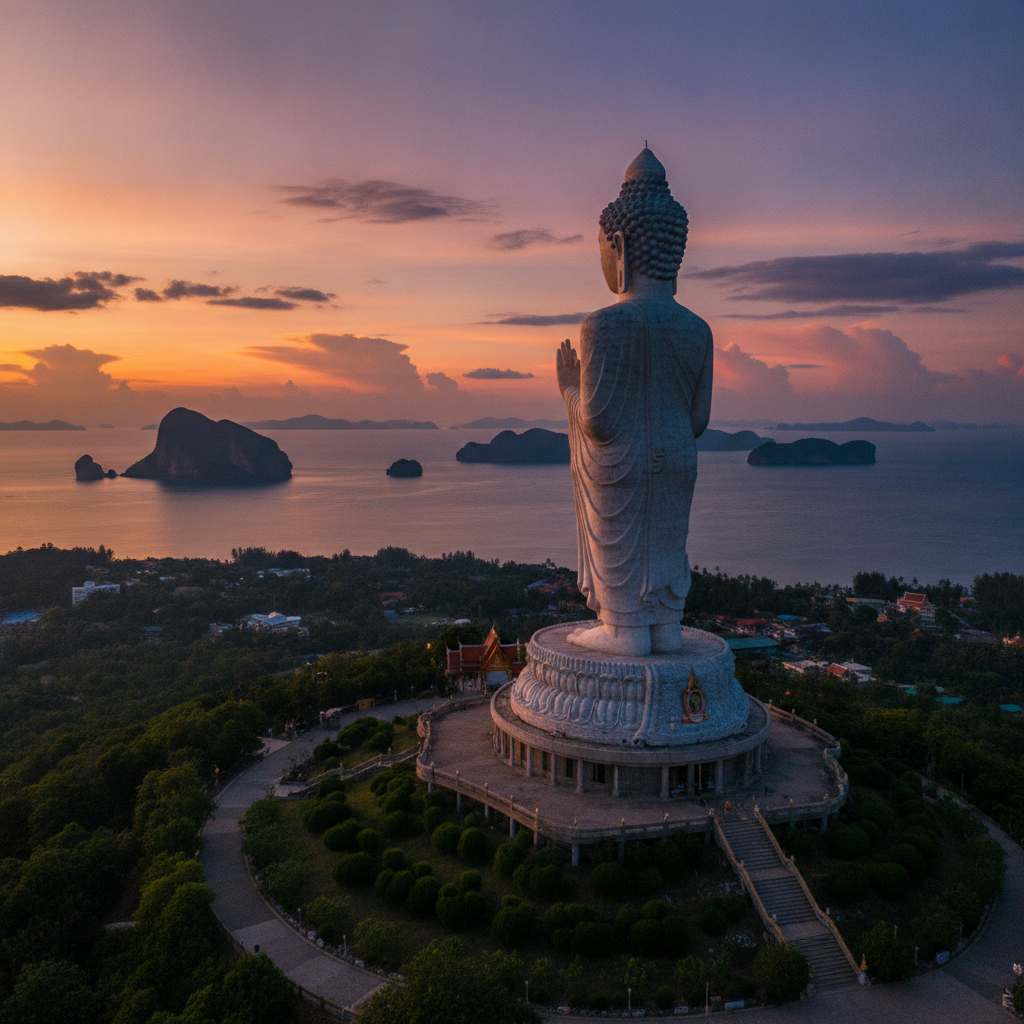
Phuket's Big Buddha—a 45-metre seated Maravija Buddha image in Burmese white marble, visible from most of the island's southern half, constructed on the Nakkerd Hills (345 metres) between 2004 and 2021 at a cost of over 30 million baht (€820,000) funded entirely by donations—is the island's most visible landmark and a significant Buddhist pilgrimage site for Thai visitors (many of whom come from the mainland specifically to donate to the ongoing construction and maintenance). The views from the base: on clear days, both coasts of Phuket and the surrounding islands are visible simultaneously—the Andaman Sea to the west, Phang Nga Bay to the east, the Phi Phi Islands to the south. The adjacent Wat Chalong (the largest and most visited temple on Phuket island—dedicated to two 19th-century monks, Luang Pho Cham and Luang Pho Chuang, who are believed to have led the local Phuket Chinese community in defending the island against Haw-Chinese bandits in the 1870s) is the starting point for most Thai religious visits to the island.
- 2
Phuket's Food Scene – Southern Thai Cuisine
Southern Thai cuisine—the food tradition of the Thai-Malay peninsula from Chumphon southward—is significantly different from the central Thai food (pad thai, green curry, tom yum) that most visitors know. The defining characteristics: higher heat (southern curries use fresh turmeric, dried chillies, and shrimp paste in combinations not used in the north or centre), the strong Muslim-influenced Malay food tradition of the south (massaman curry—Thai-Muslim, containing spices from the Indian trade route; mee Hokkien—a yellow noodle dish brought by Chinese immigrants; roti—flaky flatbread sold from Muslim market stalls). Phuket-specific food: khao yam (a southern rice salad with fresh herbs, toasted coconut, dried seafood, and a sour-sweet dressing—one of southern Thailand's most distinctive dishes), mee Hokkien (Phuket's Chinese-origin stir-fried noodle with prawns and pork crackling), and the seafood (the local fishing industry supplies fresh-caught grouper, squid, and crab to the seafood restaurants of Rawai and the Phuket Town market).
- 3
Phuket's Luxury Resort Economy – High-End Tourism
Phuket has developed one of Asia's most sophisticated luxury resort ecosystems—a consequence of the island's natural assets (consistent sun, beautiful beaches, accessible international airport), early investment in high-end infrastructure, and the absence of the historical architectural heritage that makes competing destinations like Bali simultaneously more culturally rich and more visually complex. The luxury tier: the Amanpuri (opened 1988—the Aman group's original and most iconic property, 40 pavilions on the Pansea headland north of Patong, the resort that defined the 'pavilion in the trees' tropical luxury model for the entire industry), the Six Senses Yao Noi (in Phang Nga Bay, on the island with the most dramatic James Bond Island views), and a cluster of smaller ultra-luxury properties on the north end of Surin and Bang Tao beaches. The economic model: high-end resort stays typically cost $500–2,000/night, attract a different demographic (wealthy Europeans, Gulf state visitors, Asian high-net-worth) from the Patong backpacker market, and generate disproportionate revenue per visitor while occupying less land and generating less environmental impact.
- 4
Bang Tao Beach & the Laguna Resort Complex
Bang Tao Beach—6 km of undeveloped sand on Phuket's northwest coast, accessible along a rough track until the early 1990s—is now dominated by the Laguna Phuket resort complex: a cluster of six 5-star hotels (Angsana, Outrigger, Banyan Tree flagship property, Cassia, Dusit Thani, and others) arranged around a system of interconnected lagoons on a former tin mine site. The Laguna complex—opened in phases from 1992, covering 1,000 acres—is the most ambitious integrated resort development in Thailand: guests can move between the six hotels by boat through the lagoon system, sharing golf course, beach club, and restaurant facilities. The property transformation of a former tin-mining waste lagoon into a luxury resort is both an engineering achievement (the water had to be detoxified and the land stabilised) and a critique of the environmental accounting of tourism development. The northern end of Bang Tao Beach beyond the Laguna complex remains quieter, with independent beach clubs and budget guesthouses.
- 5
Phuket vs Koh Samui – Thailand's Island Divide
The comparison between Phuket (Andaman Sea coast, 570 km², connected to the mainland by a 700-metre bridge) and Koh Samui (Gulf of Thailand, 229 km², reached by ferry or flight from Surat Thani) illuminates the range of island tourism experiences in Thailand and the ways in which geography, development history, and visitor demographics shape different resort personalities. Phuket: larger, more developed, more diverse in accommodation range (from ₹300 baht/night guesthouses to ₹60,000 baht/night Aman suites), international airport with direct European flights, strong Chinese and Russian visitor base, Bangla Road party culture, more varied beach character (10+ distinct beaches with different personalities). Koh Samui: smaller, more intimate scale, concentrated on Chaweng and Lamai beaches, famous for the Full Moon Party at nearby Koh Phangan (monthly on the full moon—originally a beach party of a few hundred travellers in 1985, now 20,000–30,000 attendees), generally younger and more backpacker-oriented in the cheaper areas, somewhat more conservative in the north around the Fisherman's Village at Bophut.
- 6
Practical Phuket – Getting There, Getting Around & Avoiding the Pitfalls
Phuket International Airport (HKT)—5 km north of Thalang, 35 km north of Patong—receives direct flights from Bangkok (1.5 hours, ₹1,200–4,000 baht/€33–109), direct flights from Singapore, Kuala Lumpur, Hong Kong, and seasonal charter flights from Europe, Russia, China, and Australia. Getting around: the taxi mafia (metered taxis are absent from Phuket entirely; all taxi services operate on fixed, negotiated rates set by the Phuket Taxi Association—consistently higher than Bangkok, frequently negotiated in bad faith with tourists; prices from airport to Patong ₹600–800 baht/€16–22); Grab (available on Phuket but drivers sometimes refuse app rides in favour of cash-at-higher-price; enforcement is selective); rented scooter (₹200–400/day—the practical way to explore the island, required for the interior and less-served beaches, but traffic on the main roads is dangerous and accident rates are high for inexperienced riders). Best seasons: November–April (dry season, ideal conditions); May–October (monsoon, some rain daily, beach flags often red, cheaper prices, quieter). Avoid: Bangla Road New Year (extreme crowds), Songkran (heavy water fighting in built-up areas).
Walk this route with audio
Stories play automatically as you reach each stop — no tapping needed.
More in Phuket
Phuket's Lesser-Known Faces: Khao Lak's Police Boat Tsunami Memorial, Gibbons in the Last Forest & Sailing the Andaman
Phuket Complete: Phang Nga Bay's James Bond Island, Sino-Portuguese Old Town & the Andaman Sea's Leopard Sharks
Phuket's Identity: The Hokkien Heroines of 1785, Hi-So Surin Beach & the Island That Contains All Contradictions
Phuket's Hidden Depth: Tin Miners' Shophouses, Body-Piercing Vegetarian Festival & Ko Phi Phi's Overcrowding Crisis