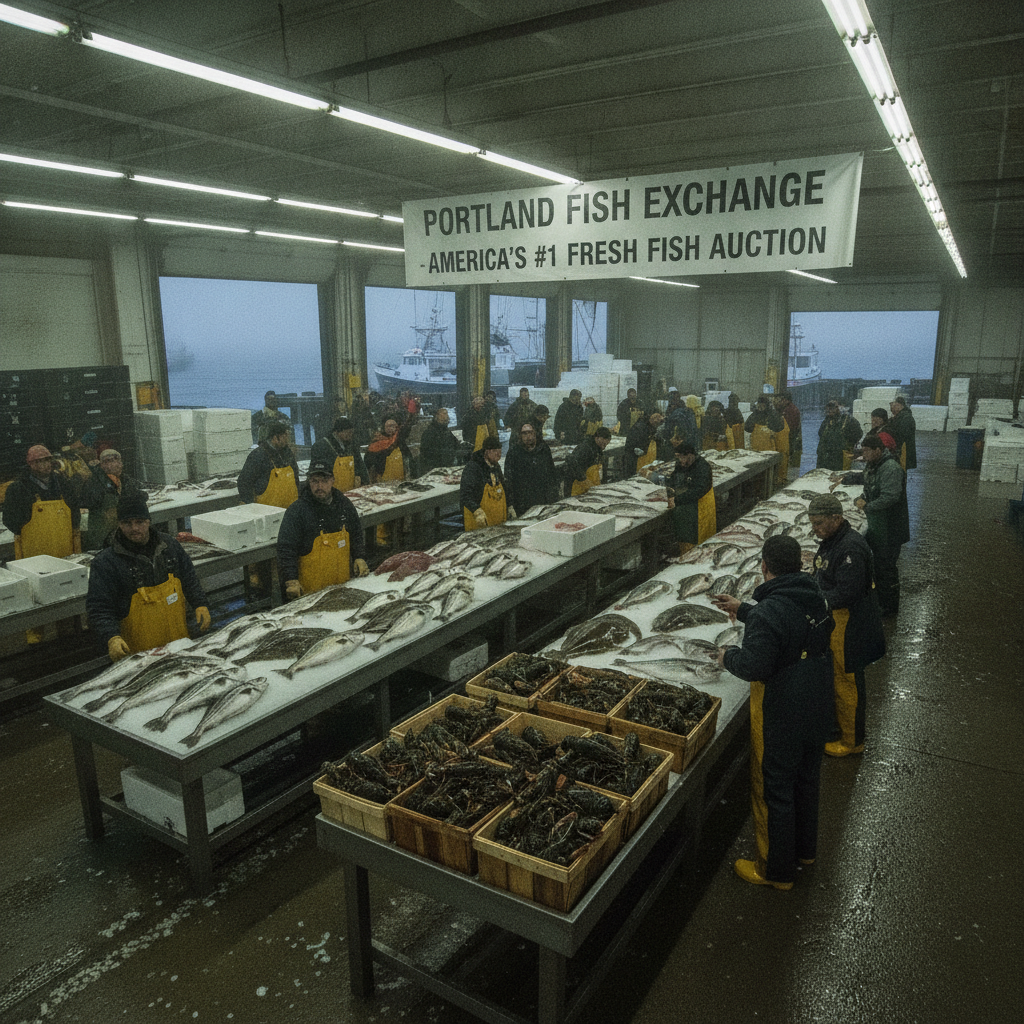
Portland Maine R5: Great Fire July 4 1866 (firecracker boatshop 4pm 1500 buildings 10,000 homeless 2 dead, rebuilt by 1870 most architecturally unified Victorian streetscape US, Italianate brick bracketed cornices, Maine granite Vinalhaven Deer Isle Crotch Island most important US stone industry 1820-1900), Civil War (70,000 Maine men 70% male population, 20th Maine Gettysburg July 2 1863, Chamberlain born 1828 Brewer bayonet charge Little Round Top saved Union left Medal of Honor awarded June 11 1900 37 years later, 54th Massachusetts Fort Wagner July 18 1863 Glory 1989 Denzel Washington Oscar), Bowdoin (1794 Brunswick 40km, Hawthorne Scarlet Letter 1850, Longfellow, Franklin Pierce 14th President Kansas-Nebraska Act 1854, Chamberlain, Peary North Pole, Peary-MacMillan Arctic Museum, University of Maine 1865 Orono 11,000), Freeport L.L. Bean (1912 Leon Bean Maine Hunting Shoe 100 pairs refunded, 24hrs 365 days since 1912, 3M visitors/year, 200 outlet stores, Desert of Maine overfarmed glacial silt 50 acres), Literature (Thoreau Maine Woods 1864 Katahdin 1846, E.B. White Charlotte's Web North Brooklin farm 1938-1985, Robert McCloskey born 1914 died Deer Isle 2003 Make Way Ducklings 1941 Caldecott 1942 Blueberries Sal), Economy (Aroostook 18-20% poverty 30% population loss since 1960, logging Penobscot River, paper mills Millinocket East Millinocket Lincoln Rumford closed 2008-2014 5000 jobs, cannabis 2016 2020 retail USD 150M 800 retailers, remote work COVID top 10 inflows).
Portland Maine R5: Great Fire July 4 1866 (1500 buildings 10,000 homeless, rebuilt 1870 most unified Victorian streetscape, Italianate brick, Maine granite most important US stone 1820-1900), Civil War (70,000 men, 20th Maine Gettysburg July 2 1863, Chamberlain bayonet charge Little Round Top Medal of Honor 37 years later, 54th Massachusetts Fort Wagner 1863 Glory 1989 Denzel Oscar), Bowdoin (1794 40km, Hawthorne Scarlet Letter, Pierce 14th Kansas-Nebraska 1854, Chamberlain Peary, Peary-MacMillan Arctic Museum, UMaine 1865 11,000), Freeport L.L. Bean (1912 Maine Hunting Shoe 100 refunded, 24hrs 365 days, 3M visitors 200 outlets, Desert of Maine glacial silt 50 acres), literature (Thoreau Maine Woods 1864, E.B. White Charlotte's Web North Brooklin, McCloskey Deer Isle 2003 Make Way Ducklings Caldecott 1942), economy (Aroostook 18-20% poverty 30% loss, logging Penobscot, paper mills 2008-2014 5000 jobs, cannabis 2020 USD 150M, remote work COVID top 10).
- 1
The Great Fire of 1866 and Portland's Rebuilding
The Great Fire of Portland (July 4-5, 1866): the most devastating urban fire in American history to that date, ignited by a firecracker thrown by a boy into a wooden boatbuilder's shop on Commercial Street at approximately 4pm on July 4. The fire burned for 10 hours through the wooden commercial buildings of the Old Port and Congress Street, destroying approximately 1,500 structures (out of a total of approximately 4,500 in the city), killing 2 people (remarkably few given the scale of destruction), and leaving approximately 10,000 of Portland's 31,000 residents homeless. The fire's silver lining: the speed and coherence of the rebuilding (most buildings were completed by 1870, with the entire downtown rebuilt within 5 years) created one of the most architecturally unified streetscapes in America — a coherent Victorian commercial city that has been largely preserved because Portland never grew large enough to require wholesale demolition of the 19th-century fabric. The Italianate commercial style: the predominant style of the rebuilt Portland is Italianate brick commercial architecture (bracketed cornices, round-arched windows, and cast-iron storefronts), a style directly imported from the commercial buildings of Boston's downtown that gives Exchange Street, Fore Street, and Middle Street their distinctive character. The role of granite: Portland's historic buildings also use local Maine granite (quarried on Vinalhaven, Deer Isle, and at the quarries of Crotch Island in Penobscot Bay) for foundations, steps, and ornamental elements — the same granite used in federal buildings throughout the eastern United States (the Portland granite trade was the most important stone industry in the United States from approximately 1820 to 1900).
- 2
Maine in the Civil War - the 20th Maine and Joshua Chamberlain
Maine in the Civil War: Maine contributed disproportionately to the Union war effort, sending approximately 70,000 men to service (out of a total male population of approximately 325,000, representing one of the highest service rates of any Union state). The 20th Maine Infantry Volunteer Regiment: the regiment that fought the most celebrated small-unit action of the Civil War — the defense of Little Round Top at the Battle of Gettysburg (July 2, 1863). Joshua Lawrence Chamberlain (born September 8, 1828, Brewer, Maine; died February 24, 1914, Portland, Maine): the professor of rhetoric at Bowdoin College who commanded the 20th Maine at Gettysburg, and whose decision to order a bayonet charge down Little Round Top when the regiment had exhausted its ammunition (the charge repulsed the Confederate assault on the Union left flank and, many historians argue, saved the Union army from encirclement and possibly decisive defeat at Gettysburg) is the most celebrated tactical decision by a junior officer in the Civil War. Chamberlain received the Medal of Honor for his actions at Gettysburg (awarded June 11, 1900 — 37 years after the battle). The 54th Massachusetts Infantry (the African American regiment commanded by Colonel Robert Gould Shaw, whose assault on Fort Wagner, South Carolina, on July 18, 1863, is depicted in the film Glory — 1989, directed by Edward Zwick, with Denzel Washington winning the Academy Award for Best Supporting Actor): not a Maine regiment but deeply connected to the Maine abolitionist tradition (the abolitionist movement in New England, centered in Portland, was one of the primary political drivers of the Civil War). The Maine Civil War Museum (at 1 Lithgow Street, Augusta, Maine, 80 km north of Portland): the museum covering Maine's Civil War contributions.
- 3
Bowdoin College and Maine's Academic Institutions
Bowdoin College (at 255 Maine Street, Brunswick, Maine, 40 km north of Portland, founded 1794): the liberal arts college that has produced more nationally significant alumni relative to its size (approximately 1,800 students) than virtually any other American institution of higher education. Bowdoin notable alumni: Nathaniel Hawthorne (born July 4, 1804, Salem, Massachusetts; died May 19, 1864, Plymouth, New Hampshire, the author of The Scarlet Letter 1850 and The House of the Seven Gables 1851), Henry Wadsworth Longfellow (see above), Franklin Pierce (14th President of the United States, born November 23, 1804, Hillsborough, New Hampshire; died October 8, 1869, Concord, New Hampshire — one of the most unpopular presidents in American history, who signed the Kansas-Nebraska Act in 1854, effectively nullifying the Missouri Compromise and accelerating the onset of the Civil War), Joshua Chamberlain (see above), and Robert Peary (the Arctic explorer). Bowdoin's Arctic collections: the Peary-MacMillan Arctic Museum (at 9500 College Station, Bowdoin College): the museum preserving the equipment, journals, and artifacts from the North Pole expeditions of Robert Peary (1856-1920) and Donald MacMillan (1874-1970, the last surviving member of the 1909 North Pole expedition, who returned to the Arctic 26 times over his lifetime). The University of Maine (at 168 College Avenue, Orono, Maine, 130 km north of Portland, founded 1865): the flagship public university of Maine, with approximately 11,000 students, the Alfond Arena (hockey arena), and the most important agricultural research program in the state (the UMaine Cooperative Extension provides agricultural research and outreach throughout Maine).
- 4
Freeport, L.L. Bean, and Maine Outlet Shopping
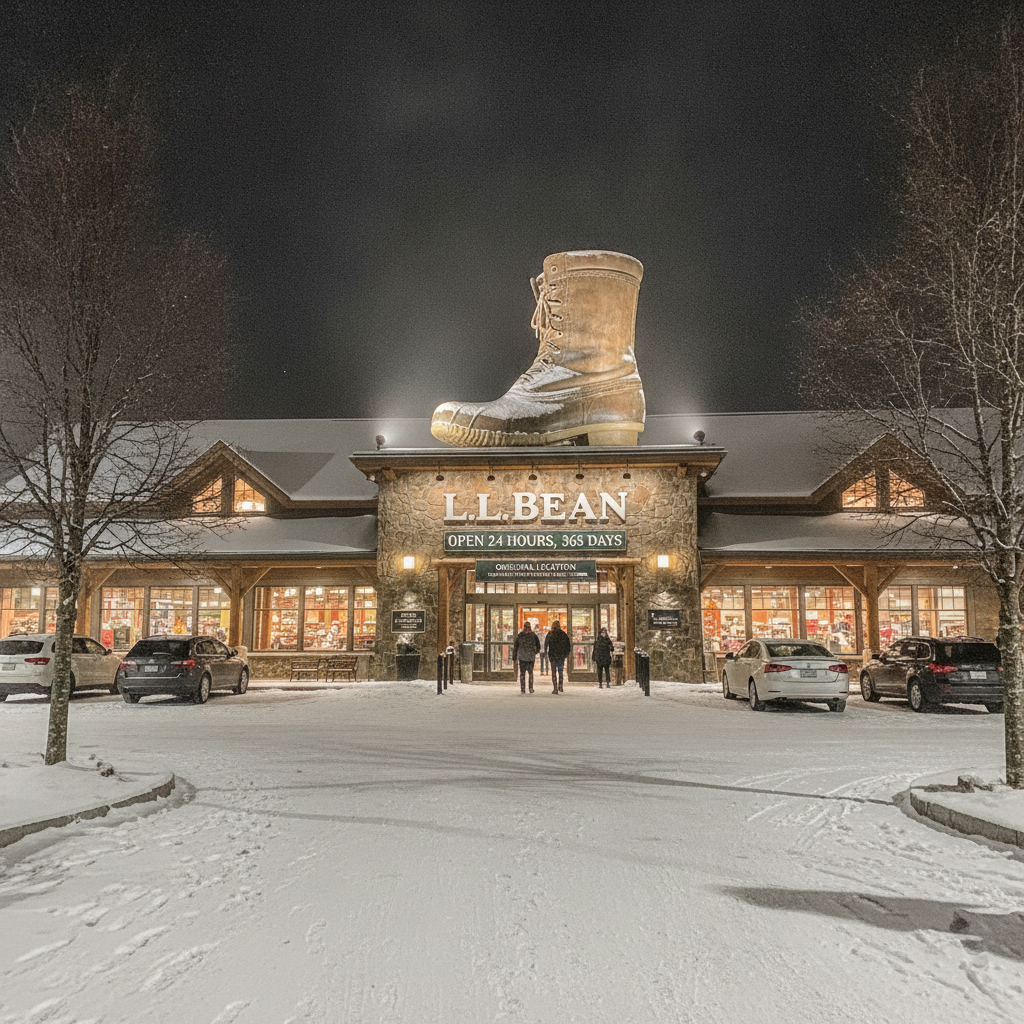
Freeport, Maine (at 30 km north of Portland on US Route 1 and Interstate 295): the outlet shopping village built around the L.L. Bean flagship store, which attracts approximately 3.5 million visitors per year to a town with a permanent population of approximately 8,500 — making Freeport the most visited small town in Maine. L.L. Bean history: Leon Leonwood Bean (born October 13, 1872, Greenwood, Maine; died February 5, 1967, Pompano Beach, Florida) founded L.L. Bean in 1912 after inventing the Maine Hunting Shoe (a rubber-bottomed, leather-topped boot that kept his feet dry while hunting — the original design was improved after the first 100 pairs fell apart and Bean refunded all 100 customers, establishing the unconditional satisfaction guarantee that remains the cornerstone of the L.L. Bean brand). The L.L. Bean flagship store (the original and primary retail location, at 95 Main Street, Freeport, open 24 hours a day, 365 days a year, with approximately 3 million square feet of retail space after numerous expansions): the most famous retail store in Maine and one of the most famous in the United States. Bean's outdoor recreation programs: the L.L. Bean Outdoor Discovery Schools offer courses in kayaking, fly fishing, snowshoeing, cross-country skiing, and outdoor skills at locations throughout Maine. The Freeport outlet district: in addition to L.L. Bean, Freeport has approximately 200 outlet stores (including Patagonia, Orvis, Brooks Brothers, Coach, and dozens of other brands) concentrated along Main Street and Bow Street, making it one of the three or four most significant outlet shopping destinations on the East Coast. Desert of Maine (at 95 Desert Road, Freeport, 5 km from the L.L. Bean store): the 160-year-old geological curiosity in which overfarming and overgrazing in the 19th century exposed the glacial silt deposits beneath the topsoil of the Tuttle Farm, creating a 50-acre deposit of fine glacial sand that gives the appearance of a desert in coastal Maine.
- 5
The Maine Coast in Literature - The Atlantic and Caldecott Awards
Maine in American cultural imagination: no state has been more thoroughly romanticized in American literature and visual art than Maine, and no state's coastline has been more frequently painted, photographed, and written about. The Maine coast in American literature: the Penobscot Bay area has inspired a disproportionate share of American nature and outdoor writing, from Henry David Thoreau's The Maine Woods (1864, documenting three canoe journeys into the Maine wilderness, including his ascent of Katahdin in 1846 and his account of the logging industry that was destroying the Maine forest) to E.B. White's essays in the New Yorker and Harper's Magazine that described his saltwater farm in North Brooklin. The White farmhouse (at 34 Allen Cove Road, North Brooklin, Maine, 220 km northeast of Portland): the farm where E.B. White (the author of Charlotte's Web, Stuart Little, and The Elements of Style, the most influential writing guide in American history) lived from 1938 until his death in 1985. Robert McCloskey (born September 15, 1914, Hamilton, Ohio; died June 30, 2003, Deer Isle, Maine): the author and illustrator of Make Way for Ducklings (1941, set in Boston Public Garden, the most beloved American picture book of the 20th century, winning the Caldecott Medal in 1942) and Blueberries for Sal (1948, set on a Maine hillside), who lived on an island in Penobscot Bay and used the Maine coast as the setting for his most important work. Caldecott Medal fact: the Caldecott Medal (awarded annually since 1938 by the American Library Association for the most distinguished American picture book illustration) is named for the Victorian illustrator Randolph Caldecott — not an American, and not from Maine.
- 6
Maine's Economy, Poverty, and the Rural-Urban Divide
Maine's economic geography: Maine has the most significant rural-urban economic divide of any northeastern state, with Portland and the Midcoast experiencing prosperity and growth while large areas of northern, western, and eastern Maine face deep poverty, population loss, and the collapse of traditional resource industries (logging, fishing, potato farming). The Maine poverty rate (approximately 11-12% overall) conceals extreme geographic variation — Aroostook County (the large farming county in northern Maine, bordering Quebec and New Brunswick) has a poverty rate of approximately 18-20% and has lost approximately 30% of its population since 1960 as the mechanization of the potato harvest eliminated the seasonal agricultural labor economy. The logging industry: Maine was the most heavily logged state in America from the 1840s to the 1920s, with the Penobscot River (the primary log-driving river in Maine) carrying millions of board feet of lumber annually from the forests of the interior to the mills of Bangor and Old Town. The collapse of the Maine paper industry (the paper mills of Millinocket, East Millinocket, Lincoln, and Rumford closed between 2008 and 2014, eliminating approximately 5,000 mill jobs in towns that had been built around single employers) represents one of the most complete economic collapses in recent American history. The cannabis economy: Maine legalized recreational cannabis in 2016 (effective 2020 for retail sales), and cannabis has become one of the fastest-growing agricultural industries in the state, with approximately 800 registered cannabis retailers by 2024 generating approximately USD 150M in annual sales. The Maine New Economy: the combination of outdoor recreation tourism, craft food and beverage production, remote work migration (Portland was among the top 10 US cities for remote worker inflows during the COVID-19 pandemic), and the creative economy has partially offset the decline of traditional resource industries.
Walk this route with audio
Stories play automatically as you reach each stop — no tapping needed.
More in portland-maine
Portland Maine: Old Port, lighthouses, lobster industry, food scene, Acadia, and practical guide
Portland Maine R2-R5: Arts District (Portland Museum of Art 1882 18,000 works Winslow Homer collection, I.M. Pei wing 1983, First Friday Art Walk 10,000 monthly, Portland Observatory 1807 only remaining US maritime signal tower, State Theatre 1929 Art Deco 1600 seats); Literary (Harriet Beecher Stowe Uncle Tom's Cabin 1851-1852 best-selling 19th century US after Bible 300,000 copies year one Lincoln so you started this great war, Stephen King born Portland 1947 Bangor bat-gate house, Sarah Orne Jewett Country Pointed Firs 1896, E.B. White Charlotte's Web Maine saltwater farm); Casco Bay Islands (Peaks Island 15min 1000 residents Battery Steele WWII 1942 graffiti murals, Cliff Island 60 residents 90min no stores roads, Eagle Island Peary North Pole April 6 1909 summer home 1904, Maine Island Trail 375 miles 7000 kayakers); Wilderness (90% forested 7M hectares, moose 75,000-80,000 largest contiguous US, Baxter 83,371ha Governor Baxter 37 donations 1931-1962, Katahdin 1606m AT northern terminus 3540km 1000-1500 thru-hikers/year, Moosehead Lake 483km2 largest NE); Architecture (Great Fire July 4 1866 1500 buildings 10,000 homeless most destructive US before Chicago 1871, rebuilt 1867-1875 most coherent Victorian streetscape US, Victoria Mansion 1858 finest Italian Villa US, City Hall Carrere Hastings 1909); Seasonal (summer book 2-4 weeks advance, Lobster Festival July, Sunday River 135 trails, Sugarloaf best natural snow).
Portland Maine R4: Winslow Homer (born 1836 moved Prouts Neck 1883, Northeaster 1895 Blue Boat 1892 Eight Bells 1886, studio National Historic Landmark opened 2012, Farnsworth Museum Rockland finest NE regional art NC Wyeth died railroad crossing 1945, Andrew Wyeth Christina's World 1948 Olson House Cushing, Jamie Wyeth 1946 dynastic family), outdoors (sea kayaking premier eastern US, Maine Island Trail 600km 200 island campsites, L.L. Bean Freeport 1912 open 24hrs 365 days since 1951, Mount Battie 475m Camden Hills, Sugarloaf 1291m above treeline), Congress Street (Maine Historical Society 1822 oldest institution 2M items, Monument Square Civil War memorial Simmons 1891, Portland Press Herald 1862, West End Victorian Federal Greek Revival Italianate Queen Anne), Rangeley Lakes (180km north, 650km2 lake chain, Victorian resort 1880s Rangeley Lake House 500 guests, brook trout 6-8kg depleted, Wilhelm Reich Museum 1897-1957 orgone FDA censored destroyed publications 1954-1956 most significant scientific censorship US), Lobster roll (cold Mayo Maine-style vs warm drawn butter CT-style, Reds Eats Wiscasset 41 Water Street 45-90min lines full pound no mayo, Lukes Lobster 2009 Holden, Eventide brown butter bao, Five Islands lobster shacks), Wabanaki (Penobscot Passamaquoddy Maliseet Mi'kmaq Abenaki 12,000 years, Indian Island Old Town 2500 members, birchbark canoe 400kg capacity 20kg weight, Maine Indian Claims Settlement 1980 USD 81.5M 60% of Maine largest US Native settlement at time, Abbe Museum Bar Harbor).