Memory & Stone: Prague's Jewish Quarter (Josefov)
One of Europe's best-preserved Jewish quarters, Prague's Josefov tells a thousand years of Jewish history through six synagogues, the oldest Jewish cemetery in Central Europe, and one of the world's greatest collections of Judaica. This walk through a neighborhood that has survived pogroms, Joseph II's urban reforms, and the Holocaust is both a moving memorial and an architectural revelation.
- 1
Old-New Synagogue
The oldest surviving synagogue in Europe, the Staronová synagoga was built around 1270 in an austere Gothic style that predates almost all Gothic structures in Bohemia. According to legend, the synagogue is built on the site of an ancient temple, and the clay figure of the Golem—created by Rabbi Loew ben Bezalel in the 16th century to protect the Jewish community—lies dormant in the attic, awaiting revival. The interior is still used for prayer services: twelve-pointed stars, tattered medieval banners, and the ancient bimah create an atmosphere of extraordinary antiquity. The synagogue survived all attempts to demolish it—including Josef II's 18th-century demolition of the ghetto—because it was deemed too sacred to destroy.
- 2
Old Jewish Cemetery
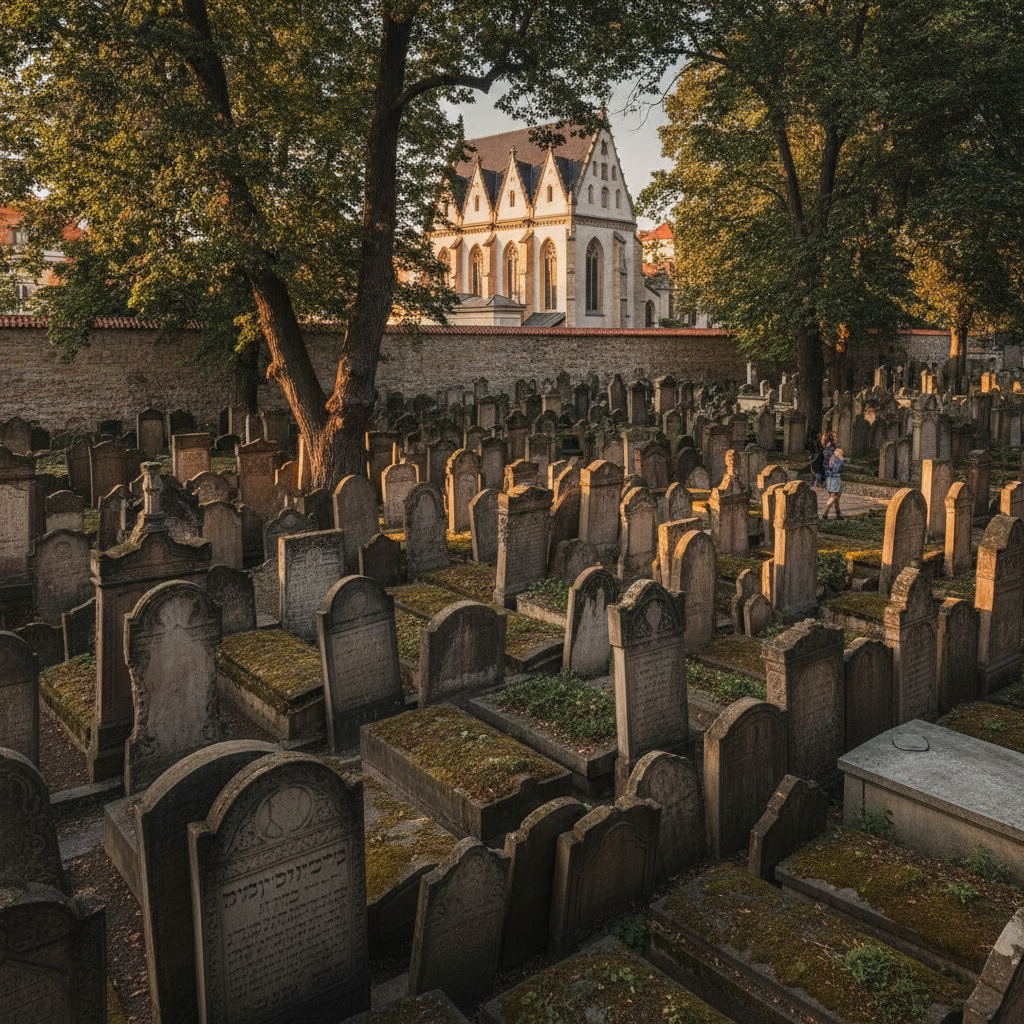
The most powerful site in Josefov, the Starý židovský hřbitov was in use from the early 15th century until 1787. Because Jewish law forbids the destruction of a grave, and because the ghetto had no room to expand, the dead were buried in layers—up to twelve deep in some sections. The result is a dense field of some 12,000 tombstones, tilted at every angle by centuries of subsidence, packed so tightly that they form a continuous textured surface of stone. Among those buried here is Rabbi Loew (died 1609), whose grave is still covered in pebbles and notes by visitors seeking his blessing. Walking through the cemetery, surrounded by leaning stones and twisted trees, is one of the most affecting experiences in Prague.
- 3
Pinkas Synagogue
Built in 1535, the Pinkasova synagoga is now a memorial to the 77,297 Bohemian and Moravian Jews murdered in the Holocaust—the second-largest Jewish community destroyed in the Nazi genocide. Every available wall surface inside the synagogue is covered in handwritten names, dates of birth, and dates of deportation, written in an act of collective commemoration by Jewish artists after 1945. The Communist authorities whitewashed the walls in 1968 (claiming damp); the names were painstakingly restored after 1989 and continue to be maintained. The upper floor holds an exhibition of drawings made by children in the Theresienstadt concentration camp—an astonishing record of imagination surviving amid horror.
- 4
Maisel Synagogue
The original Maisel Synagogue, built in 1592 by Prague's Jewish mayor Mordecai Maisel, was the most lavish private synagogue in Europe—a reflection of Maisel's extraordinary wealth and his close relationship with Emperor Rudolf II. The current Neo-Gothic building (rebuilt after fires in 1689 and 1754) houses the Jewish Museum's collection of silver Judaica, Torah crowns, pointers, and ceremonial objects. The collection was assembled partly from items confiscated by the Nazis from hundreds of destroyed Jewish communities across Bohemia and Moravia—making it one of the largest collections of its kind in the world, preserved by an irony of history.
- 5
Spanish Synagogue
The newest and most ornate of Josefov's synagogues, the Španělská synagoga was built in 1868 in a Moorish-Alhambra Revival style—a deliberate evocation of the golden age of Sephardic Jewish culture in medieval Spain. Every surface of the interior is covered in geometric patterns, arabesques, and gilded stucco in turquoise, gold, and terracotta—a visual intensity that makes it one of the most remarkable interiors in Prague. The building now houses an exhibition tracing the history of Jews in Bohemia and Moravia from the Emancipation of 1781 to the present day.
- 6
Rudolfinum Concert Hall
At the edge of Josefov, overlooking the Vltava, the Rudolfinum is Prague's premier concert venue and one of the finest examples of Czech Neo-Renaissance architecture. Built in 1885 and home to the Czech Philharmonic Orchestra, the building's Dvořák Hall is considered among the most acoustically perfect concert spaces in the world. The Rudolfinum's terrace café, overlooking the river and the distant towers of the Old Town, is one of the most civilized spots in the city for an afternoon coffee—a graceful counterpoint to the weight of history in the streets behind you.
Walk this route with audio
Stories play automatically as you reach each stop — no tapping needed.
More in prague
The High Ground: Letná Park, Holešovice & Prague's Creative Quarter
Stone Saints & Hidden Gardens: Charles Bridge & Malá Strana
Bohemian Crown: Prague Castle & Hradčany
River & Gardens: Troja Chateau, Prague Zoo & the Wild North
Legend & Sky: Vyšehrad Fortress & the Czech Pantheon