Quebec City: The Song Used Instead of Happy Birthday at Every Party, the Pedestrian Street Saved by Artists in 1970 and the Underwater Boat Found Under a Plaza
Watch the provincial government run a province of 8.5 million from a Second Empire building where bar terraces line the opposite sidewalk and the lieutenant governor lives in a cliff-top Victorian house now open as a public park, understand that Bonhomme Carnavals sash is the same type of belt the voyageurs used to support their backs during thousand-kilometre winter paddling journeys, walk the narrowest commercial street in North America saved from abandonment by artists renting derelict 17th-century stone buildings in 1970, hear Gilles Vigneaults Gens du pays sung at birthdays the way everyone else sings Happy Birthday and understand what that means about Quebec identity, cycle the rehabilitated Saint Charles River park that replaced an industrial waterway in a neighborhood still recovering from 30 years of lead contamination, and see the 18th-century wooden boat pulled from under a plaza that proved everything built in Old Quebec since 1608 is sitting on top of something older.
- 1
Quebec City Governance and National Capital
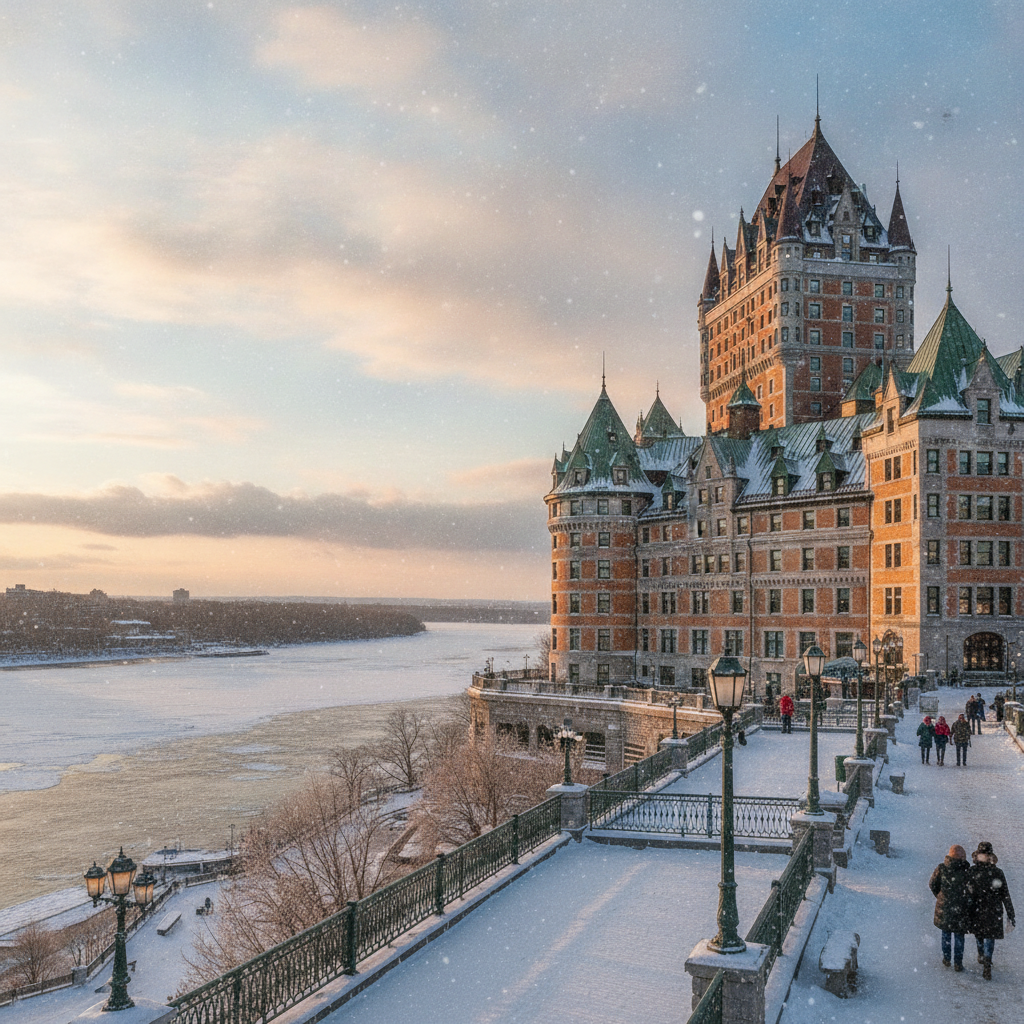
Quebec City serves as the capital of Quebec province, the seat of the National Assembly of Quebec and the entire provincial government apparatus, making it simultaneously a historic tourism city and a functioning political capital where the daily business of governing 8.5 million people takes place. The National Assembly building, constructed in Second Empire style between 1877 and 1886, has a facade decorated with bronze statues of 22 figures from Quebec history. The Grande Allee boulevard running west from the old city walls is lined with government ministries, embassies, and official residences on one side and bar and restaurant terraces on the other, creating a peculiar mixture of officialdom and nightlife unique to Quebec City. The official residence of the Lieutenant Governor of Quebec, Bois-de-Coulonge Park, is a Victorian country house on the cliff above the St. Lawrence accessible as a public park. The city also hosts the offices of numerous Crown corporations, research institutions, and cultural agencies funded by the Quebec government as part of a deliberate policy to maintain Quebec City as a living capital rather than an administrative center emptied after business hours.
- 2
Quebec City Carnival Bonhomme and Traditions
Bonhomme Carnaval, the snowman mascot of the Quebec Winter Carnival created in 1954 for the first modern carnival, wears the Assomption sash, or ceinture flechee, a finger-woven belt of red and multi-colored wool that is one of the most distinctive traditional craft objects of French-Canadian material culture, woven by habitants in the Assomption region east of Montreal beginning in the early 19th century. The sash was worn by voyageurs as a utility belt for tightening loads and providing back support during paddling, and became a symbol of Quebecois identity. Bonhomme holds the key to Quebec City during the Carnival period in a ceremonial handoff from the mayor that the carnival organization insists is entirely literal. The Caribou cocktail, a Carnival tradition consisting of red wine mixed with brandy, vodka, or whiskey and served warm or cold, is sold from the sash-wearing vendors throughout the Carnival grounds. The snow bathing competition, where contestants in swimsuits roll in the snow at outdoor temperatures well below freezing, is the most-photographed event of the Carnival and requires participant insurance. The tradition of Carnival was revived in 1955 after a 24-year hiatus caused by World War II and postwar austerity.
- 3
Vieux-Quebec Petit-Champlain Shopping and Crafts
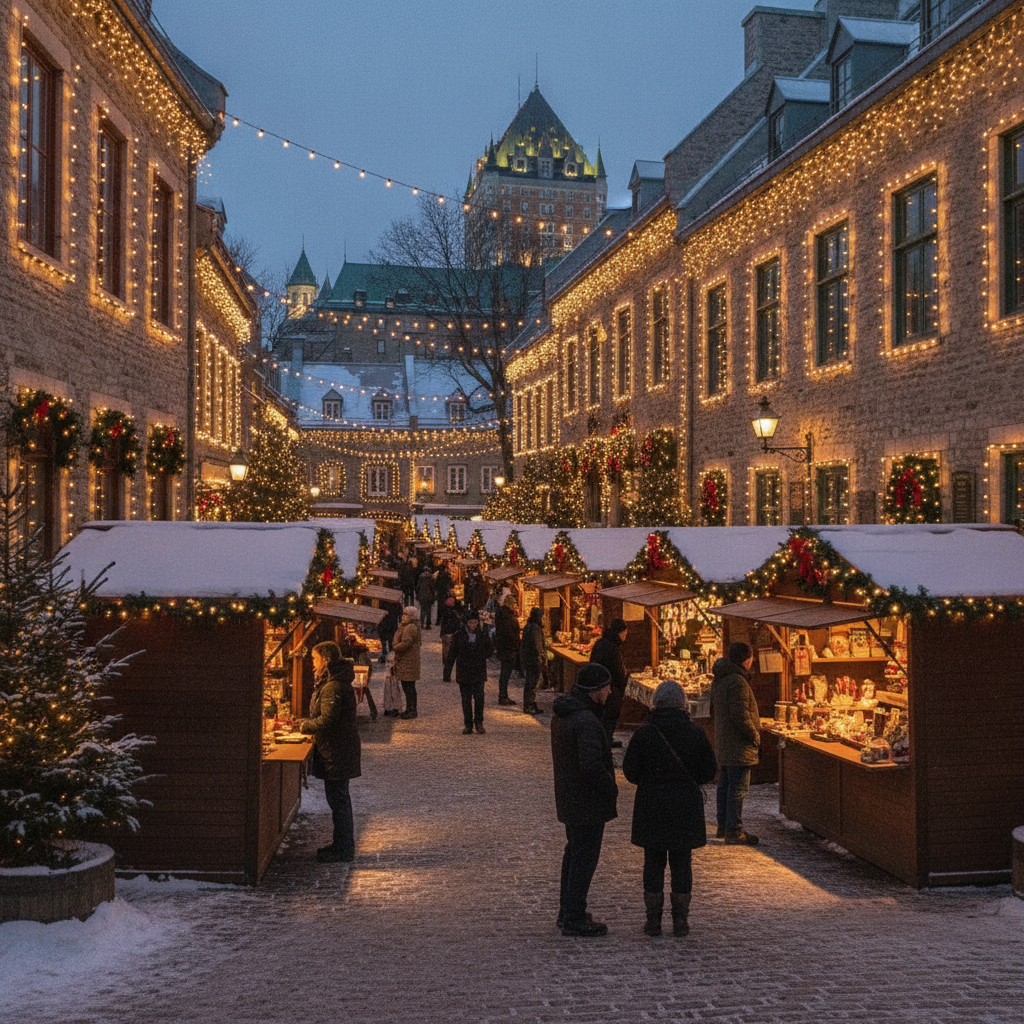
The Quartier Petit-Champlain in Lower Town Quebec City, a pedestrian-only quarter of stone buildings from the 17th and 18th centuries at the base of the cliff below the Chateau Frontenac and accessed by the Breakneck Stairs or the funicular, contains the highest concentration of independent boutiques, craft studios, and artisan workshops in Quebec City, selling locally produced ceramics, weavings, jewelry, indigenous art, woodwork, and food products. The street was virtually abandoned by 1960 when businesses relocated to the suburbs, and was rescued beginning in 1970 by a cooperative of artists and merchants who rented the derelict buildings and established workshops and galleries, pioneering what became a model of heritage commercial district revival. The Christmas season transforms Petit-Champlain into one of the most admired Christmas market environments in North America, with outdoor lights, fir trees, and market stalls. The Maison Louis-Jolliet at the base of the Breakneck Stairs, once the home of the explorer who identified the extent of the Mississippi River in 1673, is now the lower funicular terminal. The Rue du Petit-Champlain is listed as the narrowest commercial street in North America.
- 4
Quebec City Music Scene and Chanson Quebecoise
Quebec City has a distinctive music culture anchored in the chanson quebecoise tradition, the French-Canadian singer-songwriter genre developed in the 1950s and 1960s by artists including Felix Leclerc, Gilles Vigneault, and Pauline Julien, whose songs became anthems of Quebec cultural identity and the sovereignty movement. Gilles Vigneaults song Gens du pays, written in 1975, is used as a birthday song in Quebec in place of the English Happy Birthday and functions as an unofficial national anthem for francophone Quebec. The Bar Le Dag in Saint-Roch and the various small venues on the Rue Saint-Jean outside the old city walls present local artists in the chanson and contemporary folk traditions. The Festival d Ete de Quebec in July is the largest event but smaller festivals including the Carrefour International de Theatre in spring and the Coup de Coeur Francophone in fall present French-language music and theater. The Moulin Images, a nighttime projection show on grain silos at the Old Port, is a large-format son-et-lumiere presentation that has been performed each summer since 2008, using the industrial landscape as a screen for narrative Quebec history.
- 5
Quebec City Saint Charles River and Limoilou
The Saint Charles River, dividing Old Quebec from the Limoilou quarter to the northeast, was the primary waterway of New France after the St. Lawrence, used for log driving, industrial milling, and navigation by smaller vessels that could not navigate the full St. Lawrence. The river was channeled, straightened, and largely buried under urban infrastructure in the 20th century, leaving only a short section visible near where it meets the St. Lawrence at the Old Port. The revitalization of the accessible section of the Saint Charles River into a linear park with cycling and walking paths, completed in 2013, is considered one of the most successful urban waterway rehabilitation projects in Quebec. The Limoilou quarter, developed as a planned working-class neighborhood in the early 20th century with a grid street plan and brick apartment blocks, was stigmatized for decades by its proximity to a lead smelter that closed in 1985 after decades of contaminating the neighborhood, and is now being rehabilitated through arts investment, new restaurants, and population return of young families attracted by affordable housing prices relative to Old Quebec.
- 6
Quebec City Archaeological Discoveries
Quebec City is one of the most archaeologically rich urban sites in North America, with the continuous habitation of the area for 400 years of French and British occupation layered over Indigenous sites going back thousands of years, and the extremely dry stone building basements and cliff-side fill deposits of Old Quebec preserving organic material including wood, leather, seeds, and textiles that would not survive in less stable soil conditions. The discovery of the bateau Josephine under the Place Royale construction site in the 1970s demonstrated the archaeological significance of Lower Town and led to systematic archaeological requirements for any construction in Old Quebec. The Cartier-Brebeuf National Historic Site excavations identified the probable location of Cartiers 1535 winter camp and the Marie-Agatha, a vessel brought by Cartier. The archaeology of the Citadel and fortifications has revealed the complete sequence of defensive construction from the 1690s through the 1850s. The basement of the Hotel-Dieu hospital, founded by the Augustinian nuns in 1639, contains in-situ archaeological remains of the original 17th-century structures. Archaeological artifacts from Old Quebec excavations are displayed at the Musee de la Civilisation and the Parks Canada visitor centers throughout the city.
Walk this route with audio
Stories play automatically as you reach each stop — no tapping needed.
More in Quebec City
Quebec City: The Bridge That Collapsed Twice and Invented Professional Engineering Ethics, the Navy Battle That Really Ended New France and Beaver Hats That Built a City

Quebec City: The Battle That Lasted 15 Minutes But Changed a Continent, the World Largest Winter Carnival and the Tech Quarter Built Under a Chateau
Quebec City: A Bateau Pulled from Under a Building, the Narrowest Sovereignty Referendum in Democratic History and a Language Law That Changed a City
Quebec City: A Meteorite Crater That Made a Wine Region, the Ice Hotel That Melted Every Spring and the Scurvy Cure That Europe Forgot for 200 Years
Quebec City: The First University in Canada Founded 1663, Why the Ice Canoe Race Depends on a Freezing River That Freezes Less Every Decade and What 4.5 Million Tourists Do to a City of 800000