The Appian Way & the Catacombs: Rome's Ancient Road to the Dead
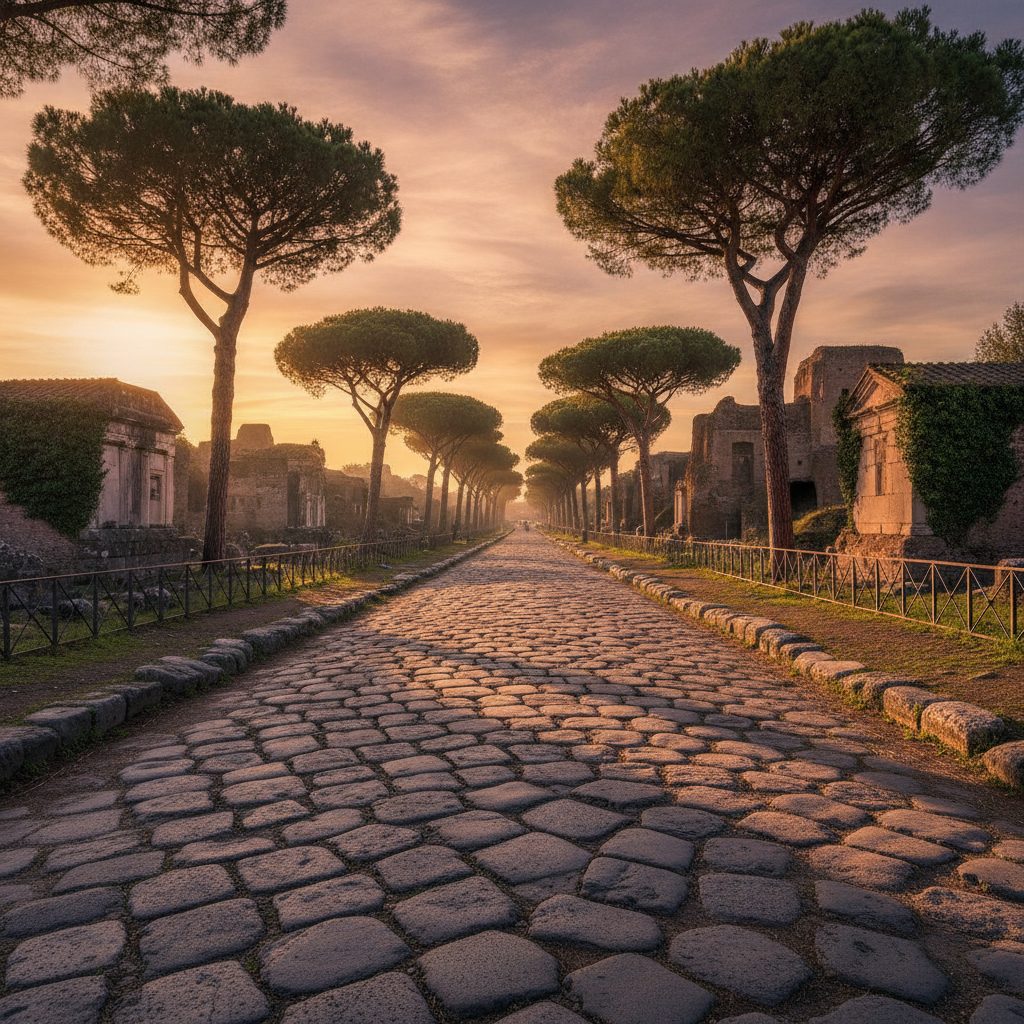
The Via Appia Antica ('Ancient Appian Way'), begun in 312 BC by the Censor Appius Claudius Caecus, was the first and greatest of Roman roads—running 563 km from Rome to Brindisi on the Adriatic coast, and connecting Rome to Greece and the eastern Mediterranean. The stretch immediately outside Rome's Aurelian Wall is lined with ancient Roman tombs (burial inside the city walls was forbidden), which also became the location of the Christian, Jewish, and pagan catacombs. The road is now preserved as a regional park; the original basalt paving stones survive for miles, and the combination of ancient road, tomb monuments, umbrella pines, and the Roman countryside makes this one of the most atmospheric walks or cycling routes in the world.
- 1
Porta San Sebastiano — The Gate of the Appian Way
Porta San Sebastiano, the largest surviving gate of the Aurelian Wall (built 271–275 AD by Emperor Aurelian), marks the point where the Via Appia Antica leaves the city. The gate was substantially strengthened in the 5th and 6th centuries (including by Belisarius, the Byzantine general who defended Rome against the Goths in 536 AD); the current structure, with its two flanking round towers, dates largely from the 5th-century reconstruction. The Museum of the Aurelian Wall is located inside the gate and offers access to a substantial section of the wall itself (with views over the surrounding countryside). Immediately outside the gate, the Via Appia Antica begins—the first paving stones underfoot are original Roman basalt, laid in the 2nd or 3rd century AD, though the road alignment is original to 312 BC.
- 2
Catacombs of San Callisto — The Largest Christian Catacombs
The Catacombs of San Callisto (Catacombe di San Callisto) are the largest, most famous, and most-visited of Rome's approximately 40 known catacombs: an underground cemetery of approximately 20 km of tunnels on four levels, containing approximately 500,000 burials (Christians, Jews, and pagans) from the 2nd through the 5th centuries AD. The site was the official cemetery of the early Church of Rome; 16 popes and a large number of martyrs were buried here (the Crypt of the Popes, on the second level, is the most visited area). The word 'catacomb' derives from the Greek kata kymbas ('near the hollow')—a reference to the topography of this specific site; only later did the term apply to underground cemeteries generally. Guided tours (mandatory; individual visits not permitted) take approximately 45 minutes and cover a small portion of the total tunnel network; the full extent has never been fully mapped.
- 3
Catacombs of San Sebastiano — The Apostolic Catacombs
The Catacombs of San Sebastiano (Catacombe di San Sebastiano) are the only catacombs to have been continuously known and visited since antiquity (the others were lost and rediscovered from the 16th century onward). The site derives special significance from the tradition that the bodies of Saints Peter and Paul were temporarily stored here during the persecutions of the 3rd century—an extraordinary claim that gives the site the name ad catacumbas ('at the hollow') from which the generic term derives. The upper level includes a remarkable series of pagan mausolea (1st–2nd century AD), decorated with frescoes, stucco, and mosaics of exceptional quality, including one of the earliest known representations of a peacock in funerary art (a symbol of immortality). The basilica above (San Sebastiano fuori le Mura, rebuilt 17th century) is one of the seven pilgrimage churches of Rome.
- 4
Circus of Maxentius — The Best-Preserved Roman Circus
The Circus of Maxentius (Circo di Massenzio), built around 309 AD by the Emperor Maxentius on his private villa estate on the Appian Way, is the best-preserved Roman circus (chariot racing track) in existence: the starting gates (carceres) at the north end, the turning posts (meta) at each end, and the central barrier (spina) are all visible, as are the cavea (seating banks) on both sides. At 513 meters long and 91 meters wide, it is only slightly smaller than the Circus Maximus. Because it was never stripped for building materials (unlike the Circus Maximus, which was quarried continuously from the medieval period), the structure survives to a height of several meters in places. The obelisk originally placed on the spina (the Obelisk of Domitian) was moved to Piazza Navona by Pope Innocent X in 1651, where it remains. The complex also included a mausoleum for Maxentius's son Romulus (who died in 309 AD).
- 5
Tomb of Cecilia Metella — The Most Famous Tomb on the Appian Way
The Tomb of Cecilia Metella (Mausoleo di Cecilia Metella), built around 50 BC for the daughter-in-law of the Roman general and statesman Marcus Licinius Crassus (the richest man in Rome, member of the First Triumvirate with Caesar and Pompey), is the most imposing funerary monument on the Appian Way and one of the most photographed ancient structures in Rome. The cylindrical tower (29 meters in diameter, 11 meters high) of travertine stone was incorporated into a medieval castle by the Caetani family in 1302 and served as a toll gate on the Appian Way—visitors were charged to pass. The Caetani battlements were added at this time (giving the structure its distinctively medieval appearance despite its ancient core). The frieze of ox skulls (bucranio) around the drum was an extremely influential decorative motif, widely copied in the Renaissance. Lord Byron described it in Childe Harold's Pilgrimage; Hawthorne, Dickens, and Zola all wrote about it.
- 6
Villa of the Quintilii — The Emperor's Stolen Villa
The Villa of the Quintilii (Villa dei Quintili), 5 km south of the Aurelian Wall, is one of the largest and most luxurious Roman villas ever excavated: a suburban estate of approximately 24 hectares, built in the late 2nd century AD by the brothers Sextus and Marcus Quintili Condianus (suffect consuls in 151 AD). The villa was seized by Emperor Commodus in 182 AD after he had both brothers executed on trumped-up charges—his desire for the villa was apparently the primary motivation—and became an imperial residence. The ruins include a large bath complex, a nymphaeum (ornamental grotto/fountain), a hippodrome (private track for exercise), aqueduct branches feeding the estate, and several ranges of residential rooms. The site was extensively plundered in the Renaissance for marble (including the Laocoön group, found here in 1506 and now in the Vatican Museums), but recent excavations have significantly added to knowledge of the complex. Entry is via a combined ticket with the Caracalla Baths.
Walk this route with audio
Stories play automatically as you reach each stop — no tapping needed.
More in rome
Campo de' Fiori, the Jewish Ghetto & Trastevere: Rome's Most Lived-In Neighborhoods
The Vatican, St. Peter's Basilica & Castel Sant'Angelo: The Heart of Christendom from River to Dome
The Capitoline Hill, Trajan's Markets & the Monti Neighborhood: Between Rome's Ancient Power and its Liveliest Quarter
The Aventine Hill, the Knights' Keyhole & Testaccio: Rome's Best-Kept Secrets
Quirinal Palace, Via Veneto & Capuchin Crypt: From Baroque Power to Dolce Vita Glamour