The Aventine Hill, the Knights' Keyhole & Testaccio: Rome's Best-Kept Secrets
The Aventine Hill is the most quiet and least visited of Rome's seven historic hills—a hilltop of orange gardens, medieval churches, and secret viewpoints, separated from the tourist crowds that pack the Colosseum and Forum just across the valley. Immediately below the hill to the west lies Testaccio, historically Rome's working-class meat-packing district, now transformed into one of the city's best food and nightlife neighborhoods, built on the mountain of broken amphoras (Monte Testaccio) that accumulated over four centuries of the city's wine and oil trade.
- 1
Garden of Oranges — The Secret Viewpoint of Rome
The Garden of Oranges (Giardino degli Aranci, officially Parco Savello) on the Aventine Hill is one of the most beautiful and least-visited gardens in Rome: a small hilltop garden planted with bitter orange trees (the so-called Seville oranges, whose fruit cannot be eaten but whose blossoms perfume the garden in spring), with a terrace at the south end offering one of the finest views of Rome available without a admission fee. The view takes in the Tiber valley, Trastevere, the dome of St. Peter's, the Janiculum, and—on clear days—the Alban Hills. The garden was created in 1932 on the site of the 13th-century fortress of the Savello family; the medieval walls of the fortress are still visible on the garden's edge. The garden is free, rarely crowded, and is best visited in the late afternoon when the light on the Tiber and rooftops is at its most beautiful.
- 2
Santa Sabina — The Most Beautiful Early Christian Church in Rome
Santa Sabina, built 422–432 AD, is the finest example of an early Christian basilica in Rome and one of the most perfectly preserved pre-medieval churches anywhere in the world: the interior retains its original 5th-century cypress wooden doors (the carved panel in the upper left corner is one of the earliest surviving depictions of the Crucifixion in art—without a cross, just the figure of Christ between two others), 24 original Corinthian columns taken from a Roman temple, marble inlay floor, and the long nave with its clerestory windows unchanged in 1,600 years. The church is administered by the Dominican Order and retains an atmosphere of genuine monastic calm. The adjacent ruins include what may be the only surviving example of a Mithraeum (underground temple of Mithras, a mystery religion popular with Roman soldiers) still in situ in Rome. Entry is free; the church is frequently empty.
- 3
Knights of Malta Keyhole — Rome's Greatest Secret View
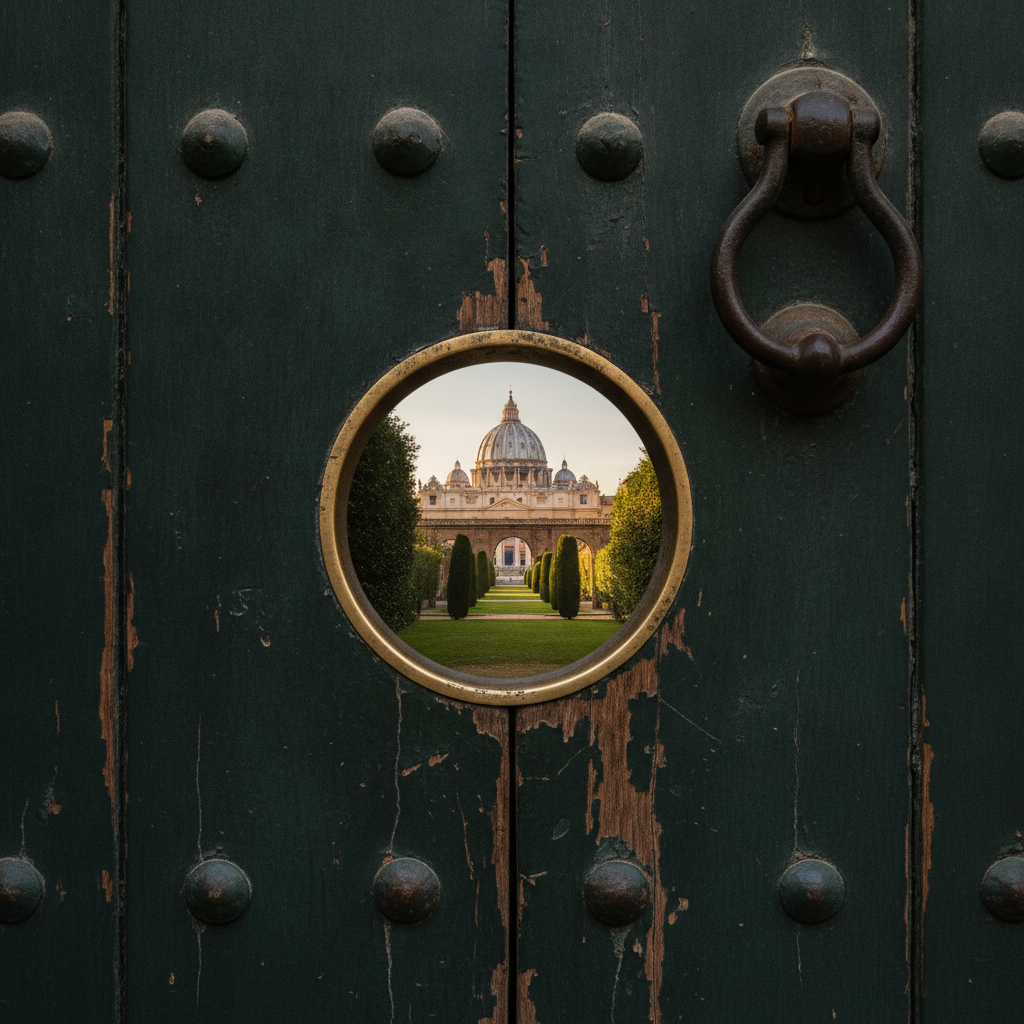
The Piazza dei Cavalieri di Malta (Piazza of the Knights of Malta) on the Aventine Hill, designed entirely by Giovanni Battista Piranesi (the Venetian engraver and architect celebrated for his Views of Rome) in 1765, contains one of Rome's most beloved secrets: the keyhole in the massive green wooden door of the Priory of the Order of Malta. Peering through the keyhole, the viewer sees a precisely engineered optical illusion—three gardens and a hedge-lined avenue carefully aligned so that the dome of St. Peter's Basilica appears perfectly framed and centered at the end of the tunnel of greenery, appearing much closer than its actual distance (3 km away). The alignment is not accidental: Piranesi designed the entire complex with this view as the culminating visual effect. The keyhole is free to look through; there is invariably a small queue. The piazza itself (the obelisks and carved stones are by Piranesi) is worth careful examination.
- 4
Testaccio Market — Rome's Best Food Market
The Testaccio Market (Mercato Testaccio), relocated to a purpose-built covered market hall in 2012 (moving from its original open-air location), is widely considered the best food market in Rome for quality, variety, and authenticity: local vendors selling produce, meat, cheese, bread, and prepared foods, primarily to local residents rather than tourists. The stalls include some of Rome's finest examples of supplì (fried rice balls with tomato and mozzarella—Rome's iconic street food), trapizzino (a pizza-dough pocket stuffed with traditional Roman meat dishes), and the entire range of Roman offal-based dishes (trippa, coda alla vaccinara, pajata) that characterize the Testaccio neighborhood's culinary tradition. The market is busiest on weekday mornings; it closes at 2pm. The surrounding neighborhood (Via Galvani, Via Marmorata, Piazza di Santa Maria Liberatrice) contains some of Rome's best small restaurants and wine bars for lunch and dinner.
- 5
Protestant Cemetery — The Most Beautiful Cemetery in the World
The Cimitero Acattolico (Non-Catholic Cemetery, usually called the Protestant Cemetery), established in 1716 against the ancient Aurelian Wall in the shadow of the Pyramid of Cestius, is widely described by those who have visited it as the most beautiful cemetery in the world: a walled garden filled with flowering plants, cypress trees, and ancient Roman tomb monuments, containing the graves of some of the most important artists and writers of the Romantic period. Keats died in Rome in 1821 at age 25 and is buried here (the gravestone reads 'Here lies one whose name was writ in water'—his chosen epitaph); Shelley's heart (after his cremation in 1822 on a beach north of Rome) is buried here; Antonio Gramsci (the Marxist philosopher, 1937) is also buried here. The cats of the Protestant Cemetery are famous—a small colony is maintained by a charitable association and is often the first thing visitors photograph. Entry is by donation; the cemetery is small and takes about 45 minutes to walk in full.
- 6
Pyramid of Cestius — The Egyptian Pyramid in Rome
The Pyramid of Cestius (Piramide di Caio Cestio), built around 12 BC as the tomb of Gaius Cestius (a Roman praetor and member of the Septemviri Epulones, the board responsible for organizing public feasts), is one of the best-preserved ancient monuments in Rome and certainly the most unexpected: a fully intact white marble-clad Egyptian-style pyramid (36 meters tall, 29.5 meters wide at the base) incorporated into the Aurelian Wall in 271–275 AD (the wall was built around it). The interior chamber (accessible by guided tour on selected weekend mornings only—one of the most restricted visits in Rome) contains remarkably well-preserved fresco decoration. The pyramid was built in the 'Ethiopic' style fashionable in Rome after Augustus's conquest of Egypt in 30 BC; the fashion for Egyptian-style tombs was relatively short-lived (Augustus's mausoleum is a cylinder, not a pyramid) and the Pyramid of Cestius is one of only a handful of examples to survive.
Walk this route with audio
Stories play automatically as you reach each stop — no tapping needed.
More in rome
Campo de' Fiori, the Jewish Ghetto & Trastevere: Rome's Most Lived-In Neighborhoods
The Vatican, St. Peter's Basilica & Castel Sant'Angelo: The Heart of Christendom from River to Dome
The Capitoline Hill, Trajan's Markets & the Monti Neighborhood: Between Rome's Ancient Power and its Liveliest Quarter
The Appian Way & the Catacombs: Rome's Ancient Road to the Dead
Quirinal Palace, Via Veneto & Capuchin Crypt: From Baroque Power to Dolce Vita Glamour