Quirinal Palace, Via Veneto & Capuchin Crypt: From Baroque Power to Dolce Vita Glamour
The Quirinal Hill and the Via Veneto represent two of Rome's most distinct identities: the Quirinal, the largest and highest of Rome's seven hills, site of the papal summer residence (1583–1870) and now the official residence of the President of the Italian Republic—the most powerful address in modern Italian political life; and the Via Veneto, the broad, tree-lined boulevard that was the epicenter of the Dolce Vita era (Fellini's film, 1960) when Rome's film industry and American expatriate community made it the most glamorous street in Europe. Between them: Bernini's greatest fountains, one of the most macabre attractions in the world (the Capuchin Crypt), and the neighborhood of Prati.
- 1
Quirinal Palace — Italy's Highest Office
The Palazzo del Quirinale, on the Quirinal Hill (the highest of Rome's seven hills at 61 meters), was built beginning in 1583 as a summer residence for Pope Gregory XIII, intended to provide papal relief from the malarial heat of the Vatican (lower-lying and closer to the Tiber). It served as the principal papal residence from 1592 (Clement VIII) until 1870, when Italian troops entered Rome and the palace became the residence of the Italian kings (1870–1946) and subsequently of the Presidents of the Italian Republic (1948–present). In a city of extraordinary palaces, the Quirinal is the largest: the building has 1,200 rooms and stands on grounds of 110,000 square meters. The Scuderie Papali (papal stables), across the piazza (built in the 17th century to house the papal horses and the public coach), now function as a world-class exhibition venue (the Scuderie del Quirinale) hosting some of the most important temporary exhibitions in Italy. The Piazza del Quirinale contains one of Rome's best urban compositions: two ancient Roman marble horse-tamers (the Dioscuri—Castor and Pollux, 5th century BC Greek originals), flanking an Egyptian obelisk, centered in front of the palace facade.
- 2
Piazza Barberini & the Triton Fountain — Bernini's Greatest Fountain
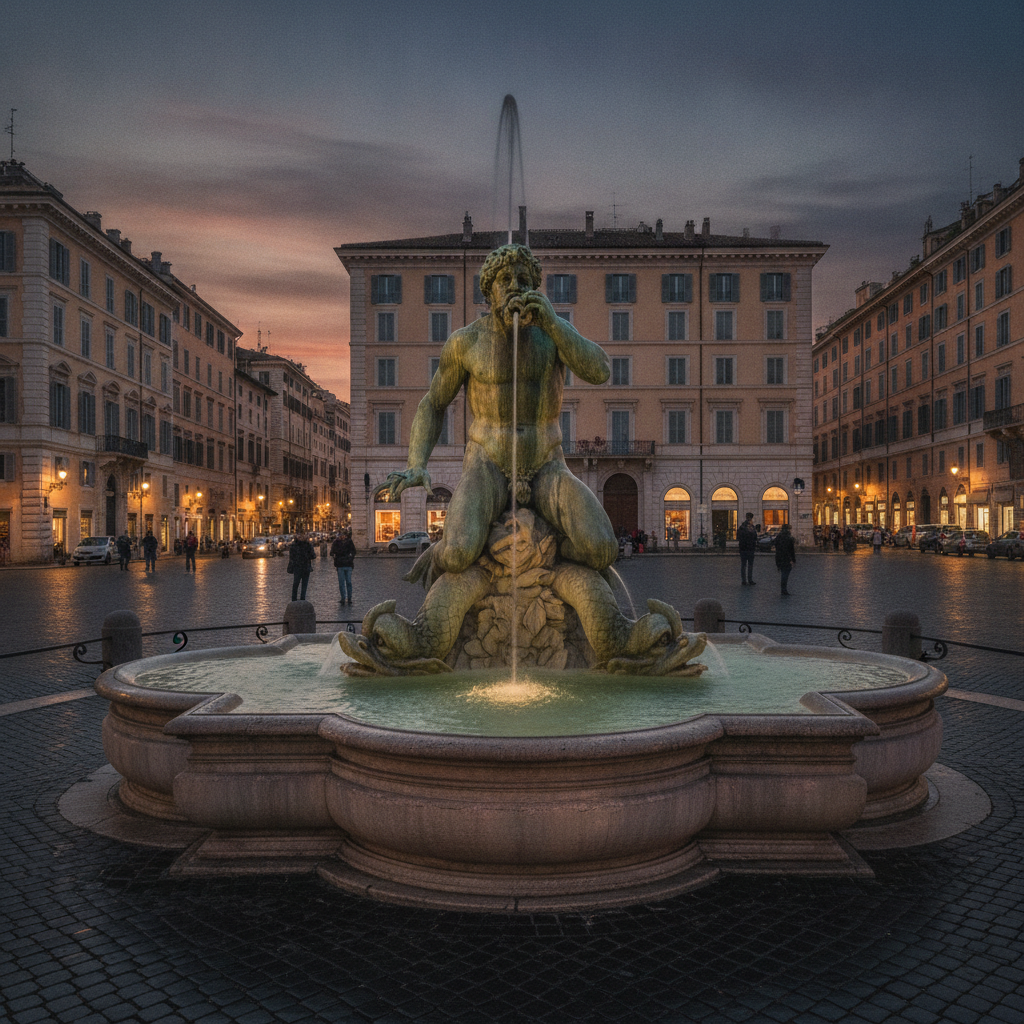
Piazza Barberini, the busy junction at the base of Via Veneto, contains two of Bernini's finest fountains: the Fontana del Tritone (Triton Fountain, 1643) at the center—considered by many art historians to be Bernini's finest sculptural achievement in bronze—showing the sea-god Triton kneeling on four upward-curving dolphin tails, blowing a jet of water skyward through a conch shell; and the smaller Fontana delle Api (Bee Fountain, 1644) set into the corner of the piazza. The Barberini bees (the three bees on the Barberini family coat of arms, the family of Pope Urban VIII who commissioned both fountains) appear on both. The Triton Fountain was the first free-standing fountain sculpture in Rome not to incorporate an ancient spolia element—entirely designed and executed by Bernini. The piazza itself, despite the traffic, retains the feel of Baroque urban space; the adjacent Palazzo Barberini (now the National Gallery of Ancient Art) contains one of Rome's most important painting collections, including Raphael's La Fornarina (1518–20), Caravaggio's Judith and Holofernes (1598–99), and Holbein the Younger's Henry VIII (c. 1540).
- 3
Via Veneto — The Street of the Dolce Vita
Via Vittorio Veneto, the broad, gently curving boulevard running from Piazza Barberini to the Porta Pinciana in the Aurelian Wall, was Rome's most glamorous street in the late 1950s and early 1960s: the American Embassy (at number 119, opened 1951) drew American diplomats, journalists, and celebrities; the Grand Hotel Flora, Hotel Excelsior, and Hotel Eden attracted film stars and directors working at Cinecittà; the outdoor tables of the Café de Paris and Harry's Bar became the gathering point for the paparazzi (a word coined from Paparazzo, a character in Fellini's film). Federico Fellini filmed the opening sequence of La Dolce Vita (1960) on this street; Marcello Mastroianni and Anita Ekberg's famous Trevi Fountain scene was shot nearby. The street has been somewhat less fashionable since the 1970s, but retains its luxury hotel and restaurant character; the wide pavement lined with horse-chestnut trees, outdoor café tables, and 19th-century apartment buildings make it one of the most pleasant walking streets in Rome.
- 4
Capuchin Crypt — The Most Macabre Place in Rome
The Capuchin Crypt (Cripta dei Cappuccini), beneath the church of Santa Maria della Concezione dei Cappuccini on Via Veneto, is one of the most extraordinary and disturbing places in Rome: five small rooms beneath the church whose walls, ceilings, and side chapels are entirely decorated with the bones and mummified remains of approximately 3,700 Capuchin friars who died between 1528 and 1870. The decorations—skulls arranged in geometric patterns, arm bones forming scalloped arches, vertebrae creating ornamental rosettes—were arranged by the friars themselves as a meditation on death and resurrection. A sign at the exit reads: 'What you are now, we once were; what we are now, you shall be.' The crypt is now a museum; access is via the small museum at the church entrance. Entry is by ticket (modest fee); the crypt is small and visits take approximately 20–30 minutes. The atmosphere is unlike anything else in Rome.
- 5
Prati — The Neighborhood Behind the Vatican
Prati ('meadows') is the large, grid-planned residential and commercial neighborhood on the right bank of the Tiber, immediately north of the Vatican City and Castel Sant'Angelo. It was developed in the 1880s after Italian unification on land that had been open meadows (hence the name), designed in a rational Haussmannian grid of broad avenues and residential blocks for the new class of civil servants, lawyers, and middle-class professionals drawn to Rome by the capital's newly established institutions. Today Prati is a solidly bourgeois, distinctly un-touristy neighborhood of good family restaurants, independent bookshops, excellent coffee bars, and food shops oriented toward local residents. The main shopping streets (Via Cola di Rienzo and Via Candia) offer the most normal, non-tourist Rome shopping experience available near the center. The neighborhood is best used as a base for Vatican visits and an escape from the tourist circuit.
- 6
Piazza Cavour — The Legal and Literary Heart of Rome
Piazza Cavour, named for Camillo Benso, Count of Cavour, the architect of Italian unification, is the principal public square of the Prati neighborhood and one of Rome's less-visited but charming squares: a tree-lined rectangle with a central obelisk-free monument to Cavour, surrounded by the most important legal institutions in Italy. The Palazzo di Giustizia (Palace of Justice, 1910), facing the square on one side, is the seat of the Italian Supreme Court of Cassation—the highest civil and criminal court in Italy—and one of the most bombastic examples of Italian neo-Baroque civic architecture in existence (Romans call it the Palazzaccio, 'the ugly palace'). The square is adjacent to the Lungotevere Prati, the embankment road along the right bank of the Tiber, from which views of Castel Sant'Angelo and the dome of St. Peter's are particularly good on clear evenings. Several excellent restaurants and cafés around the square cater primarily to lawyers and court workers—a reliable indicator of food quality.
Walk this route with audio
Stories play automatically as you reach each stop — no tapping needed.
More in rome
Campo de' Fiori, the Jewish Ghetto & Trastevere: Rome's Most Lived-In Neighborhoods
The Vatican, St. Peter's Basilica & Castel Sant'Angelo: The Heart of Christendom from River to Dome
The Capitoline Hill, Trajan's Markets & the Monti Neighborhood: Between Rome's Ancient Power and its Liveliest Quarter
The Appian Way & the Catacombs: Rome's Ancient Road to the Dead
The Aventine Hill, the Knights' Keyhole & Testaccio: Rome's Best-Kept Secrets