Ara Pacis, Via Margutta & Villa Borghese: Rome's Art and Green Escapes
Rome is not only ancient ruins and baroque churches—it is also one of the world's great repositories of Renaissance and Baroque sculpture, held in a villa set in one of Europe's finest urban parks, and the site of Italy's most important contemporary art museum. This route moves from the neoclassical housing of Augustus's most significant monument (the Ara Pacis), through Rome's most artistic street (Via Margutta), up to the park-museum complex of the Villa Borghese, and north to the MAXXI, Rome's 21st-century answer to the Guggenheim.
- 1
Ara Pacis — Augustus's Monument to the Pax Romana
The Ara Pacis Augustae ('Altar of Augustan Peace'), consecrated January 30, 9 BC, is the most significant surviving monument of Augustan Rome: an elaborately carved marble altar enclosure celebrating the return of Augustus from campaigns in Hispania and Gaul and proclaiming the onset of the Pax Romana (Roman Peace)—the 200-year period of relative stability across the Roman Empire. The relief sculptures (extraordinarily well-preserved, with much of the original paint color now lost but the carving in almost perfect condition) are among the finest examples of classical figural relief in the world: the north and south walls depict the actual people who attended the altar's consecration, identifiable as Augustus, his family, the priests, and senators—the only surviving group portrait of Augustan Rome's ruling class. The altar was excavated in fragments from the 16th century onward (the last excavation, 1937–38, recovered the bulk of the pieces); it was controversially rehoused in a building by Richard Meier (completed 2006), Rome's first major contemporary public building in 70 years, generating debate about modern architecture in the ancient city.
- 2
Via Margutta — Rome's Most Artistic Street
Via Margutta, running parallel to the Via del Corso between the Spanish Steps and Piazza del Popolo, has been the home of Rome's artist and intellectual community since the 17th century: Velázquez and Poussin both lived here, as did Picasso (briefly), and the street was for centuries the location of Rome's antique dealers, frame-makers, studios, and galleries. Federico Fellini lived at number 110 for much of his adult life (the building still bears a plaque), and Gregory Peck's character in Roman Holiday famously has a studio on Via Margutta. Today the street retains much of its artistic character: galleries, antique shops, artisan workshops, and several art schools line the narrow lane. A semi-annual street exhibition of paintings (the Cento Pittori exhibit) has taken place on Via Margutta since 1953. The street is also notable for its private gardens and courtyards, hidden behind unassuming doors.
- 3
Pincian Hill — Gardens Above the City
The Pincian Hill terraced gardens (Villa Borghese's western edge, connected to Piazza del Popolo below by a winding path) serve as the elegant transition between the city below and the park above. The famous terrace viewpoint (Terrazza del Pincio) offers the finest view of Piazza del Popolo and the Roman skyline. The gardens contain a gallery of 229 busts of notable Italians (from Dante to Garibaldi to Verdi), a 19th-century patriotic public art project. The boat pond (Laghetto di Villa Borghese), visible from the terrace, can be explored by rowboat rental—one of the most pleasant activities in Rome on a hot afternoon. The transition from the formal Italian gardens of the Pincio to the more naturalistic English-style landscape of the Villa Borghese park represents a deliberate 19th-century design shift.
- 4
Villa Borghese Park — Rome's Greatest Urban Park
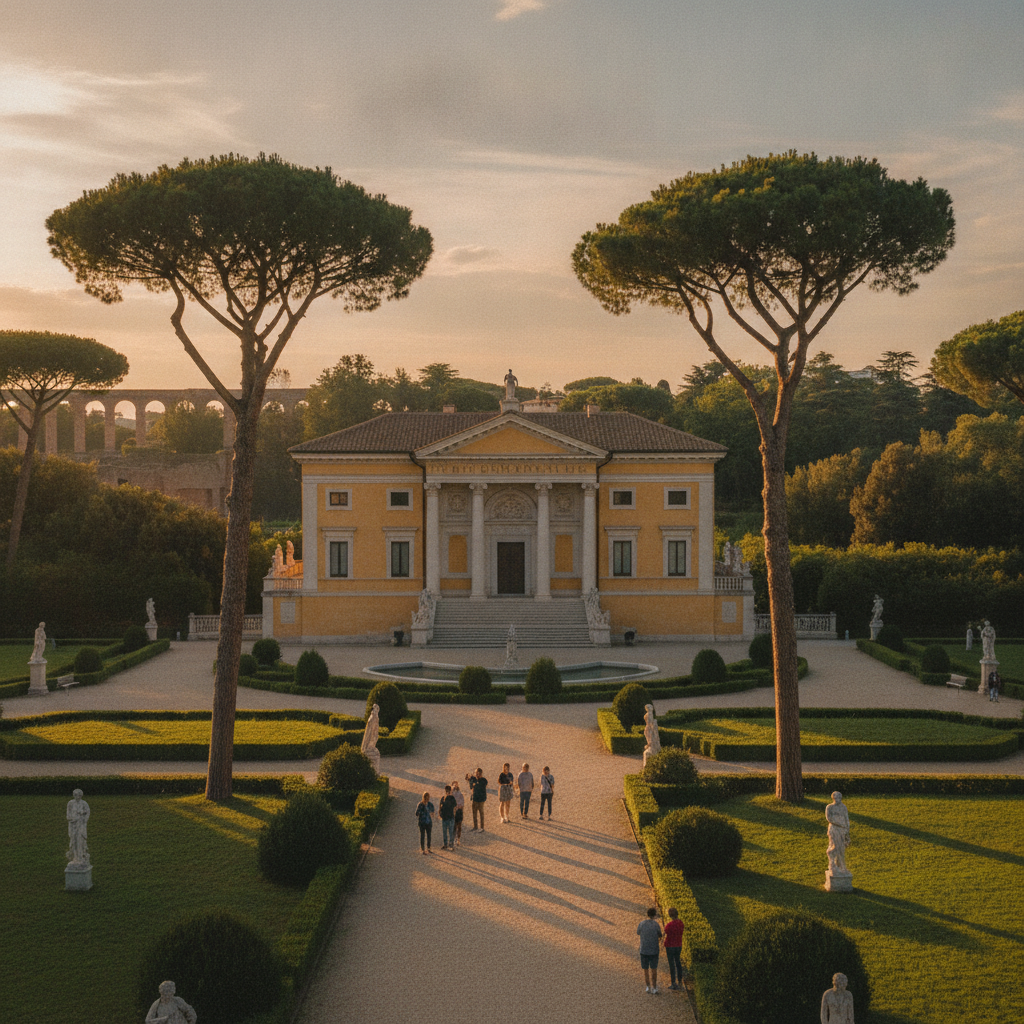
Villa Borghese is Rome's principal public park (80 hectares), created in the early 17th century as the private garden estate of Cardinal Scipione Borghese (nephew of Pope Paul V) and opened to the public in 1903. The park contains the Galleria Borghese, two other museums (Museo Carlo Bilotti and the National Gallery of Modern Art), the Bioparco (Rome's zoo), an outdoor theatre, a children's playpark (Villa dei Bambini), and the Pincian Hill gardens. The landscape architecture is the work of multiple eras: formal Italian-style gardens around the casino villa, English-style naturalistic landscape in the broader park (redesigned in the 18th century), and avenues of umbrella pines (pinus pinea) that give the Roman park landscape its distinctive silhouette. The park is most beautiful at dawn and dusk, when the light through the pines is extraordinary.
- 5
Galleria Borghese — The World's Greatest Small Museum
The Galleria Borghese occupies the casino villa (the pleasure palace at the heart of Cardinal Scipione Borghese's estate) and contains one of the most extraordinary collections of sculpture and painting assembled by any single collector. Cardinal Scipione was the primary patron of the young Gian Lorenzo Bernini, and the museum's ground floor holds six rooms of Bernini marble sculpture that are without parallel in any museum in the world: Aeneas, Anchises and Ascanius (1619); The Rape of Persephone (1621–22); David (1623–24); Apollo and Daphne (1622–25)—the four greatest achievements of marble sculpture since Michelangelo, all executed before Bernini was 27 years old. The upper floor painting collection includes Raphael's Deposition (1507), Titian's Sacred and Profane Love (c. 1514), and six Caravaggio paintings (more than any other museum). Booking is MANDATORY and must be done well in advance—the museum allows only 360 visitors per two-hour slot.
- 6
MAXXI — Rome's Museum of 21st-Century Art and Architecture
MAXXI (Museo Nazionale delle Arti del XXI Secolo), opened 2010 in the Prati/Flaminio neighborhood north of Villa Borghese, is Italy's national museum of contemporary art and architecture, housed in a building by Zaha Hadid (her first completed building in Italy, winner of the 2010 Stirling Prize—the most prestigious award in British architecture). The building itself—a continuous, flowing series of curvilinear black steel and concrete forms, with galleries that stack, intersect, and overlap in three dimensions—is one of the finest examples of 21st-century museum architecture in the world. The permanent collection covers Italian and international art and architecture from the 1960s onward; the temporary exhibition program is one of the most ambitious in Italy. The building is best appreciated from the pedestrian piazza in front, where the facade's swooping geometry and the interaction between the building and its urban context are most clearly visible.
Walk this route with audio
Stories play automatically as you reach each stop — no tapping needed.
More in rome
Campo de' Fiori, the Jewish Ghetto & Trastevere: Rome's Most Lived-In Neighborhoods
The Vatican, St. Peter's Basilica & Castel Sant'Angelo: The Heart of Christendom from River to Dome
The Capitoline Hill, Trajan's Markets & the Monti Neighborhood: Between Rome's Ancient Power and its Liveliest Quarter
The Appian Way & the Catacombs: Rome's Ancient Road to the Dead
The Aventine Hill, the Knights' Keyhole & Testaccio: Rome's Best-Kept Secrets