Oruro Carnival and the Bolivian Altiplano Festival Calendar
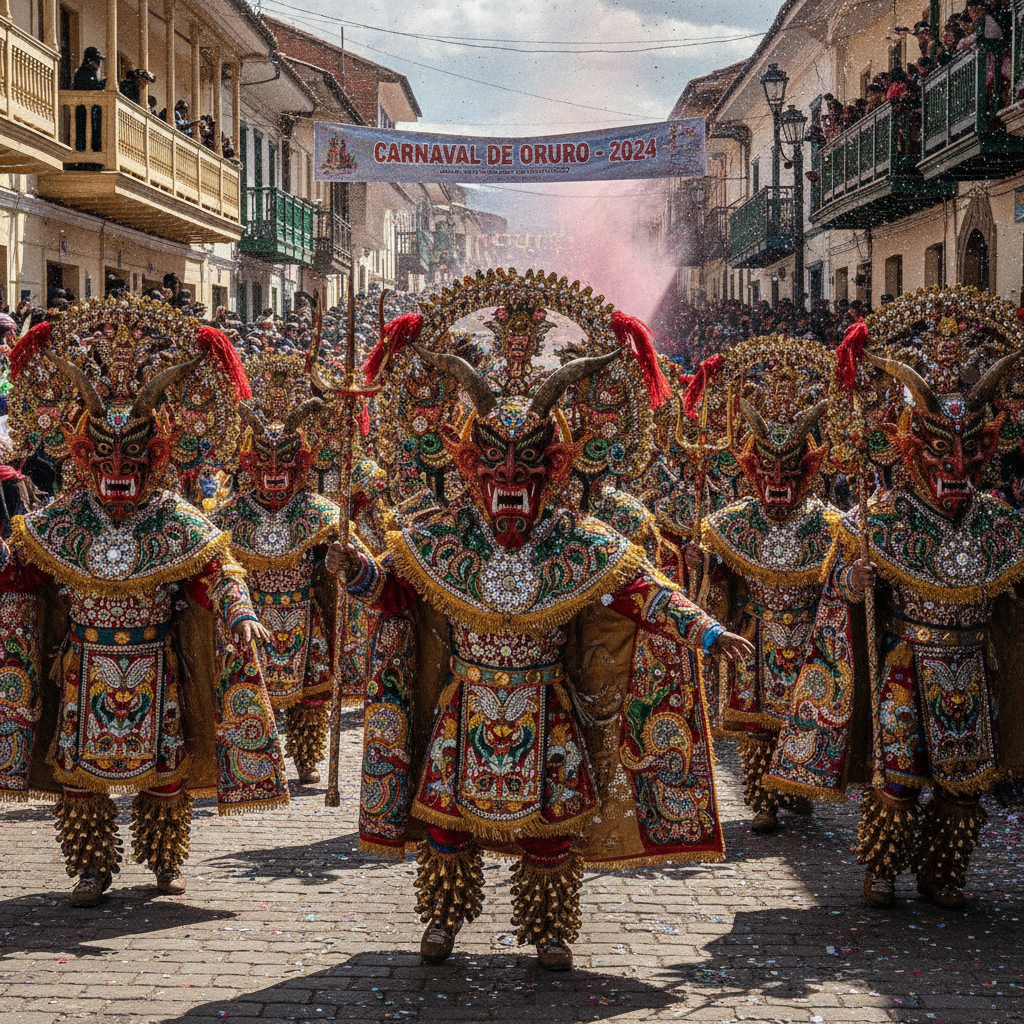
The Oruro Carnival, held annually in the city of Oruro approximately 200 kilometers north of Uyuni on the altiplano, is recognized by UNESCO as an Intangible Cultural Heritage of Humanity and is the most spectacular festival in Bolivia, drawing hundreds of thousands of visitors for its Diablada devil dance processions, elaborate costumes, and multi-day street celebrations. The festival has pre-Hispanic indigenous roots that were overlaid with Catholic imagery after the Spanish conquest, creating a syncretic celebration in which the devil dancers represent evil defeated by the Virgin of Candelaria. The altiplano calendar extends beyond Oruro to include the Tinku ritual combat festival in Potosi department, the Alasitas miniature fair cycle, and the harvest and planting ceremonies that structure agricultural life throughout the highland year.
- 1
Oruro Carnival: The Diablada and Its Origins
The Oruro Carnival, celebrated in the week before Ash Wednesday with the main procession on the Saturday before carnival, involves up to 30,000 costumed dancers from over 60 organized dance fraternities called fraternidades performing for up to 20 hours continuously through the streets of Oruro. The Diablada, the devil dance that is the central and most iconic element of the carnival, involves elaborately costumed dancers representing the Archangel Michael and a hierarchy of devils and demons drawn from Spanish colonial Catholic imagery combined with pre-Hispanic Andean underworld figures. The devil costumes, built over months by specialized artisans, weigh up to 30 kilograms and incorporate masks with articulated features, mirrored glass, and bright colors; the construction of a single high-quality devil costume can cost several thousand dollars. The Diablada fraternidades include some of the oldest surviving carnival organizations in South America, with some dating to the early colonial period. The dance is performed in honor of the Virgin of Candelaria, the patroness of Oruro, and concludes with a procession to the Sanctuary of the Virgin where the dancers enter in full costume to venerate the image.
- 2
Other Oruro Dances: Morenada, Caporales, and the Full Procession
The Oruro Carnival procession includes approximately 60 different dance styles beyond the Diablada, representing different communities, professions, and cultural identities within the broad Bolivian altiplano cultural space. The Morenada, depicting enslaved African workers brought to the colonial silver mines, involves heavy costumes including large mechanical masks with rolling eyes and extensive chest pieces, danced at a slow shuffling pace that reflects the movement of workers exhausted by labor and chains. The Caporales, depicting the overseer class above the enslaved workers, involves energetic acrobatic dancing with high kicks and jumps in contrast to the slow Morenada beneath them, and has become one of the most popular dances particularly among younger participants. The Tinku dance represents the ritual combat tradition of northern Potosi communities. The Llamerada depicts llama herding communities. The Suri Sicuri uses the suri, the Andean ostrich, as its central imagery. The overall procession covers approximately 4 kilometers of a dedicated route through Oruro and takes many hours to complete, with grandstand seating available for purchase and free standing viewing along the route.
- 3
Tinku: Ritual Combat in the Northern Potosi Communities
The Tinku, a traditional ritual combat practice of the Aymara and Quechua communities of northern Potosi department, involves organized hand-to-hand fighting between members of different communities or moieties in a ceremony that is simultaneously a religious offering, a community cohesion ritual, and a festival celebration. The Tinku fights traditionally occurred at specific festival times including the May 3 celebration of the Cross in towns like Macha and Ocuri, and participants from different communities would meet to fight with bare hands, sometimes using stones, and occasionally causing serious injury or death which was understood as an offering of blood to the Pachamama to ensure agricultural fertility. The Bolivian government has periodically attempted to suppress the more violent aspects of Tinku while acknowledging its cultural significance. The Tinku dance that appears in the Oruro Carnival is a stylized and non-violent representation of the combat tradition, performed in costumes derived from the dress of the northern Potosi communities. Travelers to the actual Tinku festivals in Macha are rare and should understand that they are attending a genuine community religious ceremony rather than a tourist performance.
- 4
Alasitas: The Festival of Miniature Desires Across the Altiplano
The Alasitas festival tradition, centered on the acquisition of miniature objects and their blessing by a spiritual specialist in the belief that the Ekeko deity of abundance will cause the miniature to manifest in real life, operates across the Bolivian altiplano in multiple annual cycles with the main La Paz celebration on January 24 and subsidiary Alasitas fairs in Oruro, Potosi, and other altiplano towns throughout the year. The tradition in the Uyuni region is celebrated at smaller local scale in the communities around the salt flat, with the miniature vendors setting up around local churches and squares. The objects available at Alasitas fairs have evolved continuously to reflect changing desires: alongside the traditional houses and diplomas, miniature international passports, airline tickets, cryptocurrency hardware wallets, and smartphones now appear alongside the traditional items. The Ekeko figure himself has evolved; the 2018 controversy over a museum in La Paz displaying a white-skinned Ekeko based on a colonial-era figure rather than the standard indigenous Ekeko image generated significant public debate about the cultural authenticity of the tradition and who controls its representation.
- 5
Potosi: The Colonial Silver City and Its Mining Legacy
Potosi, located approximately 200 kilometers northeast of Uyuni at 4,090 meters altitude, is one of the most historically significant cities in the Americas, designated a UNESCO World Heritage Site for its colonial architecture and its role as the center of the Spanish silver economy that financed the early modern global trade system. The city was founded in 1546 following the discovery of silver at Cerro Rico the previous year, and grew within decades to rival Seville in population, becoming one of the largest cities in the world by the late 16th century with a population estimated at 160,000 at its peak. The colonial city center retains an extraordinary concentration of baroque churches, the Casa de la Moneda royal mint where silver was processed into coins, the Casa de las Tres Portadas, and the original grid of colonial streets laid out in the 1540s. The cooperative miners who still work in the depleted Cerro Rico, extracting zinc, tin, and residual silver in conditions that have improved marginally from the colonial period, offer paid visits to tourists who can enter the working mine with guides and bring gifts of coca leaves, alcohol, and cigarettes for the miners and their patron deity Tio, the devil of the mine.
- 6
Sucre: The White City and Bolivia Constitutional Capital
Sucre, located approximately 150 kilometers north of Potosi and 320 kilometers northeast of Uyuni at 2,810 meters altitude, is the constitutional capital of Bolivia, the seat of the national judiciary, and one of the best-preserved colonial cities in South America, earning UNESCO World Heritage designation for its whitewashed architecture and uniform colonial urban fabric. The city was founded as La Plata in 1538 and served as the administrative center of the Real Audiencia de Charcas, the Spanish colonial court that governed the silver-rich region; Bolivia declared independence at Sucre in 1825 and the city was renamed in honor of independence leader Antonio Jose de Sucre. The city's university, the Universidad Mayor Real y Pontificia de San Francisco Xavier de Chuquisaca, founded in 1624, is one of the oldest universities in the Americas. The dinosaur tracks at Cal Orck'o, a quarry just outside Sucre, are the largest and most diverse dinosaur footprint site in the world, covering a limestone wall that has been tilted to near-vertical by Andean uplift and contains over 5,000 individual tracks from at least 15 species including the longest known sauropod trackway. Sucre is connected to Uyuni by a rough but scenic road and by occasional bus services.
Walk this route with audio
Stories play automatically as you reach each stop — no tapping needed.
More in Salar de Uyuni

Salar de Uyuni History: Pre-Columbian Peoples, Colonial Routes, and Bolivian Independence
Salar de Uyuni Practical Guide: Getting There, Tour Types, Packing, and Safety
Wildlife of the Bolivian Salt Flat Region: Vicunas, Viscachas, and Desert Adaptations

Stargazing at the Salar de Uyuni: One of the Best Night Skies on Earth

Uyuni Tour Logistics: Jeep Tours, Seasons, and the Three-Day Itinerary