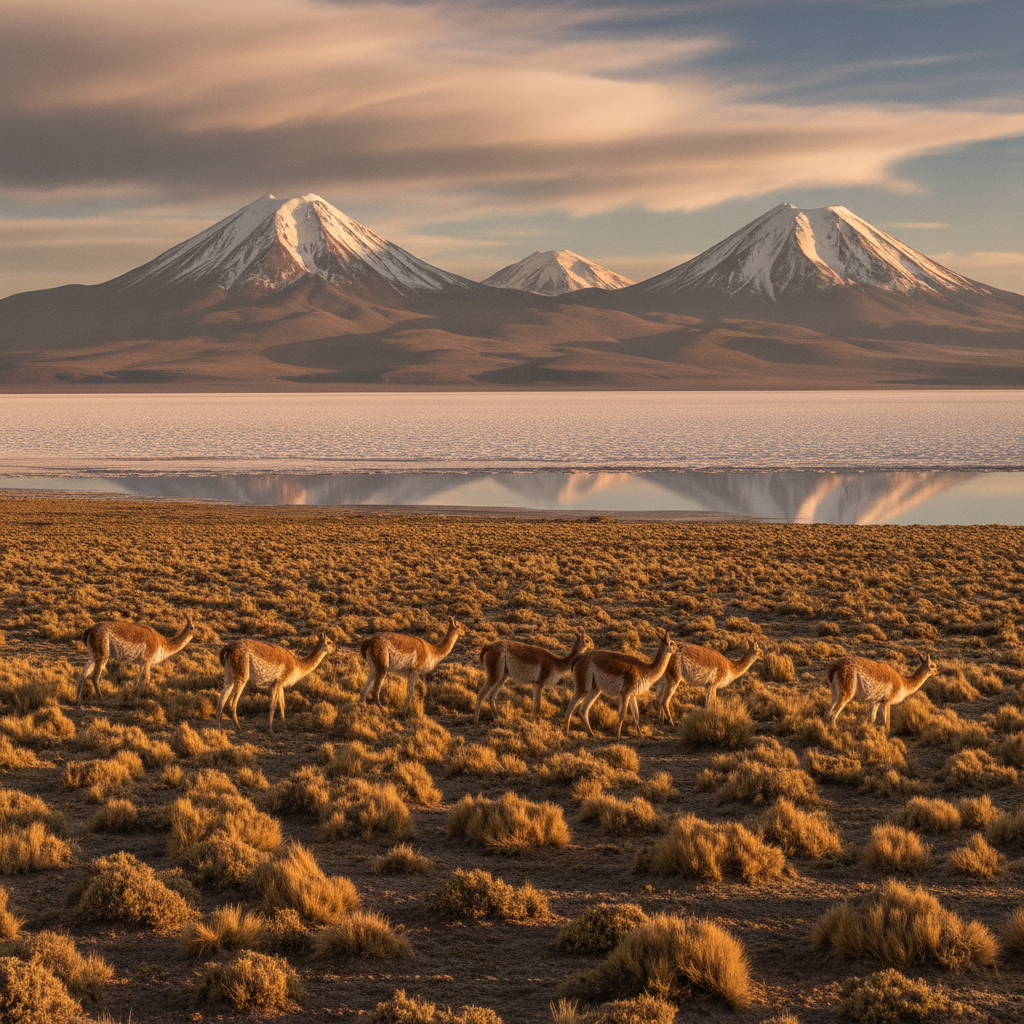
Wildlife of the Bolivian Salt Flat Region: Vicunas, Viscachas, and Desert Adaptations
The seemingly barren landscape of the Bolivian altiplano around the Salar de Uyuni supports a surprisingly rich fauna adapted to extreme altitude, cold, drought, and the mineral-rich but nutrient-poor environment. The vicuna, the smallest and most elegant of the four South American camelids, grazes the dry grasslands of the altiplano in family groups and was hunted to near-extinction before international protection in the 1960s allowed a recovery to over 300,000 animals. The viscacha, a long-tailed rabbit-like rodent related to the chinchilla, inhabits rocky outcrops throughout the altiplano and Eduardo Avaroa Reserve and is among the most photographed mammals of the region. The three flamingo species of the colored lagoons represent the most spectacular wildlife concentration in the region, but the altiplano also hosts Andean condors, puna hawks, and dozens of other bird species adapted to the high-altitude environment.
- 1
Vicunas: The Golden Camelid of the Altiplano
The vicuna, Vicugna vicugna, is the smallest of the four South American camelids alongside the guanaco, llama, and alpaca, standing approximately 90 centimeters at the shoulder and weighing 35 to 65 kilograms. The vicuna produces the finest natural fiber of any animal in the world, with individual hairs measuring 12 to 14 microns in diameter, thinner than the finest cashmere and more than twice as fine as standard wool. The Inca controlled vicuna fiber as a royal monopoly, conducting periodic chaku roundup ceremonies in which thousands of animals were herded into enclosures for shearing before release; killing vicunas was punishable by death under Inca law. Spanish colonialism eliminated these protections, and uncontrolled hunting for meat and fiber reduced the global population to fewer than 10,000 animals by the 1960s. The 1969 international agreement between Peru, Bolivia, Chile, and Argentina that prohibited vicuna hunting and fiber trade, followed by regulated community-based fiber harvesting programs from the 1990s onward, has allowed recovery to over 300,000 animals. Vicuna fiber remains extraordinarily expensive, with a vicuna wool coat retailing for tens of thousands of dollars.
- 2
Viscachas: The Rocky Sentinels of the Altiplano
The southern viscacha, Lagidium viscacia, is a large rabbit-like rodent that inhabits rocky outcrops and cliff faces throughout the Bolivian and Peruvian altiplano, distinguished by its long bushy upward-curving tail, large ears, and the habit of sitting motionless in full sun on prominent rocks in a posture that makes it simultaneously conspicuous and difficult to distinguish from the rock itself. Viscachas are among the most photographed mammals of the Uyuni region because they are abundant, bold, and photogenic, inhabiting the same rocky island formations and reserve landscapes visited on jeep tours, and sitting still long enough for extended photography. The viscacha is closely related to the chinchilla, which inhabits similar rocky terrain in the Andes at lower elevations and was hunted to commercial extinction for its fur. Viscachas are colonial, living in family groups in rock crevices, and their alarm calls alert the entire colony when a predator such as an Andean condor or puma is observed. The animals are entirely herbivorous, grazing on the sparse dry grasses and lichens available in the rocky altiplano habitat.
- 3
Andean Condor: The Largest Flying Bird in the Americas
The Andean condor, Vultur gryphus, with a wingspan reaching 3.3 meters and a weight of 11 to 15 kilograms, is the largest flying bird in the world by combined wingspan and weight, and is the most charismatic of the large birds visible in the Uyuni region. The condor is a scavenger that uses thermal updrafts to soar effortlessly for hours over the altiplano and Andean valleys searching for carcasses of large mammals, and is capable of traveling 200 kilometers in a single day without flapping its wings. The Andean condor has deep cultural significance throughout the Andes as a symbol of power and connection between the human and divine realms; in Inca cosmology the condor represented the upper world of the gods. Condor populations declined severely through the 20th century due to persecution by farmers who believed condors killed livestock, secondary poisoning from carcasses, and lead poisoning from gut piles of shot animals; international conservation efforts have stabilized populations in Bolivia and neighboring countries. Condors are most commonly seen soaring over the escarpments of the Eduardo Avaroa Reserve and the rocky ridges above the colored lagoons.
- 4
Puna Grassland Birds: The Hidden Avifauna of the Salt Flat Region
The dry puna grasslands and rocky slopes surrounding the Salar de Uyuni support a distinctive bird community adapted to the harsh altiplano environment, largely overlooked by visitors focused on the flamingos of the colored lagoons. The Andean hillstar hummingbird, one of the highest-altitude hummingbirds in the world, is found at up to 5,000 meters and enters nightly torpor to survive freezing temperatures, lowering its body temperature close to ambient to conserve energy. The puna plover, the Andean lapwing, the puna ibis, and various species of sierra finch represent the small and medium bird fauna of the open grassland habitat. The Diademed sandpiper-plover, one of the most range-restricted birds in South America and classified as vulnerable to extinction, inhabits the edges of high-altitude bogs and streams in the altiplano. Several species of mining birds, small finch-like passerines that excavate burrows in earthen banks, are altiplano specialists whose North American birder visitors are usually unaware of but which represent genuinely exciting records for South American birding enthusiasts.
- 5
Puma and the Predator Community of the High Andes
The puma, Puma concolor, the most widely distributed large land predator in the Americas, is present throughout the Bolivian altiplano including the Eduardo Avaroa Reserve, where it preys primarily on vicuna, viscacha, and the wild relatives of the domestic llama. Pumas in the altiplano environment face extreme conditions including freezing nights, thin air, and prey that is difficult to catch in open terrain with no cover for stalking; the altiplano puma population is therefore sparse and sightings are uncommon even for researchers. The Andean cat, Leopardus jacobita, one of the rarest and least-studied wild felids in the world, inhabits rocky terrain in the high Andes and altiplano at elevations up to 5,000 meters, preying primarily on viscachas and mountain chinchillas. The Andean cat is estimated to number fewer than 2,500 mature individuals across its range in Argentina, Bolivia, Chile, and Peru and is classified as endangered; it is rarely photographed in the wild and almost never seen by tourists. Camera trap programs in Bolivia have documented Andean cat presence in the Uyuni region reserve.
- 6
Domestic Camelids: Llamas, Alpacas, and the Living Altiplano Economy
The llama and alpaca, both domesticated from wild guanaco and vicuna ancestors respectively approximately 6,000 years ago in the Peruvian altiplano, remain central to the economic and cultural life of altiplano communities throughout the Uyuni region and broader Bolivian and Peruvian highlands. The llama, the larger of the two domesticated species, is primarily a pack animal and meat source, capable of carrying loads of 25 to 30 kilograms over long distances in altiplano terrain where wheeled vehicles were traditionally impractical. The alpaca, smaller and bred for fiber rather than carrying capacity, produces wool in a wider color range than sheep wool and with superior thermal properties for altitude environments. Llama and alpaca herds managed by Aymara and Quechua families across the altiplano are grazed on the puna grasslands between the salt flats and the volcanic mountain slopes, and the animals are integral to the ceremonial and spiritual life of herding communities in ways that persist alongside modernization. Llama meat in dried form called charque, the origin of the English word jerky via its adoption in colonial North America, remains a staple protein source in Bolivian highland cooking.
Walk this route with audio
Stories play automatically as you reach each stop — no tapping needed.
More in Salar de Uyuni

Salar de Uyuni History: Pre-Columbian Peoples, Colonial Routes, and Bolivian Independence
Salar de Uyuni Practical Guide: Getting There, Tour Types, Packing, and Safety

Stargazing at the Salar de Uyuni: One of the Best Night Skies on Earth

Uyuni Tour Logistics: Jeep Tours, Seasons, and the Three-Day Itinerary
Geology of the Bolivian Altiplano: Volcanoes, Minerals, and the Andean Plateau