Salzburg Mozart — the Mozarteum Foundation, Mozart Museums & the Complete Musical Legacy
The entire city of Salzburg is organized around the legacy of Wolfgang Amadeus Mozart — the two Mozart museums, the Mozarteum Foundation, the Salzburg Festival, and the Mozart Week form the most comprehensive musical legacy of any single composer in any city in the world.
- 1
The Mozarteum Foundation — the World Center of Mozart Research
The Internationale Stiftung Mozarteum (the International Mozarteum Foundation, Schwarzstraße 26, the institution dedicated to the preservation and the research of Mozart's life and work since 1870, the foundation holding the most complete archive of Mozart manuscripts, letters, and documents in the world, the Great Hall at Schwarzstraße 26 the 600-seat concert hall and the primary venue for the year-round Mozart concert series and the Mozart Week): the archive (the Mozarteum archive the most comprehensive single-composer archive in existence — the 500+ pages of Mozart's handwritten musical manuscripts, the family correspondence of 1,400 letters including the complete series of letters between Mozart and his father Leopold, the portrait collection including the authenticated portraits of Mozart, the archive accessible to scholars by appointment), the Mozart concerts (the year-round concert series in the Great Hall — the 'Mozartkraftwerk' series of concerts every Friday evening at 7:30pm from September to June, the 'Piano matinees' on Sundays at 11am in the Wiener Saal — the 330-seat chamber concert hall, the most reliably consistent Mozart concert programming in Salzburg outside the festival periods, tickets €25-45 at mozarteum.at), the Magic Flute House (the Zauberflötenhäuschen, the wooden garden pavilion transported from Vienna where Mozart is believed to have composed part of Die Zauberflöte — The Magic Flute — in 1791, installed in the Mozarteum garden, accessible during opening hours, the most unusual single object in the Salzburg Mozart topography) and the Mozarteum library (the research library with 120,000+ volumes on Mozart and the Viennese Classical period, the most complete single-composer research library in the world, open to the public at reduced scope by appointment).
- 2
The Two Mozart Museums — Birthplace and Residence Compared
The Mozart museum circuit (the two Mozart museums in Salzburg — the Geburtshaus and the Wohnhaus — operated by the Mozarteum Foundation, the most complete documentation of Mozart's life available in a single city, the combination ticket the correct purchase for the visitor with 2-4 hours for the complete Mozart museum experience): Mozarts Geburtshaus (the Birthplace at Getreidegasse 9, the third-floor apartment where Mozart was born January 27 1756 and where the family lived 1747-1773, the 5-room apartment the most visited museum in Salzburg at 350,000+ visitors per year, €13 adults, daily 9am-5:30pm in summer, the furnishings not original — the family removed all personal objects when they moved — but the period reconstruction including the child's violin, the fortepiano, the portrait miniatures of the family, and the original floor plan preserved in the apartment layout), Mozarts Wohnhaus (the Residence at Makartplatz 8 in the Salzburg New Town, the house where the Mozart family lived 1773-1780 — the family's larger and more comfortable residence across the Salzach River from the Old Town, the museum rebuilt after the 1944 Allied bombing of the Makartplatz area — the original house destroyed in the bombing — as a faithful recreation on the original floor plan, €13 adults, daily 9am-5:30pm, the audio guide the most recommended entry mode as the rooms have less visual content than the Geburtshaus but more musical content — the listening stations with the musical examples in context), and the Mozart family history (the key biographical fact most useful for understanding Salzburg: Leopold Mozart — the father — was the Vize-Kapellmeister of the Salzburg court orchestra, a professional musician and a music teacher who spent 25 years developing his son's talent through the grand tours of Europe — the tours to Vienna 1762-1763, the Italian tours 1769-1773, the Paris tour 1777-1778 — the father-son relationship the most intensely documented parent-child relationship in 18th-century Europe, the correspondence the raw material for the most studied biography in classical music).
- 3
Mozart's Music — the Essential Salzburg Listening Guide
Mozart's Salzburg period works (the compositions from the Salzburg years 1756-1781, before Mozart left Salzburg permanently for Vienna — the 25 years of Salzburg residence produced the most complete body of early classical work in the repertoire): the Salzburg symphonies (the 36 symphonies Mozart composed in Salzburg before 1781, the most important being: Symphony No. 25 in G minor K.183 — the only minor-key symphony before the Prague, the work composed at age 17 in 1773, the 'little G minor' the most emotionally intense of the Salzburg symphonies; Symphony No. 29 in A major K.201 — considered by scholars the first truly mature Mozart symphony, composed 1774 at age 18, the work demonstrating the complete command of the symphonic form; and the Haffner Serenade K.250 — composed 1776 for the marriage of Marie Elisabeth Haffner, the most elaborate of the Salzburg orchestral works), the Salzburg piano concertos (the Piano Concerto No. 9 in E flat major K.271 'Jeunehomme' — composed 1777 at age 21, the first fully mature piano concerto, the slow movement the most tragic music Mozart had yet written, the work the single essential Mozart piano concerto from the Salzburg period), the Salzburg serenades (the Eine Kleine Nachtmusik K.525 — actually composed in Vienna 1787, not Salzburg, the most common misconception in the Mozart tourist circuit in Salzburg — the correct Salzburg serenade is the Serenata Notturna K.239, composed 1776) and the Missa Brevis works (the 12 Masses composed for the Salzburg Cathedral, the Mass in C minor K.427 the most significant — composed in Vienna 1782-1783 but performed in Salzburg at the premiere of October 26 1783, the most important religious work of Mozart's career).
- 4
The Salzburg Festival — Practical Attendance Guide
The Salzburg Festival attendance guide (the Salzburger Festspiele, July 18 to August 31 annually, the world's most prestigious classical music festival with 270,000 attendees, the most logistically complex cultural event in Europe to attend): tickets (the main ticket sale for the following year's festival opens in early November via the Salzburg Festival website at salzburgerfestspiele.at — the exact opening date announced in October, the date the most important in the Salzburg Festival calendar for the international visitor, the ticket categories: the opera tickets the most competitive at €50-450 depending on category, the 5-6 operas per festival each with 6-10 performances — the Jedermann and the Young Conductors Award concerts often available in the main sale, the Konzerte and the recitals slightly less competitive at €25-200, the Ouverture Spirituelle religious concerts the most accessible at €30-80), the last-minute options (the Wiederverkauf — the official resale system at the festival box office from July onwards, the box office for same-day standing tickets 'Stehplätze' at €30 for the rear standing positions in the Großes Festspielhaus, the most affordable festival access, the standing ticket queue forming 1-2 hours before performance), accommodation during the festival (the Salzburg accommodation prices increasing 3-5x during the festival — the correct strategy is Munich as a base, the Munich-Salzburg train in 90 minutes at €15-40 allowing day attendance without festival accommodation costs, the strategy used by 30,000+ festival visitors per year) and the festival venues (the Großes Festspielhaus — the 2,179-seat main opera house carved into the Mönchsberg cliff, architect Clemens Holzmeister 1960 — the Felsenreitschule — the 1,549-seat outdoor theatre carved from the Mönchsberg rock, the most dramatically atmospheric performance venue in the world — the Haus für Mozart — the 1,580-seat medium opera house in the former court stables, the Mozarteum Great Hall, and the Domplatz outdoor stage for Jedermann).
- 5
Salzburg as Mozart's Escape — Vienna and the European Career
Mozart's departure from Salzburg (the pivotal event in Mozart's life: the March 1781 dismissal from the service of Prince-Archbishop Colloredo in Vienna — the most consequential event in the history of classical music, Mozart the first major composer to attempt a freelance career without court patronage, the attempt successful enough to define the composer's independence as a viable model for the following 200 years): the Archbishop Colloredo context (the Prince-Archbishop Hieronymus Colloredo the most educated and most Enlightenment-influenced Archbishop of Salzburg — the reformer who reduced the number of holy days, reorganized the clergy, and tried to introduce Enlightenment rationalism into the most Baroque of Alpine archdioceses — the relationship between Colloredo and Mozart the productive tension between the sophisticated patron who recognized Mozart's genius and the composer who was too large for Salzburg's provincial court), the Vienna career (Mozart in Vienna 1781-1791: the 10 years that produced Don Giovanni, Le Nozze di Figaro, Così fan Tutte, Die Zauberflöte, the Piano Concertos K.466 and K.491, the last 3 symphonies — K.543, K.550, K.551 — the String Quintets and the Clarinet Concerto, the most concentrated decade of genius in the Western classical tradition, all of it produced after Mozart left Salzburg permanently), and the Salzburg-Vienna parallel (the correct understanding for the Salzburg visitor: Salzburg is where Mozart was born and trained, Vienna is where Mozart worked and died, the Salzburg museums the record of the formation — the Vienna Musikverein and the Mozart Requiem in the Michaelerplatz the record of the achievement, the Salzburg visit the beginning of the Mozart story, the Vienna visit the completion, the two cities the correct combined itinerary for the Mozart-focused traveller).
- 6
The Salzburg Mozarteum — the Great Hall Concert Experience
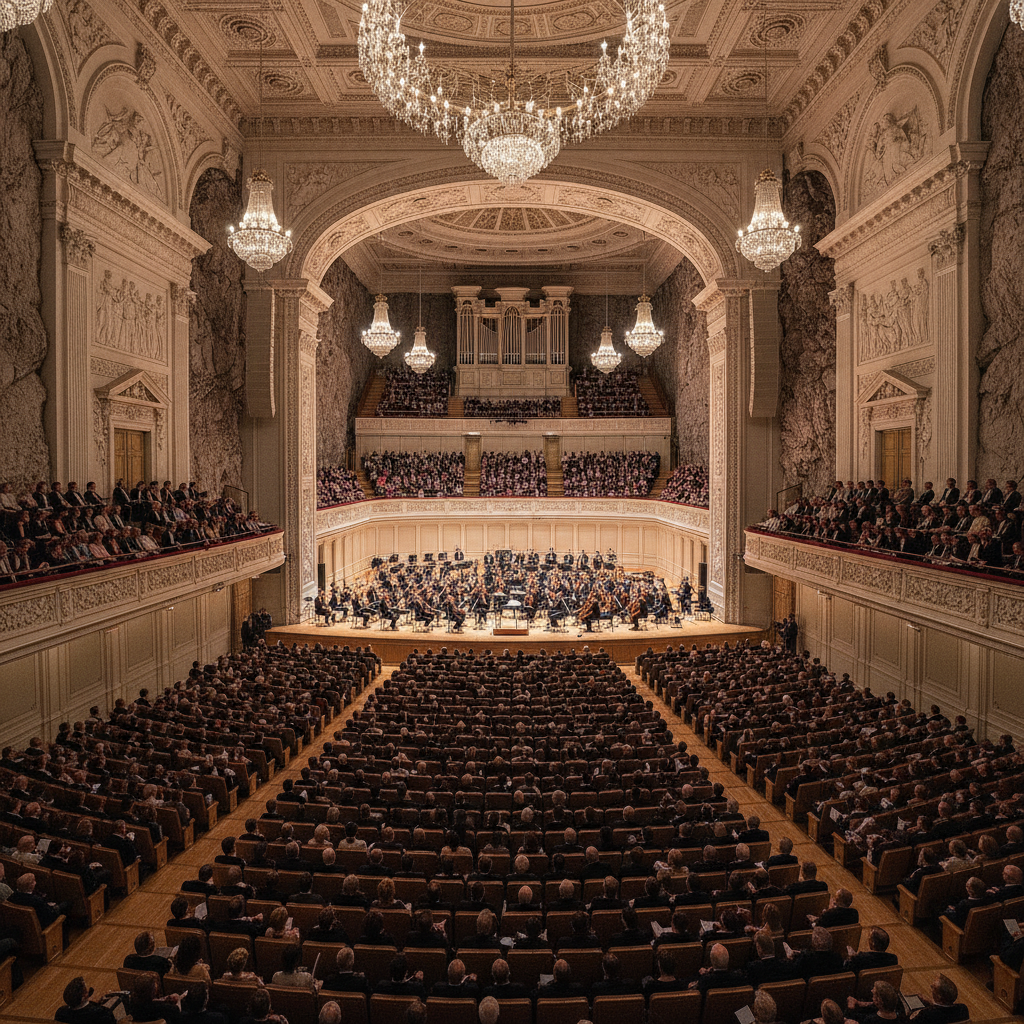
The Great Hall of the Mozarteum (Schwarzstraße 26, the 600-seat concert hall of the Mozarteum Foundation, the primary venue for the year-round Mozart concert series in Salzburg outside the festival periods, the hall built 1914 in the Neoclassical style, the acoustic the most naturally suited to the Classical and early Romantic repertoire of any concert hall in Austria): attending a concert (the Mozartkraftwerk Friday series, the Sunday matinee concerts, and the special evening performances available at mozarteum.at — the ticket purchase at the box office at Schwarzstraße 26 or online, the box office open Monday-Friday 10am-4pm and 1 hour before each concert, the typical ticket €25-45 for the standard Friday concert, €60-80 for the special soloists in the Great Hall, the hall seating the standard European concert hall format of the stalls, the first balcony, and the upper gallery — the stalls row 10-15 the optimum acoustic position for the Mozart chamber works), the programme (the Mozarteum concert programme the most Mozart-specific in Europe — the programmes built around the complete survey of the Mozart catalogue, 2-3 concerts per week from October to June with the Summer Academy concerts in July-August, the Mozarteum a complete alternative to the Salzburg Festival for the visitor who arrives outside the festival period and the least commercially mediated Mozart concert experience in the city), and the Wiener Saal (the 330-seat chamber concert hall in the Mozarteum adjacent to the Great Hall, the smaller venue used for the chamber music concerts, the piano recitals, and the masterclass performances of the Summer Academy students — the most intimate and the most technically serious Mozart chamber concert available in Salzburg, the acoustic chamber the most suitable of any Salzburg venue for the string quartet and the solo piano repertoire, tickets €20-35).
Walk this route with audio
Stories play automatically as you reach each stop — no tapping needed.
More in salzburg
Salzburg — the Hohensalzburg Fortress, Mozart's Birthplace & the Sound of Music City
Salzburg Art and Museums — the Museum der Moderne, Salzburg Museum & the Rupertinum
Salzburg Practical — Seasons, the Mozart Week, Christmas Market & Getting Around
Salzburg Day Trips — the Salzkammergut Lakes, Hallstatt & the Austrian Alpine Landscape