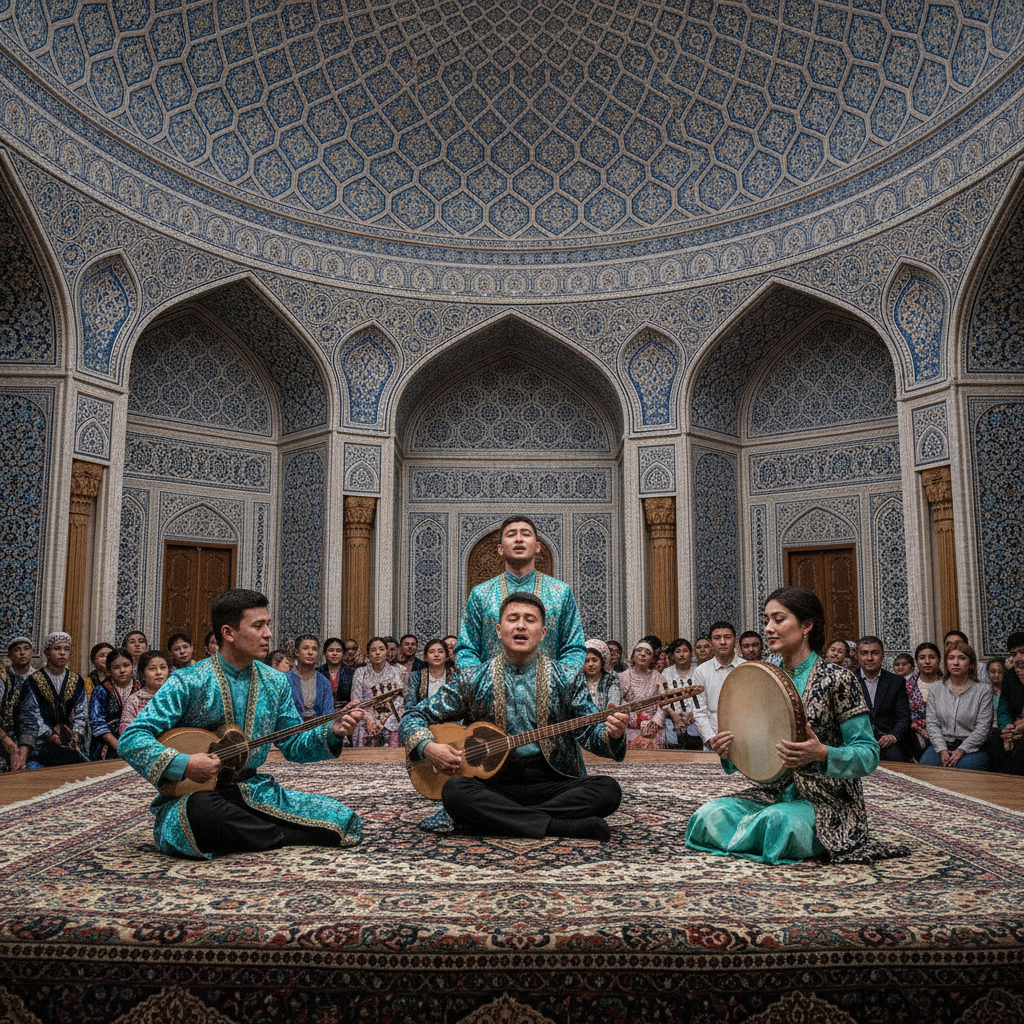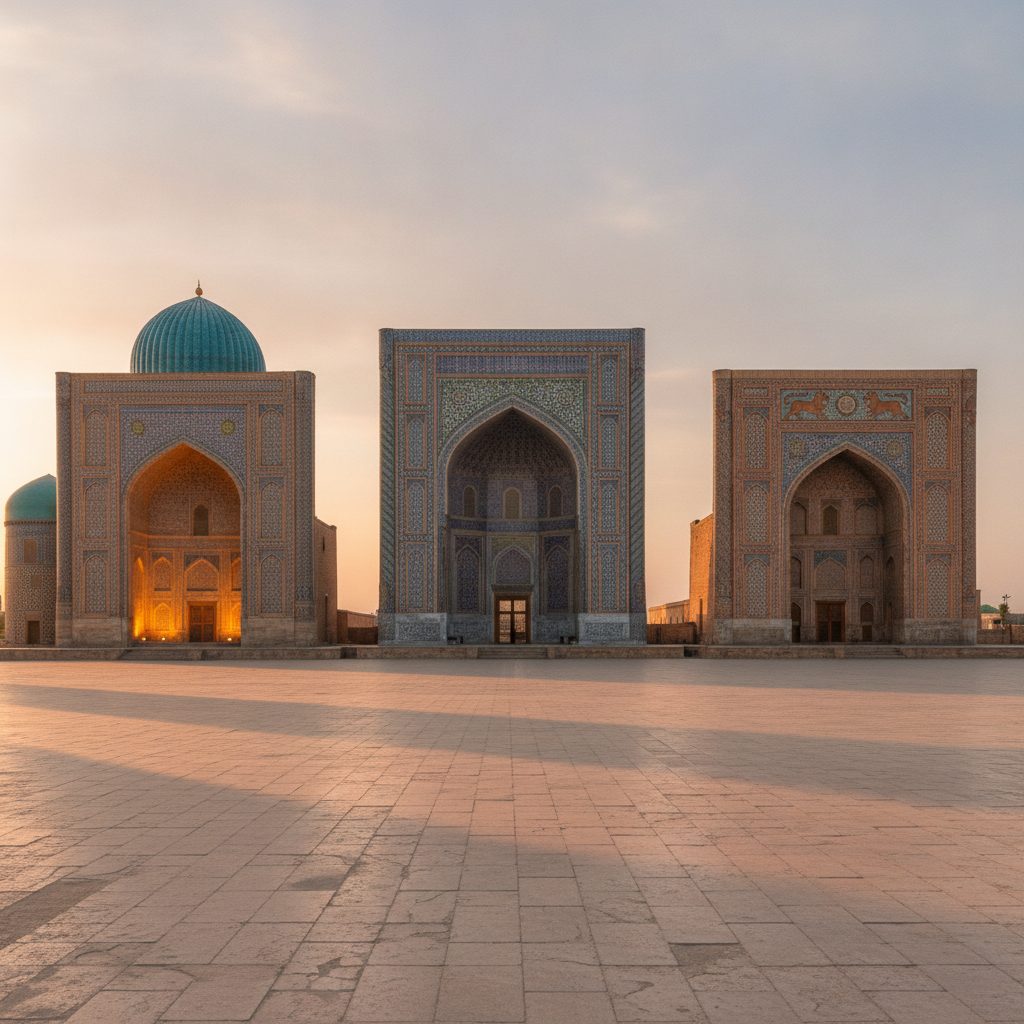
The Curse of Tamerlane's Tomb Opened Two Days Before the German Invasion, the 64-Ribbed Melon-Dome That Became the Template for the Taj Mahal & the 7th-Century Mural Showing Korean Ambassadors Bringing Gifts to a Sogdian King
The Gur-e-Amir tomb opened by Soviet archaeologists on June 20, 1941 — Germany invaded two days later; the 64-ribbed turquoise dome exported to India as the Mughal mausoleum template leading to the Taj Mahal; the Afrosiyab Palace mural (650-700 CE) showing the first visual record of Korean-Central Asian diplomatic contact; the Shah-i-Zinda legend of Qutham ibn Abbas still living underground since 676 CE; Timur's 95 Indian elephants carrying materials for the world's largest mosque; and the Samarkand Card covering all 4 major sites for USD 15.
- 1
The Registan – The World's Most Beautiful Square
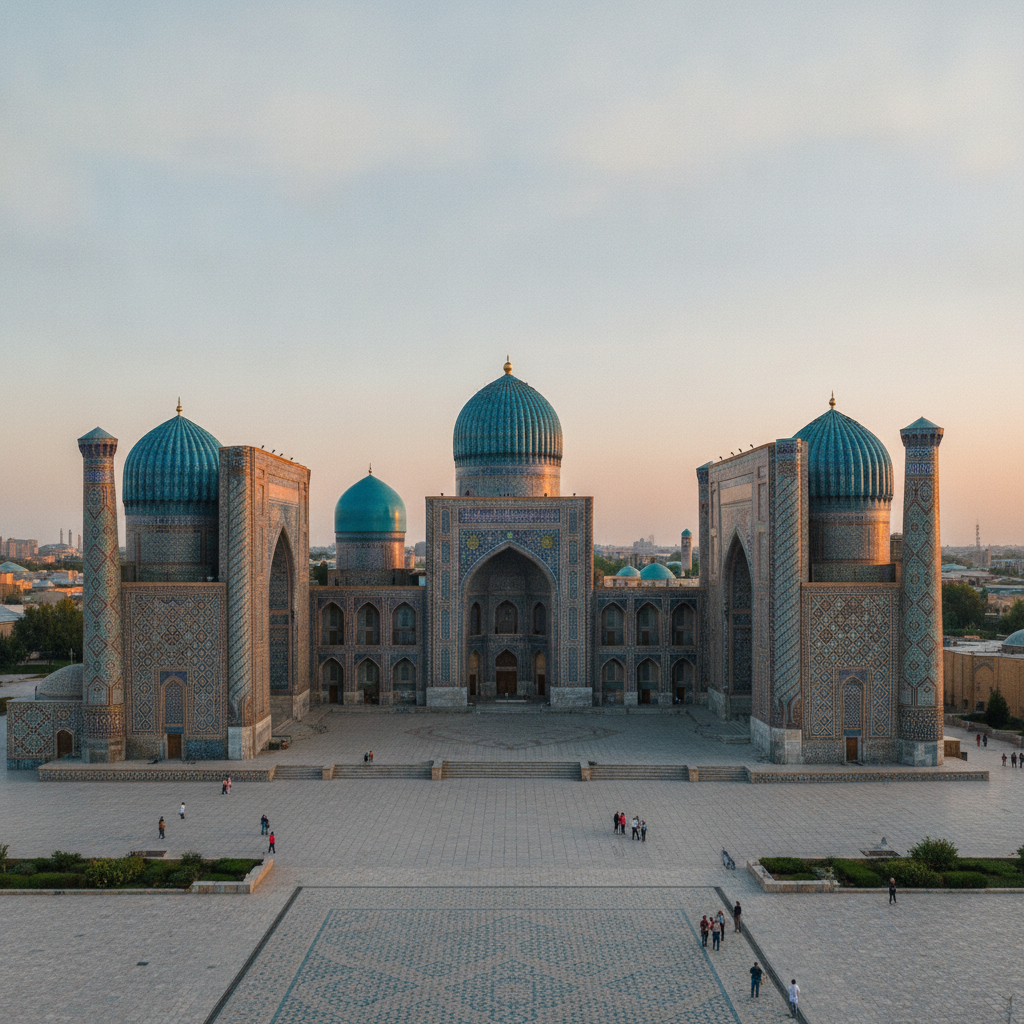
The Registan (Регистон—'Sandy Place' in Tajik/Persian—the central public square of medieval Samarkand and the most intact ensemble of Islamic monumental architecture in Central Asia): the three madrasas of the Registan. The Ulugbek Madrasa (the western madrasa, built by the Timurid ruler Ulugbek (the astronomer-king who ruled Samarkand 1409–1449): constructed 1417–1420; the portal arch (pishtaq) rises 33m; the interior courtyard (hujra) contains 50 student cells arranged on two floors around the central garden): the Tilya-Kori Madrasa (the northern madrasa, built 1646–1660 during the Shaybanid period; the name means 'Gilded' in Uzbek—the interior of the prayer hall (iwan) is covered with gold leaf applied over blue painted arabesques in the 19th century Bukharan style; the gold leaf area approximately 400 m²—the most extensive surviving gold-leaf ceiling in Central Asia): the Sher-Dor Madrasa (the eastern madrasa built 1619–1636; the name means 'Tiger-Bearing'—the two heraldic images above the portal arch show lions chasing deer with the sun rising behind them, an unusual figural representation in Islamic architecture, explained by the secular and Zoroastrian-influenced nature of Timurid court art). The night illumination (the Registan sound-and-light show operates May–September, 21:00–22:00 nightly).
- 2
Gur-e-Amir – The Tomb of Tamerlane
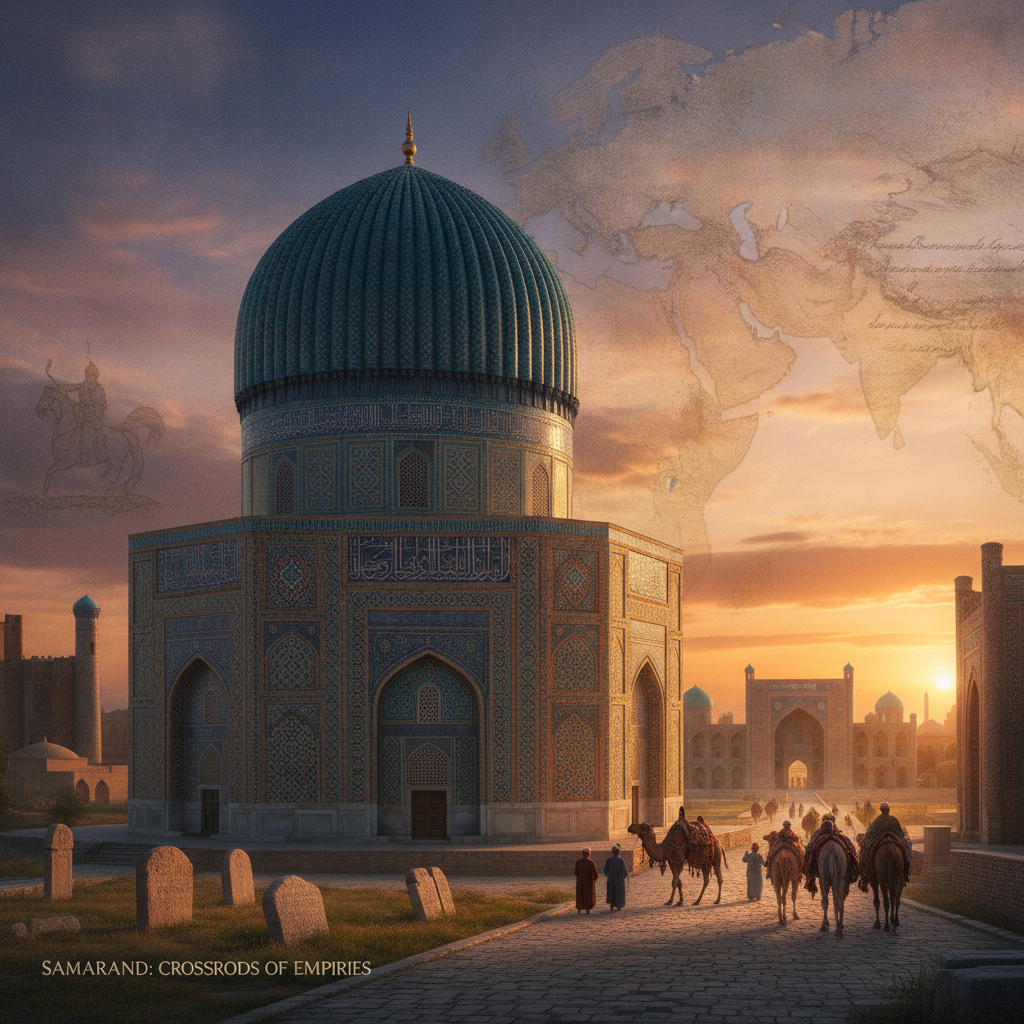
The Gur-e-Amir (گور امیر—'Tomb of the Ruler' in Persian—the mausoleum of Amir Timur (Tamerlane) and the architectural prototype for the great Mughal tombs of India including the Taj Mahal): the mausoleum complex. The construction (the original mausoleum was built 1404 by Timur for his grandson Muhammad Sultan who predeceased him; Timur himself died in 1405 during his campaign toward China and was interred here rather than in his intended tomb at Shahrisabz): the dome (the ribbed turquoise-and-gold dome rises 34m above the base—the ribbed melon-dome form (the 64 ribs symbolizing the 64 suras of the Quran according to Timurid tradition) became the defining form of Central Asian mausoleum architecture and was exported to India via the Mughal rulers who were direct descendants of Timur): the interior cenotaphs (the crypt chamber 6m below floor level contains the actual sarcophagi: Timur's black nephrite (dark green jade) sarcophagus is the largest—1.8m long; the inscription on the sarcophagus includes the phrase 'Were I alive, the world would tremble'—reportedly added by Timur himself): the curse (the Soviet archaeologist Mikhail Gerasimov opened the tomb on June 20, 1941—the Uzbek elders warned against opening the tomb, and Germany invaded the USSR two days later on June 22, 1941).
- 3
Shah-i-Zinda – The Living King Necropolis
The Shah-i-Zinda (شاه زنده—'The Living King'—the necropolis avenue of Timurid mausoleums on the northeastern slope of the Afrosiyab hill): the avenue of domes. The legend (the necropolis is named for Qutham ibn Abbas, a cousin of the Prophet Muhammad who according to local tradition brought Islam to Sogdia in 676 CE and was beheaded by the Zoroastrians—the legend states that he descended into a well in the hillside and is still living (hence 'Living King') in a paradisiacal garden beneath the earth): the architecture (the Shah-i-Zinda avenue contains 11 mausoleums built during the 14th–15th century Timurid period, arranged along a raised avenue ascending the hill: the tilework (the mausoleums are covered in the finest surviving Timurid mosaic tilework in Central Asia—the cuerda seca (dry cord) technique tiles with turquoise, ultramarine, white, and black geometric and floral patterns, many maintaining their original 14th-century glazing)): the most notable mausoleums (the Shadi Mulk Aka mausoleum (1372)—the oldest surviving Timurid mausoleum in Samarkand, built by Timur for his sister; the Tuman Aka mausoleum (1405)—the most geometrically complex tilework, with 5-pointed star patterns in turquoise on white ground): the pilgrimage (Shah-i-Zinda is an active pilgrimage site—Uzbek and Tajik women in white headscarves visit the tomb of Qutham ibn Abbas at the far end of the avenue).
- 4
Bibi-Khanym Mosque – Timur's Ambition in Stone
The Bibi-Khanym Mosque (مسجد بیبی خانم—the Grand Cathedral Mosque of Samarkand, built by Amir Timur 1398–1404 following his Indian campaign): the monument to imperial ambition. The construction (Timur ordered the mosque built following his sack of Delhi in 1398–1399 and the plunder of the Tughlaq Sultanate: the construction used 95 elephants brought from India to carry building materials and 500 craftsmen conscripted from across the Islamic world—the construction speed (6 years for a building with a 35m-span main dome) resulted in structural compromises that led to partial collapse within decades of completion): the scale (at its completion the Bibi-Khanym was the largest mosque in the Islamic world: the main prayer hall dome span 35m; the total courtyard 130m × 78m; the portal arch height 40m): the decline and restoration (the mosque was badly damaged by the 1897 earthquake and continued to deteriorate until the Soviet-era restoration (1974–1987) rebuilt the main dome and the main portal using original tiles recovered from the rubble—the current structure is approximately 60% reconstruction): the Koran stand (in the courtyard stands a marble Koran stand (Koranpult) 2m in diameter—the marble is a single piece from a Mongolian quarry, and tradition holds that women who pass beneath the stand will become fertile).
- 5
Afrosiyab – Ancient Sogdiana Beneath Samarkand
The Afrosiyab archaeological site (the ruins of the ancient city of Marakanda/Afrosiyab—the pre-Timurid city of Samarkand that was destroyed by Chinggis Khan in 1220 CE and never rebuilt): the archaeology of Sogdiana. The history (the hill of Afrosiyab northeast of the modern city marks the site of Marakanda—the Sogdian capital visited by Alexander the Great in 329 BCE and mentioned by Arrian as the capital of the Sogdian satrap Spitamenes—the city occupied approximately 219 hectares at its peak in the 7th–8th century CE): the 7th-century palace (the most significant archaeological find: the Afrosiyab Palace murals (650–700 CE)—the frescoes discovered in 1965 in a reception hall of the pre-Islamic Sogdian ruler depict: the northern wall: an embassy scene showing ambassadors from China, India, and Korea bringing gifts to the Sogdian king; the western wall: a royal hunting scene with falconers; the southern wall: a river procession with musicians on boats—the murals are the most complete surviving depiction of Sogdian court life and diplomatic relations in the pre-Islamic period): the Afrosiyab Museum (the on-site museum houses the original murals in situ—the murals were detached and remounted in the museum (opened 1970) and are the single most important visual record of Silk Road diplomacy in the 1st millennium CE).
- 6
Samarkand Practical Guide – Arrival, Orientation & Day Plan
The Samarkand practical guide (the essential logistics for visiting the most intensely touristed city in Uzbekistan): the arrival and orientation guide. The transport access (Samarkand International Airport (SKD): the airport receives regular flights from Tashkent (45 min, 10× daily on Uzbekistan Airways and Qanon Air), Istanbul, Moscow, Frankfurt, and Dubai; the Afrosiyob high-speed train from Tashkent (2h10m, 4× daily, USD 10–15 economy): the train station is 3 km from the Registan (taxi 10 min, USD 2)): the city layout (the old city (Sharq) contains the Registan, Gur-e-Amir, Shah-i-Zinda, Bibi-Khanym, and the Siab Bazaar within a 2km radius—all walkable in a single 6-hour circuit): the accommodation (the Platan Hotel (4-star, 200m from Registan, USD 80–120/night); the Hotel Grand Samarkand (the best traditional-style hotel, Uzbek architecture, USD 60–90); the boutique guesthouses in the Mahalla Khoja Akhror district adjacent to Shah-i-Zinda (USD 30–50)): the timing (the Registan at dawn (06:00–07:00 before tour groups arrive) and at the sound-and-light show (21:00) are the two optimal viewing times: midday heat in July–August peaks at 40°C—the optimal travel months are April–May and September–October): the practical details (the Samarkand Card (USD 15) provides entry to Registan, Gur-e-Amir, Shah-i-Zinda, and Bibi-Khanym—purchased at the Registan ticket office).
Walk this route with audio
Stories play automatically as you reach each stop — no tapping needed.
More in Samarkand

Uzbekistan Circuit: Bukhara, Khiva, Tashkent, and the Most Comprehensively Silk Road Single Central Asian Heritage Country
Samarkand History: Tamerlane, the Timurid Empire, the Silk Road Trade, Alexander the Great, and the Most Historically Layered Single Central Asian City
Samarkand Essential: The Registan, Shah-i-Zinda, Gur-e-Amir, Bibi-Khanym, and the Most Magnificently Tiled Single Silk Road City

Samarkand Science: Ulugh Beg, the Medieval Observatory, Islamic Astronomy, and the Most Scientifically Consequential Single Central Asian Ruler
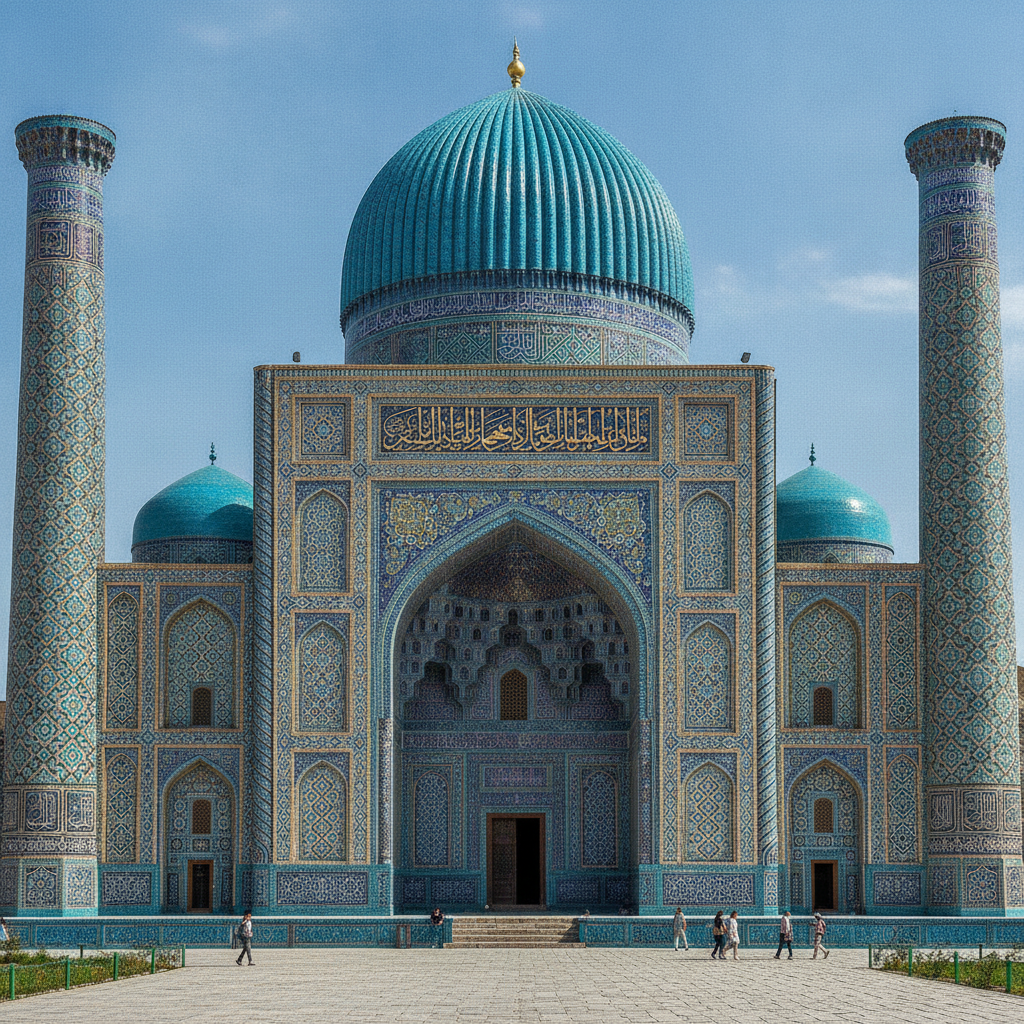
Samarkand Architecture: The Timurid Tilework, the Madrasas, the Dome Engineering, and the Most Comprehensively Blue-Tiled Single Islamic Heritage