Pintxos, Old Town & San Sebastián's World-Class Gastronomy
San Sebastián (Donostia in Basque — the city on the Bay of Biscay coast of the Basque Country, population approximately 186,000): the city with the highest concentration of Michelin stars per capita of any city in the world (the San Sebastián metropolitan area has more Michelin-starred restaurants per square kilometre than any other place on Earth), the city whose 'Parte Vieja' (Old Town) pintxos bars are the greatest concentration of extraordinary food in the world — is the undisputed gastronomic capital of the world.
- 1
The Parte Vieja — San Sebastián's Old Town Pintxos District
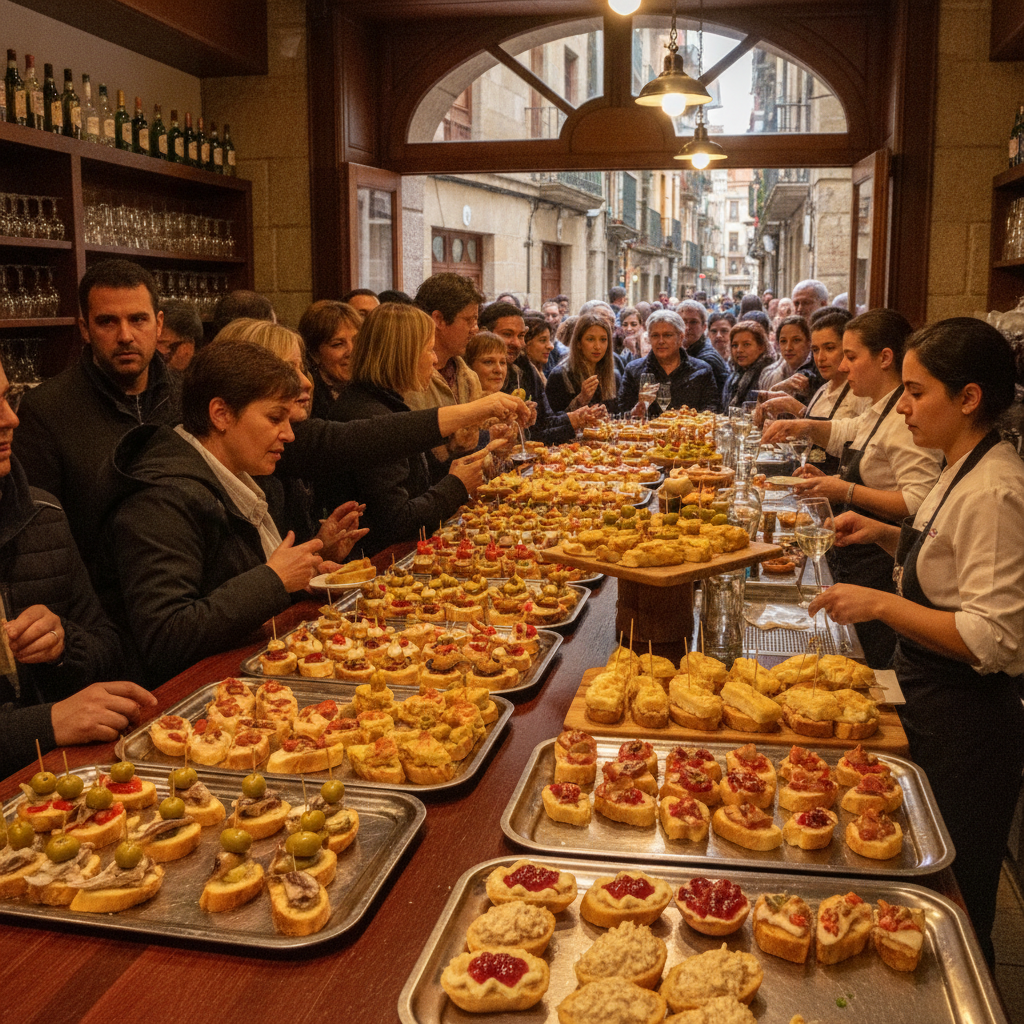
The Parte Vieja (the 'Old Town' of San Sebastián — the compact historic centre of the city, the neighbourhood between the Monte Urgull (the hill at the western end of La Concha bay) and the Río Urumea (the river at the eastern edge of the city), the neighbourhood of the narrow streets ('calles') and the pintxos bars that is the gastronomic heart of the Basque Country): the streets (the streets of the Parte Vieja — the most important pintxos streets: the Calle 31 de Agosto (the '31 August Street' — named for the date of the fire of 1813 in which the Anglo-Portuguese forces burned San Sebastián after capturing the city from the French, the fire that destroyed all of San Sebastián except the Parte Vieja church and a single street — the Calle 31 de Agosto), the Calle de la Pescadería (the 'Fishmonger's Street'), and the Calle Fermín Calbetón (the street that many food writers consider to have the highest concentration of exceptional pintxos bars in the world)): the pintxo (the pintxo ('pincho' in Spanish, 'pintxo' in Basque — the 'spike' in both languages, referring to the toothpick that holds the topping to the bread): the defining food of San Sebastián, the small snack (a slice of bread topped with the ingredient or combination of ingredients) that is both the street food of the Parte Vieja bars and the medium for the most technically sophisticated and the most creative cooking in Spain: the classic pintxos (the classic pintxos of the Parte Vieja bars: the 'Gilda' (the most iconic pintxo — the anchovy, the olive, and the guindilla pickled pepper on the toothpick, invented at the Casa Vallés bar in 1946 and named for the Rita Hayworth film 'Gilda' (1946) because it was 'spicy, salty, and a little dangerous' like the film's femme fatale), the 'tortilla de patatas' (the potato omelette pintxo), the 'txangurro' (the stuffed spider crab pintxo), and the 'bacalao al pil-pil' (the salt cod in the 'pil-pil' emulsion sauce pintxo)): the innovative chef pintxos (the innovative pintxos — the avant-garde pintxos served at the most celebrated Parte Vieja bars (the Bar Zeruko, the Bar Txepetxa, the Bar La Cuchara de San Telmo) that represent the most exciting contemporary cooking in Spain at a price of €2-4 per pintxo).
- 2
Txakoli — Basque Country's Native White Wine
Txakoli (the 'Txakolina' — the native white wine of the Basque Country, the DO (Denominación de Origen) wine produced in three Basque appellations: the Getariako Txakolina (the Txakoli of Getaria, the most important appellation, produced around the coastal fishing village of Getaria 22 km west of San Sebastián), the Bizkaiko Txakolina (the Txakoli of Bizkaia, produced around Bilbao), and the Arabako Txakolina (the Txakoli of Álava, produced in the Álava province of the Basque Country)): the wine style (the Txakoli wine style — the wine made predominantly from the 'Hondarrabi Zuri' (the white grape variety indigenous to the Basque Country, 'Hondarrabi' referring to the Basque coastal town of Hondarribia) and the 'Hondarrabi Beltza' (the red variety), producing a light (9.5-11% ABV), bone-dry, high-acid, slightly sparkling ('petillant') white wine with the characteristic green apple and citrus fruit character): the pouring (the characteristic Basque way of pouring the Txakoli — the bottle held high above the glass (30-60 cm / 1-2 feet above the glass) and the wine poured in a thin stream to aerate the wine and to emphasize the natural effervescence: the 'txotx' (the 'cider house' pouring in the cideries of the Basque Country — the cider ('sagardoa' — the Basque word for cider) poured from the barrel in a similar high-pour style)): the Txakoli with pintxos (the pairing of the Txakoli wine with the pintxos — the quintessential Basque Country gastronomic combination, the dry, lightly sparkling, high-acid Txakoli cutting through the richness of the pintxos ingredients and refreshing the palate between bites).
- 3
The Michelin Stars of San Sebastián
San Sebastián's Michelin stars (the extraordinary concentration of Michelin-starred restaurants in the San Sebastián metropolitan area — the city that consistently holds the record for the highest concentration of Michelin stars per capita of any city in the world): the Michelin Guide (the Michelin Guide ('Guide Michelin' — the restaurant rating guide published annually by the Michelin tyre company, the guide that is the most prestigious and the most influential rating system in the world for haute cuisine, the guide whose star system (one star = 'a very good restaurant', two stars = 'excellent cooking, worth a detour', three stars = 'exceptional cuisine, worth a special journey') defines the hierarchy of fine dining worldwide)): the San Sebastián Michelin landscape (the Michelin-starred restaurants of San Sebastián and its surroundings (as of the mid-2020s): the three-Michelin-star restaurants (the highest tier) — the 'Arzak' (the restaurant of Juan Mari Arzak (b.1942) and his daughter Elena Arzak (b.1969) in the Alto de Miracruz neighbourhood of San Sebastián, the restaurant that is consistently ranked as one of the top 50 restaurants in the world and that is the most famous restaurant in the Basque Country (Juan Mari Arzak is the patriarch of the 'Nueva Cocina Vasca' — the 'New Basque Cuisine' movement that revolutionized Spanish cooking in the 1970s-1980s)), the 'Akelarre' (the restaurant of Pedro Subijana (b.1948) on the cliff above the Bahía de Igueldo, another pioneer of the Nueva Cocina Vasca movement), and the 'Martín Berasategui' (the restaurant of Martín Berasategui (b.1960) in Lasarte-Oria, 9 km south of San Sebastián — the chef with the most Michelin stars of any Basque chef): the two-Michelin-star restaurants — the 'Mugaritz' (the restaurant of Andoni Luis Aduriz (b.1971) in Rentería, 10 km east of San Sebastián, the restaurant that is consistently ranked in the top 10 restaurants in the world and that represents the most experimental and the most intellectually provocative approach to cuisine in the Basque Country).
- 4
La Concha Beach — Europe's Most Beautiful Urban Beach
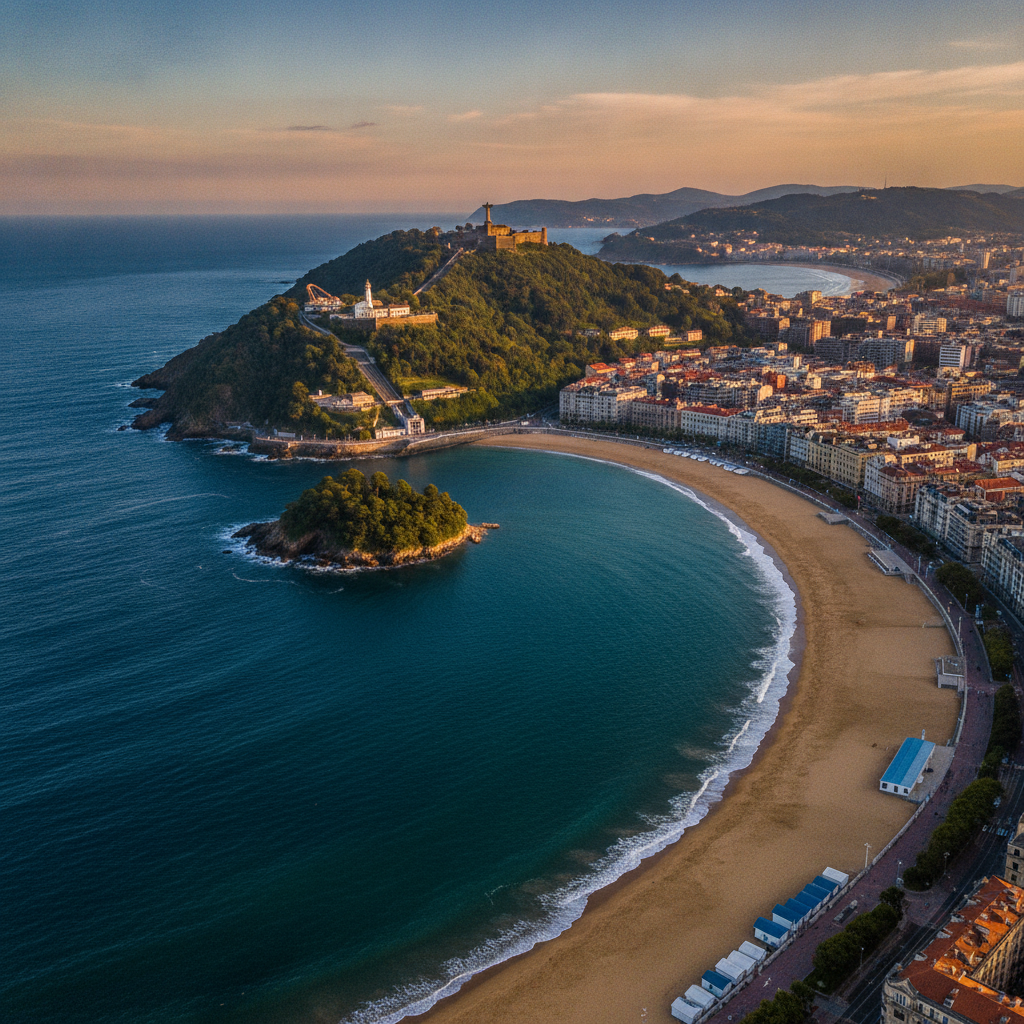
La Concha (the 'Shell' — the main beach of San Sebastián, the semicircular bay beach that is consistently voted the most beautiful urban beach in Europe): the bay (the Bahía de la Concha — the perfectly semicircular bay of San Sebastián, enclosed on the west by the Monte Igueldo (the hill with the funicular and the amusement park above the western end of the bay) and on the east by the Monte Urgull (the hill above the Parte Vieja, topped by the statue of the Sacred Heart of Jesus), with the small island of the Santa Clara visible in the centre of the bay): the beach (the Playa de la Concha — the crescent-shaped sandy beach of approximately 1.35 km length, backed by the elegant Belle Époque promenade ('Paseo de la Concha') with the balustrade of cast iron and the white painted cast-iron beach huts and changing cabins): the Paseo de la Concha (the promenade along the back of the La Concha beach — the most elegant promenade in northern Spain, with the neoclassical building facades of the San Sebastián Ensanche (the 19th-century planned extension of the city) overlooking the beach from the north side of the promenade): the Belle Époque San Sebastián (the Belle Époque character of the La Concha area — the legacy of the period when San Sebastián was the summer resort of the Spanish royal family (Queen Maria Christina of Austria (1858-1929), the regent of Spain 1885-1902, established the royal summer court in San Sebastián in the 1880s), the period when the most elegant hotels, casinos, and villas of San Sebastián were built along the La Concha beachfront).
- 5
Monte Igueldo & Monte Urgull — San Sebastián's Twin Hills
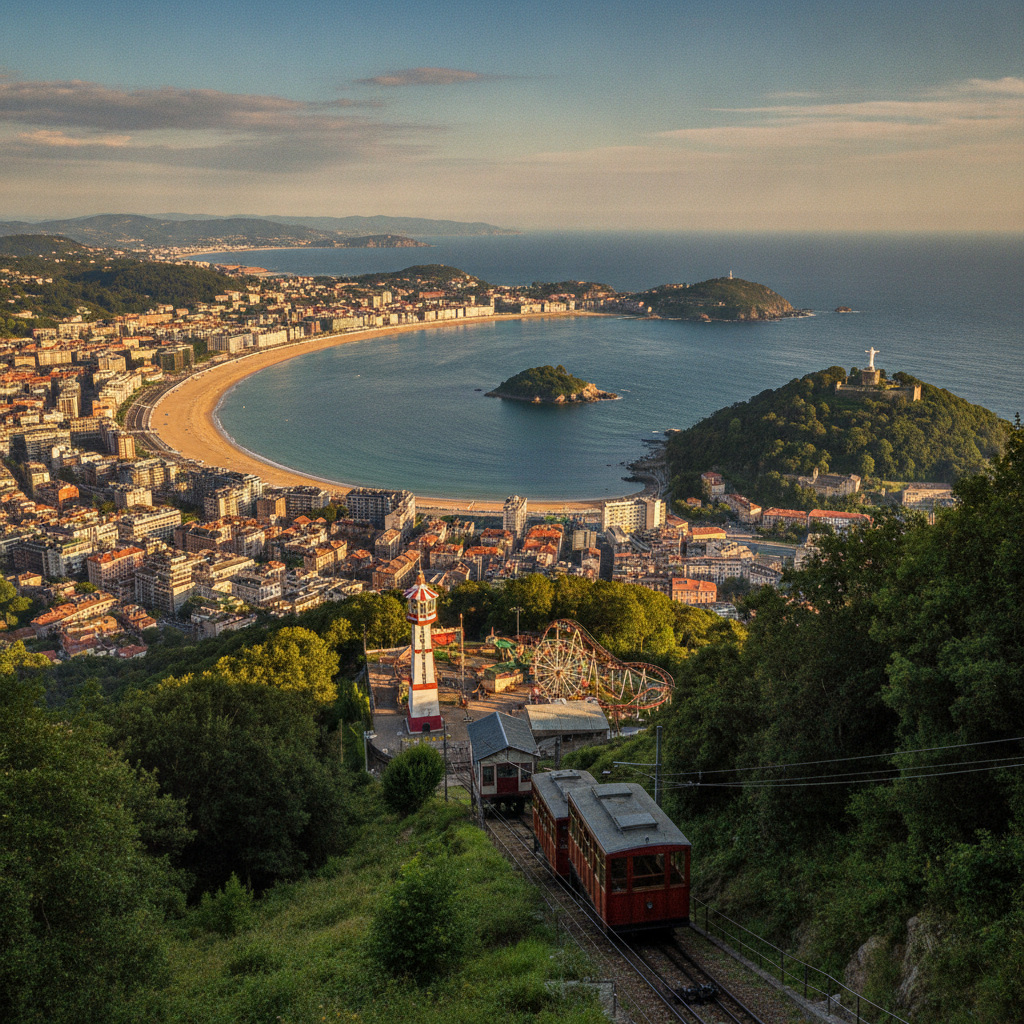
The two hills that frame the La Concha bay of San Sebastián (the twin hills that define the topography and the cityscape of San Sebastián): the Monte Urgull (the hill at the eastern end of the La Concha bay — the 123-metre (404-foot) hill above the Parte Vieja, the hill that was the site of the medieval fortress of San Sebastián (the 'Castillo de la Mota' — the fortified castle on the summit of Monte Urgull that was the defensive stronghold of the city from the medieval period to the 19th century), the hill now preserved as a public park with the walking trails through the pine and oak woodland and the ruins of the medieval walls): the statue of the Sacred Heart (the 'Cristo del Castillo' — the monumental statue of the Sacred Heart of Jesus at the summit of Monte Urgull, the most recognizable landmark of San Sebastián (visible from the La Concha beach and from the bay), the 12-metre (39-foot) tall statue erected in 1950): the Monte Igueldo (the hill at the western end of the La Concha bay — the 181-metre (594-foot) hill at the western edge of San Sebastián, the hill accessible by the Monte Igueldo funicular (the funicular railway built in 1912, the most scenic way to ascend Monte Igueldo) and topped by the Monte Igueldo amusement park (the small hilltop amusement park, the oldest amusement park in Spain, with the vintage rides and the panoramic views of La Concha)): the view from Monte Igueldo (the view from the summit of Monte Igueldo — the panoramic view of the entire La Concha bay with the city of San Sebastián, the Parte Vieja, the Monte Urgull, the Isla de Santa Clara, and the Basque countryside behind the city).
- 6
Basque Cuisine Philosophy — Nueva Cocina Vasca
The 'Nueva Cocina Vasca' (the 'New Basque Cuisine' — the culinary movement that began in San Sebastián in the late 1970s and that transformed Spanish (and global) cooking, the movement that is the direct predecessor of the 'molecular gastronomy' and 'avant-garde cuisine' movements of the 1990s-2000s): the origins (the Nueva Cocina Vasca — born in 1976 in San Sebastián when a group of young Basque chefs (led by Juan Mari Arzak, Pedro Subijana, Karlos Arguiñano, and Luis Irizar) founded the 'Nueva Cocina Vasca' movement after a trip to the French Basque Country (where they encountered the 'Nouvelle Cuisine' of Paul Bocuse, Joël Robuchon, and Michel Guérard): the movement (the Nueva Cocina Vasca — the movement that applied the principles of the French Nouvelle Cuisine (the rejection of heavy sauces, the emphasis on the quality of the ingredient, the lighter cooking methods) to the traditional Basque cooking tradition (the cooking tradition of the Basque fishermen, the farmers, and the txoko (the all-male private gastronomic clubs of the Basque Country)): the innovation (the innovation of the Nueva Cocina Vasca — the movement that inspired the next generation of Spanish chefs: Ferran Adrià (the chef of 'El Bulli' in Roses, Catalonia — the restaurant that was consistently voted the best restaurant in the world in 2002-2009 and that pioneered the 'molecular gastronomy' or 'Techno-emotional cuisine' approach), Juan Roca (of 'El Celler de Can Roca' in Girona), and the entire generation of Spanish chefs who made Spain the most innovative and the most exciting culinary nation in the world in the 1990s-2010s).
Walk this route with audio
Stories play automatically as you reach each stop — no tapping needed.
More in san-sebastian
Pasajes Harbour, Hondarribia & the Basque Border Coast
Sagardotegi, Basque Cider Houses & Seasonal Traditions
Monte Igueldo, Monte Urgull & San Sebastián's Panoramic Views
Basque Culture, Euskara & the Ancient Identity of San Sebastián
La Concha Beach, Belle Époque Promenade & San Sebastián Elegance