Santa Fe: Plaza, Canyon Road, O'Keeffe, Loretto Chapel, Bandelier, and New Mexican Cuisine
Santa Fe (elevation 2,194 m, the highest state capital in the United States, population 85,000) was founded 1610 as the capital of the Spanish province of Nuevo Mexico -- four years before the Dutch founded New Amsterdam (New York) and ten years before the Pilgrims landed at Plymouth Rock -- making it the oldest capital city in the United States by a margin of over a century. Santa Fe sits at the foot of the Sangre de Cristo Mountains (Blood of Christ Mountains, named for their red twilight coloring, reaching 3,774 m at Santa Fe Baldy), in a pinon-juniper forest at 2,194 m that gives the city a climate dramatically cooler than Albuquerque (100 km south, 670 m lower), with frequent afternoon thunderstorms in summer, real snowfall in winter, and the most intense blue sky in the American Southwest due to the altitude and low humidity. Santa Fe is the third-largest art market in the United States (after New York and Los Angeles), with an estimated USD 1B+ in annual art sales from approximately 250 galleries, the Santa Fe Indian Market (August, USD 100M, 1,200 juried Native artists), and SITE Santa Fe. The arts economy, tourism (approximately 2 million visitors per year), government (as the state capital), and the nearby national laboratories define the economic base of a city that belies its small population with outsized national cultural influence.
- 1
The Santa Fe Plaza and the Palace of the Governors
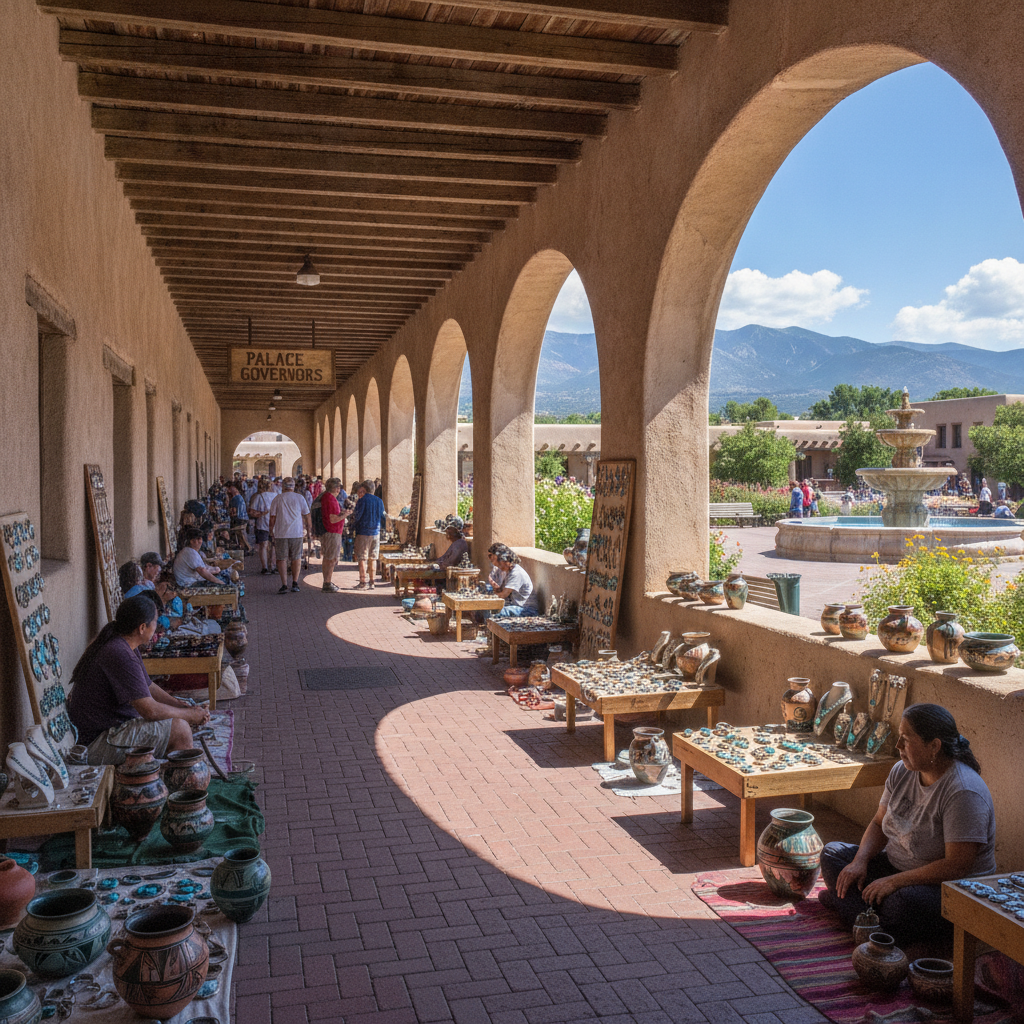
The Santa Fe Plaza (the central plaza at the heart of downtown Santa Fe, bounded by Palace Avenue, Lincoln Avenue, San Francisco Street, and Old Santa Fe Trail): the oldest public park in the United States still in continuous use as a public gathering space, established in 1610 when the city was founded as the capital of the Spanish province of Nuevo Mexico under Governor Pedro de Peralta. The Santa Fe Plaza has served as the symbolic center of four successive sovereign governments -- the Spanish Colonial capital (1610-1821), the capital of independent Mexico (1821-1846), the capital of the Territory of New Mexico under U.S. occupation (from August 18, 1846, when General Stephen Kearny rode into the plaza and raised the American flag without a shot being fired), and the capital of the State of New Mexico (since January 6, 1912). The Palace of the Governors (at 105 West Palace Avenue, on the north side of the Santa Fe Plaza, built approximately 1610-1613): the oldest continuously occupied public building in the United States, serving as the seat of government for Spanish, Pueblo (during the Pueblo Revolt of 1680-1692, when Po'pay and the Pueblo warriors drove the Spanish from New Mexico for 12 years), Mexican, and American governors of New Mexico. The Palace of the Governors is now part of the New Mexico History Museum (at 113 Lincoln Avenue, Santa Fe, established 2009): the most comprehensive collection of New Mexico historical artifacts and documents in existence, with the Billy the Kid tintype (the only authenticated photograph of William H. Bonney, taken approximately 1879-1880, purchased by businessman William Koch for USD 2.3M at Brian Lebel's Old West Auction in 2011) as the prize of the collection. The Portal Program: the daily market on the portal (covered walkway) of the Palace of the Governors, where juried Native American artisans (exclusively from New Mexico Pueblos and tribes) sell directly to the public.
- 2
Canyon Road - The Mile of Art
Canyon Road (the 1-km street running southeast from the Santa Fe River to Cristo Rey Church, Santa Fe): the most concentrated gallery district in the United States and one of the most concentrated in the world, with approximately 80-100 art galleries, studios, restaurants, and shops in historic adobe buildings along a single street -- generating an estimated USD 200M+ in annual art sales. Canyon Road's history: the road was originally a Pueblo trading path, then a Spanish Colonial acequia-side agricultural lane serving the early Santa Fe settlers, then the home of Spanish Colonial weaving and craft traditions. The artist colony arrived in the 1920s when painter Josef Bakos (one of the Los Cinco Pintores, the five Santa Fe painters who established the Canyon Road art colony in 1921) moved into a studio on Canyon Road. The galleries: Nedra Matteucci Galleries (at 1075 Paseo de Peralta), LewAllen Galleries (at 1613 Paseo de Peralta), the Gerald Peters Gallery (at 1011 Paseo de Peralta, specializing in American Impressionism and the Taos and Santa Fe art colonies), and Wiford Gallery (at 403 Canyon Road) are among the most prestigious, with individual works ranging from USD 500 to USD 500,000+. The Cristo Rey Church (at 1120 Canyon Road, built 1940 by John Gaw Meem as part of the 400th anniversary of Francisco Vasquez de Coronado's expedition, the largest adobe church in the United States, with walls 1.2 m thick and a sanctuary seating 1,000): the church housing the stone reredos (altar screen) carved in 1760 and considered the finest example of Spanish Colonial religious art in the United States. The First Friday art openings: every first Friday evening (5-7 pm), the Canyon Road galleries hold simultaneous opening receptions, transforming the street into a pedestrian gallery walk with wine and music.
- 3
Georgia O'Keeffe and the Santa Fe Art World
The Georgia O'Keeffe Museum (at 217 Johnson Street, Santa Fe, established July 17, 1997 -- the first museum in the United States dedicated to a female artist): the primary repository of O'Keeffe's lifetime work, with 3,000 items in the collection (paintings, drawings, watercolors, pastels, and sculpture), including the Black Iris III (1926), the Jimson Weed/White Flower No. 1 (1932, sold at Sotheby's New York on November 20, 2014 for USD 44.4M -- the highest price ever paid at auction for a painting by a female artist at the time, a record that stood until 2018), and the Patio with Black Door (1955). O'Keeffe's New Mexico: Georgia O'Keeffe (1887-1986) first visited New Mexico in 1917 with her patron and future husband Alfred Stieglitz, returned every summer beginning in 1929, and moved permanently to Abiquiu in 1949, describing the landscape as hers in a way no other place had ever been. The Abiquiu house (open for tours by reservation, at Abiquiu, NM, 80 km north of Santa Fe): the adobe compound she purchased in 1945 for USD 10 and spent decades renovating, now operated by the Georgia O'Keeffe Museum. The Santa Fe art market: Santa Fe is the third-largest art market in the United States (after New York and Los Angeles), with an annual art market estimated at USD 1B+ generated by approximately 250 galleries and the major auction events -- the Santa Fe Indian Market (August, approximately USD 100M), the Spanish Market (July, on the Santa Fe Plaza), and SITE Santa Fe (the contemporary art biennial, one of the most prestigious in the American West). The Meow Wolf House of Eternal Return (at 1352 Rufina Circle, Santa Fe, opened March 17, 2016): the 20,000-square-foot immersive narrative art installation created by the Santa Fe arts collective Meow Wolf, with 70+ artists creating a Victorian house concealing a multiverse portal.
- 4
The Loretto Chapel Staircase and Santa Fe's Religious Heritage
The Loretto Chapel (at 207 Old Santa Fe Trail, Santa Fe, completed 1878, designed by architect Antoine Mouly in French Gothic style for the Sisters of Loretto at the Foot of the Cross): the former chapel of the Sisters of Loretto girls school, now a private event venue, famous throughout the world for the Miraculous Staircase -- a 6-m-tall circular wooden staircase with two complete 360-degree turns and no central support column, no visible means of support, and (in the original construction) no nails, built by an unknown carpenter who appeared at the chapel in 1877 and disappeared after completing the staircase without accepting payment. The staircase was studied by engineering teams from the U.S. Army Corps of Engineers and concluded to be structurally remarkable -- the wood species used (a close-grained hardwood) has not been definitively identified, and no record of a craftsman building it appears in Santa Fe records of the period. The legend: the Sisters of Loretto had run out of money to build a staircase to their choir loft after the chapel was completed without one (the architect Antoine Mouly having died during construction), and after novenas to Saint Joseph (the patron saint of carpenters), an unknown craftsman arrived with only a donkey, a toolbox, and a tub of water (for steaming the wood into curves). The San Miguel Mission (at 401 Old Santa Fe Trail, Santa Fe, built 1610-1628 on the south side of the Santa Fe River in the Barrio de Analco): the oldest church in the United States still in continuous use (older than the Loretto Chapel by 250 years and continuously used by the indigenous Tlaxcalan workers who built it for the Spanish Colonial government). The Santa Fe Cathedral Basilica of Saint Francis of Assisi (at 131 Cathedral Place, Santa Fe, built 1869-1884 by French Archbishop Jean-Baptiste Lamy -- born October 11, 1814, Lempdes, France; died February 13, 1888, Santa Fe, the inspiration for Willa Cather's novel Death Comes for the Archbishop published 1927).
- 5
Bandelier National Monument and the Pueblo Cliff Dwellings
Bandelier National Monument (at 15 Entrance Road, Los Alamos, NM, 56 km north of Santa Fe via US-285 and NM-502, established as a national monument February 11, 1916 by President Woodrow Wilson, named for archaeologist Adolph Bandelier -- born August 6, 1840, Bern, Switzerland; died March 18, 1914, Seville, Spain -- whose novel The Delight Makers, 1890, was the first novel set among the ancient Pueblo people): the 33,677-acre national monument protecting the Ancestral Pueblo cliff dwellings, kiva ruins, and petroglyphs of Frijoles Canyon on the Pajarito Plateau. The Ancestral Pueblo history at Bandelier: the Pajarito Plateau was inhabited from approximately 1150 CE as Ancestral Pueblo people migrated from drier regions to the north, establishing villages in the volcanic tuff (soft compressed volcanic ash) cliffs of Frijoles Canyon. The cliff dwellings (cavates): the rooms carved directly into the soft volcanic tuff face of the canyon walls, with thousands of individual room-spaces carved to provide storage and sleeping space supplementing the freestanding pueblos built at the cliff base. The Long House: the largest ruin at Bandelier, a pueblo approximately 800 rooms long built against the south-facing tuff cliff, with the carved cavates visible as dark holes in the cliff face above the ruins of the ground-level walls. The Alcove House (Ceremonial Cave): the kiva and small pueblo in a 40-m-high alcove in the canyon wall, accessible only by four wooden ladders totaling 37 m of vertical climb -- the most dramatic Ancestral Pueblo site accessible to visitors in New Mexico. Los Alamos (adjacent to Bandelier, at 475 20th Street, Los Alamos, NM): the town created entirely by the Manhattan Project in 1943 on a remote plateau to house the physicists and engineers designing the first atomic bomb, still the home of Los Alamos National Laboratory (LANL, the nuclear weapons design laboratory, 10,500 employees, USD 3.9B annual budget, co-designer of the Trinity device tested July 16, 1945).
- 6
Santa Fe Cuisine, the New Mexican Table, and the Farmers Market
Santa Fe's restaurant culture: Santa Fe has the highest density of acclaimed independent restaurants per capita of any American city of comparable size (population approximately 85,000), driven by its status as the premier arts tourism destination in the American Southwest, the high disposable income of its visitor base, and a food culture that synthesizes indigenous Pueblo cooking, Spanish Colonial techniques, and the American farm-to-table movement. The Santa Fe Farmers Market (at the Railyard, 1607 Paseo de Peralta, Santa Fe, operating year-round, Tuesdays and Saturdays, with the Saturday market from April through November the primary event): the most significant farmers market in the mountain West, with 150+ vendors selling locally produced food within a 160-km radius of Santa Fe. The signature Santa Fe restaurants: The Shed (at 113 1/2 East Palace Avenue, Santa Fe, in a hacienda built in 1692, operating as a restaurant since 1953): the most historically significant New Mexican restaurant, serving red chile-smothered dishes in a building that predates American ownership of New Mexico by 154 years. Cafe Pasqual's (at 121 Don Gaspar Avenue, Santa Fe, founded 1979 by Katharine Kagel): the most nationally acclaimed Santa Fe restaurant, known for the breakfast burritos and the hand-painted murals by muralist Leovigildo Martinez. La Boca and Taberna (at 72 West Marcy Street): the Iberian tapas restaurant consistently among the top-rated in the Southwest. The Compound Restaurant (at 653 Canyon Road, founded 1966 by William Lumpkins): the landmark Canyon Road fine dining institution. The Izanami at Ten Thousand Waves (at 3451 Hyde Park Road, 8 km north of Santa Fe): the Japanese mountain spa and restaurant in the Sangre de Cristo foothills offering the most unusual dining experience in New Mexico -- kaiseki cuisine served in a traditional Japanese bathhouse setting at 7,300 feet.
Walk this route with audio
Stories play automatically as you reach each stop — no tapping needed.
More in santa-fe
Santa Fe: Roswell, Chaco Culture, Turquoise Trail, Billy the Kid, Farm-to-Table Dining, and City Demographics
Santa Fe: Pueblo Revolt, Taos Pueblo, High Road, Santa Fe Opera, and Adobe Architecture
Santa Fe: SITE Santa Fe, Nuclear Heritage, Santa Fe Trail, O'Keeffe at Abiquiu, Acequia Culture, and Economy
Santa Fe: Literary Colony, Museum of Art, Chimayo Weaving, Railyard District, Mountain Life, and Practical Tips
Santa Fe: O Keeffe Country, Ancient Trade Routes and Complexity Science