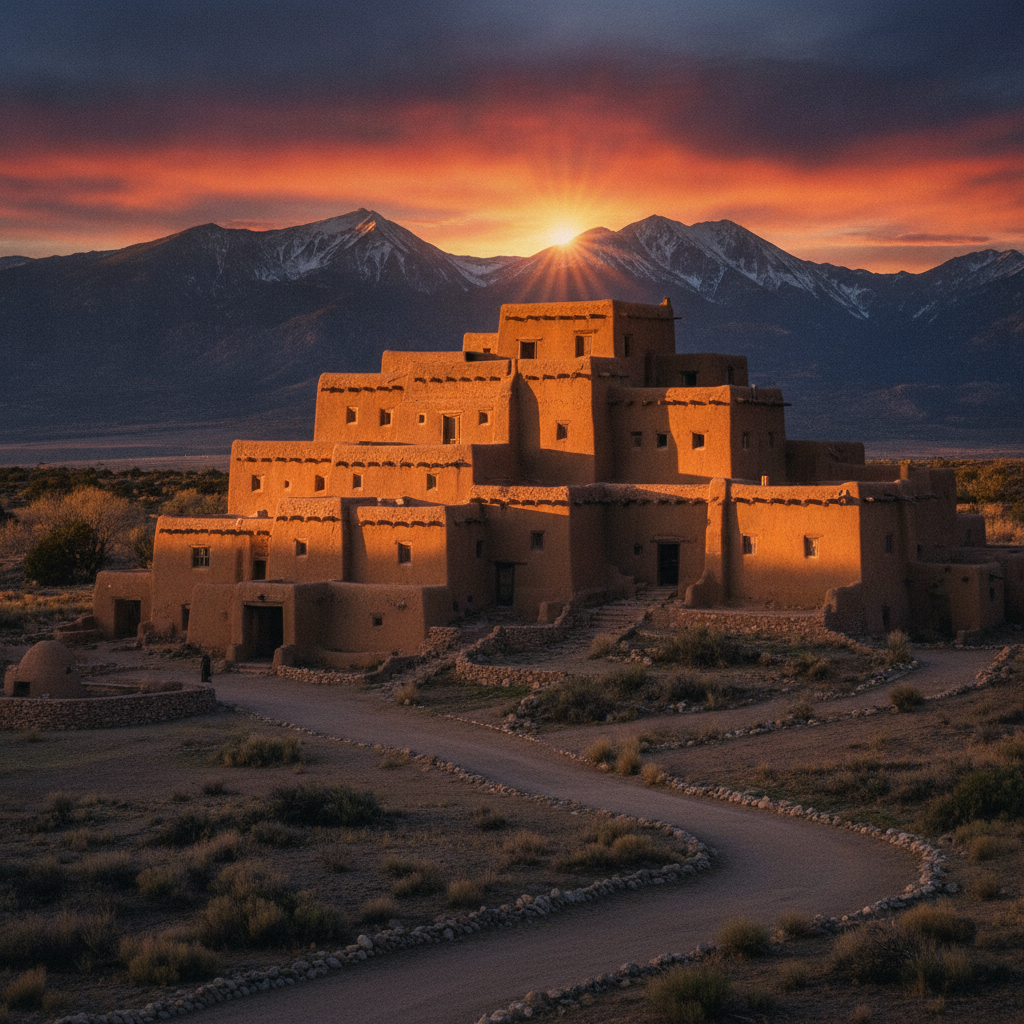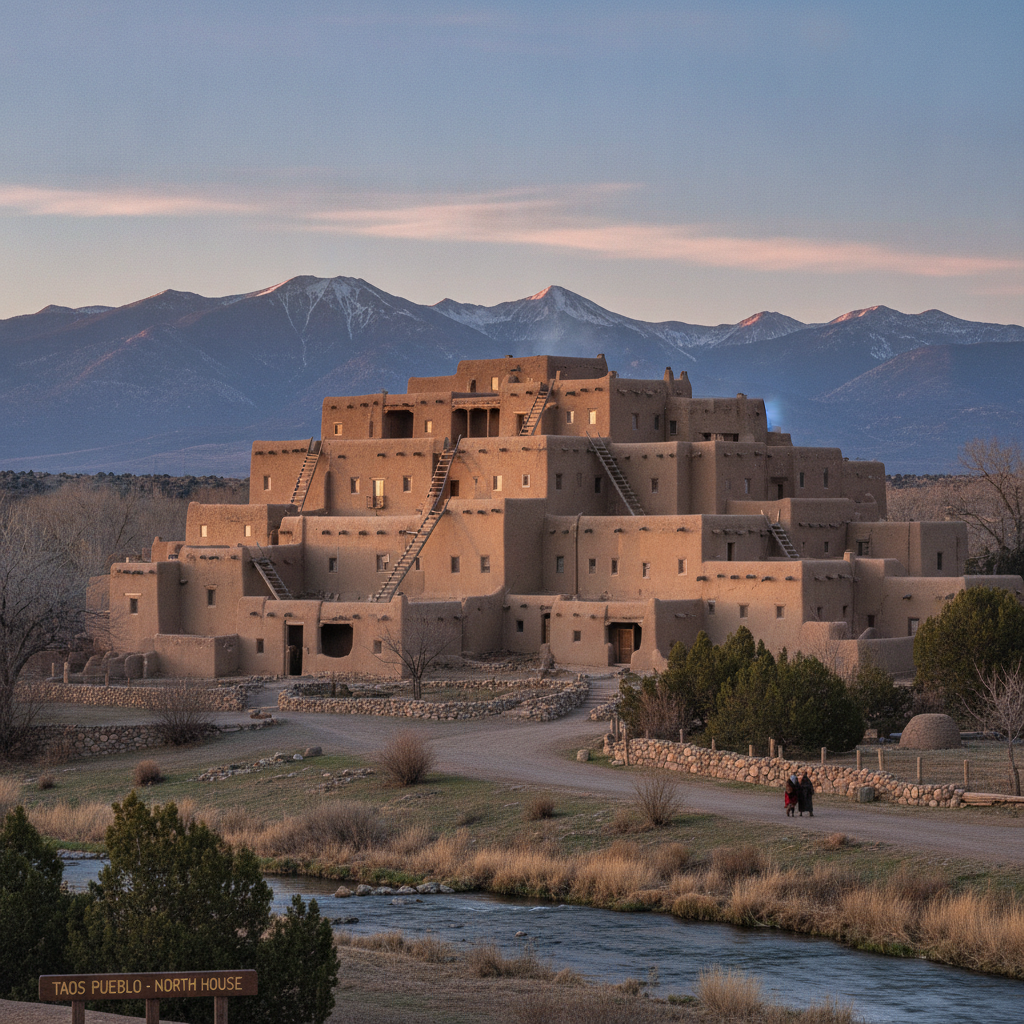
Santa Fe: Pueblo Revolt, Taos Pueblo, High Road, Santa Fe Opera, and Adobe Architecture
Santa Fe: Pueblo Revolt 1680 (Po'pay born 1630 Ohkay Owingeh organized 17,000 Pueblo people 24 Pueblos 640km simultaneously killed 401 settlers 21 of 33 priests expelled 2,100 Spanish, knotted cord warning plan, most successful indigenous uprising Americas, reconquest 1692 de Vargas September 13, Fiesta de Santa Fe oldest US civic celebration since 1712 Zozobra burning), Taos Pueblo (UNESCO 1992 over 1,000 years continuous habitation oldest US community, North and South House 5-6 stories 150 residents without electricity or water, Blue Lake taken 1906 returned Nixon December 15 1970 only federal land returned to indigenous owners, D.H. Lawrence Georgia O'Keeffe Ansel Adams Taos Society Artists 1915), Ten Thousand Waves (1981 Japanese onsen spa 2,348m Sangre de Cristo, Izanami kaiseki, Ski Santa Fe 3,560m highest ski resort American Southwest 750m vertical 9km from plaza, Truchas Peak 4,011m second highest NM, Pecos Wilderness alpine lakes Pecos Pueblo abandoned 1838), High Road to Taos (130km NM-503 76 68, Chimayo Ortega Trujillo eight generations weaving, Santuario de Chimayo 1816 300,000 pilgrims/year Good Friday 30,000 walk New Mexico Lourdes, Las Trampas San Jose de Gracia 1760 finest Spanish Colonial religious architecture, Truchas Milagro Beanfield War 1988), Opera (John Crosby 1957 5 operas summer, theater burned 1967 Madama Butterfly ember, rebuilt 1968 2,128 seats open-air, US premiere Berg Lulu 1963 Strauss Ariadne 1971, tailgate champagne parking lot unique tradition), Adobe Style (Historic Style Ordinance 1957 most comprehensive US aesthetic law, 350mm walls 18-20C constant temperature passive solar 1,000 years, La Fonda inn on plaza site since 1607 older than US).
- 1
The Pueblo Revolt of 1680 - The Most Successful Indigenous Uprising in American History
The Pueblo Revolt of 1680 (August 10, 1680): the most successful Native American military uprising against European colonizers in the history of the Americas, in which the Pueblo leader Po'pay (born approximately 1630, Ohkay Owingeh, San Juan Pueblo; died 1692) organized a coordinated simultaneous uprising of 17,000 Pueblo people from 24 Pueblos spanning 640 km of the Rio Grande valley, killing 401 Spanish settlers and 21 of the 33 Franciscan priests, and driving the remaining 2,100 Spanish survivors south to El Paso del Norte in a desperate retreat -- expelling the entire Spanish colonial population from New Mexico. Po'pay issued a warning to the Pueblos via knotted cords (one knot to be untied each day, with the revolt beginning when the last knot was untied), but the Spanish colonial governor learned of the plan and forced Po'pay to move the revolt forward by two days -- the simultaneous nature of the uprising, executed by 24 Pueblos speaking six mutually unintelligible languages across 640 km without modern communications, remains one of the most remarkable feats of military coordination in the history of the Americas. The Spanish did not return to New Mexico until 1692, when Governor Diego de Vargas (born 1643, Madrid; died 1704, Bernalillo) led the Reconquest (the Reentry) -- entering Santa Fe on September 13, 1692 without significant fighting because Po'pay had died in 1692 and the coalition of Pueblos had fragmented. The Fiesta de Santa Fe (September, the oldest civic celebration in the United States, annually since 1712): commemorates the 1692 Reconquest with the burning of Zozobra (Old Man Gloom, a 20-m marionette burned each year to symbolize the destruction of the previous year's sorrows) and the historical procession of La Conquistadora.
- 2
Taos Pueblo and the Northern Rio Grande
Taos Pueblo (at the end of Pueblo Road, Taos, NM, 100 km north of Santa Fe): the most famous Native American pueblo in the United States and a UNESCO World Heritage Site (designated 1992), with two multi-story adobe residential complexes (Hlauuma/North House and Hlaukwima/South House, both standing approximately 5-6 stories at their highest points) that have been continuously inhabited for over 1,000 years -- making Taos Pueblo the oldest continuously inhabited community in the United States. The Taos Pueblo construction: the buildings are constructed of adobe (a mixture of earth, water, and organic material -- typically straw or grass -- formed into bricks and sun-dried) and plastered with a mixture of earth and water each year by the women of the Pueblo in the traditional plastering ceremony. Approximately 150 people still live in the traditional rooms of the North and South House, without electricity or running water, maintaining the pre-Columbian lifestyle by choice. The Blue Lake (Pueblo-de-Taos-Blue-Lake-Wilderness Area, sacred to the Taos Pueblo people): the sacred mountain lake that was taken from the Taos Pueblo by the U.S. government in 1906 for inclusion in the Carson National Forest, for which the Pueblo fought for 64 years (one of the longest land title disputes in US history) until President Nixon signed the bill returning Blue Lake to the Pueblo on December 15, 1970 -- one of the only instances in U.S. history of federal land being returned to its indigenous owners. Taos (the town, population 6,000): the arts community established in 1915 by painter Bert Geer Phillips and Ernest Blumenschein (who had a wagon wheel breakdown in Taos in 1898 and stayed), which became the Taos Society of Artists (founded 1915), attracting D.H. Lawrence, Georgia O'Keeffe, Ansel Adams, and dozens of major 20th century artists.
- 3
Ten Thousand Waves and the Sangre de Cristo Mountain Life
Ten Thousand Waves Japanese Mountain Spa (at 3451 Hyde Park Road, Santa Fe, 8 km north of downtown at 2,348 m in the Sangre de Cristo foothills, founded 1981 by Duke Klauck): the most distinctive spa in the American Southwest, modeled on a traditional Japanese onsen (mountain hot spring resort) with individual and communal hot tubs fed by geothermally heated water, Japanese architecture, sake service, and the Izanami restaurant serving izakaya and kaiseki cuisine in the most improbable fine-dining setting in New Mexico -- a traditional Japanese mountain bathhouse at 7,700 feet elevation, 10 minutes from the Santa Fe Plaza. The Sangre de Cristo Mountains (the southernmost subrange of the Rocky Mountains, running from Santa Fe north to the Colorado border, reaching 4,011 m at Truchas Peak and 3,774 m at Santa Fe Baldy): the defining geological feature of northern New Mexico, with the ski basin (Ski Santa Fe at 3,560 m, the highest ski resort in the American Southwest with a 750-m vertical drop, 9 km from downtown Santa Fe) and the wilderness areas providing the outdoor recreational base for the Santa Fe lifestyle. The Santa Fe National Forest (3,000 square km surrounding Santa Fe): the forest containing the Pecos Wilderness (the most popular wilderness area in New Mexico, with the Pecos River headwaters, alpine lakes, and the ruins of the Pecos Pueblo -- a major Pueblo trade center destroyed by the Comanche and abandoned 1838). The Truchas Peaks: the three summit peaks of Truchas Peak (4,011 m, the second-highest peak in New Mexico after Wheeler Peak at 4,011 m -- Truchas North Peak at 4,003 m and Truchas Middle Peak at 3,994 m) rising dramatically above the high road villages of Truchas, Trampas, and Las Trampas.
- 4
The High Road to Taos and the Villages of the Sangre de Cristo
The High Road to Taos (the scenic route from Santa Fe to Taos via NM-503, NM-76, and NM-68, approximately 130 km): the most scenically dramatic and culturally authentic road in New Mexico, passing through the historic Hispanic villages of the Sangre de Cristo Mountains -- communities that were established by Spanish Colonial land grants in the 17th and 18th centuries and have maintained a distinctive Hispanic mountain culture, weaving tradition, and religious practice (the Penitente Brotherhood, the lay religious fraternity of the moradas) largely unchanged for three centuries. The villages of the High Road: Chimayo (40 km north of Santa Fe): the weaving center of New Mexico, home of the Ortega and Trujillo weaving families who have maintained the Rio Grande weaving tradition (the double-weave tapestry technique introduced by the Spanish in the 18th century) for eight generations; and the Santuario de Chimayo (at 15 Santuario Drive, Chimayo, built 1816) -- the most visited Catholic pilgrimage site in the United States (approximately 300,000 pilgrims per year, with the Holy Week pilgrimage on Good Friday drawing 30,000 people walking from Santa Fe, Albuquerque, and beyond to reach the santuario, where the pocito (the small hole in the ground) contains earth believed to have miraculous healing properties -- the New Mexico Lourdes). Truchas (65 km north of Santa Fe, at 2,660 m): the mountaintop village that appeared in Robert Redford's 1988 film The Milagro Beanfield War. Las Trampas (70 km north of Santa Fe): the San Jose de Gracia Church (built 1760, considered the finest example of Spanish Colonial religious architecture in New Mexico, with original wall paintings and carved wooden santos intact).
- 5
Santa Fe Opera and the Performing Arts
The Santa Fe Opera (at 301 Opera Drive, 10 km north of Santa Fe on US-285, established 1957 by John Crosby -- born July 12, 1926, Los Angeles; died December 15, 2012, Santa Fe -- the son of a Metropolitan Opera singer): the most celebrated summer opera company in the United States and one of the most respected in the world, presenting 5 operas per season in a stunning open-air theater at 2,194 m in the desert foothills, with the Jemez Mountains visible to the west and the stars of the New Mexico night sky overhead. The Santa Fe Opera facility: the original opera house burned to the ground on July 27, 1967 during a performance of Madama Butterfly (the cause was determined to be an ember from a grass fire on the hillside above the theater); the new theater (built 1968, rebuilt and expanded 1998 to its current form, seating 2,128 with partial open-air sides) is considered one of the finest opera house designs in the world for its acoustic properties and its integration of the desert landscape. The repertoire: the Santa Fe Opera is famous for staging world and U.S. premieres of European operas and for presenting the complete cycle of a single composer's major works. Notable premieres: the U.S. premiere of Richard Strauss's Ariadne auf Naxos (1971), the U.S. premiere of Alban Berg's Lulu (1963), and the world premiere of Stewart Wallace's Harvey Milk (1996). The tailgate parties: the Santa Fe Opera is the only major opera company in the United States where the predominant pre-performance dining is tailgate parties in the parking lot, with opera-goers arriving 2-3 hours before curtain to set up elaborate picnics and champagne on the hoods of their cars in the desert air -- one of the most distinctive opera traditions in America. The season runs July through August.
- 6
Santa Fe Style, Architecture, and the Historic District
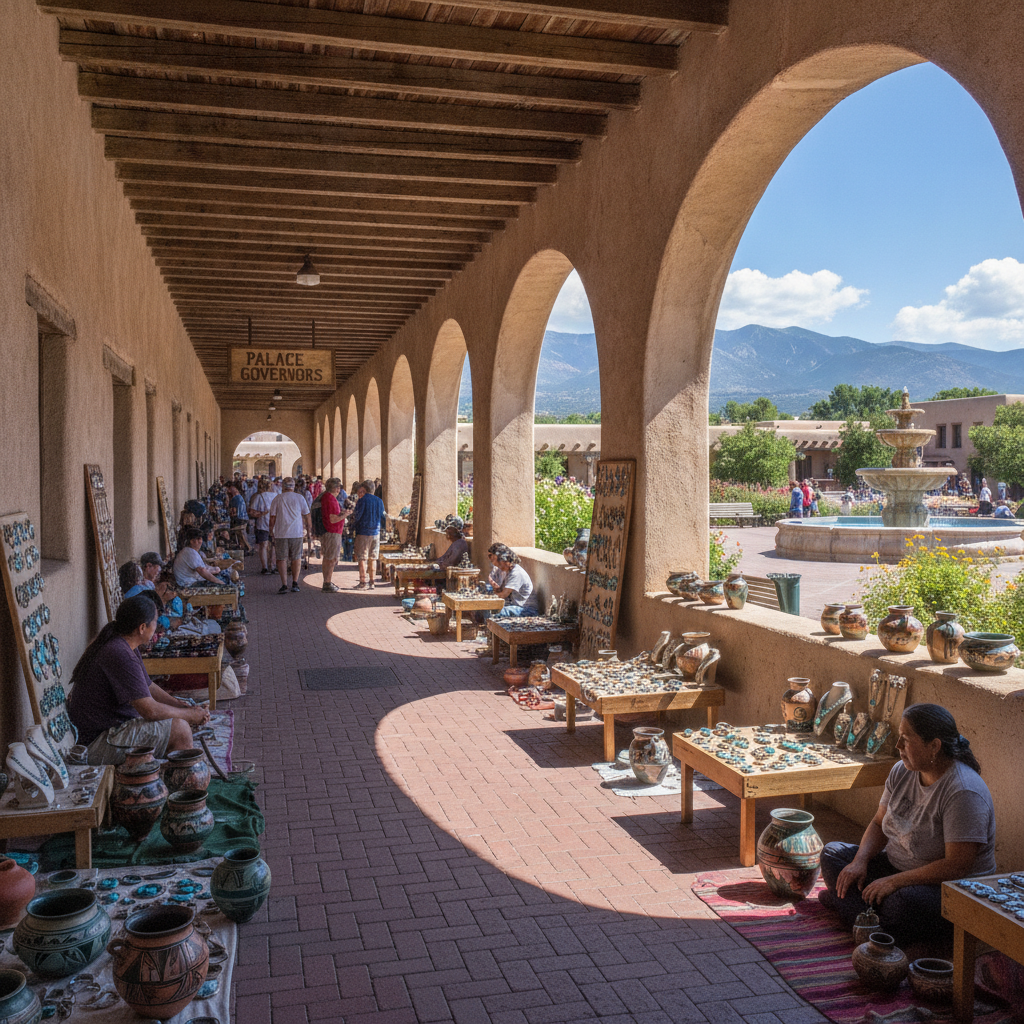
The Santa Fe Style (the aesthetic system that governs architecture, interior design, food presentation, clothing, jewelry, and art in Santa Fe): the most completely realized and carefully enforced regional aesthetic in the United States, based on the synthesis of Pueblo Revival architecture (adobe walls, flat roofs, vigas, portal, and earth tones) and Spanish Colonial and Territorial elements (pitched metal roofs, brick coping on flat roof parapets, symmetrical facades) enforced by the City of Santa Fe Historic Style Ordinance (adopted 1957, revised multiple times, the most comprehensive historic aesthetic preservation law of any American city). The Historic District zoning: virtually every building in the central 1.2 square km of downtown Santa Fe must conform to either the Old Santa Fe Style (Pueblo Revival) or the Territorial Style -- flat roofs, earth-toned plaster, no visible utility equipment, specific window and door proportions. The result is the most visually consistent urban environment of any American city, immediately identifiable from a single photograph. The adobe building tradition: the 350 mm (14-inch) thick adobe walls of traditional Santa Fe buildings maintain a nearly constant interior temperature of 18-20C (64-68F) throughout the summer heat (when exterior temperatures reach 32-35C) and winter cold (when exterior temperatures fall to -15C), requiring minimal mechanical heating and cooling -- a passive solar technology 1,000 years old. The Inn of the Governors (the most characteristic mid-range Santa Fe accommodation), the La Fonda on the Plaza (at 100 East San Francisco Street, on the site of the inn that has stood on the Santa Fe Plaza since 1607 -- an inn has been at this corner for longer than the United States has existed), and the Eldorado Hotel and Spa (at 309 West San Francisco Street, the largest hotel in Santa Fe at 219 rooms, built 1986 in Pueblo Revival style): the three defining accommodations of Santa Fe.
Walk this route with audio
Stories play automatically as you reach each stop — no tapping needed.
More in santa-fe
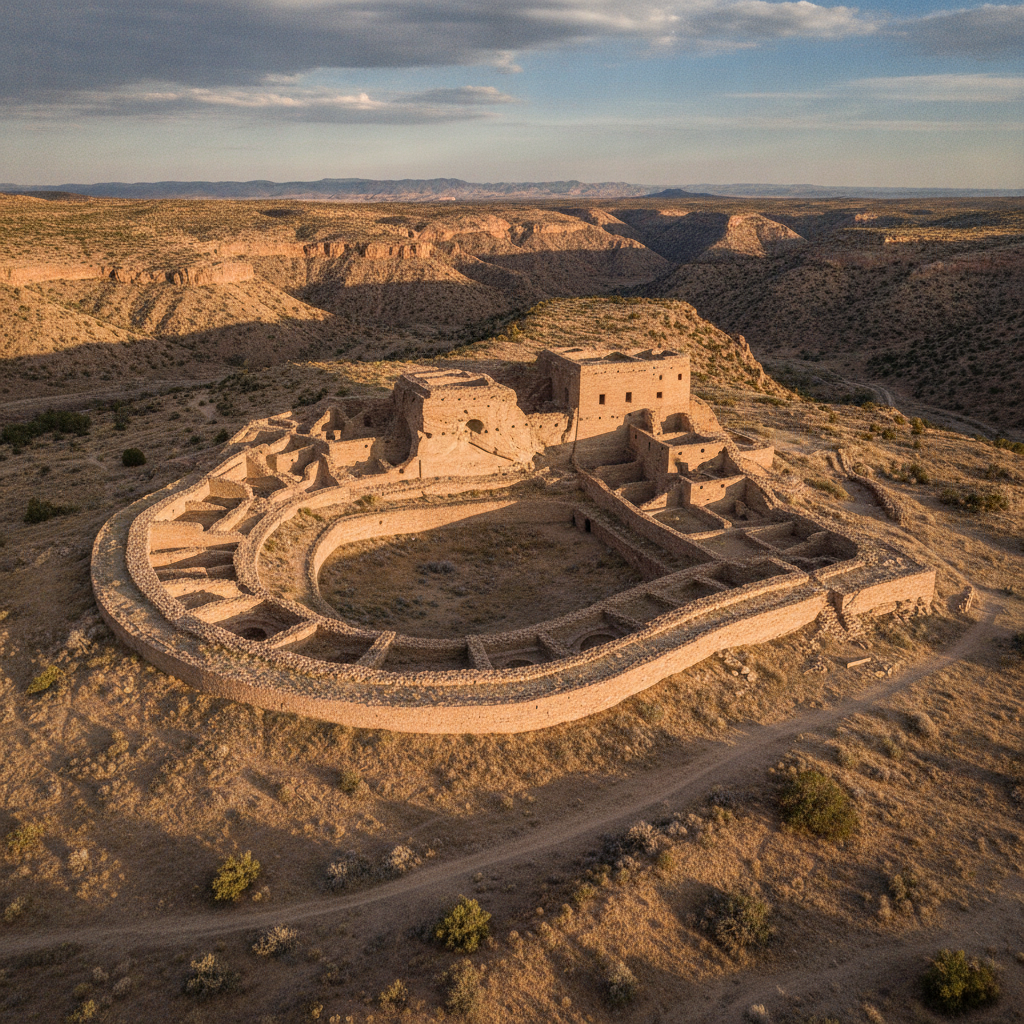
Santa Fe: Roswell, Chaco Culture, Turquoise Trail, Billy the Kid, Farm-to-Table Dining, and City Demographics
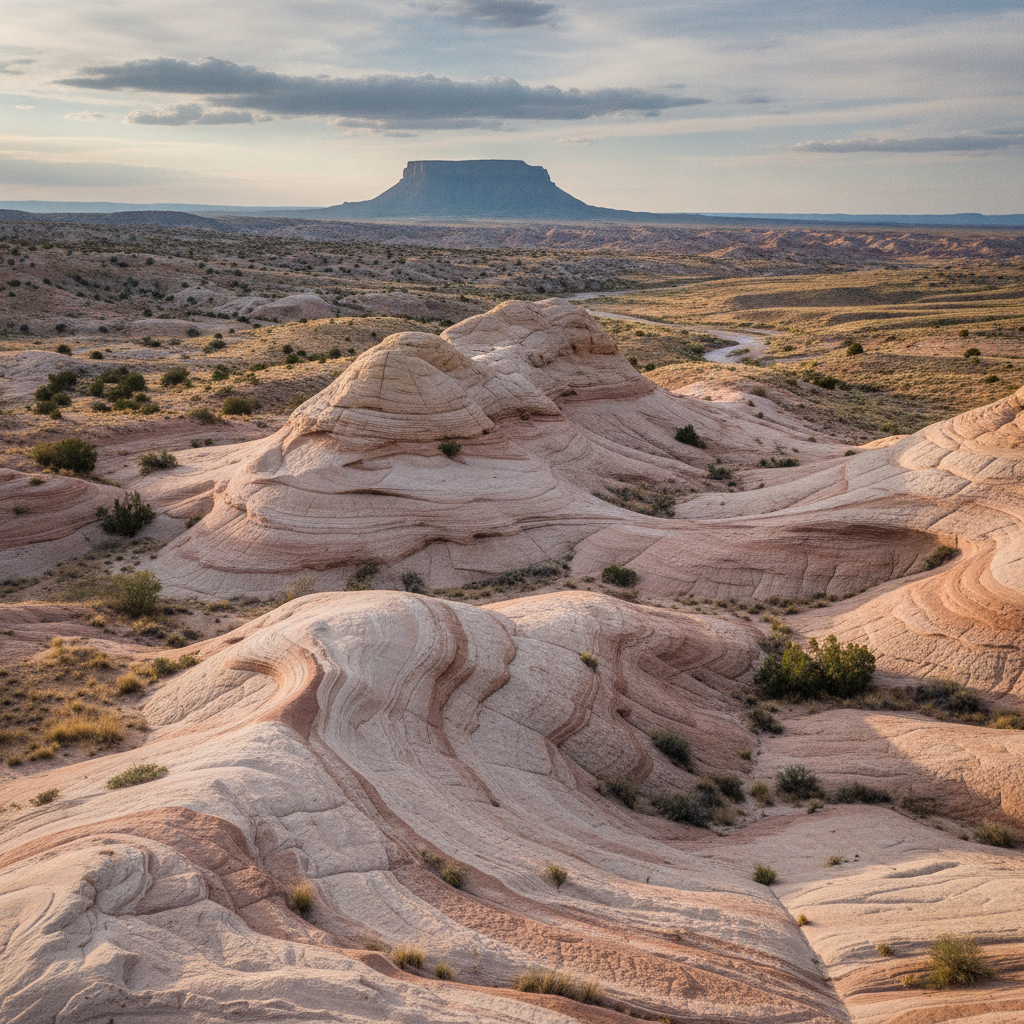
Santa Fe: SITE Santa Fe, Nuclear Heritage, Santa Fe Trail, O'Keeffe at Abiquiu, Acequia Culture, and Economy
Santa Fe: Plaza, Canyon Road, O'Keeffe, Loretto Chapel, Bandelier, and New Mexican Cuisine
Santa Fe: Literary Colony, Museum of Art, Chimayo Weaving, Railyard District, Mountain Life, and Practical Tips
Santa Fe: O Keeffe Country, Ancient Trade Routes and Complexity Science