Santa Fe: Roswell, Chaco Culture, Turquoise Trail, Billy the Kid, Farm-to-Table Dining, and City Demographics
Santa Fe: Roswell (310km southeast, UFO Incident July 1947 Project Mogul balloon debris initial press release flying disc retracted, International UFO Museum 1991 150,000-200,000 visitors/year Alien Festival 30,000-40,000 July, Carlsbad Caverns 430km 119 limestone caves sulfuric acid dissolution Big Room 1,220m x 190m x 107m largest US 3rd world, 400,000 Brazilian free-tailed bats May-October 20-30 minutes spiral emergence), Chaco (200km NW UNESCO 1987 established 1907, 850-1150 CE most sophisticated pre-Columbian north Mexico, Pueblo Bonito D-shaped 5-story 650 rooms 37 kivas 850-1150 CE, 650km engineered roads 9m wide arrow-straight 150 outlier communities 150,000 sqkm, aligned solar solstice equinox lunar standstill 18.6-year cycle, International Dark Sky Park), Turquoise Trail (Cerrillos Hills State Park 1116 acres turquoise mined 900 CE identified Cahokia to Chichen Itza 3,000km trade network, Golden ghost town 1825 first gold rush west Mississippi 23 years before California, San Francisco Church carved altar screen intact), Billy the Kid (born November 23 1859 disputed birthplace died July 14 1881 age 21 shot by Pat Garrett, Lincoln County War 1878-1879 Tunstall murdered February 18 1878 age 24, Lincoln Historic Site courthouse jail escape April 28 1881 killed two guards), farm-to-table (Farmers Market 1968 oldest Southwest, Kakawa Chocolate House 2006 Aztec Mayan cacao chile achiote vanilla pre-Columbian drinks, Cowgirl BBQ Guadalupe Street most visited casual patio margaritas brisket, Gruet Winery Ponderosa Valley wine region), demographics (median age 43.5 highest any comparable US city, Hispanic 50% nuevomexicano surnames trace 17th-18th century land grants, median home USD 600K+, Airbnb removed 1,500-2,000 long-term units, Canyon Road 100+ galleries 2005 to 80 in 2024, Meow Wolf generation Tech Tuesday remote workers new creative economy).
- 1
Roswell and Southern New Mexico Day Trips
Roswell, New Mexico (at 2100 North Main Street, Roswell, NM, 310 km southeast of Santa Fe via US-285): the small city of 46,000 most famous worldwide for the Roswell UFO Incident of July 1947 -- the recovery of debris from the crash of an unidentified object on the Foster Ranch 120 km north of Roswell (now confirmed by the U.S. Air Force as Project Mogul surveillance balloon debris, but the initial U.S. Army Air Field press release stating the recovery of a flying disc and subsequent retraction by the commanding general created the most enduring conspiracy theory in American history). The International UFO Museum and Research Center (at 114 North Main Street, Roswell, established 1991, the most visited attraction in Roswell): a community museum dedicated to the 1947 incident and UFO phenomena generally, with approximately 150,000-200,000 visitors per year. Roswell hosts the Alien Festival each year in early July (around the July 4 anniversary of the incident) attracting approximately 30,000-40,000 visitors in alien-themed costumes. Carlsbad Caverns National Park (at 727 Carlsbad Caverns Highway, Carlsbad, NM, 430 km southeast of Santa Fe): the national park containing 119 limestone caves formed over 4-6 million years by sulfuric acid dissolution of the reef limestone -- the Big Room (the main cave chamber at Carlsbad Caverns, 1,220 m long, 190 m wide, and 107 m high at its tallest point) is the largest cave chamber by volume in the United States and the third-largest in the world. The bat flight: from May through October, approximately 400,000 Brazilian free-tailed bats (Tadarida brasiliensis) emerge from the Natural Entrance of Carlsbad Caverns at dusk in a continuous spiral stream that takes 20-30 minutes to complete -- one of the most spectacular wildlife events in the American Southwest.
- 2
Chaco Culture National Historical Park - The Center of the Pueblo World
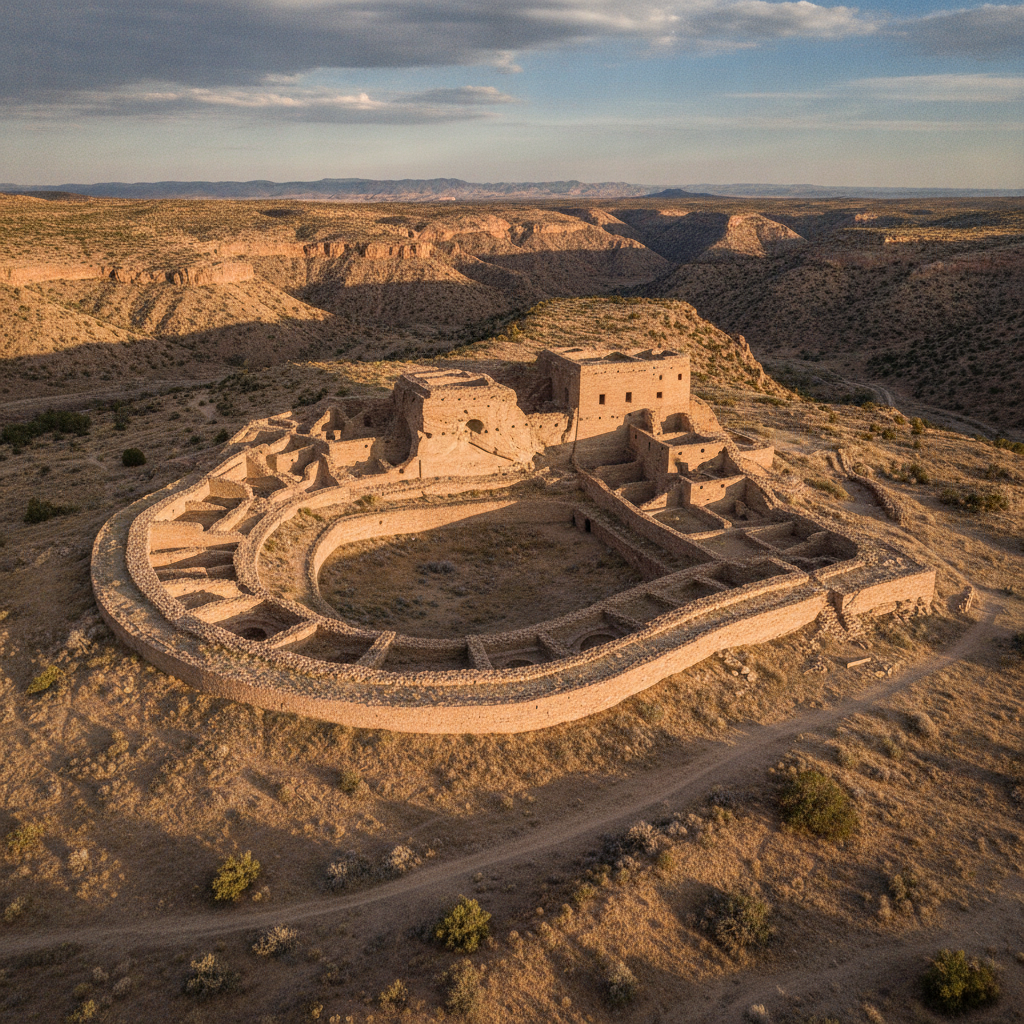
Chaco Culture National Historical Park (at 1808 County Road 7950, Nageezi, NM, 200 km northwest of Santa Fe, a UNESCO World Heritage Site since 1987, established as a national monument 1907): the most significant pre-Columbian archaeological site in the United States, preserving the ruins of the Chacoan civilization that dominated the San Juan Basin of the Colorado Plateau from approximately 850 CE to 1150 CE -- the most sophisticated pre-Columbian culture north of Mesoamerica. The great houses: the Chacoan complex includes 15 major great house pueblos (multi-story masonry buildings of extraordinary technical precision, with walls aligned to solar and lunar events and rooms numbering in the hundreds -- Pueblo Bonito, the largest great house, is a D-shaped 5-story complex with 650 rooms and 37 kivas, built in multiple construction phases between 850 and 1150 CE). The Chacoan road system: the Chacoan people constructed approximately 650 km of engineered roads (averaging 9 m wide, cut arrow-straight through terrain, with curbs, ramps, stairs, and causeways) connecting the central Chaco canyon to 150 outlier communities across 150,000 square km of the San Juan Basin -- the most extensive road system of any pre-Columbian civilization north of Mexico. Chaco as an astronomical complex: the great houses are precisely aligned to solar solstice and equinox sunrise and sunset positions, lunar standstill positions, and the 18.6-year cycle of the moon -- Pueblo Bonito's primary axis is precisely aligned east-west to the equinox sunrise, and the Chacoan Sun Dagger site on Fajada Butte marks the summer solstice with a shaft of light on a spiral petroglyph. Chaco Canyon is one of the best dark-sky sites in the American Southwest, designated an International Dark Sky Park.
- 3
The Turquoise Trail and the Oldest Turquoise Mines in North America
The Cerrillos Hills State Park (at 37 County Road 59, Cerrillos, NM, 40 km south of Santa Fe, established 2003, 1,116 acres): the state park protecting the oldest turquoise mines in North America, with archaeological evidence of mining by the ancestral Pueblo people beginning approximately 900 CE and continuing through the Spanish Colonial period and into the 20th century. The Cerrillos turquoise (the blue-green gemstone from the hydrous copper aluminum phosphate mineral turquoise, mined from the veins in the volcanic porphyry and shale of the Cerrillos Hills): traded throughout the pre-Columbian Southwest and into Mesoamerica, with Cerrillos turquoise identified by elemental analysis in archaeological sites from Cahokia (Illinois) to Chichen Itza (Yucatan, Mexico) -- a trade network spanning 3,000 km of North America. The Mine Shaft Tavern in Madrid (described in the Albuquerque routes): the Route 66-era bar at the heart of the Turquoise Trail arts community. Golden, New Mexico (at the intersection of NM-14 and NM-344, 45 km south of Santa Fe): the ghost town with the San Francisco Church (the adobe mission church with an intact carved wooden altar screen, typically closed, visible through an iron gate) in the deserted village where the first gold rush west of the Mississippi River occurred in 1825 -- predating the California Gold Rush (1848) by 23 years. The Tijeras Canyon (the canyon of US-66 and I-40 east of Albuquerque through which the Turquoise Trail passes on its way from Santa Fe): the geological formation where the Sandia Mountains and the Manzano Mountains meet, creating one of the most dramatic canyon approaches to Albuquerque in the American Southwest.
- 4
Billy the Kid and the Lincoln County War
Billy the Kid (born William H. Bonney, November 23, 1859 -- birth name, birthplace, and birth date all disputed by historians, with possible births in New York City, Indiana, or Missouri; died July 14, 1881, Fort Sumner, NM, at the home of Pete Maxwell, shot by Lincoln County Sheriff Pat Garrett -- born June 5, 1850, Chambers County, Alabama; died February 29, 1908, Dona Ana County, NM, shot in an unresolved dispute): the most famous outlaw of the American West and the most mythologized figure in New Mexico history, whose actual biography (a young man who killed between 4 and 21 men depending on how one counts the disputed cases, who participated in a cattle-ranching war in Lincoln County, New Mexico from 1878-1881, and who was killed at age 21 by his former friend turned sheriff) is considerably less heroic than the dime novel legend that emerged almost immediately after his death. The Lincoln County War (1878-1879): the commercial conflict between the Tunstall-McSween faction (backed by British cattle rancher John Tunstall, born March 6, 1853, Dalston, London; died February 18, 1878, Lincoln County, NM, age 24, murdered by allies of the Murphy-Dolan faction) and the Murphy-Dolan faction (the established merchants who controlled the supply contracts for Fort Stanton) -- a frontier war that killed approximately 30-50 people and in which Billy the Kid emerged as the most famous fighter on the Tunstall side. The Lincoln Historic Site (at 682 US-380, Lincoln, NM, 230 km southeast of Santa Fe): the best-preserved Lincoln County War village in New Mexico, with the original Murphy-Dolan store, the courthouse jail (from which Billy the Kid escaped on April 28, 1881, killing two guards), and the Tunstall store all intact.
- 5
Santa Fe Cuisine and Farm-to-Table Dining Beyond the Basics
The farm-to-table movement in Santa Fe: the city has one of the most developed farm-to-table dining ecosystems of any American city, anchored by the year-round Santa Fe Farmers Market (established 1968, one of the oldest in the American Southwest), the density of acclaimed independent restaurants, and the proximity of Hatch Valley green chile, Chimayo red chile, local Churro lamb, and organic produce from the Rio Grande farms of the Espanola Valley. The Guadalupe Street neighborhood (the restaurant corridor between the Railyard and the historic district): the most concentrated dining area outside Canyon Road, with restaurants including Radish and Rye (New American small plates), Counter Culture (the progressive vegan restaurant), and the Cowgirl BBQ (at 319 South Guadalupe Street, the most visited casual restaurant in downtown Santa Fe for its patio, margaritas, and smoked brisket). The Cerrillos Road food corridor: the section of Cerrillos Road between St. Francis Drive and Rodeo Road that contains the most affordable Santa Fe dining, with the New Mexican food restaurants, Mexican taquerias, and fast food that serves the working population of the city. The Santa Fe chocolate tradition: Kakawa Chocolate House (at 1050 Paseo de Peralta, established 2006): the historically inspired chocolate house serving Aztec and Mayan chocolate drinks (the pre-Columbian cacao beverages made with chile, achiote, and vanilla without sugar) and European colonial-era drinking chocolate -- the most unusual beverage destination in the American Southwest. The Santa Fe wine culture: the proximity to the New Mexico wine country (Gruet Winery in Albuquerque, the Ponderosa Valley Vineyards in Ponderosa, NM 80 km west of Santa Fe) and the sophisticated restaurant wine lists (the Compound Restaurant has one of the finest wine lists in the Southwest) make Santa Fe one of the better wine-dining destinations in the mountain West.
- 6
Santa Fe Today - Population, Demographics, and the Future of an Art City
Santa Fe demographics and the changing city: the permanent population of Santa Fe (approximately 85,000 in the city, 150,000 in the metro) is aging rapidly, with a median age of 43.5 years (one of the highest of any American city of comparable size) and a population that is increasingly composed of retirees, second-home owners, and remote workers who have relocated for the lifestyle and the arts. The Hispanic majority: Santa Fe County is approximately 50% Hispanic or Latino, with a large native nuevomexicano population whose ancestors have lived in the Santa Fe area since the Spanish Colonial period -- one of the oldest continuously rooted communities in the United States, with surnames (Baca, Garcia, Lucero, Martinez, Montoya, Romero, Ortega, Vigil) that trace to specific 17th and 18th century land grant families. The affordable housing crisis: the median home price in Santa Fe (USD 600,000+ in 2024) is among the highest in the mountain West, driven by the demand from out-of-state buyers (primarily from California, New York, and Texas), second-home buyers, and the Airbnb vacation rental market that has removed approximately 1,500-2,000 housing units from the long-term rental market. The future of the arts: the Santa Fe art market has been changing as the Baby Boomer collector generation (which built the Canyon Road gallery model) ages, and younger buyers increasingly purchase art online or at art fairs rather than visiting physical galleries. Canyon Road gallery count has declined from approximately 100+ in 2005 to approximately 80 in 2024, with several major galleries closing or relocating to online-first models. The emerging Santa Fe: the Meow Wolf generation of artists, the Tech Tuesday coworking and technology meetup community (established 2011), and the growing number of remote workers from the technology industry are creating a new creative economy alongside the traditional arts and tourism.
Walk this route with audio
Stories play automatically as you reach each stop — no tapping needed.
More in santa-fe
Santa Fe: Pueblo Revolt, Taos Pueblo, High Road, Santa Fe Opera, and Adobe Architecture
Santa Fe: SITE Santa Fe, Nuclear Heritage, Santa Fe Trail, O'Keeffe at Abiquiu, Acequia Culture, and Economy
Santa Fe: Plaza, Canyon Road, O'Keeffe, Loretto Chapel, Bandelier, and New Mexican Cuisine
Santa Fe: Literary Colony, Museum of Art, Chimayo Weaving, Railyard District, Mountain Life, and Practical Tips
Santa Fe: O Keeffe Country, Ancient Trade Routes and Complexity Science