Santorini Ancient History — Akrotiri, the Minoan Eruption & the Atlantis Hypothesis
Santorini's ancient history (the Bronze Age Minoan city of Akrotiri preserved under volcanic ash, the 3,600 BCE Minoan eruption that may have contributed to the collapse of Minoan civilization on Crete, the subsequent Greek colonization of the island and the founding of Ancient Thera) is the intellectual counterweight to the island's contemporary sunset-and-infinity-pool tourism.
- 1
The 3,600 BCE Minoan Eruption — the Volcano That Changed History
The Minoan eruption of Thera (the volcanic event dated to approximately 1640-1600 BCE by radiocarbon dating and ice core evidence, or 1450 BCE by the conventional archaeological chronology — the precise date remains one of archaeology's most contested questions — the eruption expelling 60 cubic kilometres of magma, the most powerful volcanic event in the history of the eastern Mediterranean, the pyroclastic flows reaching as far as Crete 110km south, the volcanic ash detectable in ice cores from Greenland and Antarctica, the resulting 35-metre tsunami devastating the coastal settlements of the eastern Mediterranean) is the geological and historical foundation of all Santorini visits. The connection to Minoan Crete (the eruption occurring within 100 years of the collapse of the Minoan palace civilization on Crete, the causal relationship debated but the temporal correlation striking) and the Atlantis hypothesis (Plato's description of Atlantis in the Timaeus and Critias dialogues of 360 BCE as an island civilization destroyed in a single day that sank into the sea, widely proposed as a cultural memory of the Theran eruption and the Minoan collapse) are the interpretive frameworks.
- 2
Akrotiri Archaeological Site — the Roofed Bronze Age City
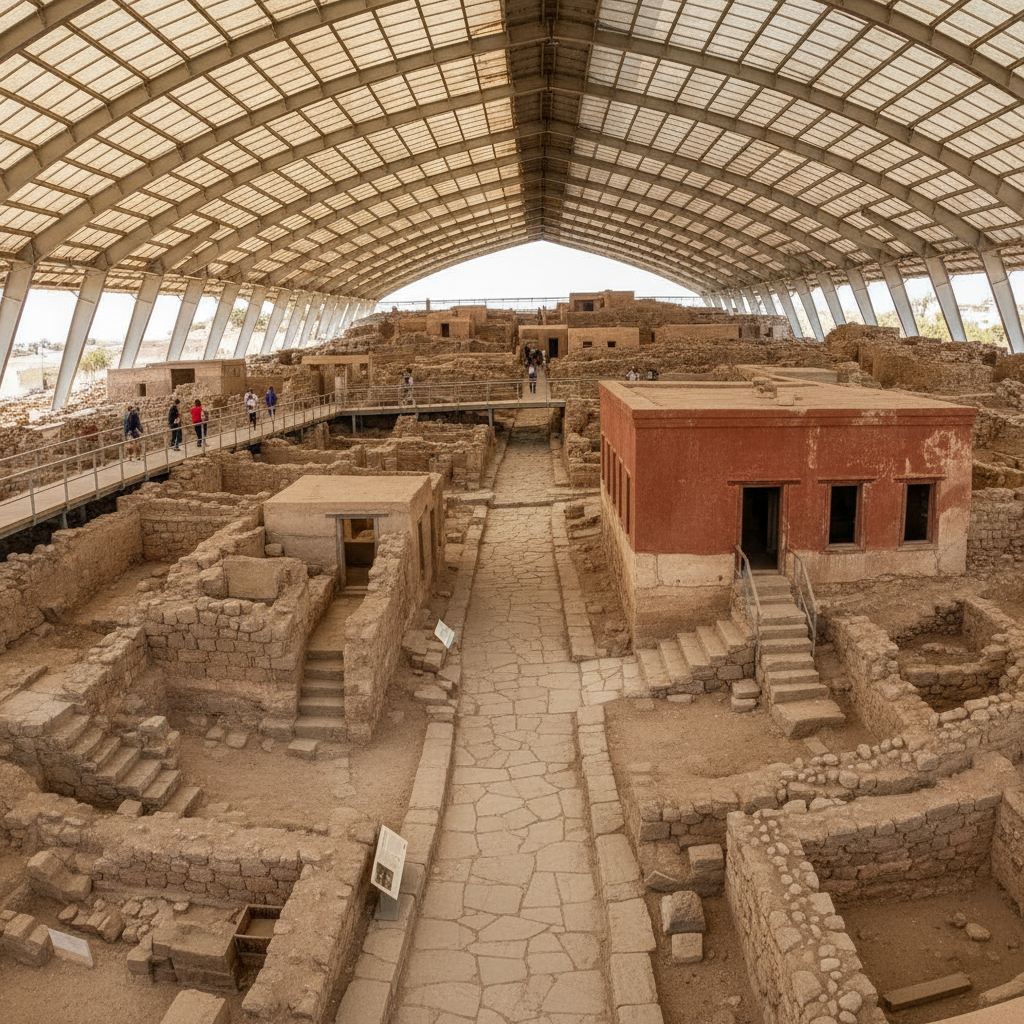
Akrotiri (the roofed archaeological site at the southwest tip of Santorini, €12 adults, Tuesday-Sunday 8am-8pm May-September, the excavation conducted continuously since 1967 under the direction of the Late Spyridon Marinatos and subsequently Christos Doumas, the site covering approximately 3 hectares of the estimated 20-hectare original city) presents the most intimate view of Minoan domestic and civic life available anywhere — the multi-storey buildings (the West House, the House of the Fisherman, Xeste 3 — the ceremonial building with the most elaborate fresco programme, the original frescoes now in Athens and Fira museums) are intact to first-floor level and in some cases to second-floor level, the building materials the same volcanic pumice quarried from the island itself. The most important observation at Akrotiri: the absence of human remains and gold objects, confirming a successful evacuation, the population escaping with their valuables before the main eruption.
- 3
Museum of Prehistoric Thera — the Frescoes and Gold Ibex
The Museum of Prehistoric Thera (Mitropoleos 22, Fira, €6 adults, Tuesday-Sunday 8am-8pm, the purpose-built museum opened 2000 containing all portable finds from the Akrotiri excavations) is the essential companion to the archaeological site. The key exhibits: the Boxing Boys fresco (the most complete Minoan fresco from Akrotiri, two young boys boxing in coloured loincloth, the first representation of boxing in European art), the Spring fresco (the swallows above red lilies, the first naturalistic landscape painting in European art), the Fisherman fresco (the young man carrying two bunches of fish, the earliest representation of deep-sea fishing in European art), and the gold ibex figurine (the gold hammered figure of a leaping ibex, the highest-quality goldsmith work from Bronze Age Greece, the single most valuable portable object from Akrotiri). The museum's chronological organization (the pre-eruption Minoan period, the post-eruption gap, the Geometric-period recolonization) contextualizes the eruption's effect on the island's human history.
- 4
The Atlantis Hypothesis — Science vs. Legend
The identification of Santorini with Plato's Atlantis (the proposal first made by Spyridon Marinatos in 1939, developed by J.V. Luce in The End of Atlantis 1969, and popularized in dozens of books and television documentaries) is based on: the Theran eruption's scale (a volcanic collapse producing the landmass loss that Plato describes), the Minoan civilization's advanced maritime culture (matching Plato's description of Atlantis as a naval power), and the timing (the eruption predating Plato's account by 1,200 years, which Plato's text attributes to an Egyptian priestly tradition garbling the original dates). The scientific consensus (the Atlantis dialogues are a philosophical thought experiment by Plato, not a historical record, the story invented to illustrate political philosophy about the hubris of naval empires) and the tourist industry consensus (the Atlantis Museum in Akrotiri village, the Atlantis boat tours, the Atlantis hotel name, the Atlantis souvenir shops — the myth generating approximately 20 percent of all Santorini tourism enquiries by search volume) represent the interpretive divide that visitors must navigate themselves.
- 5
Ancient Thera on Mesa Vouno — the Dorian City
Ancient Thera (the Dorian city founded on the Mesa Vouno ridge in the 9th century BCE, at 369m above the southeastern coast of Santorini, the city inhabited continuously from the Dorian colonization through the Hellenistic and Roman periods to approximately 726 CE, free access, open Tuesday-Sunday 8am-3pm) is the most accessible ancient ruin on Santorini independent of the Akrotiri site. The Agora (the central public space, the Royal Stoa — the colonnaded market building — partially standing to column height), the Theatre (the 3rd-century BCE open-air theatre, the seats cut into the rock, the stage wall still intact to 3m height, the performance of Aeschylus plays recorded in the Hellenistic period), and the gymnastic inscriptions on the rock face (the names of gymnasts carved into the limestone at the 7th-century BCE gymnasium — the practice of carving the names of successful athletes into the sacred rock being the oldest epigraphic evidence of competitive athletics in the Aegean) are the three essential elements of the site.
- 6
Imerovigli and the Skaros Rock — the Castle Without a Village
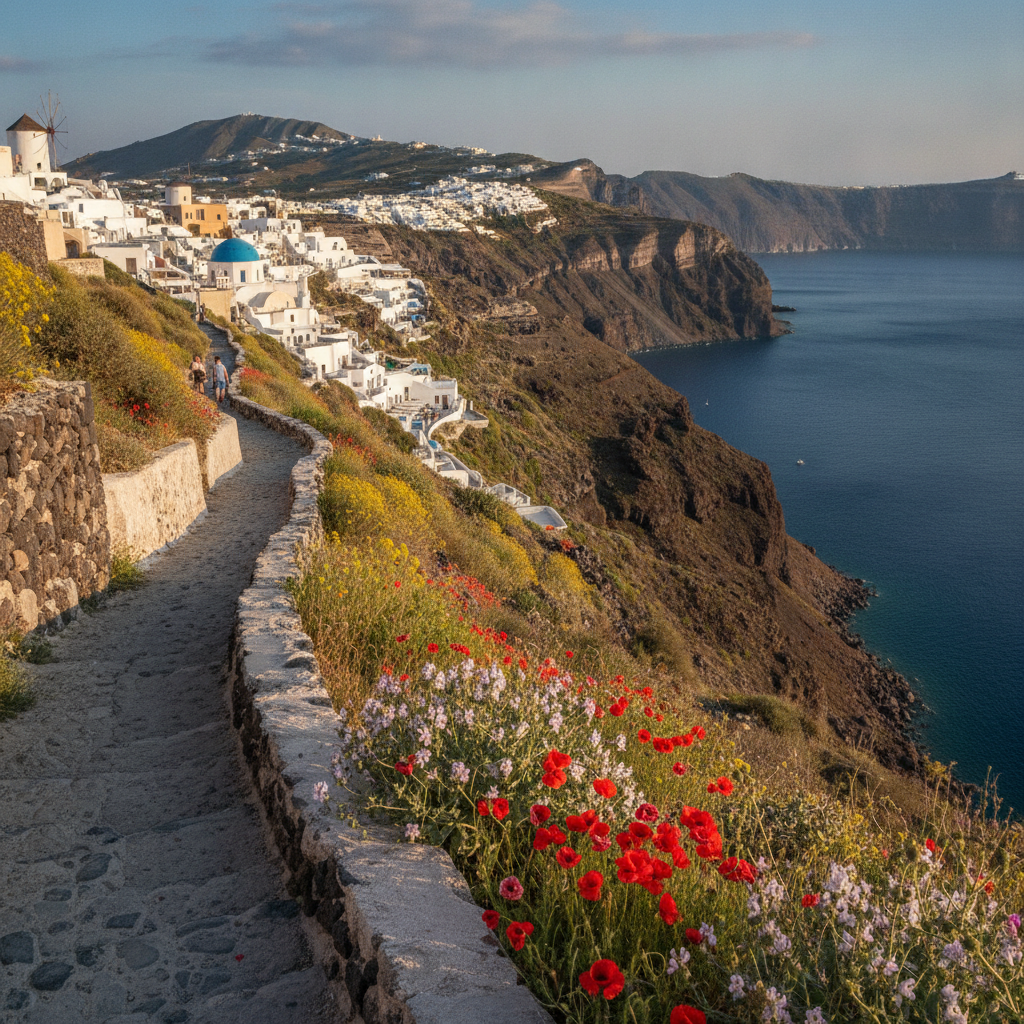
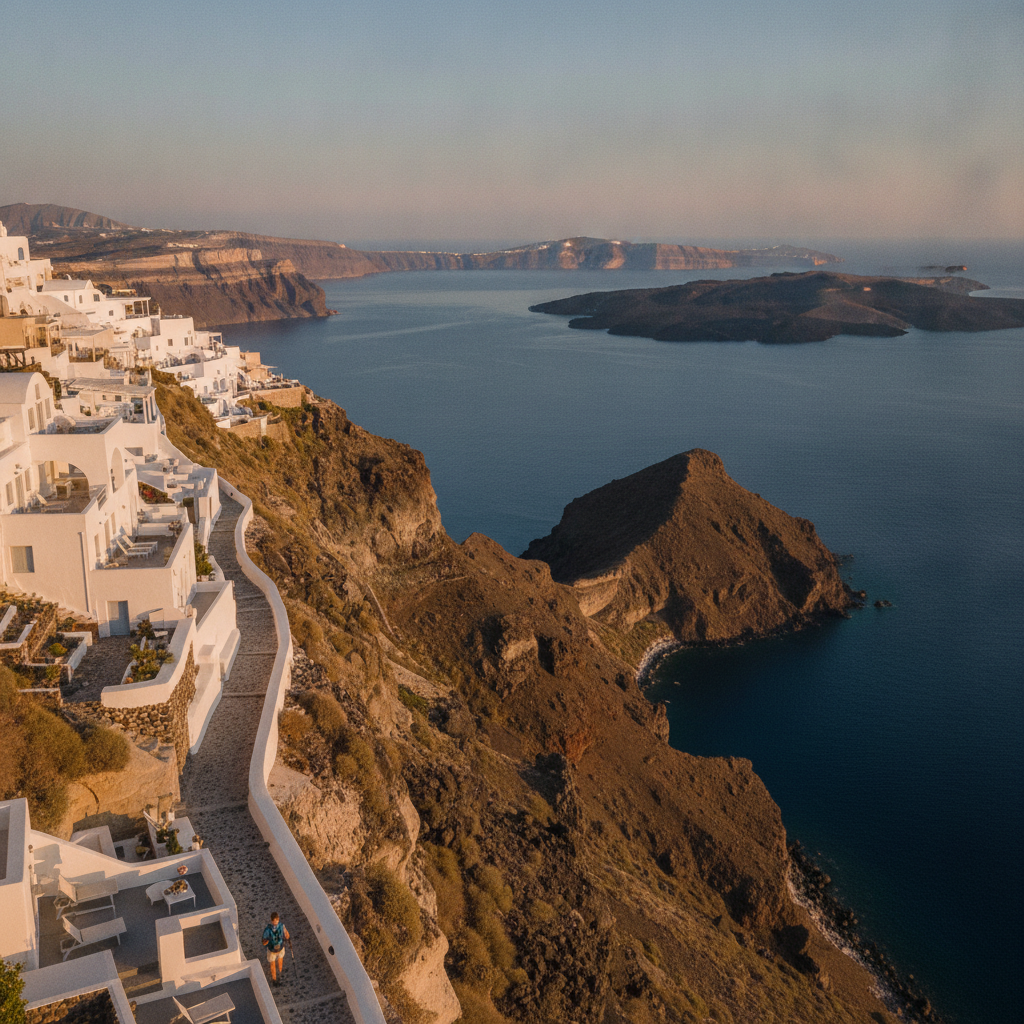
Imerovigli (the village on the highest point of the caldera rim between Fira and Oia, the most elevated caldera-rim settlement at 300m, the most expensive caldera-view accommodation on the island after Oia, the village merging seamlessly with Firostefani to the south into a continuous cliff-edge settlement with infinity pools and cave hotels) and the Skaros Rock (the medieval Byzantine castle rock jutting into the caldera from the Imerovigli cliff, the ruin of the 13th-century Venetian kastro on the tip of the volcanic promontory, the path from Imerovigli to the Skaros tip taking 20 minutes each way, the route descending 80m from the village level to the castle foundations — the ruined buildings of the medieval fortress and the 360-degree caldera view from the tip of the rock justify the walk, the position the best midday photography location between Oia and Fira) are the caldera rim's architectural and geological extremes — the most expensive accommodation on the island's most dramatic rocky promontory.
Walk this route with audio
Stories play automatically as you reach each stop — no tapping needed.
More in santorini
Santorini Food & Wine — Assyrtiko, Fava, Tomatokeftedes & Local Products
Oia — the Blue-Domed Village, Caldera Views & the Most Famous Sunset in Greece
Santorini Villages & Hiking — Emporeio, Megalochori, Pyrgos & the Inland Island
Santorini Caldera Boat Tour — the Volcano, Hot Springs & Thirasia Island