Santorini Food & Wine — Assyrtiko, Fava, Tomatokeftedes & Local Products
The Santorini food tradition (the produce of the volcanic soil, which provides exceptional mineral richness to the island's endemic varieties of tomato, fava bean, white aubergine, and grape, combined with the Aegean seafood of the caldera fishing boats) creates a distinct and immediately recognizable cuisine entirely different from mainland Greek cooking.
- 1
Tomatokeftedes — the Santorini Cherry Tomato Fritters
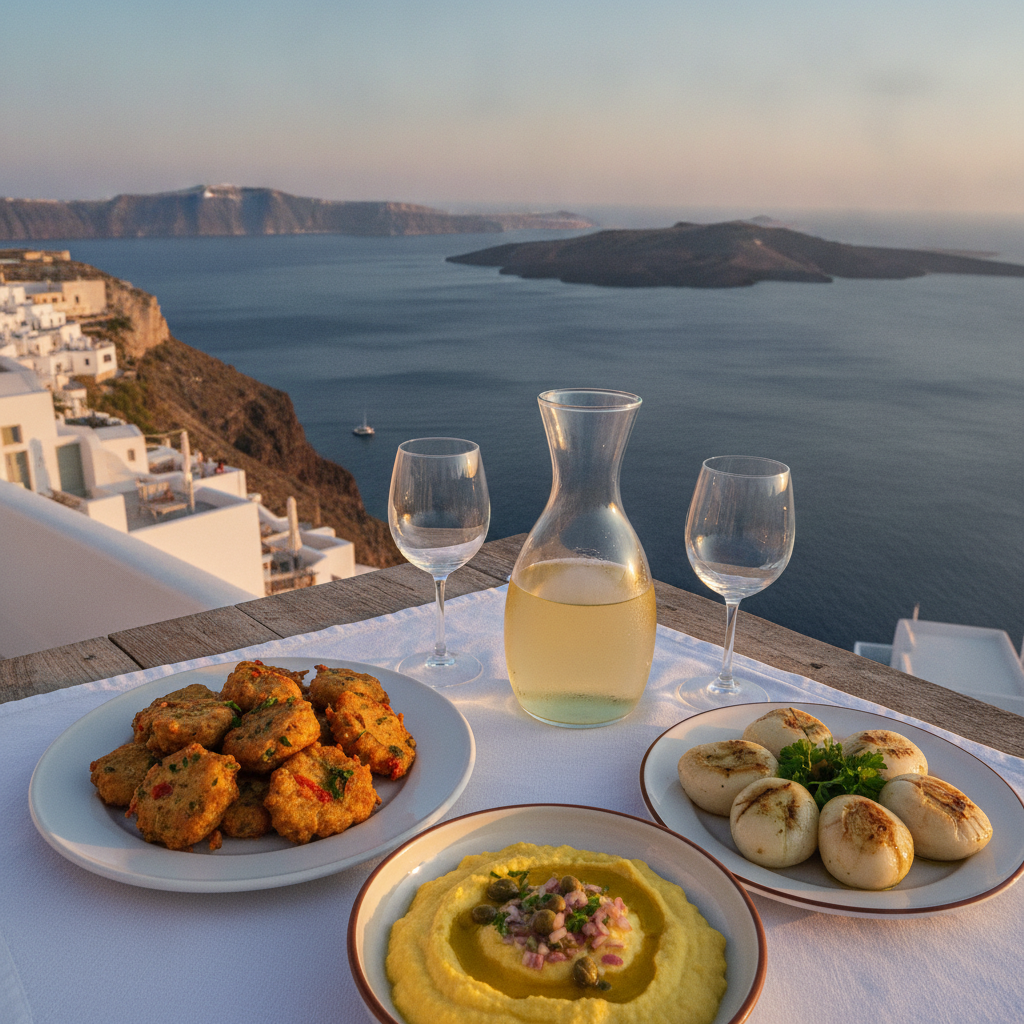
Tomatokeftedes (the cherry tomato fritters of Santorini, made from the small, intensely sweet cherry tomatoes grown in the volcanic soil of the island's southern plateau — the Santorini cherry tomato, dried naturally in the sun for 3-4 days before use, the flavour concentration extraordinary compared to supermarket tomatoes — the tomatoes mixed with mint, onion, and flour then fried in olive oil into small round fritters, €8-12 per portion at every taverna and mezedhopoleion on the island) are the defining Santorini meze. The tomatoes themselves (the Santorini cherry tomato, available dried at the island's organic food shops at €4-8 per 100g, the preserves at €5-10 per jar) are the island's most distinctive food product for taking home. The Taverna Roka (the taverna in Fira's old town section behind the cathedral, the tomatokeftedes made with tomatoes from the owner's own garden, the best version on the island, open May-October noon-11pm, cash only).
- 2
Fava Santorinis — the Yellow Split Pea Puree
Fava Santorinis PDO (the yellow split pea puree made from the endemic Santorini fava bean variety — not a true fava bean but a vetch variety, Lathyrus clymenum, grown on Santorini and Thirasia for at least 3,500 years, the volcanic soil giving the bean an exceptionally smooth texture and sweet, nutty flavour distinct from the coarser mainland Greek fava made from yellow split peas — the puree dressed with raw onion, capers, and olive oil, the definitive meze of the southern Cyclades) is available at every taverna on the island and is the correct gateway to Santorini's endemic food culture. The Santorini fava PDO (the protected designation covering only the Lathyrus clymenum variety grown on the island, sold dried at food shops for €5-8 per 500g, the significantly more expensive but completely different flavour from continental Greek fava) and the capers from the caper plants growing wild in the island's volcanic walls (the smallest and most piquant capers in Greece, the Santorini caper harvested in June by hand from the wild plants in the stone walls of the terraced fields, €4-6 per jar) are the two endemic products defining the Santorini fava preparation.
- 3
Santorini White Aubergine — the Endemic Purple-Free Variety
The Santorini white aubergine (Melitzana Santorinis, the endemic aubergine variety grown only on Santorini and Thirasia, the small oval fruits entirely white without any purple pigment, the flesh less bitter and more tender than standard aubergines, the variety well-adapted to the island's drought conditions and volcanic soil, grown without irrigation — the plants watered only by the night dew condensing on the leaves, the ancient Cycladic agricultural technique still used today) is available at the island's markets and tavernas from July to October. The imam baildi preparation (the white aubergine stuffed with onions, tomatoes, and garlic then slow-baked, the Santorini version using only the white variety and the island's cherry tomatoes, available at traditional tavernas for €10-14) and the grilled white aubergine with olive oil and garlic (the simplest correct preparation, available at the Nikolas Taverna in Fira, one of the few remaining traditional family tavernas not converted to tourist-menu format, open noon-11pm daily May-October) are the best cooking contexts.
- 4
Vinsanto — the Aged Dessert Wine of the Caldera
Vinsanto (the Santorini dessert wine, made from sun-dried Assyrtiko, Athiri, and Aidani grapes — the drying performed on bamboo mats in the sun for 10-14 days, concentrating the sugar to extraordinary levels — then fermented slowly and aged in French oak barrels for 2, 4, 8, 15, or 20 years depending on producer and style, the 15-20 year versions the most complex and amber-coloured, the wine reaching 9-12 percent alcohol with 120-250g/litre residual sugar, the flavour profile of dried apricot, fig, walnut, coffee, and caramelized honey) is the historic wine of Santorini, produced for export to the Orthodox Christian churches of Russia and Eastern Europe from the 14th century — the name Vinsanto is the Venetian abbreviation of Vino di Santorino, not the Italian word for holy wine. Estate Argyros (the largest Vinsanto producer, the 20-year Vinsanto at €70/375ml, available at the estate shop in Episkopi) and Santo Wines (the cooperative Vinsanto 15-year at €30/375ml, available at the caldera terrace tasting room in Pyrgos) are the two Vinsanto benchmarks.
- 5
Chlorotyri and Local Cheeses
Chlorotyri (the fresh white cheese made from goat's and sheep's milk on Santorini and Thirasia, a soft brine-stored cheese similar to feta but made exclusively from island animals, the taste more complex and less salty than industrial feta, available at the island's traditional food shops at €4-8 per 100g) and the Cycladic honey (the thyme honey produced from the wild thyme growing on the caldera cliffs and the volcanic hillsides of Santorini, the bees foraging on the thyme, oregano, and sage of the island's semi-arid plateau, the honey darker and more intensely flavoured than mainland thyme honey, €8-15 per 500g jar at the island's organic food shops in Fira and Oia) are the dairy and condiment expressions of Santorini's endemic food culture. The Archipelagos Deli (Stavros, Fira, the specialist island food shop stocking all Santorini PDO and endemic products: the fava, white aubergines, cherry tomatoes, chlorotyri, caper berries, honey, and all major Santorini wine labels) is the one-stop source for the island's complete food range.
- 6
Fresh Fish and Caldera Tavernas
The fresh fish of the Santorini caldera (the Aegean Sea fish species caught by the 35 fishing boats based at the ports of Oia-Ammoudi, Fira-Skala, Vlychada, and Akrotiri, the catch varying seasonally — the European sea bass, gilthead sea bream, red mullet, octopus, and the small Aegean cuttlefish in season June-September, the swordfish and tuna in the open Aegean in summer) is the protein at the centre of the Santorini restaurant tradition. The correct seafood tavernas (the family-run fish restaurants as opposed to the caldera-view tourist restaurants charging 3-4× the correct price for the same fish): Katina at Ammoudi (the taverna directly on the Ammoudi Bay rocks, the oldest fish restaurant in Santorini, the freshest fish by virtue of the owner fishing the caldera himself, the grilled octopus and the whole grilled sea bream at market price), the fish tavernas at Vlychada Marina (the working harbour on the southeast coast, the three tavernas serving the island's fishing community, the price per kg of fresh fish at market rate, 30-50 percent below the Oia tourist restaurants for identical quality). Lunch rather than dinner: the freshest fish is cooked at lunch; dinner tavernas may be serving the previous day's catch.
Walk this route with audio
Stories play automatically as you reach each stop — no tapping needed.
More in santorini
Oia — the Blue-Domed Village, Caldera Views & the Most Famous Sunset in Greece
Santorini Villages & Hiking — Emporeio, Megalochori, Pyrgos & the Inland Island
Santorini Caldera Boat Tour — the Volcano, Hot Springs & Thirasia Island
Santorini Practical Guide — When to Visit, Logistics, Beaches & the Caldera Rim Walk