The Persepolis Treasury Tablets the Primary Documentary Evidence for Achaemenid Administration, Saadi's Bani Adam Verse on the UN Headquarters Wall & the DNA Proof That the Shiraz Wine Grape Actually Originates in France Not Persia
The Persepolis Treasury administrative tablets — the primary documentary evidence for Achaemenid administrative and economic organization; Saadi's Bani Adam verse (Human beings are members of a whole / In creation of one essence and soul) on the Persian carpet at the UN headquarters in New York; DNA analysis proving the Syrah/Shiraz wine grape is actually a cross of two French varieties (Dureza and Mondeuse Blanche) — definitively ruling out a Shirazi origin; the fal-e Hafez bibliomancy tradition of opening the Divan at random for prophecy at the Hafez Tomb; Persepolis burned by Alexander the Great in 330 BCE as possible revenge for the Persian burning of Athens in 480 BCE; and world's oldest wine production evidence from Iran (Hajji Firuz Tepe, 5400 BCE).
- 1
Persepolis – The Ceremonial Capital of the Achaemenid Empire
Persepolis (Takht-e Jamshid — تخت جمشید — Throne of Jamshid): the primary ancient monument near Shiraz and the greatest surviving monument of the Achaemenid Persian Empire: the site (Persepolis is located 60 km northeast of Shiraz on the Marvdasht plain: the UNESCO inscription (Persepolis was inscribed on the UNESCO World Heritage List in 1979 — one of the first sites inscribed): the construction (Persepolis was begun by Darius I the Great (Darius I — r. 522–486 BCE) approximately 515 BCE and expanded by his successor Xerxes I (r. 486–465 BCE) and Artaxerxes I (r. 465–424 BCE): the function (Persepolis was a ceremonial capital used primarily for the Nowruz (New Year) celebration — the annual reception of delegations from all 23 subject nations of the empire bringing tribute): the Apadana staircase (the Apadana staircase bas-relief carvings — the most complete visual record of the Achaemenid Empire — the carved limestone panels show 23 delegations of subject peoples bringing tribute: the delegations identifiable by their dress and gifts include the Lydians, the Armenians, the Sogdians, the Indians, the Ethiopians, and the Egyptians): the burning (the deliberate burning of Persepolis by Alexander the Great in 330 BCE — possibly as revenge for the Persian burning of Athens in 480 BCE): the Treasury (the Persepolis Treasury — the central storehouse of the Achaemenid imperial finances — the treasury tablets found at Persepolis are the primary documentary evidence for the Achaemenid administrative and economic system).
- 2
Hafez Tomb – The Most Beloved Persian Poet
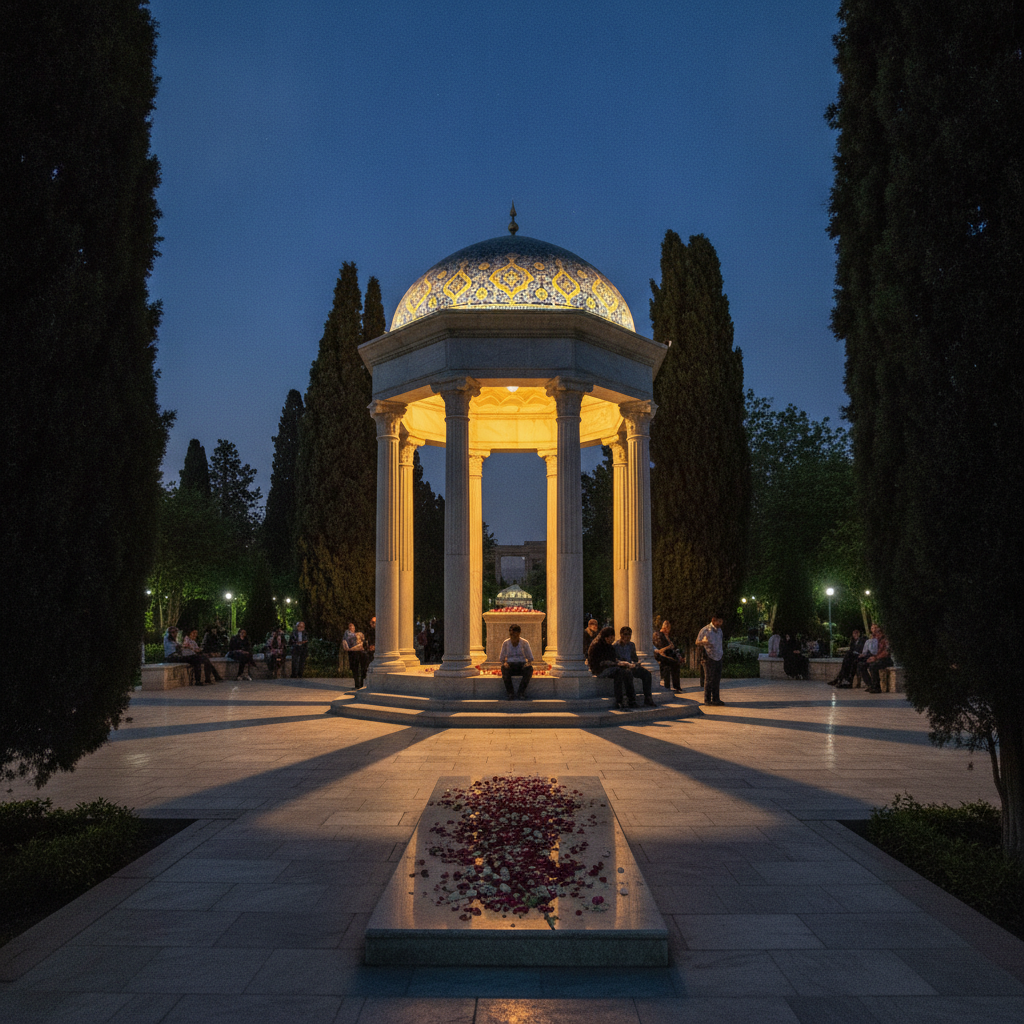
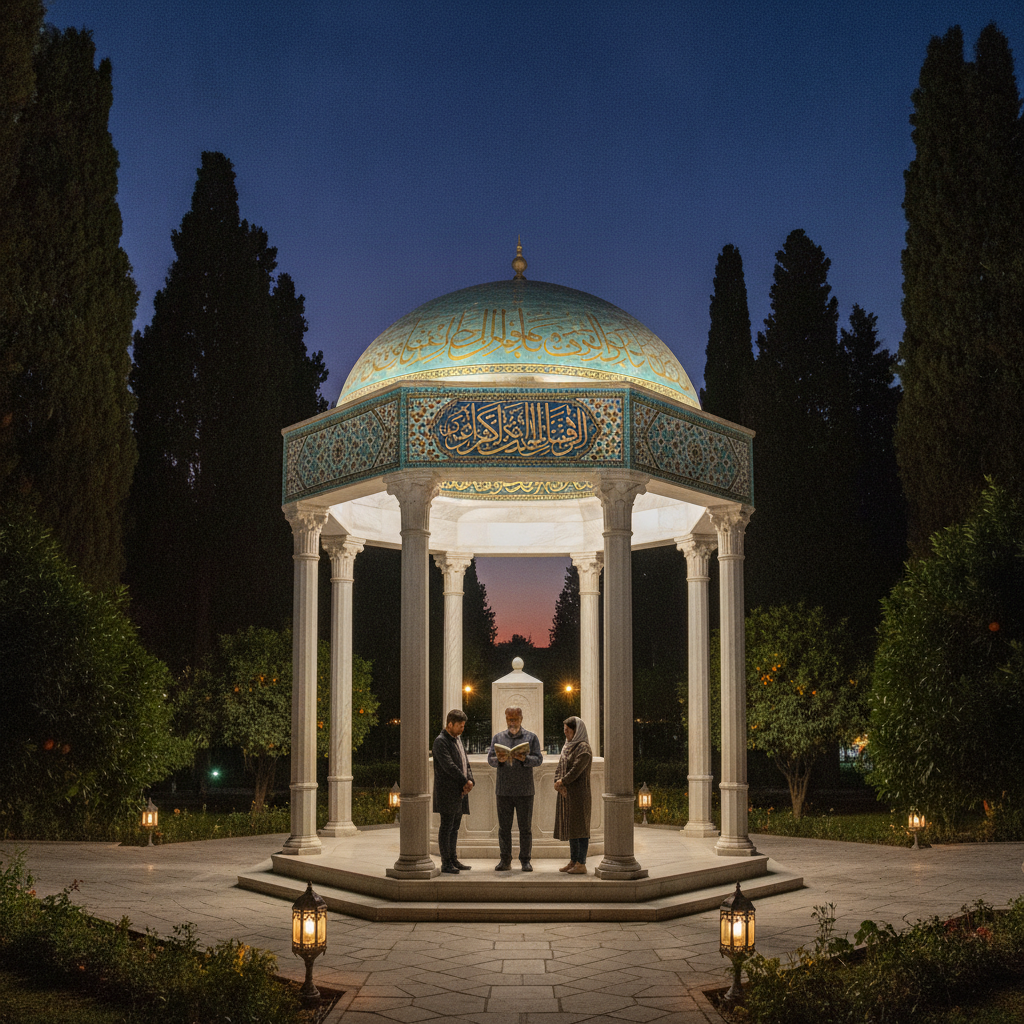
The Hafez Tomb heritage (the Aramgah-e Hafez — the tomb and memorial garden of the greatest lyric poet in the Persian literary tradition — the primary pilgrimage site of Iranian cultural identity): the literary heritage guide. The Hafez (Khwaje Shamso'd-Din Mohammad Hafez-e Shirazi (خواجه شمسالدین محمد حافظ شیرازی) approximately 1315–1390 CE — the most celebrated Persian poet and the supreme master of the ghazal form: the name (the pen name Hafez (حافظ — Memorizer) indicates that he memorized the entire Quran in all 14 canonical recitation traditions — an extraordinary feat of memory): the primary work (the Divan of Hafez (Divan-e Hafez) — a collection of approximately 500 ghazals: the ghazal (the primary Persian poetic form — a 5–12 couplet poem with a consistent rhyme and radif (refrain) at the end of each couplet: Hafez's ghazals operate simultaneously on multiple levels: the literal level (love poetry, wine poetry, nature poetry): the Sufi mystical level (the beloved is God, the wine is divine knowledge, the tavern is the Sufi lodge): the social-political level (veiled criticism of hypocrisy in the clergy and the court): the tomb garden (the Aramgah-e Hafez (عارامگاه حافظ) — the primary cultural pilgrimage site of Shiraz: the current marble pavilion over the tomb was designed by the French architect Andre Godard in 1935 — a slender colonnaded marble structure with a dome covered in blue and gold tile: the practice of fal-e Hafez (bibliomancy using the Divan) is performed at the tomb — visitors open the Divan at random and the opened poem is read as a prophecy).
- 3
Saadi Tomb & the Garden of Paradise
The Saadi Tomb heritage (the Aramgah-e Saadi — the garden tomb of the poet Saadi — the second of Shiraz's great pilgrim poets): the literary heritage guide. The Saadi (Abu-Muhammad Muslih al-Din bin Abdallah Shirazi (سعدی شیرازی) approximately 1210–1291 CE): the primary works (the Gulistan (Rose Garden — 1258) and the Bostan (Orchard — 1257) — two of the most influential books in Persian literature: the Gulistan (a combination of prose and verse: the Gulistan is organized into 8 chapters covering the conduct of kings, the morals of dervishes, the virtue of contentment, the benefits of silence, love and youth, old age, the effects of education, and rules for social conduct: the primary distinctive feature of the Gulistan is the combination of wit, irony, and wisdom in very compressed narrative anecdotes: the most famous lines (the most internationally quoted lines from any Persian poet are from the Bostan of Saadi: the Bani Adam verse (Human beings are members of a whole / In creation of one essence and soul — the verse is inscribed on the entrance of the United Nations headquarters in New York): the UN inscription (the Bani Adam verse appears on a Persian carpet displayed in the United Nations building in New York — donated by Iran to the UN in 2005 — the most widely displayed Persian poetry in the world: the tomb garden (the Aramgah-e Saadi (عارامگاه سعدی) in the northeast of Shiraz: a garden complex containing the tomb chamber (rebuilt 1952 by the architect Mohsen Foroughi) set in a formal Persian garden with a fish pond and flowering rose bushes).
- 4
The Vakil Bazaar & Qavam House
The Shiraz bazaar and historic house heritage (the Vakil Bazaar and the Qavam House — the two most important examples of Zand dynasty architecture in Shiraz): the heritage guide. The Vakil Bazaar (the Bazaar-e Vakil (بازار وکیل — the Regent's Bazaar) — the primary historical bazaar of Shiraz built by the Zand dynasty ruler Karim Khan Zand (r. 1750–1779): the construction (the bazaar was built between 1758 and 1779 as part of Karim Khan's transformation of Shiraz into the capital of the Zand dynasty: the architecture (the Vakil Bazaar consists of a main covered arcade 200m long (the main timcheh) with a series of domed caravanserai courts attached: the tile decoration (the Vakil Bazaar tile work (primarily 18th-century Zand and 19th-century Qajar additions) is the finest commercial architecture tilework in Iran outside Isfahan: the Vakil Hammam (the adjacent Vakil public bath — now converted to a traditional teahouse and restaurant — the finest surviving Zand-era hammam in Iran: the bath is still entirely intact (the changing room (sarbineh), the hot room (garmkhaneh), and the massage room): the Qavam House (the Narenjestan-e Qavam (Orangery of Qavam) — the primary example of Qajar domestic architecture in Shiraz: the house was built between 1879 and 1886 for the Qavam family (the influential Shirazi merchant-official family that served as governors of Fars Province throughout the Qajar period): the primary interior feature (the mirror room (talar-e aineh) — a reception room whose walls and ceiling are entirely covered with mirror mosaic in Qajar style).
- 5
Shiraz Wine – The Irony of the Forbidden Grape
The Shiraz wine heritage (the extraordinary irony of Shiraz as the origin city of the Syrah/Shiraz grape variety — one of the world's most planted wine grape varieties — in a country where alcohol is legally prohibited): the wine heritage guide. The Shiraz grape (the connection between the city of Shiraz and the wine grape known as Shiraz (in Australia and South Africa) and Syrah (in France and most of Europe) is the subject of one of wine's most debated origin questions: the hypothesis (the hypothesis that the Syrah grape originated in Shiraz and was brought to France by Crusaders or Phoenician traders was popular in the 19th century and is still widely repeated in wine literature: the DNA evidence (the DNA analysis (2000, Bowers and Meredith, UC Davis) demonstrated that Syrah is a cross of two French grape varieties: Dureza (a southwestern French variety) and Mondeuse Blanche (a Savoyard variety) — the DNA evidence definitively rules out a Near Eastern origin for the wine grape: the Persian wine tradition (wine production in Iran predates Islam by at least 7,000 years — the world's oldest wine production evidence comes from the Hajji Firuz Tepe site in northwest Iran (5400–5000 BCE): the contemporary situation (wine production in Iran was banned in 1979 by the Islamic Republic — the vineyards were partially converted to raisin and table grape production: the non-Muslim minorities (the Armenian Christians of Jolfa and the Zoroastrian communities of Yazd and Kerman are legally permitted to produce wine for their own religious use).
- 6
Shiraz Practical Guide – Hafez to Persepolis in 2 Days
The Shiraz practical travel guide (the logistics and planning for visiting Shiraz and Persepolis efficiently): the practical guide. The location (Shiraz (شیراز) — the capital of Fars Province in southern Iran: population 1.9 million: altitude 1,486m in the Zagros mountain valley: the transport (from Tehran: daily VIP bus from Tehran South Terminal (5–7 hours): daily Iran Air and Mahan Air flights (1 hour): from Isfahan: VIP bus (7 hours) or Iran Air flight (50 minutes): the airport (Shiraz International Airport (SYZ) — 12 km northeast of the city center): the visa (same as Tehran — visa on arrival for most European, Asian, and other nationalities except US, UK, and Canada): the currency (same as all Iran — USD cash is essential: the unofficial rate gives the best value at Shiraz exchange offices near the Vakil Bazaar): the Persepolis day trip (the Persepolis day trip (60 km northeast of Shiraz by shared taxi or tour): the shared taxi from the central Shiraz taxi stand to Persepolis: IRR 3,000,000–5,000,000 (USD 4–7) for the car each way (not per person): the Persepolis entry fee: IRR 5,000,000 (USD 7 at the unofficial rate) for foreign visitors: allow 3 hours for the site: the Naqsh-e Rostam (the Achaemenid royal tomb complex 6 km from Persepolis — the cliff tombs of Darius I, Xerxes I, Artaxerxes I, and Darius II carved in the rock face — combine with Persepolis in the same day): the 2-day circuit (Day 1: Hafez Tomb + Saadi Tomb + Vakil Bazaar + Qavam House + Nasir al-Molk Mosque: Day 2: Persepolis + Naqsh-e Rostam + Pasargadae (the Tomb of Cyrus the Great, 130 km north of Shiraz).
Walk this route with audio
Stories play automatically as you reach each stop — no tapping needed.
More in Shiraz
Shiraz Food: Kalam Polo, Faloodeh, the Local Persian Cuisine, the Traditional Teahouses, and the Most Culinarily Regional Single Iranian City
Shiraz Essential: Persepolis, the Pink Mosque, the Tomb of Hafez, Eram Garden, and the Most Poetically Beautiful Single Iranian City

Shiraz Zoroastrian Heritage: The Fire Temples, Pars as the Persian Heartland, the Ancient Religion, and the Most Historically Consequential Single Pre-Islamic Iranian Faith
Hafez Memorized the Quran in 14 Recitations by Age 20 and His Divan Serves as the Oracle (Fal-e Hafez) for 85 Million Iranians Today, Saadi's Bani Adam Verse is Engraved at the United Nations, Karim Khan Built Shiraz as Capital but Refused the Title of Shah

Shiraz Wine and Poetry: The Grape Heritage, the Persian Garden Culture, Hafez and Saadi, and the Most Romantically Literary Single Iranian City