Sentosa Island: Singapore's Pleasure Island
Sentosa Island, connected to the southern tip of Singapore's main island by the Sentosa Gateway road causeway (opened 1992), a pedestrian boardwalk, and the Sentosa Express monorail from VivoCity, was until 1972 a British military base known as Pulau Blakang Mati ('island of death from behind' in Malay, referring to pirate raids) and before that a kampong of Malay fishing communities. Renamed 'Sentosa' (meaning 'peace and tranquility' in Malay) and developed as a resort from the 1970s, the island now hosts Resorts World Sentosa (the integrated resort containing Universal Studios Singapore, S.E.A. Aquarium, and the Casino), three beach areas (Siloso Beach, Palawan Beach, and Tanjong Beach), Heritage Station, and the cable car terminal connecting to Mount Faber on the mainland — the first cable car system built in Southeast Asia (1974).
- 1
VivoCity and the Sentosa Gateway
VivoCity, Singapore's largest shopping mall (1,109,200 square feet of retail floor space across three floors, opened 2006, designed by Toyo Ito), serves as the gateway to Sentosa: the Sentosa Express monorail station is on VivoCity's third floor, the Sentosa Gateway road causeway departs from just south of the mall, and the pedestrian boardwalk connects the two islands at waterfront level. The mall's design is notable for its open-air rooftop amphitheatre and water features overlooking the Strait of Singapore, and for its Waves concept — a flowing white exterior inspired by waves rolling onto a beach. VivoCity also houses the HarbourFront MRT station (the Circle Line and North-East Line intersection), making it the primary transport hub for Sentosa access and the entire HarbourFront district.
- 2
Resorts World Sentosa and Universal Studios Singapore
Resorts World Sentosa (RWS), opened in 2010, is one of Singapore's two integrated resorts (the other being Marina Bay Sands) and, at its opening, the second largest casino in the world by floor area. The resort contains Universal Studios Singapore (the only Universal Studios theme park in Southeast Asia, with rides and shows based on Hollywood films including Transformers, Jurassic Park, Shrek, and Battlestar Galactica), the S.E.A. Aquarium (one of the world's largest aquariums, containing over 100,000 sea animals in 50 million litres of water, including a 36-meter-wide viewing panel into the Open Ocean Habitat), the Maritime Experiential Museum, Adventure Cove Waterpark, and 6 hotels ranging from the Hard Rock Hotel to the luxury Crockfords Tower. The casino's architecture — a curved red-and-white structure with a retractable roof — was designed to evoke a Chinese lucky charm (the sycee gold ingot), reflecting the target market's superstitions around fortune and luck.
- 3
Fort Siloso — The Guns That Pointed the Wrong Way
Fort Siloso, a British coastal defense battery at the western tip of Sentosa preserved as a heritage museum, is the most important World War II site in Singapore: the only preserved British coastal battery from the Malayan Campaign (1941-42) and the location that gave rise to one of the most persistent myths of military history — the claim that the British guns defending Singapore 'could only fire out to sea' and were therefore useless against the Japanese invasion force that came overland from the north. Fort Siloso's guns were in fact capable of rotating to fire inland (several of the 15-inch guns did fire during the Battle of Singapore in 1942), but the fortification's design — optimized for naval attack from the Strait, with limited ammunition for land engagement — meant they had limited effectiveness against a ground assault. The museum, built into the original gun emplacements and underground tunnels, is the best-preserved and most atmospheric war museum in Singapore, with life-size figures in the tunnels depicting scenes from the 1942 campaign.
- 4
Siloso, Palawan, and Tanjong Beaches
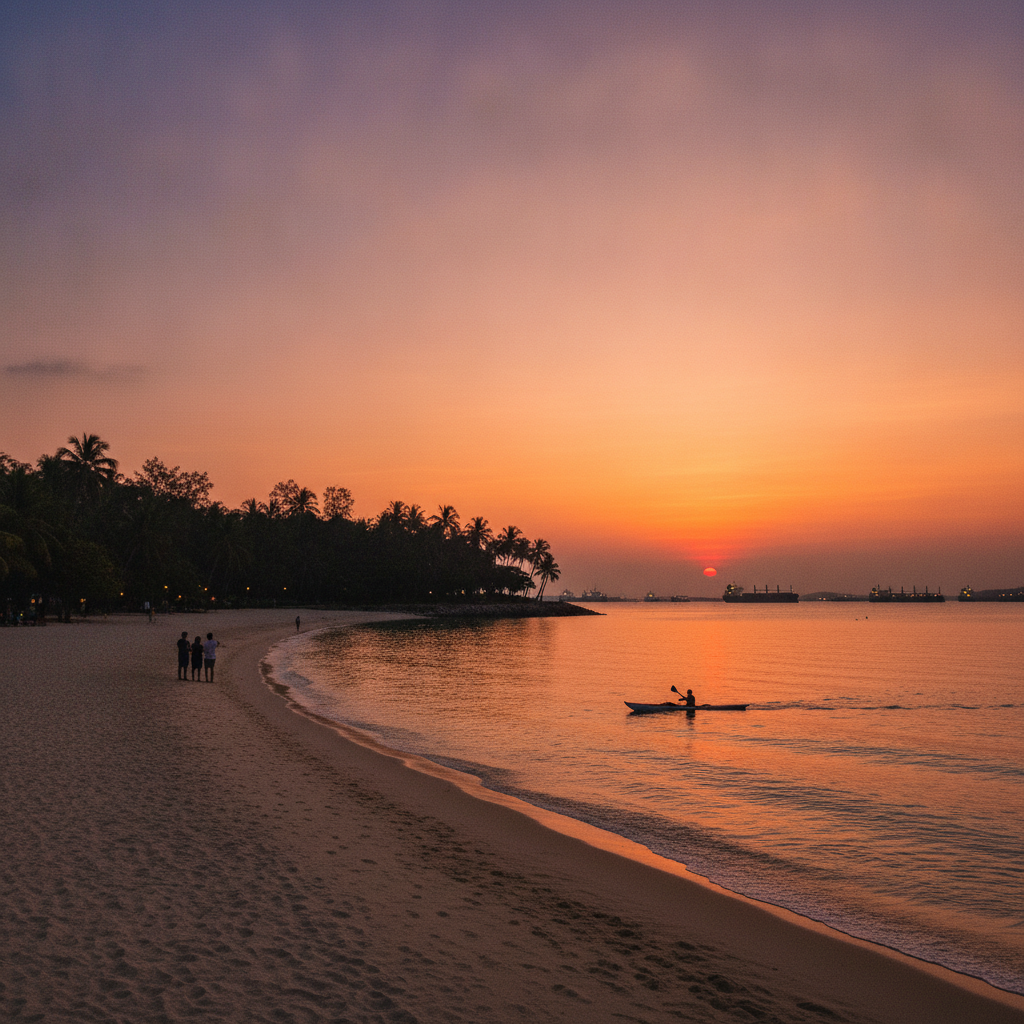
Sentosa's three beach areas — Siloso Beach (the most developed and liveliest, with beach bars, water sports, and rental facilities), Palawan Beach (containing the Palawan Suspension Bridge connecting to a small island that bills itself as 'the southernmost tip of continental Asia' — a commercially dubious but photogenic claim), and Tanjong Beach (the quietest and least developed, at the eastern end of the island, containing the Tanjong Beach Club) — were all artificially created or extended by importing sand from Indonesia and Malaysia from the 1970s to the 2000s. Sentosa's beaches face the Strait of Singapore rather than open ocean, meaning the sea is calm, the horizon is filled with container ships at anchor (one of the world's busiest shipping lanes passes immediately to the south), and swimming is safe but the water visibility is limited due to shipping traffic.
- 5
Cable Car — Singapore's First Aerial View
Singapore Cable Car, the gondola cable car system connecting Mount Faber (the highest point in southern Singapore at 105 meters, connected by road to the city) to Sentosa Island via two intermediate towers, was the first cable car system built in Southeast Asia when it opened in 1974. The system has three stations (Mount Faber, HarbourFront/VivoCity, and Sentosa), carries approximately 1,200 passengers per day in glass-floored gondolas, and provides the best aerial view of the Singapore Strait, the container port (the world's second-busiest container port by volume, handling 37 million TEU per year), and the Sentosa coastline available to the public. A 2010 cable car tragedy — two workers killed when a ship's mast struck a cable and caused two gondolas to fall into the sea — led to a redesign of the system with higher cable clearance over the shipping channel.
- 6
Resorts World Aquarium and Marine Life Park
S.E.A. Aquarium (South East Asia Aquarium) at Resorts World Sentosa, opened in 2012 and one of the world's largest aquariums when it opened (subsequently surpassed by the Georgia Aquarium in Atlanta and the Okinawa Churaumi Aquarium in Japan), contains over 100,000 marine animals from 1,000 species in 50 million litres of water organized into 10 zones representing different marine environments of the Indian Ocean and Southeast Asia: the coral reefs of Southeast Asia, the kelp forests of the northeastern Pacific, the deep ocean trench, and the Open Ocean Habitat — a 36-meter wide, 8.3-meter tall acrylic viewing panel that is one of the largest single viewing windows in the world, through which visitors look into a 18-million-litre habitat containing thousands of fish including manta rays, sharks, and giant groupers.
Walk this route with audio
Stories play automatically as you reach each stop — no tapping needed.
More in singapore
East Coast and Katong: Peranakan Heritage and Seaside Singapore
Marina Bay: Singapore's Futurist Waterfront
Little India and Kampong Glam: Singapore's Indian and Malay Quarters
Orchard Road and the Botanic Gardens: Shopping and Green Sanctuary
Colonial Civic District: The Architecture of Empire