St. Louis R3: Scott Joplin (King of Ragtime born 1868 Texarkana, Maple Leaf Rag 1899 first sheet music 1M copies, Entertainer 1902 revived The Sting 1973 7 Oscars, Pulitzer 1976 posthumous, 2658 Delmar House State Historic Site), Josephine Baker (born 1906 St. Louis, Paris 1925 banana dance Folies Bergere most photographed woman 1920s, French Resistance Croix de Guerre Legion d'Honneur, March on Washington August 28 1963 only woman official speaker, French state funeral Notre-Dame April 15 1975 Rainbow Tribe 12 adopted children), Tennessee Williams (Glass Menagerie 1944 set St. Louis family 4633 Westminster Place 1918), Vincent Price (born 1911 St. Louis horror films), Eads Bridge (1874 first steel bridge in world, chromatic steel, pneumatic caissons 33m bedrock first US use, Grant ceremonial July 4 1874, Boeing 14,000 engineers Hazelwood), German food heritage (Forty-Eighters 1848 Missouri Rhineland vineyards, Hill neighborhood Italian toasted ravioli Charlie Gitto's, provel cheese St. Louis pizza Imos Pi Pizzeria Obama 2008, gooey butter cake 1930s mistake), St. Louis decline (856,000 1950 to 300,000 65% largest US city decline, city-county separation 1876, Cortex USD 2B Washington Avenue lofts 3000 units), day trips (Meramec Caverns Jesse James, Elephant Rocks 1.5B year granite, Missouri Wine Country Hermann Norton grape, Grant Hardscrabble farm 1850s).
St. Louis R3: Scott Joplin (born 1868, Maple Leaf Rag 1899 first 1M sheet music, Entertainer 1902 revived Sting 1973, Pulitzer 1976, Joplin House 2658 Delmar), Josephine Baker (born 1906 St. Louis, Paris 1925 banana dance most photographed woman 1920s, French Resistance Croix de Guerre Legion, March on Washington August 28 1963, French state funeral Notre-Dame April 15 1975, 12 Rainbow Tribe children), Tennessee Williams (Glass Menagerie 1944 set St. Louis 4633 Westminster), Eads Bridge (1874 first steel bridge world, pneumatic caissons 33m first US, Grant July 4 1874, Boeing 14,000 engineers), food (German Forty-Eighters 1848, Hill Italian toasted ravioli Charlie Gitto's, provel pizza Imos Pi Obama, gooey butter cake 1930s accident), decline (856,000 1950 to 300,000 65%, city-county 1876, Cortex Washington lofts 3000), day trips (Meramec Caves Jesse James, Elephant Rocks 1.5B granite 680 tons, Missouri Rhine wine Hermann Norton grape, Grant Hardscrabble 1850s).
- 1
Scott Joplin and Ragtime - St. Louis Musical Heritage
Scott Joplin (born November 24, 1868, Texarkana, Texas; died April 1, 1917, New York City): the King of Ragtime, whose compositions (Maple Leaf Rag, 1899, the first sheet music in American history to sell over one million copies; The Entertainer, 1902; Elite Syncopations, 1902; Treemonisha, the ragtime opera, 1911) defined the ragtime genre and created the rhythmic foundation for jazz, blues, and ultimately rock and roll. Joplin spent the most productive years of his career in St. Louis (1890-1907), living in the boarding house at 2658 Delmar Boulevard (now the Scott Joplin House State Historic Site) and publishing his most famous compositions through the St. Louis publisher John Stark. Ragtime defined: ragtime (syncopated piano music developed in the Black communities of the Midwest in the 1890s-1910s, combining African American musical traditions with European classical forms — particularly march and dance forms) was the dominant popular music of the United States from approximately 1897 to 1917, predating jazz as the first African American musical genre to achieve widespread commercial success in white America. The Entertainer revival: Scott Joplin's music was largely forgotten by the time of his death in 1917, but was dramatically revived when The Entertainer was used as the main theme of the film The Sting (1973, directed by George Roy Hill, starring Paul Newman and Robert Redford), which won 7 Academy Awards and brought Joplin's ragtime compositions to a new generation of listeners. Joplin was posthumously awarded the Pulitzer Prize in 1976. The Joseph Baker (Josephine Baker, born Freda Josephine McDonald, June 3, 1906, St. Louis; died April 12, 1975, Paris): the most internationally famous St. Louisan, who left the United States in 1925 (fleeing American racism) to become the most celebrated entertainer in France and Europe.
- 2
Josephine Baker and Tennessee Williams - St. Louis Creative Legacy
Josephine Baker (born Freda Josephine McDonald, June 3, 1906, St. Louis; died April 12, 1975, Paris): the dancer, singer, and actress who left St. Louis in 1921 at age 15 to perform on Broadway, and moved to Paris in 1925, where she became the most celebrated female entertainer in Europe (the banana dance in the Folies Bergere, 1926, made her the most photographed woman in the world in the late 1920s). Baker was a civil rights activist who refused to perform before segregated audiences in the United States, assisted the French Resistance in World War II (carrying messages for the Deuxieme Bureau written in invisible ink on her sheet music), was awarded the Croix de Guerre and the Legion d'Honneur, and was the only woman officially recognized as a speaker at the March on Washington on August 28, 1963 (the day of King's I Have a Dream speech). Baker was granted French citizenship in 1937, married French conductor Jo Bouillon in 1947, and adopted 12 children from 12 different countries and ethnicities (her Rainbow Tribe). She was the first American-born woman to receive a French state funeral at Notre-Dame de Paris on April 15, 1975. Tennessee Williams (born Thomas Lanier Williams III, March 26, 1911, Columbus, Mississippi; died February 25, 1983, New York City): the playwright who grew up at 4633 Westminster Place, St. Louis (the family moved there in 1918), and whose St. Louis experience (the family's fall from Southern planter class to urban poverty and the suffocating bourgeois conformity of St. Louis society) directly inspired The Glass Menagerie (1944, set in St. Louis, Williams's breakthrough play). Vincent Price (born May 27, 1911, St. Louis; died October 25, 1993, Los Angeles): the actor associated with Gothic horror films (House of Wax, 1953; House of Usher, 1960; The Masque of the Red Death, 1964; Theatre of Blood, 1973) who was born in St. Louis.
- 3
The Eads Bridge and St. Louis as an Engineering City
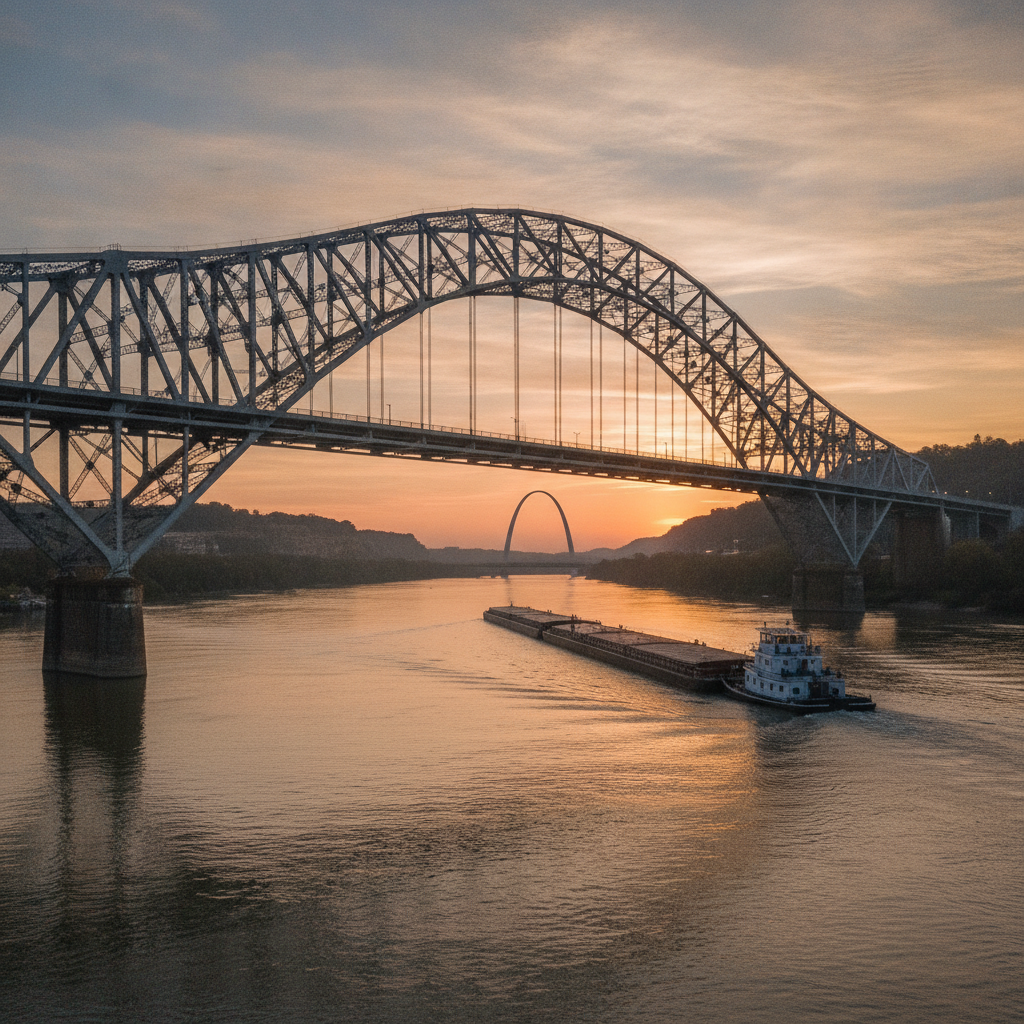
The Eads Bridge (at Washington Avenue and the Mississippi River, opened July 4, 1874): the first steel bridge in the world (using chromium steel for the structural members — the first large-scale use of steel in bridge construction), the first bridge to span the Mississippi River at St. Louis (using caissons extending 33 m below the river surface to reach bedrock — the first use of pneumatic caissons in the United States, a process that caused caisson disease or the bends in numerous workers), and a landmark achievement of American engineering. James B. Eads (born May 23, 1820, Lawrenceburg, Indiana; died March 8, 1887): the self-taught engineer who designed the bridge (with only 18 months of formal schooling, having educated himself by reading the engineering library of a merchant whose boat he had helped recover from the Mississippi River) and overcame political opposition, engineering skepticism, and a Congressional investigation to complete it. Ulysses S. Grant drove the ceremonial stake at the bridge opening on July 4, 1874 — a date chosen deliberately to coincide with Independence Day. The McKinley Bridge (1910), the Veterans Bridge (1932), and the Stan Musial Veterans Memorial Bridge (2014): the bridges connecting St. Louis to East St. Louis, Illinois. St. Louis as an engineering hub: the Boeing Defense, Space and Security headquarters (at 100 North Riverside Plaza, Chicago, but with the principal operations center in Hazelwood, Missouri, 25 km north of downtown St. Louis) employs approximately 14,000 engineers in the St. Louis area, making aerospace and defense the largest private employer in the metropolitan area.
- 4
The Soulard Farmers Market and St. Louis Ethnic Food Heritage
The German immigrant heritage of St. Louis: German immigrants (the Forty-Eighters — the liberal and revolutionary refugees from the failed German Revolution of 1848) settled in St. Louis and the surrounding Missouri Rhine Valley (a stretch of the Missouri River between Washington and Hermann, Missouri, approximately 100 km west of St. Louis, where German immigrants established vineyards modeled on the Rhine Valley) in large numbers in the 1840s-1870s, making St. Louis approximately 30% German-born by 1860 and creating the strong beer culture (the Anheuser-Busch brewery, founded by German immigrants) and civic institutions (the Schiller Theater, the German-language newspapers) that defined 19th-century St. Louis. The Italian heritage of St. Louis: the Hill neighborhood (see above) is the most coherent Italian-American neighborhood in the Midwest, with the tradition of toasted ravioli, the restaurants of the Garvey-Cunetto family, and the restaurants of Charlie Gitto's (at 5226 Shaw Boulevard, founded 1980), Rossino's, and Zia's. St. Louis-style pizza: the cracker-thin crust, square-cut, provel cheese St. Louis pizza style is defended with genuine passion by St. Louisans and dismissed with genuine disdain by pizza traditionalists from New York, New Haven, and Italy. The best St. Louis pizza: Imo's Pizza (the definitive chain), Pi Pizzeria (at 6144 Delmar Boulevard, University City, which became nationally famous when Barack Obama ordered from the Pi Pizzeria during the 2008 campaign). The gooey butter cake: the quintessential St. Louis baked good (a coffee cake variant with a dense, gooey filling of butter, cream cheese, eggs, and sugar, invented by mistake at a St. Louis bakery in the 1930s when a baker accidentally reversed the ratio of butter to cake batter) now available at virtually every St. Louis bakery and the Gooey Louie shop.
- 5
St. Louis Today - Population Decline, Revival, and Urban Challenges
St. Louis population decline: St. Louis is the most prominent example of post-industrial urban decline in the American Midwest, with a population that peaked at 856,796 in 1950 and has fallen to approximately 300,000 in 2024 — a 65% population decline that is the largest percentage decline of any major American city in the 20th century. The causes of decline: the combination of white flight to the suburban ring (enabled by post-WWII subsidized mortgages that were restricted to new construction in white suburbs and denied to existing urban neighborhoods through redlining), the decentralization of the industrial economy that had supported working-class urban neighborhoods, the separation of the city from the county (1876) that prevented the city from annexing growing suburbs, and the high crime rates that followed from concentrated poverty. The Laclede's Landing (the restored 9-block stretch of brick warehouses along the riverfront north of the Gateway Arch): the historic commercial district that experienced gentrification in the 1970s-1980s and has struggled to maintain vitality since. The Cortex innovation district (see above): the most significant economic development in contemporary St. Louis. Washington Avenue loft district (the converted 19th-century garment and shoe manufacturing warehouses on Washington Avenue, west of downtown): the most successful residential conversion project in St. Louis, creating approximately 3,000 loft apartments in former industrial buildings. The St. Louis crime rate: St. Louis has one of the highest violent crime rates of any large American city, with a murder rate that is among the top 5 nationally — concentrated in specific north and south St. Louis neighborhoods and overwhelmingly affecting Black residents.
- 6
Day Trips from St. Louis - Caves, Wine, and History
Day trips from St. Louis: the metropolitan area offers excellent day trip options in all directions. Meramec Caverns (at 1135 Highway W, Stanton, Missouri, 95 km southwest of St. Louis): the largest cave system in Missouri, with 7 km of surveyed passages, the 7-story formation room (one of the largest cave rooms in the Midwest), and the Jesse James connection (the cave was used by Jesse James as a hideout, or so the Meramec Caverns marketing claims — a claim of disputed historical accuracy). Elephant Rocks State Park (at 7406 Missouri Highway 21, Belleview, Missouri, 130 km south of St. Louis): the state park with the famous elephant rocks — massive granite boulders (up to 27 m long, weighing up to 680 metric tons) that have been rounded by weathering over 1.5 billion years into shapes resembling elephants lined up to drink from a water hole. The Missouri Wine Country (Hermann and the Missouri Rhineland, approximately 100 km west of St. Louis): the wine region established by German immigrants in the 1840s-1850s, producing wines from Norton (the native Missouri grape variety, also called Cynthiana, which is resistant to the phylloxera louse that devastated European vineyards in the 1870s-1890s), Vidal Blanc, and Chardonel. Adam Puchta Winery (at 1947 Frene Creek Road, Hermann, established 1855): the oldest continuously operating family winery in Missouri. Ulysses S. Grant National Historic Site (at 7400 Grant Road, St. Louis, the Hardscrabble farm): the farm where Grant lived with his wife Julia in the 1850s, now a National Historic Site preserving the cabin and outbuildings from Grant's pre-Civil War years.
Walk this route with audio
Stories play automatically as you reach each stop — no tapping needed.
More in st-louis

St. Louis: Garden City, World Fair Parks and American Music Roots

St. Louis: World-Class Art, Ancient Cities and Neighborhood Soul
St. Louis: Gateway Arch, founding history, Forest Park, music, sports, and food
St. Louis: Victorian Parks, Rock and Roll Sidewalks and the Gateway West
St. Louis R2-R4: Dred Scott (March 6 1857 worst Supreme Court decision, Taney ruling no Black citizenship no Congressional slavery limits precipitated Civil War, Scott freed May 1857, Old Courthouse trial 1846, Ferguson August 9 2014 Michael Brown BLM catalysis), Architecture (Wainwright Building 1891 Sullivan first coherent skyscraper, Old Courthouse cast-iron dome 1862, Union Station 1894 Theodore Link 100,000 daily peak 1940 now hotel aquarium Ferris wheel, Pruitt-Igoe 1956 Yamasaki demolished 1972-1976 symbol failed public housing), Universities (WashU top 20 US #14 25 Nobel laureates T.S. Eliot born St. Louis 1888 Nobel 1948, Saint Louis University 1818 oldest west Mississippi, Cortex USD 2B 450 companies Square Asana biotech), Anheuser-Busch (Budweiser 1876 pasteurization refrigerated rail cars, InBev 2008 USD 52B largest cash acquisition history, craft Perennial Urban Chestnut 4 Hands), 1993 Flood (75,000 sq km 50 dead USD 15B 79 days above flood stage, Cahokia Mounds UNESCO 1982 largest pre-Columbian city north Mexico 10,000-20,000 people, Monks Mound larger base than Giza pyramid abandoned 1300 CE), Neighborhoods (Delmar Divide racial segregation, Loop Walk of Fame Berry Baker Williams Eliot Grant Joplin, Soulard 1779 farmers market oldest west Mississippi Mardi Gras 200,000 second US largest).