Blue Mountains, Katoomba & Jenolan Caves: A World Heritage Day Trip from Sydney
The Blue Mountains World Heritage Area (declared 2000, part of the Greater Blue Mountains Area inscription, one of the largest areas of temperate eucalyptus woodland in the world: 1.03 million hectares, 400+ eucalyptus species, the most biodiverse eucalyptus ecosystem on Earth) lie 80 kilometres west of Sydney — 90 minutes by train from Central Station — offering escarpment lookouts, ancient rainforest gorges, the Three Sisters rock formation, the world's steepest railway, and the extraordinary Jenolan limestone cave system.
- 1
Echo Point & The Three Sisters (Katoomba)
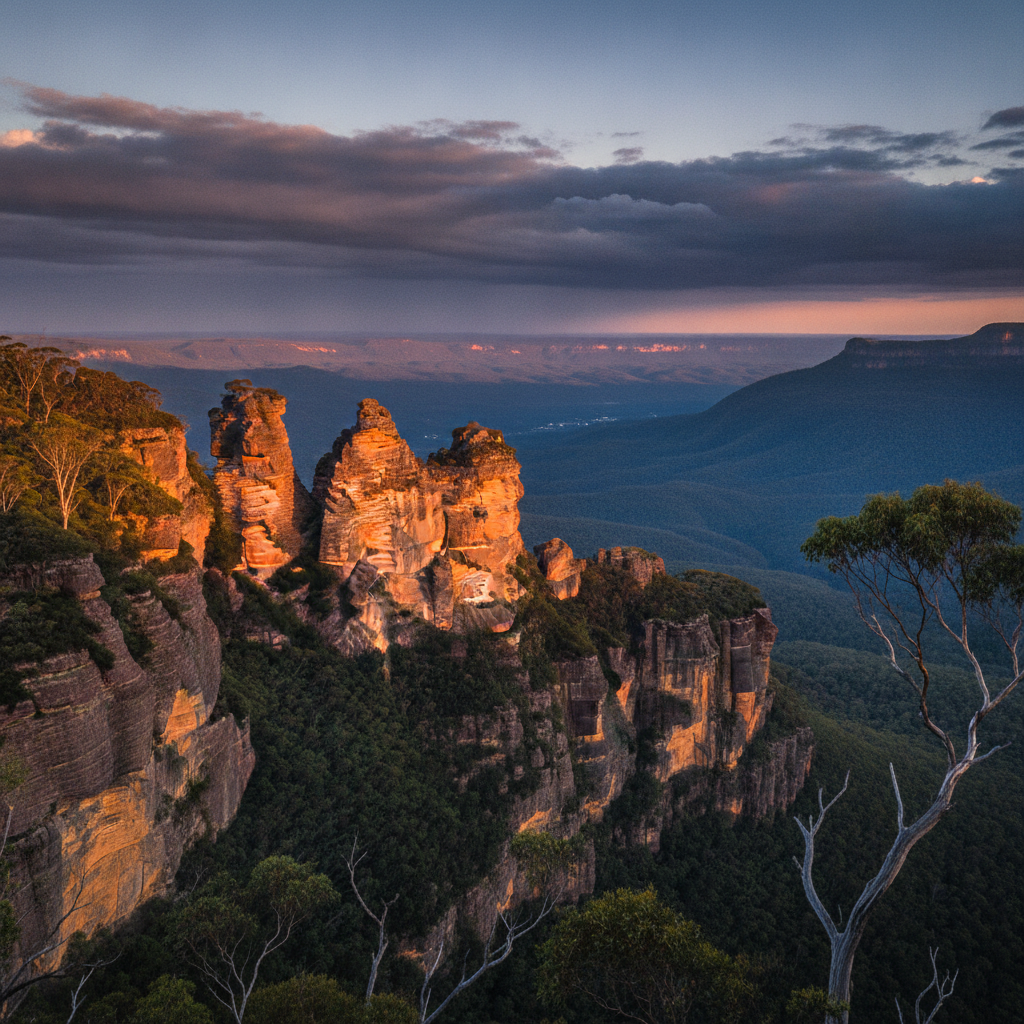
Echo Point (Echo Point Road, Katoomba, the primary lookout over the Jamison Valley and the Three Sisters — the most visited natural attraction in New South Wales, receiving 3.5 million visitors per year) — provides the canonical view of the Three Sisters (Meehni, Wimlah, and Gunnedoo in Gundungurra language; three sandstone pinnacles at the northern escarpment of the Jamison Valley, heights 922m, 918m, and 906m above sea level; formed 180 million years ago during the Triassic period from compacted beach and delta sands; the columns are the remnants of a harder rock layer resisting erosion after the surrounding softer rock was removed by millions of years of weathering; the Aboriginal Dreamtime story tells that the three sisters were turned to stone by their father, a witchdoctor, to protect them from a Bunyip — a creature of Aboriginal mythology — while he went to fight it; he was also turned to stone before he could reverse the spell; the three pinnacles continue to erode at approximately 1 millimetre per year, and will eventually collapse into the valley in geological time). The Blue Mountains originally received their name from the blue haze visible from the coast (created by the evaporation and photolysis of eucalyptol, a volatile oil released by the billions of eucalyptus trees in the valleys, which scatters blue wavelengths of sunlight through a mechanism similar to the Rayleigh scattering that makes the sky blue).
- 2
Scenic World (1945) — Scenic Railway, Scenic Skyway & Cableway
Scenic World (Violet Street, Katoomba, the largest private tourist attraction in Australia by annual throughput: 1.3 million visitors per year) — comprises four interconnected experiences: the Scenic Railway (opened 1945, reconstructed 2013; at 52 degrees, the steepest passenger railway in the world, steeper than any ski jump; originally built in the 1880s as an industrial incline railway to bring coal and shale up from the Jamison Valley mines; carries 84 passengers per trip, descending 415 vertical metres in 415 metres of horizontal distance in approximately 3 minutes; the minimum recommended age is 2; the maximum slope of 52 degrees is approximately the equivalent of standing inside a glass being tipped to pour), the Scenic Skyway (a cable car traversing 270 metres across Katoomba Falls gorge, 270 metres above the valley floor, with a glass floor through which the waterfall beneath can be seen, the longest cable car in Australia), the Scenic Cableway (540 metres to the valley floor through the former coal and shale mine workings), and the 2.4-kilometre Scenic Walkway (a boardwalk through the Jurassic-age temperate rainforest of the Jamison Valley floor).
- 3
Leura Village & Leura Cascades
Leura (the village immediately east of Katoomba on the Great Western Highway, named by railway surveyor John Whitton in 1867 from the Gundungurra word 'leura', meaning 'lava', after volcanic basalt outcrops in the area; the most picturesque of the Blue Mountains villages, and the one most often cited by residents as their preferred place to live; famous for its European gardens — the Blue Mountains climate supports many European tree species including English oaks, beech, cherry blossom, and autumn maples that are rare in the coastal lowlands — and its 1920s-1930s cottage architecture, particularly along the Mall and Sublime Point Road) — Leura Cascades (a series of small cascades in a narrow gully at the eastern end of the Leura escarpment, surrounded by temperate rainforest and Blue Mountains ash trees, reached by a 1-kilometre walk from the Leura Cascades Picnic Area: the finest picnic area in the Blue Mountains, the point from which the 45-kilometre Grand Canyon Walk and the Federal Pass Walk to Katoomba can be joined). The Megalong Valley (to the south of Leura, 600 metres below the escarpment, accessible by a steep unsealed road, the most beautiful pastoral valley in the Blue Mountains, farmed continuously since the 1820s, with several heritage farmstays).
- 4
Wentworth Falls & Conservation Hut Walk
Wentworth Falls (the waterfall township 10 kilometres east of Katoomba, named for William Charles Wentworth — the explorer who led the first crossing of the Blue Mountains in 1813, later the most significant political figure in colonial New South Wales — and the site of Wentworth Falls itself, a three-tiered waterfall dropping 187 metres into the Jamison Valley, the most accessible waterfall in the Blue Mountains and the one offering the most dramatic head-on view, accessible from the Conservation Hut car park in 15 minutes via the easy Overcliff Walk). The Conservation Hut (a heritage-listed stone cottage built by the Katoomba Council in 1938 as a bush walking refuge, now operated as a café and information point at the top of the Valley of Waters walk: the finest waterfall walk in the Blue Mountains, descending through three distinct forest zones — plateau heath, wet sclerophyll forest, and temperate rainforest — to Vera Falls, Sylvia Falls, and finally the Weeping Rock cave waterfall at the base, with a total vertical descent of 320 metres).
- 5
Blackheath & Govetts Leap (the Grose Valley)
Blackheath (the highest township in the Blue Mountains at 1,065 metres elevation, 10 kilometres north of Katoomba, the coldest inhabited town in New South Wales and the snowiest town east of the Great Dividing Range — receives an average of 17 days of snowfall per year, unusual in eastern Australia — famous for its autumn leaf displays from the European trees along Govetts Leap Road, and for the Rhododendron Festival held each spring) — Govetts Leap (the escarpment lookout 5 kilometres from Blackheath, providing the most dramatic view in the Blue Mountains: a vertical drop of 476 metres to the Grose Valley floor, with the Grose River visible 600 metres below, and the entire uninhabited Grose Wilderness — one of only two wilderness areas in the Blue Mountains World Heritage Area — stretching to the horizon; the lookout is named for Richard Govett, a surveyor who mapped the escarpment in the 1830s; the 'leap' part of the name is believed to derive from an unconfirmed story that Govett's horse leapt over the escarpment edge). The Grand Canyon Walk (6 kilometres circular, 4 hours, descending into the only canyon in the Blue Mountains where the walls are close enough together to form a true enclosed canyon, filled with mosses, ferns, hanging gardens, and a stream, the most varied geological walk in the Blue Mountains).
- 6
Jenolan Caves (380 million years old) — The Greatest Limestone Cave System in the Southern Hemisphere
Jenolan Caves (Jenolan Caves Road, 170 kilometres west of Sydney via Katoomba and Oberon — best reached from the Blue Mountains as an extension to a Katoomba day trip — the longest known cave system in the Southern Hemisphere: 40 known caves, 300+ kilometres of explored passages, 25+ kilometres of open water stream passages, the greatest concentration of limestone cave formations in Australia) — formed 380 million years ago during the Devonian period from marine sediments of the ancient Inland Sea, uplifted and karstified over subsequent geological eras into an extraordinary landscape of stalactites, stalagmites, flowstones, shawls, cave pearls, helictites, and cave coral. The Jenolan Caves Reserve (1866, the oldest nature reserve in Australia — earlier than any national park or wildlife reserve in the world — designated to protect the caves from quarrying after local residents lobbied the NSW government from 1838) surrounds the cave system and contains the Grand Arch (a natural arch 24 metres high, 50 metres wide, and 110 metres long, through which the Jenolan River flows, the largest natural arch in Australia and one of the largest in the world), the Blue Lake (a subterranean lake visible from the surface through a shaft in the cave ceiling, with water of extraordinary clarity coloured brilliant blue by calcite precipitation) and the Jenolan Caves House (1897-1926, the luxury heritage hotel complex built by the NSW Government to accommodate cave visitors, the oldest tourism accommodation complex in Australia still in continuous operation under a single management).
Walk this route with audio
Stories play automatically as you reach each stop — no tapping needed.
More in sydney
Manly Ferry, North Head & Scenic Headland: The World's Most Beautiful Ferry Crossing
Darling Harbour, Chinatown & Barangaroo: Sydney's Western Waterfront
Sydney Opera House, Circular Quay & The Rocks: The Iconic Harbour Foreshore
Newtown, Surry Hills & Paddington: Sydney's Inner City Cultural Corridor
Bondi to Coogee: Australia's Most Famous Coastal Walk