Sydney Harbour Bridge, Milsons Point & North Sydney: The Northern Shore
Crossing the Sydney Harbour Bridge from the city to the North Shore reveals a different Sydney: the sandstone-and-garden suburbs of Milsons Point, Kirribilli, and North Sydney that face the CBD across the harbour, with the best views in the city and the least tourist-visited significant sites. Luna Park, Kirribilli House (the Prime Minister's Sydney residence), and the commanding panoramas from the North Sydney side of the bridge show Sydney from its most photogenic angle.
- 1
Dawes Point / Tarra-barra — Southern Pylon & Bridge View
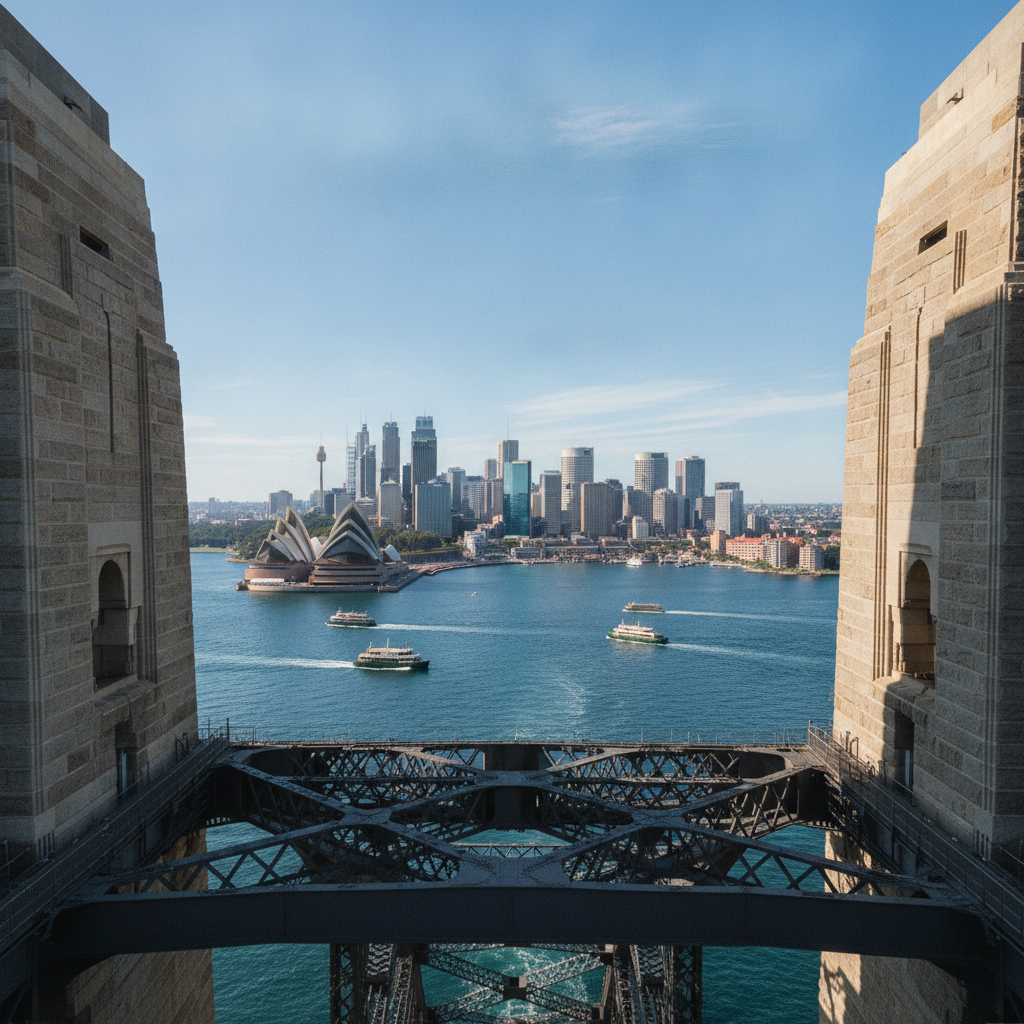
Dawes Point (Tarra-barra in the Gadigal language, the rocky point below the southern end of the Sydney Harbour Bridge) — named for Lieutenant William Dawes, who established the first meteorological and astronomical observatory in Australia here in 1788 (from this point he could observe signal flags on the South Head signal station warning of arriving ships) — is the best ground-level viewpoint for the Sydney Harbour Bridge and the only place where you can see the full span from below. The Bridge Pylon Lookout (inside the southeastern pylon of the bridge, accessible via stairs, 87 steps, open daily) provides a 360-degree view of the harbour from 89 meters elevation. The Dawes Point Battery (1840s, a now-grassed fortification that once guarded the harbour entrance) contains the largest surviving collection of colonial-era cast-iron cannons in Australia. The stretch of waterfront from Dawes Point east to the Opera House is the Sydney Harbour Foreshore Reserve, managed by the NSW Heritage Office as a continuous heritage precinct.
- 2
Sydney Harbour Bridge Pedestrian Walk & BridgeClimb
The Sydney Harbour Bridge pedestrian walkway (eastern footway, accessible from the Cumberland Street stairs in The Rocks at the southern end, or from Milsons Point at the northern end) — the only way to cross the bridge on foot without the BridgeClimb commercial tour — provides the most extraordinary free view in Sydney: a 1.1-km walk across the top of the bridge at 59 meters above sea level, with panoramic views of the harbour, Opera House, city, and Eastern Suburbs. The BridgeClimb commercial experience (since 1998, from the southern end in The Rocks) allows visitors to climb to the summit of the arch (134 meters above sea level) in groups of 12, taking 3.5 hours for the standard climb and 1.5 hours for the 'Sampler' climb (to the pylon top). BridgeClimb is the most expensive tourist experience in Sydney ($300-400 per person for the summit climb) and serves approximately 300,000 climbers per year. The bridge's 1932 opening was attended by 300,000 spectators, and more than 200,000 people walked across it on opening day.
- 3
Milsons Point & Luna Park (1935)
Milsons Point (the ferry wharf and train station at the northern end of the Sydney Harbour Bridge, with the distinctive Art Deco arch of the Milsons Point railway station visible from the city side) — the closest point on the North Shore to the city, separated only by the bridge — is most famous for Luna Park Sydney (1 Olympic Drive, Milsons Point, opened October 4, 1935, one of the oldest continuously operating amusement parks in the world): the grinning Art Deco entrance face (the third 'face,' the current version designed by artist Martin Sharp in 1994) is one of the most photographed and recognized images in Australian culture, appearing on countless albums, posters, and artworks. Luna Park occupies the site of the steel fabrication workshops built during bridge construction (1923-1932). The park's Big Dipper roller coaster (1935-1935, rebuilt 1953, rebuilt again 1982) was the scene of Australia's worst amusement park tragedy (the 'Ghost Train fire' of June 9, 1979, which killed 7 people, including 6 children, when the Ghost Train ride caught fire; the fire's origin has never been definitively established and is the subject of ongoing speculation about potential arson).
- 4
Kirribilli & Kirribilli House (Prime Minister's Residence)
Kirribilli (the peninsula immediately east of the Sydney Harbour Bridge's northern approach, name deriving from the Aboriginal word for 'good fishing spot') — an exclusive suburb of Victorian terrace houses and Federation-style mansions on the harbour foreshore, with some of the highest property values in Australia — contains two of Australia's most significant official residences: Kirribilli House (107 Kirribilli Avenue, built 1854-1856, the Sydney residence of the Prime Minister of Australia — the official Sydney residence, used for official functions and as a retreat, not the primary residence, which is The Lodge in Canberra) and Admiralty House (Kirribilli Avenue, built 1843, the Sydney residence of the Governor-General of Australia, the representative of the Crown). Both houses are on the headland looking directly across the harbour to the Opera House and city, providing what is consistently ranked the finest view from any official government residence in the world.
- 5
McMahons Point & Blues Point Reserve
McMahons Point and Blues Point Reserve (the finger of land extending into Sydney Harbour from the northern shore, between Lavender Bay and Berry Bay, immediately west of the Harbour Bridge approach) — the site of the former Blues Point Tower (1962, Harry Seidler's controversial 26-story residential tower, universally despised by Sydneysiders as an eyesore blocking what was once the finest harbour view from the North Shore) — provides the single best ground-level panoramic view of the entire harbour: from the Blues Point Reserve lawn, the Sydney Harbour Bridge, the CBD skyline, the Opera House, and the Kirribilli shoreline are all visible simultaneously. The reserve is famous for New Year's Eve fireworks viewing (one of the most sought-after spots for the Sydney New Year's Eve fireworks display, which draws 1 million+ spectators to the harbour foreshore each December 31). Blues Point Tower, despite being universally loathed, has been defended by architectural preservationists as one of Sydney's significant mid-century modernist buildings.
- 6
North Sydney CBD & Milson Island Views
North Sydney (the commercial district immediately north of the Harbour Bridge, the second-largest concentration of office space in New South Wales after the Sydney CBD) — once a major commercial hub in its own right, now largely overshadowed by the city — contains some significant architectural landmarks: the MLC Centre North Sydney (Seidler, 1977), the North Sydney Olympic Pool (1936, the oldest 50-meter pool still in use in Australia, where Don Bradman trained and where the Australian Olympic swimming team has prepared), and Berry Island Reserve (Wollstonecraft, an uninhabited island connected to the mainland by a causeway, a significant Aboriginal carving site with rock engravings of fish, wallabies, and human figures dating to at least 5,000 years ago). The view south from North Sydney — across the harbour to the city skyline, with the Opera House and Harbour Bridge completing the composition — is the view most used in media to represent Sydney.
Walk this route with audio
Stories play automatically as you reach each stop — no tapping needed.
More in sydney
Manly Ferry, North Head & Scenic Headland: The World's Most Beautiful Ferry Crossing
Darling Harbour, Chinatown & Barangaroo: Sydney's Western Waterfront
Blue Mountains, Katoomba & Jenolan Caves: A World Heritage Day Trip from Sydney
Sydney Opera House, Circular Quay & The Rocks: The Iconic Harbour Foreshore
Newtown, Surry Hills & Paddington: Sydney's Inner City Cultural Corridor