Newtown, Surry Hills & Paddington: Sydney's Inner City Cultural Corridor
The inner-western and inner-eastern suburbs of Sydney — Newtown, Surry Hills, Darlinghurst, and Paddington — form the most culturally dense corridor in Australia, containing the highest concentration of independent music venues, alternative bookshops, vintage clothing stores, LGBTQ+ venues, terrace house architecture, art galleries, and restaurants per capita of any comparable urban area in the Southern Hemisphere.
- 1
Newtown & King Street (Australia's Most Diverse Main Street)
Newtown (the inner-western suburb 4 kilometres from the CBD, accessible by train from Central Station; the most ethnically, culturally, and politically diverse suburb in Australia — consistently voted Australia's most LGBTQ+-friendly suburb, Australia's most vegan-friendly suburb, and Australia's most politically progressive suburb in separate surveys) — King Street (the main street of Newtown, 1.2 kilometres of unbroken commercial frontage rated by Lonely Planet as the most interesting main street in Australia) — contains: the Newtown Hotel (1852, now the most important live music pub in Sydney's inner west, hosting 7 nights per week of live music for 170 years), Gleebooks (1975, the most significant independent bookshop in Australia for new and secondhand academic and literary titles, winner of the Australian Bookseller of the Year award 6 times, the only Australian bookshop with a separate specialist children's bookshop, academic philosophy section, and regular author events drawing international literary figures including Salman Rushdie, Colm Tóibín, and Hilary Mantel), the Enmore Theatre (1912, the oldest surviving theatre in the inner suburbs of Sydney, the premier mid-sized live music venue in Sydney: capacity 1,600, the venue where INXS, Midnight Oil, The Easybeats, and Cold Chisel all played formative shows), and the Royal Hotel (1888, heritage-listed, the finest example of Victorian Commercial Italianate architecture on King Street, containing the rooftop bar voted Sydney's finest by Time Out magazine for four consecutive years).
- 2
Surry Hills (Sydney's Food, Fashion & Arts Capital)
Surry Hills (the inner suburb immediately south of the CBD, between the CBD and Redfern) — the restaurant and bar capital of Sydney (rated by Australian Gourmet Traveller as the suburb with the highest concentration of top-rated restaurants in Australia for 2018, 2019, and 2020) — contains: Crown Street (the main dining strip, 1.4 kilometres of restaurants, bars, and cafes from Cleveland Street to Oxford Street, the highest concentration of restaurants per metre in Sydney, including Porteño, Bills, and Berta — regularly rated among Sydney's top 10 restaurants), the Brett Whiteley Studio (2 Raper Street, the studio where Australia's most celebrated postwar painter Brett Whiteley worked from 1985 until his death in 1992 from an accidental heroin overdose; now administered by the Art Gallery of NSW as a studio museum; contains the 'Self Portrait in the Studio' (1976) and the 'Alchemy' panels (1972-1973, 18 interconnected panels measuring 18 metres x 2 metres, the most ambitious single painting produced by any Australian painter); the studio is open Fridays, Saturdays, and Sundays year-round), and the Belvoir Street Theatre (25 Belvoir Street, 1984, Australia's most significant independent professional theatre company, founded by a consortium of artists including David Williamson and Robyn Nevin, and responsible for the Australian premieres of Angels in America, The Normal Heart, and Miss Saigon).
- 3
Darlinghurst & Kings Cross (Sydney's Bohemian Heartland)
Darlinghurst and Kings Cross (the adjacent inner-eastern suburbs forming Sydney's most historically bohemian and culturally significant district) — Darlinghurst Road and Victoria Street (the streets separating Darlinghurst from Kings Cross, containing: the old Bourbon & Beefsteak Bar (1969-2013, the most significant rock bar in Australian history, the venue where the members of AC/DC first met in 1973, where the Sydney pub rock scene of the 1970s and 1980s was incubated, replaced in 2013 by a hotel amid the Lock Out Laws controversy), the El Alamein Fountain (1961, the water feature in Fitzroy Gardens at the center of Kings Cross that has been the symbolic center of the Cross since its installation — a dandelion-shaped bronze fountain 5 metres in diameter, designed by Robert Woodward and frequently compared to the Dandelion fountain in Paris), and the Wayside Chapel (1964, the ecumenical community service founded by Ted Noffs on Hughes Street, Potts Point, the most significant community outreach organization in inner Sydney, serving 7,000 people per week with meals, crisis accommodation, counselling, and community programs). Kings Cross was Sydney's most famous entertainment precinct from the 1920s to the 2010s (Les Girls, the first transgender cabaret in Australia, opened in 1963 and ran until 2013; the Victoria Room (1880s renovated mansion on Victoria Street, the finest cocktail bar in Sydney according to Time Out 2022) remains.
- 4
Oxford Street & Darlinghurst: Sydney's LGBTQ+ Cultural Centre
Oxford Street (the 3-kilometre stretch from Taylor Square to Paddington, the most significant LGBTQ+ street in Australia and one of the most significant in the world) — the site of the Sydney Gay and Lesbian Mardi Gras (the annual parade and festival held since 1978 — originally a protest march on the night of 24 June 1978 that ended in police arrests and became a defining moment in Australian LGBTQ+ history; now the largest LGBTQ+ event in the Asia-Pacific region, drawing 500,000 people to the parade route and 10,000+ to the party, the most watched parade in Australian television history: the 2023 broadcast attracted 1.6 million viewers, the most watched non-sporting event in Australian television in 2023) — contains: the Stonewall Hotel (Sydney's largest and most famous LGBTQ+ venue, three levels, 1,200-person capacity, operating since 1997), the Arq Sydney (the premier LGBTQ+ nightclub in Australia, 1996-present), the Australian Lesbian and Gay Archives (the most comprehensive collection of LGBTQ+ historical material in Australia), Taylor Square (the civic square at the intersection of Oxford, Flinders, and Bourke Streets, historically the symbolic center of Sydney's LGBTQ+ community, contains the AIDS Memorial in the square's garden, one of only four AIDS memorials in public space in Australia) and the Palace Cinemas (the most significant independent cinema group in Australia).
- 5
Paddington & Oxford Street Heritage Terraces
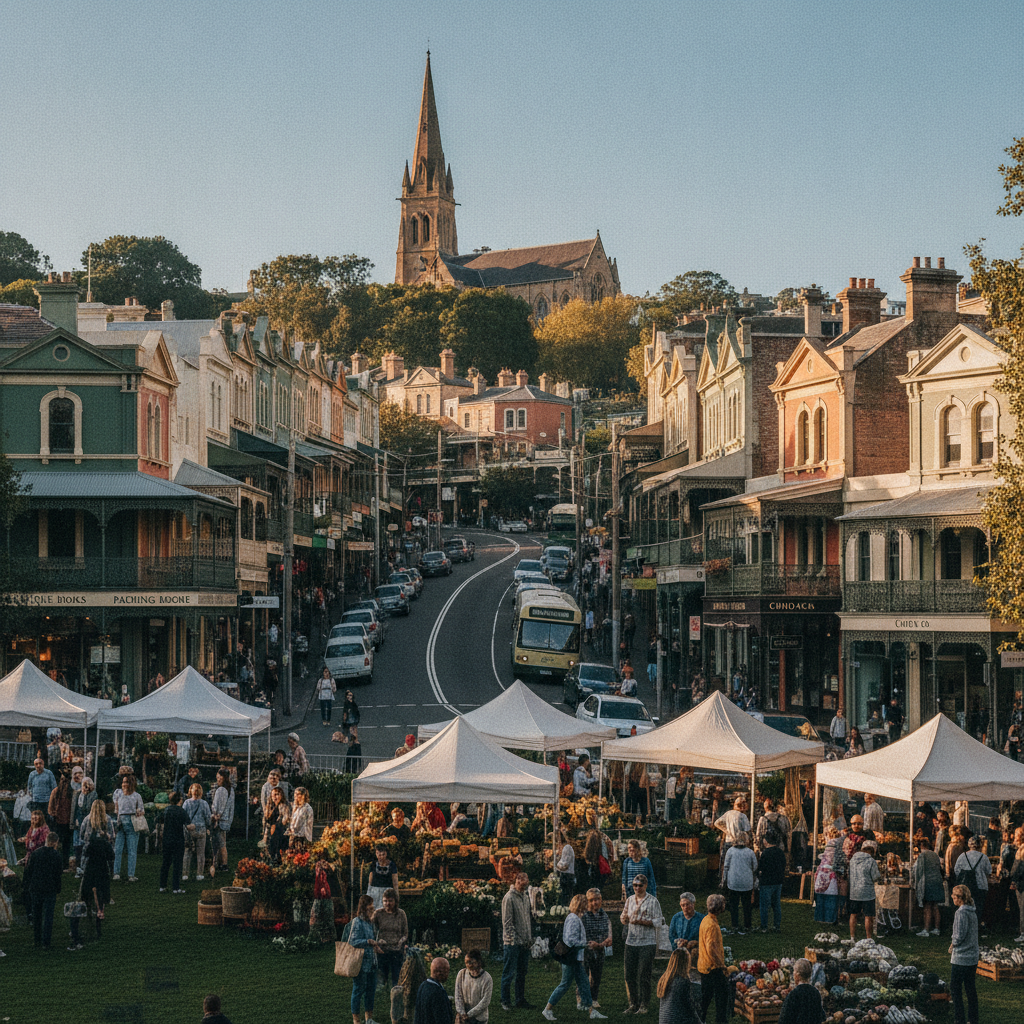
Paddington (the inner-eastern suburb 3 kilometres east of the CBD, a tightly-gridded hillside suburb of Victorian terrace houses — the finest surviving collection of Victorian residential terrace architecture in the Southern Hemisphere, and one of the finest in the world: approximately 3,800 terrace houses built between 1875 and 1895 on the slopes east of the CBD, originally built for workers in the adjacent Randwick Racecourse and Victoria Barracks, now heritage-listed and among the most expensive residential property in Sydney) — contains: Five Ways (the pentagonal intersection at the heart of Paddington where Glenmore Road, Heeley Street, Goodhope Street, Broughton Street, and Heeley Street converge, containing the Royal Hotel (1888), the Paddington Arms Hotel, and a cluster of boutique shops and cafes), the Paddington Markets (held in St John's Church grounds every Saturday since 1973, the oldest continuously-operating market in Sydney, the market where many of the designers who subsequently became Australian fashion icons — including Collette Dinnigan, Akira Isogawa, and Zimmermann — first sold their designs), and the Victoria Barracks (Oxford Street, 1841-1848, the finest intact example of early colonial military architecture in Australia, one of the largest and most important military complexes in New South Wales, still housing the NSW Army headquarters and the Army Museum of NSW).
- 6
Centennial Parklands & Moore Park
Centennial Parklands (the 360-hectare park complex at the eastern end of Oxford Street, proclaimed by Governor Lord Carrington on 26 January 1888 — the centenary of European settlement — the most significant single act of public parkland creation in Australian history: the 180-hectare Centennial Park plus the adjacent 59-hectare Moore Park and 25-hectare Queens Park) — Centennial Park (the principal park, with 9 freshwater ponds, 3.8 kilometres of formal avenues of native and European trees, 10 kilometres of paths and bridleways, the Centennial Parklands Equestrian Centre — the primary equestrian facility in Sydney, training ground for the 2000 Sydney Olympics equestrian events — the Centennial Park Café in the heritage-listed restored bandstand, and Randwick Racecourse (the principal thoroughbred racecourse in New South Wales, 1833-present, adjacent to the eastern boundary of Centennial Park; the Royal Easter Show has been held annually in the adjacent Sydney Showground since 1869, making it the longest-running annual event in Australia), the Sydney Cricket Ground (SCG, Moore Park, 1848, the most historic cricket ground in Australia; the first Test match in Australia was played here in 1882; the 'Hill' — the famous uncovered grassy embankment on the eastern side — was the birthplace of cricket barracking culture in Australia; the current capacity is 48,000), and the Sydney Football Stadium (SCG precinct, 2022 rebuild, the home ground of the NSW Waratahs, Sydney Roosters, South Sydney Rabbitohs, and Sydney FC).
Walk this route with audio
Stories play automatically as you reach each stop — no tapping needed.
More in sydney
Manly Ferry, North Head & Scenic Headland: The World's Most Beautiful Ferry Crossing
Darling Harbour, Chinatown & Barangaroo: Sydney's Western Waterfront
Blue Mountains, Katoomba & Jenolan Caves: A World Heritage Day Trip from Sydney
Sydney Opera House, Circular Quay & The Rocks: The Iconic Harbour Foreshore
Bondi to Coogee: Australia's Most Famous Coastal Walk