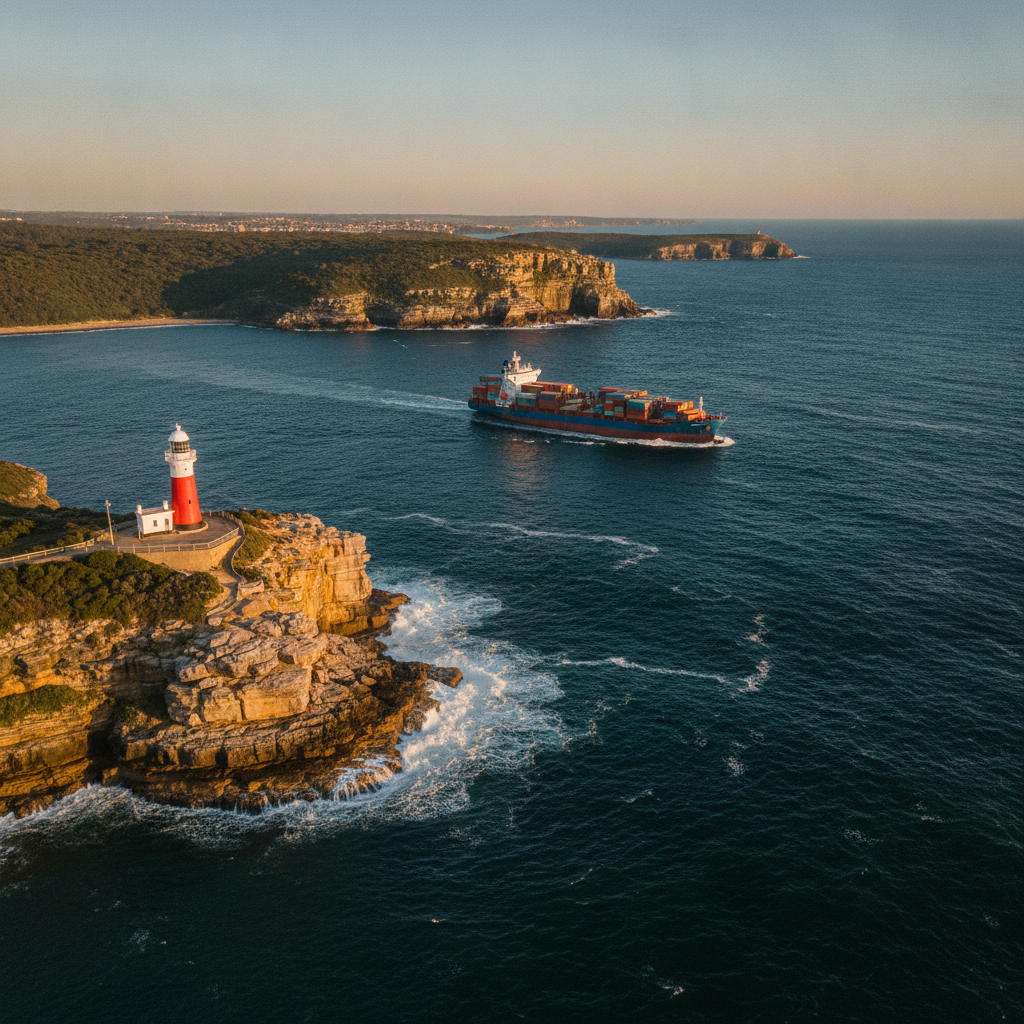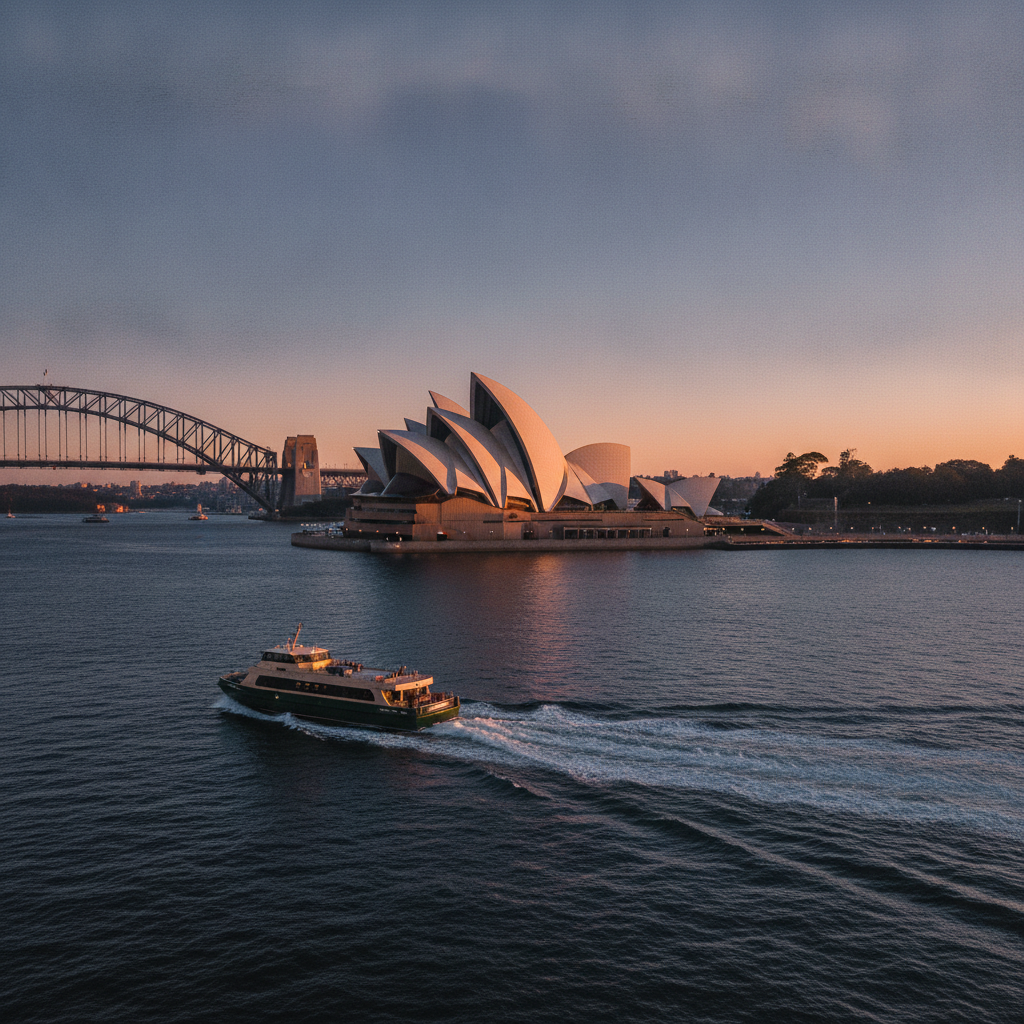
Sydney Opera House, Circular Quay & The Rocks: The Iconic Harbour Foreshore
The Sydney Opera House, Circular Quay, and The Rocks precinct — the founding site of European Australia (January 26, 1788), the anchor of one of the great natural harbours of the world, and the location of the most photographed building in the Southern Hemisphere — form the cultural and symbolic heart of Sydney and Australia. This is where First Fleet ships anchored, where convicts were landed, where the colony began, and where Australia's greatest architectural achievement now stands.
- 1
Sydney Opera House (1973) — Jørn Utzon's Masterpiece
The Sydney Opera House (Bennelong Point, Sydney, opened October 20, 1973, designed by Danish architect Jørn Utzon, 1918-2008, UNESCO World Heritage Site 2007) — the most recognizable building in the Southern Hemisphere and one of the great works of 20th-century architecture — is the product of one of the most dramatic stories in architectural history: Utzon, an unknown 38-year-old Danish architect, won the 1957 international design competition with a sketch so bold the jury initially rejected it before Eero Saarinen rescued it from the 'rejects' pile and championed it. The building took 16 years and $102 million to complete (the original budget was $7 million); Utzon resigned in 1966 in a bitter dispute with the New South Wales government over fees and design control and never returned to see his completed building. The roof shells — 14 interlocking concrete shells covered in 1,056,000 Swedish Höganäs ceramic tiles in two shades (white and cream-buff, arranged in a chevron pattern that changes appearance with the light) — are the most photographed architectural detail in Australia. The building contains 1,000 rooms and six performance venues including the Concert Hall (2,679 seats, the largest), the Joan Sutherland Theatre (1,507 seats, home of Opera Australia), and the Drama Theatre (544 seats). The building was declared a UNESCO World Heritage Site in 2007, the fastest any building has received the designation after completion.
- 2
Circular Quay (1788) — The Cove of the Colony's Birth
Circular Quay (originally named 'Semi-Circular Quay,' misnamed and eventually the misnaming stuck) — the ferry and rail hub at the base of Sydney Cove where the First Fleet under Captain Arthur Phillip landed on January 26, 1788 (the date now observed as Australia Day, though contested: it marks both the founding of European Australia and the dispossession of the Gadigal people of the Eora Nation, who had lived here for at least 30,000 years) — is the transport and ceremonial heart of Sydney. The eight ferry wharves at Circular Quay serve the Sydney Ferries network (35 wharves, 31 routes, 15 million passengers per year), the most extensive inner-city ferry network in the world. The sandstone seawall at the southern edge of Circular Quay, installed between 1851 and 1858, is the oldest intact piece of Victorian engineering in Australia. The Writers' Walk (installed 1991, 53 bronze plaques in the footpath commemorating Australian and international writers who visited or wrote about Sydney) includes Miles Franklin, Henry Lawson, Banjo Paterson, D.H. Lawrence, Joseph Conrad, and Mark Twain. Alfred Circular Quay (the railway station) is the most-used railway station in the Sydney Trains network.
- 3
The Rocks (1788) — Australia's Oldest European Neighbourhood
The Rocks — the rocky headland on the western side of Sydney Cove, the first permanent European settlement in Australia (1788) and the oldest surviving neighbourhood in the country — is a remarkable piece of urban archaeology: the dense warren of sandstone terrace houses, warehouses, hotels, and lanes built by convicts and free settlers in the late 18th and early 19th centuries, now preserved as a historic precinct. The Rocks was nearly demolished in 1971 when the Sydney Cove Redevelopment Authority proposed to replace the entire suburb with office towers; a famous campaign by building unions (the 'green bans,' led by Jack Mundey of the Builders Labourers Federation) refused to demolish the historic buildings, saving the precinct. The Rocks contains the Hero of Waterloo Hotel (1843, the oldest pub in Sydney, with a tunnel to the harbour used to impressment sailors), the Garrison Church (1840, Sydney's oldest church), Argyle Place (1830s, the only Georgian residential square in Sydney), the Museum of Contemporary Art Australia (1991, in the former Maritime Services Board building, 1952), and the weekend Rocks Markets (since 1976).
- 4
Sydney Harbour Bridge (1932) — The 'Coathanger'
The Sydney Harbour Bridge (opened March 19, 1932, designed by John Bradfield and the firm Dorman Long, chief engineer Ralph Freeman, construction 1923-1932) — the largest steel arch bridge in the world (503 meters span, though not the longest; the bridge carries eight lanes of traffic, two railway tracks, a bicycle path, and a pedestrian walkway across its 1,149-meter length) — is universally known as 'the Coathanger' for its arch profile, visible from much of metropolitan Sydney. The bridge took 9 years to build (1923-1932) and required 6 million hand-driven rivets, 52,800 tonnes of steel, and the work of 1,400 men (16 of whom died during construction). The bridge's opening ceremony was dramatically interrupted when Francis De Groot, a member of the New Guard fascist organization, rode his horse through the official ribbon and slashed it with his sword before Premier Jack Lang could cut it; De Groot was arrested and the ribbon was retied and properly cut by Lang. The BridgeClimb experience (since 1998) allows visitors to climb to the summit of the arch (134 meters above sea level) for a view across Sydney Harbour and the city; it is the most popular tourist activity in Sydney after the Opera House.
- 5
Sydney Cove & The First Fleet Landing Site
Sydney Cove — the small inlet between Bennelong Point (Opera House) to the east and The Rocks to the west, at the head of Sydney Harbour — was chosen by Governor Arthur Phillip on January 26, 1788 as the site for the permanent settlement of the British penal colony of New South Wales (he had initially considered Botany Bay, where Captain James Cook had first landed in 1770, but found the site unsuitable for settlement: insufficient fresh water, exposed anchorage, poor soil). The colony's first years were precarious: the First Fleet (11 ships, 1,485 people including 732 convicts) arrived with inadequate supplies, crop failures nearly caused mass starvation in 1790 (the 'hungry years'), and disease killed many settlers and a catastrophic proportion of the Aboriginal population (smallpox killed an estimated 50% of the Sydney Basin Aboriginal population within two years of European arrival). The First Government House (1788, demolished 1846) stood near the present Museum of Sydney (1995), which displays the foundations of the original building through a glass floor. A bronze plaque in the pavement of Bridge Street marks the exact site of the First Government House flagpole.
- 6
Royal Botanic Garden & Mrs Macquaries Chair
The Royal Botanic Garden Sydney (founded 1816 by Governor Lachlan Macquarie on the site of the colony's original vegetable gardens, 30 hectares on Farm Cove adjacent to the Opera House, the oldest scientific institution in Australia and the oldest botanic garden in the Southern Hemisphere) — contains 7,500 plant species from across the globe, a herbarium of 1.4 million plant specimens, and historic plant collections including specimens brought back by Joseph Banks and Daniel Solander on Cook's Endeavour voyage (1770). Mrs Macquaries Chair (the sandstone bench carved into the rock of Mrs Macquaries Point in 1810, reportedly at the request of Governor Macquarie's wife Elizabeth for her to watch the harbour while her husband was at work) is now the finest panoramic viewpoint in Sydney: from the chair, the Opera House and Harbour Bridge are perfectly framed together in the same view, one of the most photographed vistas in the world. The garden's 200-year-old Moreton Bay fig trees (Ficus macrophylla) — some with trunk girths of 14 meters, their surface roots extending 30 meters from the trunk — are among the most ancient living things in central Sydney.
Walk this route with audio
Stories play automatically as you reach each stop — no tapping needed.
More in sydney
Manly Ferry, North Head & Scenic Headland: The World's Most Beautiful Ferry Crossing
Darling Harbour, Chinatown & Barangaroo: Sydney's Western Waterfront
Blue Mountains, Katoomba & Jenolan Caves: A World Heritage Day Trip from Sydney
Newtown, Surry Hills & Paddington: Sydney's Inner City Cultural Corridor
Bondi to Coogee: Australia's Most Famous Coastal Walk