Longshan Temple, Wanhua & Taipei's Historic Old Town
Wanhua (萬華 — the oldest district of Taipei, the centre of settlement from the 18th century and the historic heart of the city): Longshan Temple (龍山寺 — the most important temple in Taipei, founded 1738) and the surrounding Wanhua district preserve the oldest urban fabric in Taipei, including the Snake Alley entertainment district, the Herb Market (the largest traditional Chinese medicine market in Taipei), and the Ximending youth culture district.
- 1
Longshan Temple — Taipei's Most Sacred Temple
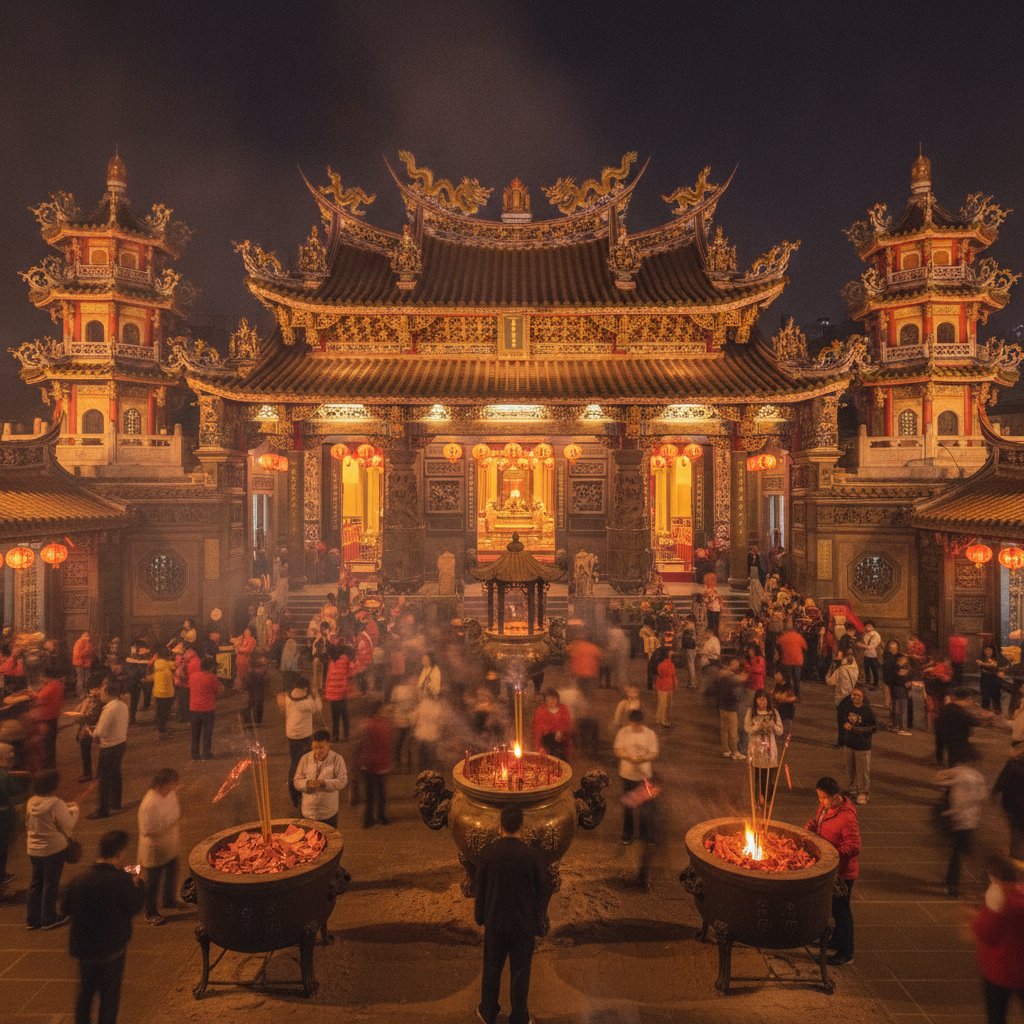
Longshan Temple (龍山寺 — the temple in the Wanhua district of western Taipei, founded 1738 by settlers from Fujian province of mainland China as the primary religious centre of the new Taiwanese settlement at Manka (the original Taiwanese name for the Wanhua area) — the most visited temple in Taiwan (approximately 4 million visitors per year) and the most important single religious site in Taipei): the temple is dedicated to Guanyin (觀音菩薩 — the Buddhist bodhisattva of compassion, the most widely worshipped deity in Taiwan) in the main hall, with over 100 additional deities of the Taoist pantheon (including Mazu (媽祖 — the sea goddess, the patron deity of Taiwan), the Earth God (土地公 — Tǔdìgōng), and the Moon God (月老 — Yuèlǎo — the god of love and marriage, to whose statue at Longshan Temple single Taiwanese pray for romantic partners)) enshrined in the subsidiary halls; the temple's ornate Taiwanese baroque architecture (the three-hall compound with its characteristic cut-ceramic (剪黏 — jiǎn zhān) roof sculptures and the elaborate stone relief carvings of the courtyard pillars) is the finest example of traditional Taiwanese temple decoration in Taipei; the temple is particularly active during festival periods (the Lantern Festival, the Tomb Sweeping Festival, and the Ghost Month (中元節 — the seventh lunar month, when the gates of hell are opened and the spirits of the dead wander the earth)).
- 2
Wanhua District — Taipei's Oldest Neighbourhood
Wanhua (萬華 — the oldest continuously settled district in Taipei, the area of the original Han Chinese settlement of 'Manka' (艋舺 — Bǎng-kah in Taiwanese), established by Fujianese settlers in the early 18th century — the most historically layered district in Taipei): the Wanhua district contains the oldest surviving urban fabric in Taipei, including the Dihua Street (the 19th-century merchant street — see separate route), the traditional medicine market (the concentration of Chinese medicine herb shops (中藥行 — zhōngyào háng) around Longshan Temple, selling dried herbs, medicinal roots, and the full range of traditional Chinese medicine ingredients), and the Snake Alley (Huaxi Street Night Market (華西街觀光夜市) — the oldest night market in Taipei (established approximately 1950), now primarily a tourist attraction rather than a local food destination, famous for its restaurants specializing in snake (the live snake restaurants that were the most notorious attraction of Taipei tourism in the 1970s-80s are largely closed, but the alley atmosphere remains distinctive)); the Bangka Park (萬華公園) adjacent to Longshan Temple is the principal daytime gathering space for elderly Wanhua residents — the game of xiangqi (Chinese chess) played at the outdoor tables is a characteristic scene.
- 3
Ximending — Taipei's Youth Culture District
Ximending (西門町 — the youth culture and entertainment district in the Wanhua district of western Taipei, adjacent to Longshan Temple — the 'Harajuku of Taipei', the centre of Taiwanese youth fashion, pop culture, and entertainment): Ximending (the area was developed as the commercial entertainment district of Taipei during the Japanese colonial period (1895-1945) and retains several important Japanese-era buildings, most notably the Red House (西門紅樓 — the octagonal red-brick building built 1908 as the first public market in Taipei, now a cultural centre with a weekend gay bar and antique market in the plaza behind)) is the most vibrant youth district in Taipei, with a particularly LGBTQ-friendly atmosphere (the plaza behind the Red House (後棟廣場) is the most prominent gay gathering space in Taipei, part of the broader acceptance of LGBTQ culture that culminated in Taiwan legalizing same-sex marriage in 2019); the Ximending main pedestrian street (the 'Pedestrian Zone' (徒步區) along Chengdu Road and the surrounding lanes) has the highest concentration of street fashion boutiques, movie theatres, and fast food chains in Taipei.
- 4
Dihua Street — Taipei's 19th-Century Merchant Street
Dihua Street (迪化街 — the historic merchant street in the Datong district of northern Taipei, adjacent to the Dadaocheng (大稻埕) district — the most important surviving example of 19th-century and early 20th-century Taiwanese commercial architecture in Taipei): Dihua Street (running approximately 800 metres north-south, most concentrated in the southern section around Minsheng West Road) was the primary commercial district of Taipei during the late Qing Dynasty and Japanese colonial period, specializing in imported goods, Chinese New Year supplies, and traditional Chinese medicine; the street's architecture is a unique blend of traditional Taiwanese shophouse (亭仔腳 — tíng-á-kha — the arcaded shopfront that characterizes traditional Taiwanese commercial architecture, with the ground floor arcade protecting pedestrians from rain) and the Baroque-influenced facades applied to the upper floors during the Japanese colonial period modernization; the Dihua Street Chinese New Year market (the market that runs in the three weeks before Chinese New Year (approximately late January-early February), when Dihua Street is transformed into the principal New Year goods market in Taipei — dried fruits, nuts, preserved meats, festive decorations, and the characteristic New Year gift baskets) is the finest expression of Taiwanese traditional commercial culture.
- 5
Taipei's Buddhist & Taoist Temple Trail
Taipei's temple culture (the rich and syncretic religious culture of Taipei, combining Taiwanese folk religion (民間信仰 — the blended Buddhist, Taoist, and Chinese ancestral worship tradition that is the primary religious practice of approximately 75% of the Taiwanese population), Taiwanese Buddhism (台灣佛教 — including the major organizations Tzu Chi (慈濟) and Dharma Drum Mountain (法鼓山)), and Taiwanese Taoism): the temples of Taipei beyond Longshan Temple include: Xingtian Temple (行天宮 — the temple in the Zhongshan district dedicated to Guan Di (關帝 — Guan Yu, the Red-Faced general of the Three Kingdoms era (3rd century CE), now the most widely worshipped deity in Taiwan among businesspeople as the god of justice, war, and business prosperity) — the most visited temple in Taipei for business prayers, with long queues of worshippers on auspicious days), Xinpu Temple (新埔廟), the Confucius Temple (台北孔廟 — the Confucian temple in the Datong district, rebuilt in the traditional South Fujian style in 1939 — the site of the annual Confucius Birthday ceremony on September 28 (Teacher's Day in Taiwan), the most elaborate Confucian ritual in Taiwan).
- 6
Bopiliao Historic Block — Preserved Colonial Taipei
Bopiliao Historic Block (剝皮寮歷史街區 — the preserved historic commercial block in the Wanhua district of western Taipei, adjacent to Longshan Elementary School — the finest surviving example of Qing Dynasty and Japanese colonial period shophouse architecture in Taipei): the Bopiliao block (the name 'Bopiliao' (剝皮寮 — Bōk-phê-liâu in Taiwanese) means 'bark-peeling sheds' — a reference to the wood trade that dominated this area in the early Taiwanese settlement period) was preserved from demolition in 2000 after local historians and preservationists campaigned for its retention, and it was subsequently restored between 2003 and 2009 as an open-air museum of Taipei's historic urban fabric; the block's 30+ preserved shophouses (the characteristic Taiwan shophouse facade of red-brick arcaded ground floor with ornamental plaster upper floors in a unique blend of South Chinese and Japanese colonial architectural elements) give the most authentic impression of 19th-century Taipei street life; the Bopiliao district hosted part of the filming of the 2008 film 'Cape No. 7' (海角七號 — the highest-grossing Taiwanese film of all time, making approximately US$15 million at the box office).
Walk this route with audio
Stories play automatically as you reach each stop — no tapping needed.
More in taipei
Yangmingshan & Hot Springs — Taipei's Volcanic Mountain Park
Zhongshan & Songshan — Taipei's Creative and Design Districts
National Palace Museum — The World's Greatest Collection of Chinese Art
Tamsui, Bali & the North Coast — Taipei's Golden Sunset District
Jiufen — The Hillside Village That Inspired Spirited Away