Taipei Night Markets — Shilin, Raohe & the Taiwanese Street Food Universe
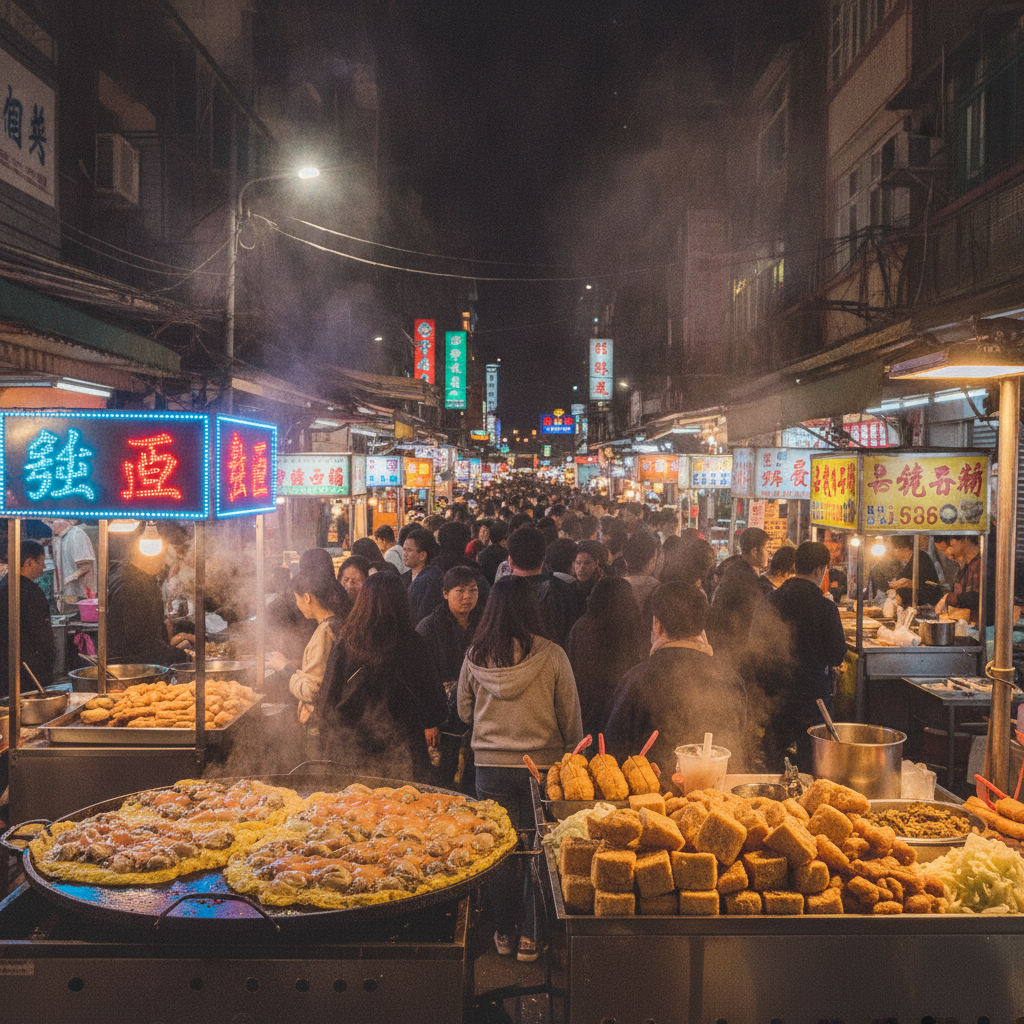
Taipei's night markets (夜市 — yèshì — the outdoor markets that open in the evening and are the primary social and culinary space of Taiwanese urban life): with approximately 30 night markets scattered across the city (Shilin, Raohe, Ningxia, Huaxi Street, Tonghua, Linjiang), Taipei has the finest and most diverse concentration of night market culture in Asia.
- 1
Shilin Night Market — The Most Famous Night Market in Taiwan
Shilin Night Market (士林夜市 — the largest and most visited night market in Taipei, in the Shilin district of northern Taipei (accessible by MRT Jiantan station)) — the most famous night market in Taiwan, receiving approximately 100,000 visitors on peak weekend evenings): the market has two main sections: the outdoor street food section (the surrounding streets (Jihe Road, Danan Road, Wenlin Road, and the adjacent alleys) with their stalls selling the full range of Taiwanese night market food) and the indoor food court (the underground food market in the former market building, now the primary venue for the most popular Shilin dishes — the oyster omelette (蚵仔煎), the enormous fried chicken cutlet (雞排), stinky tofu (臭豆腐), and the Shilin specialty dà bǐng jiā xiǎo bǐng (大餅夾小餅 — the 'big pancake hugging small pancake', a crispy flatbread filled with braised pork, egg, and Chinese pickles)); the surrounding Shilin district also has the best concentration of accessories, clothing, and phone case shopping stalls in Taipei.
- 2
Raohe Street Night Market — Taipei's Most Atmospheric Market
Raohe Street Night Market (饒河街觀光夜市 — the linear night market running 600 metres along Raohe Street in the Songshan district of eastern Taipei, adjacent to the Ciyou Temple (慈祐宮) at the western entrance — one of the oldest night markets in Taipei (established approximately 1987), considered the most atmospheric and most photogenic night market in the city by many Taipei residents): the Raohe night market's most famous specialty is the Fuzhou oyster pepper bun (福州胡椒餅 — Fúzhōu hújiāo bǐng — the baked bun filled with pork, green onion, and abundant black pepper, baked in a tandoor-like wood-burning oven — the queue for the most famous stall (the one at the Ciyou Temple entrance) regularly stretches to 30-40 minutes); the night market stalls at Raohe include the full Taipei street food vocabulary: braised pork rice (控肉飯 — kòu ròu fàn), scallion pancakes (蔥抓餅), grilled corn, sugar cane juice, and the Taiwanese sausage (香腸 — xiāngcháng — the slightly sweet pork sausage grilled over charcoal).
- 3
Taiwanese Street Food — The Complete Guide
Taiwanese street food (the most diverse and most refined night market food culture in Asia, with a unique culinary tradition that blends Fujianese, Cantonese, Japanese (from the 50-year Japanese colonial period (1895-1945)), and indigenous Taiwanese influences): the essential Taiwanese street foods are: the oyster omelette (蚵仔煎 — the sweet potato starch-thickened pancake with fresh oysters and egg, topped with a sweet chilli-based sauce — the most iconic Taiwanese street food), beef noodle soup (牛肉麵 — niúròu miàn — the Taiwanese national dish, a rich braised beef shank noodle soup in a spiced tomato and soy broth (the Sichuan-influenced style with doubanjiang (broad bean chilli paste) was developed in Taipei by Sichuan refugees who came with the Nationalist government in 1949)), scallion pancake (蔥抓餅 — the flaky layered wheat flour pancake filled with scallion and egg, cooked on a griddle — Taiwanese street food at its simplest and most satisfying), stinky tofu (臭豆腐 — the pungent fermented tofu, deep-fried until crispy and served with pickled cabbage and chilli sauce), and the coffin bread (棺材板 — the thick-fried toast filled with cream of mushroom or seafood soup — a Tainan specialty now ubiquitous in Taipei night markets).
- 4
Bubble Tea — Taiwan's Greatest Export
Bubble tea (珍珠奶茶 — Zhēnzhū nǎichá — 'pearl milk tea', also called boba tea) is Taiwan's most globally successful food invention, created in Taipei and Tainan in the mid-1980s (the two competing origin stories: Lin Hsiu-hui of Chun Shui Tang tea shop in Taichung (who reportedly added tapioca pearls (芋圓 — taro balls) to her tea in 1988); and Tu Tsong-he of Hanlin Tea Room in Tainan (who claims to have created it in the same year)): the drink (typically cold-brewed strong tea (black tea or green tea), mixed with milk or creamer, sweetened with sugar syrup, shaken with ice in a cocktail shaker, and served in a clear cup with the characteristic black chewy tapioca pearl balls at the bottom, drunk through an oversized fat straw) has spawned a global industry worth approximately US$3 billion; the finest bubble tea in Taipei is served at Chun Shui Tang (春水堂 — the chain that claims to have invented it), 50 Lan (五十嵐), and the specialist Pearl Lady (珍煮丹) shops, but the best version is often found at the most local, least touristic stand in any given night market.
- 5
Ningxia Night Market — Taipei's Old-School Night Market
Ningxia Night Market (寧夏夜市 — the oldest established night market in Taipei, in the Datong district of north-central Taipei (nearest MRT: Zhongshan) — a compact, lively market known for its traditional Taiwanese dishes and its relatively less touristy, more local atmosphere compared to Shilin or Raohe): the Ningxia Night Market (approximately 100 stalls running along the single street of Ningxia Road North) specializes in the classic Taiwanese dishes that predate the tourist night market culture — the oyster vermicelli (蚵仔麵線 — ô-á mī-suànn — oysters and pig intestine in a thick starch-thickened broth with oyster noodles), the taro ball dessert (芋圓 — yù yuán — chewy purple taro and sweet potato balls in sweet taro soup), the traditional four-treasure sticky rice (四神湯 — the traditional herbal pork soup with coix seed, Chinese yam, lotus seeds, and euryale seeds), and the famous pork ribs soup (排骨湯 — pái gǔ tāng) are the market's signature dishes.
- 6
Taiwanese Food Culture — Beyond the Night Market
Taiwanese food culture beyond the night market (the full range of Taiwanese culinary traditions that extends from the night market street food to the formal banquet cuisine of traditional Taiwanese restaurants): the essential Taiwanese dining experiences are: beef noodle soup at Lin Dong Fang (林東芳牛肉麵 — the legendary night beef noodle soup stand in the Zhongshan district (open until approximately 1am), widely considered the finest beef noodle soup in Taipei); Din Tai Fung (鼎泰豐 — the xiaolongbao (soup dumpling) restaurant chain that began in Taipei and has become the most famous Chinese restaurant in the world (with locations in Tokyo, Hong Kong, Singapore, Shanghai, and Los Angeles) — the original Xinyi branch in Taipei is the most celebrated); braised pork rice (滷肉飯 — lǔ ròu fàn — the bowl of Taiwanese rice topped with slow-braised fatty pork (the belly pork braised in soy sauce, rice wine, five-spice, and sugar) — the unofficial national dish of Taiwan, available at every traditional restaurant and stall in Taipei for NT$50-80 (approximately US$1.50-2.50)); and the Taiwanese breakfast culture (早餐 — the traditional breakfast of fried dough stick (油條 — yóutiáo) dipped in warm soy milk (豆漿 — dòujiāng), scallion egg pancake (蛋餅 — dàn bǐng), and pork sung rice ball (飯糰 — fàntuán) from the breakfast shops (早餐店 — the all-day breakfast shops open from 5-6am to 11am) that are on every street corner in Taipei).
Walk this route with audio
Stories play automatically as you reach each stop — no tapping needed.
More in taipei
Yangmingshan & Hot Springs — Taipei's Volcanic Mountain Park
Zhongshan & Songshan — Taipei's Creative and Design Districts
National Palace Museum — The World's Greatest Collection of Chinese Art

Tamsui, Bali & the North Coast — Taipei's Golden Sunset District
Jiufen — The Hillside Village That Inspired Spirited Away