Maokong Tea Culture, Pinglin & the Oolong Tea Heartland of Taiwan
Taiwan is one of the world's great tea-producing nations, responsible for some of the finest oolong teas in the world (the high-mountain oolongs of Alishan, Li Shan, and Da Yu Ling are among the most sought-after teas globally): Maokong (the tea-growing hillside district above Taipei, famous for its Tieguanyin and Wenshan Pouchong oolongs) and Pinglin (the tea-growing valley 40 km southeast of Taipei, the source of the finest Wenshan Pouchong in Taiwan) are the two principal tea tourism destinations from Taipei.
- 1
Maokong Gondola & Tea Hills
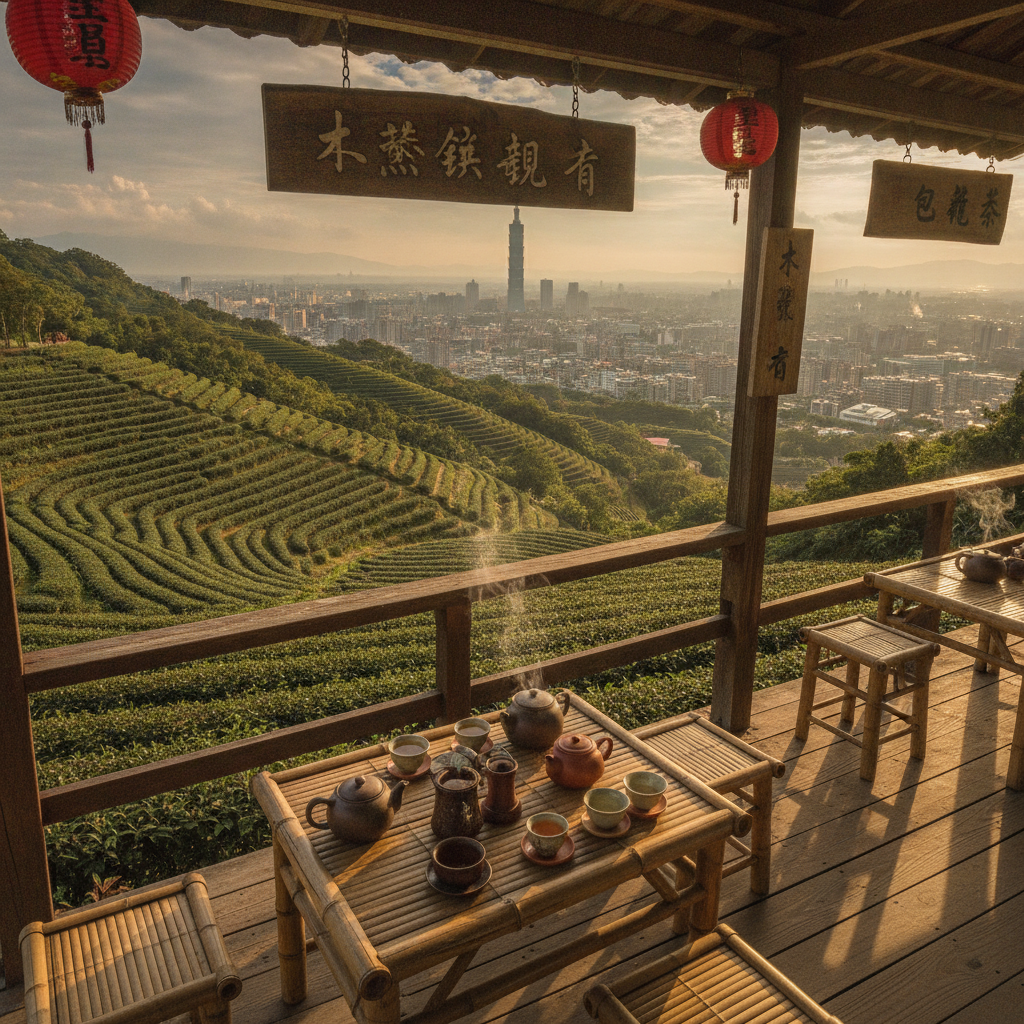
Maokong Gondola (貓空纜車 — the cable car system connecting Taipei Zoo (動物園站) in the Wenshan district with the Maokong tea-growing district at 299 metres altitude, opened 2007, providing a 4-station aerial journey over the Taipei hillside): the Maokong Gondola (with its distinctive transparent-floor Crystal Cabin gondola cars (晶亮車廂 — the cars with glass floors offering a view straight down to the tea-covered hillside below)) gives the finest aerial view of the southern Taipei hills and the Taipei basin; the Maokong district (the tea-growing hills of the Muzha (木柵) area of Wenshan — the name 'Maokong' (貓空 — 'Cat Hollow') derives from the potholes (貓孔 — 'cat holes') in the local streambed) has approximately 300 tea houses (茶藝館 — cháyì guǎn — the traditional Taiwanese tea house, where customers sit for hours drinking gongfu tea (工夫茶 — the careful multi-infusion brewing of high-grade oolong tea in small clay teapots and thimble-sized cups)), open-air tea gardens, and the best views of the Taipei basin from the south.
- 2
Wenshan Pouchong & Muzha Tieguanyin
The two great teas of the Taipei hills (the tea varieties grown in the Wenshan and Muzha (木柵) districts of southern Taipei, the only major tea-growing area within a major Asian capital city): Wenshan Pouchong (文山包種茶 — the lightly oxidized oolong tea (15-30% oxidation, the most lightly oxidized of all oolongs) grown in the Wenshan district — the most floral and delicate of the classic Taiwanese oolongs, with a characteristic green-yellow liquor and a floral aroma (the 'green tea end' of the oolong spectrum, closer to green tea than to the dark oolongs)); Muzha Tieguanyin (木柵鐵觀音 — the heavily roasted oolong tea grown in the Muzha/Maokong area (the Taipei-area version of the famous Anxi Tieguanyin from Fujian Province, China), with a distinctive roasted, nutty, 'orchid honey' character and a dark amber liquor — the strongest and most robust of the classic Taiwanese oolongs); the tea farmers of Maokong offer tea farm visits (茶農體驗 — tea farming experience programmes) during the spring (April-May) and winter (October-November) tea harvests.
- 3
High Mountain Oolong — Taiwan's World-Famous Teas
Taiwan's high-mountain oolongs (高山茶 — gāoshān chá — teas grown above 1,000 metres altitude in the Central Mountain Range of Taiwan): the three most celebrated high-mountain oolongs from Taiwan are: Alishan Oolong (阿里山烏龍 — grown on the Alishan mountain range (1,200-1,800 metres) in Chiayi County, the most widely known Taiwanese high-mountain oolong internationally, with a characteristic creamy, buttery character from the morning mists and cool temperatures), Li Shan Oolong (梨山烏龍 — 'Pear Mountain Oolong', grown at 2,200-2,600 metres in Taichung County, the highest-altitude and most premium of the mainstream high-mountain oolongs, with a distinctively sweet, complex, and long-finish character), and Da Yu Ling (大禹嶺 — the most prized and expensive Taiwanese oolong, grown at 2,600-2,800 metres in Hualien County — the world's highest-altitude tea garden, producing extraordinarily complex and mineral-rich teas that command prices of NT$10,000-30,000 (US$300-1,000) per 150g (Taiwan's equivalent of first-growth Bordeaux wine)).
- 4
Pinglin Tea Museum & Wenshan Tea Region
Pinglin (坪林 — the township in the Wenshan Tea Area 40 km southeast of Taipei, the centre of Wenshan Pouchong production and the primary 'tea tourism' destination for Taipei residents): Pinglin is accessible from Taipei in approximately 50-60 minutes by bus (the Taipei Bus Station to Pinglin bus (三峽客運 Bus No. 849)) or by bicycle (the 40 km Beiyi Highway cycling route from Xindian is one of the most scenic cycling routes near Taipei); the Pinglin Tea Museum (坪林茶業博物館 — the museum in a Chinese palace-style building on the banks of the Beishi River, with exhibits on tea history, tea farming, and tea culture in Taiwan and internationally) is the most comprehensive tea museum in Asia; the Pinglin Old Street (坪林老街 — the historic commercial street of Pinglin) has the highest concentration of specialty Pouchong tea shops in Taiwan, where the local tea farmers sell their spring and winter harvest teas directly.
- 5
Gongfu Tea Ceremony — The Taiwanese Tea Ritual
Gongfu tea ceremony (工夫茶 (also written 功夫茶) — the meticulous multi-infusion tea brewing method that is the primary ritual of Taiwanese tea culture, adapted from the Chaoshan (Chaozhou-Shantou) tea tradition of Fujian and Guangdong by Taiwanese tea culture from the 1970s onwards): the gongfu tea setup (the tea tray (茶盤 — chá pán), the clay teapot (紫砂壺 — zǐshā hú — the purple clay teapot of Yixing, Jiangsu — the primary brewing vessel for serious oolong tea, the specific clay absorbing and retaining tea flavour over years of use), the tea pitcher (茶海 — chá hǎi — for decanting the brewed tea before pouring into the cups), the aroma cup (聞香杯 — wén xiāng bēi — the tall narrow cup for appreciating the tea aroma before drinking) and the tasting cup (品茗杯 — pǐn míng bēi — the small thimble-sized drinking cup)) arranged on the tea tray, with the sequence of pre-heating the teapot, rinsing the leaves (洗茶 — 'washing the tea' — the first infusion discarded to open and clean the leaves), and then the multiple short infusions (typically 7-15 infusions from a single measure of leaves) that gradually reveal the evolving character of a fine oolong.
- 6
Sun Moon Lake & Taiwan's Tea Day Trips
Sun Moon Lake (日月潭 — the largest lake in Taiwan, in Nantou County in the central highlands, 3.5 hours by bus from Taipei (Taipei Main Station to Sun Moon Lake direct bus) — the most visited natural tourist destination in Taiwan): Sun Moon Lake is the home of the Ruby No. 18 tea (台茶18號 — the Taiwanese black tea variety developed by the Taiwan Tea Research and Extension Station by crossing the native Taiwanese wild tea (山茶 — Camellia formosensis) with an Assam variety, producing a tea with a distinctive cinnamon and vanilla character that has made it the finest black tea in Asia (and one of the finest in the world)); the Sun Moon Lake ferry (the lake ferries that connect the three wharves of the lake — Shuishe Pier (水社碼頭), Xuanguang Pier (玄光碼頭), and Ita Thao Pier (伊達邵碼頭)) give the best view of the lake; the Formosan Aboriginal Cultural Village (九族文化村 — the theme park adjacent to Sun Moon Lake, the primary visitor site for the cultures of Taiwan's indigenous peoples (原住民 — Yuánzhùmín — the Austronesian-speaking peoples of Taiwan who have inhabited the island for approximately 4,000-6,000 years, and who are now recognized as 16 distinct indigenous peoples by the Taiwanese government)).
Walk this route with audio
Stories play automatically as you reach each stop — no tapping needed.
More in taipei
Yangmingshan & Hot Springs — Taipei's Volcanic Mountain Park
Zhongshan & Songshan — Taipei's Creative and Design Districts
National Palace Museum — The World's Greatest Collection of Chinese Art
Tamsui, Bali & the North Coast — Taipei's Golden Sunset District
Jiufen — The Hillside Village That Inspired Spirited Away